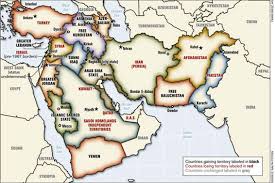
While turmoil and anarchy in the Middle East can be attributed the disunity among Arabs, the possibility of execution of well known Zionist plans supported by USA and West, to divide the Middle East in fragmented state lets cannot be ruled out. The “Bernard Lewis Plan” named after its architect Bernard Lewis, a specialist in ‘oriental studies’, the ‘history of Islam’ and the ‘interaction between Islam and the West’ is well known. Yet another Zionist Plan for the establishment of greater Israel by dividing Middle East known as “Oded Yinon Plan”, also exists. Christian-Zionist lobby has heavy influence in politics and US government. Policies of Trump and earlier rulers clearly indicate US support for Zionism in Israel. The “Bernard Lewis Plan”, “Oded Yinon Plan” and “Christian-Zionism”, all “Three” are fully integrated to achieve their heinous designs against Muslims. ... Keep reading ..... [......]
An in-depth study of the Qur’an and Islamic religious history reveals startling facts. “Risala-e-Tajdeed-ul-Islam” is a message to develop positive change in the thought and practices of Muslims.
قرآن اور اسلام کے گہرے مطالعه سےحیران کن حقائق کا انکشاف ہوا، "رساله تجديد الاسلام" مسلمانوں کے انداز فکروعمل میں مثبت تبدیلی کا پیغام ہے:
GIVEN US President Trump’s initial opposition to continuing the Afghan war, his new policy — to escalate the US military campaign in Afghanistan and blame Pakistan for the stalemate and threaten it with penalties — represents a serious political setback for Islamabad. After its anticipated angry response, Pakistan’s senior diplomats have rightly advocated a continued effort to engage the US and simultaneously develop a regional response to the new US policy. Islamabad and other regional capitals no doubt realise that America is embarking on a ‘new’ war in Afghanistan, after its initial ‘war of revenge’ (2001-2004); ‘nation building’ ( 2005-2009) and Obama’s various combinations of a ‘fight, talk, pacify and withdraw’ policy. Trump’s new policy can be described as ‘stay and fight’. The immediate US goal in Afghanistan is to prop up the pliant Kabul regime militarily and prevent its overthrow by the Afghan Taliban. The US generals, who are driving this policy, know that neither complete victory nor an acceptable political settlement is likely. The US is no longer interested in a political settlement unless the Afghan Taliban accept America’s terms. The strategic purpose of USA staying on indefinitely in Afghanistan is; not to pacify it but to use it as a base for the promotion of America’s broader objectives in the region:
One, to impose a ‘Pax Indo-Americana’ in South Asia, including by securing Pakistan’s acceptance of the status quo in Kashmir and severe restraints on Pakistan’s nuclear deterrence capability;
Two, to reverse Iran’s ascendancy in Syria, Lebanon and Iraq and neutralise its perceived threat to Israel; and,
Three, to limit the influence of China and Russia in Afghanistan and its neighbourhood and impede China’s ambitious One Belt, One Road initiative including the CPEC project.
The US is clearly no longer interested in a political settlement in Afghanistan unless the Afghan Taliban accepts America’s terms. Washington is not asking Pakistan to persuade the Afghan Taliban to agree to talks. It is demanding that Pakistan fight the Afghan Taliban itself and thus make it ‘easier’ for the US to prevent a Taliban victory and ‘stay on’ in Afghanistan. The Americans know full well that almost all the Afghan Taliban fighters are in Afghanistan. Some may try at times to hide in border valleys and forests. Some Taliban leaders cross over to the large refugee camps and Afghan ‘neighbourhoods’ in and around Pakistani cities. Their periodic presence there has been used in the past by all parties, including the Americans, to facilitate inter-Afghan contacts and dialogue.
If Pakistan were to capture or kill the Afghan Taliban leadership, they are likely to forge an alliance with the Tehreek-i-Taliban Pakistan and other militants who are attacking Pakistan. This will severely exacerbate Pakistan’s security challenges, including from the India- and Kabul-sponsored TTP and Balochistan Liberation Army (BLA) militants.
Second, with the elimination of the Afghan Taliban leadership, negotiating an Afghan peace settlement will become virtually impossible. US generals may not mind a never-ending war; but the people of Afghanistan and Pakistan deserve a strategy that leads to peace, not perpetual war.
Third, eliminating the Afghan Taliban, whose political agenda is limited to Afghanistan, will strengthen the extra-territorial terrorist groups in Afghanistan: the militant Islamic State (IS) group (against whom the Afghan Taliban are fighting); Al Qaeda, with whom the Afghan Taliban have renounced past links; and Al Qaeda associates TTP, the Islamic Movement of Uzbekistan (IMU) and the East Turkestan Islamic Movement (Etim) which are mainly threatening Afghanistan’s neighbours Pakistan, Russia, China and Central Asia. It is for these reasons that these neighbours have opened channels of contact with the Afghan Taliban.
Pakistan’s energetic new prime minister has offered intensified counterterrorism cooperation and joint border patrols to the US and Kabul. Pakistan’s ongoing programme to fence and closely monitor the border can be effective in preventing cross-border attacks. The US should convince Kabul to support it. Pakistan’s cooperation would encompass joint action against IS, Al Qaeda and their associates. Islamabad can undertake further steps to promote dialogue between Kabul and the Afghan Taliban. Naturally, Pakistan would expect reciprocal US and Afghan action against the TTP and BLA safe havens in Afghanistan. Even if Pakistan were to accommodate the US on Afghanistan, it would not be satisfied. Its demands include calls for action against the pro-Kashmiri groups (Lashkar-e-Taiba and Jaish-e-Mohammad) and for acceptance of one-sided constraints on Pakistan’s nuclear deterrence capabilities. Under US pressure, previous Pakistani governments agreed to put the LeT and JeM on the Security Council’s ‘terrorism’ list. Islamabad has outlawed them and seized their assets. The US and India want Pakistan to eliminate the iterations of these organisations and incarcerate their leaders. It would be unwise for Pakistan to accept the onus for putting its ‘house in order’ and enable India to subvert the legitimate Kashmiri struggle for self-determination and continue its brutal repression in occupied Kashmir. Pakistan is also unlikely to entertain American demands to halt the development and deployment of short- and long-range nuclear-capable missiles, especially when the US is promoting Indian armament, not disarmament, and is known to have formulated plans to neutralise Pakistan’s nuclear deterrence capabilities in a crisis. Consequently, the proffered engagement with the US is likely to prove infructuous. Pakistan should prepare itself to bear the ‘pain’ of the threatened US sanctions. It should draw its own ‘red lines’. Any sign of weakness will intensify, not ameliorate, US coercion. The Pakistani foreign minister’s consultations with China, Turkey, Iran and Russia will hopefully yield a regional consensus that would be valuable in resisting America’s new and aggressive posture. Such a regional consensus could: one, accord highest priority to eliminating IS, Al Qaeda and ‘associated’ militants TTP, Jamaatul Ahrar, Etim, IMU; two, extend support for a negotiated settlement between Kabul and the Afghan Taliban; three, endorse Pakistan’s plan to fence and closely monitor the Pak-Afghan border; and, four, demand strict respect by all, including the US-Nato forces, for the sovereignty and territorial integrity of Pakistan and other regional states. Ultimately, as history attests, an external military solution cannot be imposed on the Afghans. Like others, the US will leave the ‘graveyard of empires’ in ignominy if it does not depart in dignity. By Munir Akram, The writer is a former Pakistan ambassador to the UN. Courtesy : https://www.dawn.com/news/1358153/americas-new-afghan-war
The writer is a former Pakistan ambassador to the UN.
WHEN the Soviet Union collapsed in 1991, US President George H. W. Bush and Secretary of State James Baker promised Moscow that Nato would not be moved closer to Russia’s new borders. That promise was broken some years later by the Bill Clinton administration when the Czech Republic, Hungary and Poland were incorporated into Nato, followed soon after by Estonia, Lithuania and Latvia, previously part of the Soviet Union itself.
George Kennan, the famous ‘X’ who anonymously penned the 1947 Foreign Affairs article that provided the blueprint for America’s successful containment of the Soviet Union, was quoted by Tom Friedman (New York Times, May 2, 1998), as saying: “I think it (Nato expansion) is the beginning of a new cold war. ...the Russians will gradually react ... it is a tragic mistake”.
The Russians did react, as Kennan predicted, after Vladimir Putin had consolidated power. When the attempt was made to bring Georgia into Nato, Moscow sliced off two statelets from Georgia. When the pro-Russian president of Ukraine was ousted in a ‘political coup’, Putin took over Crimea and supported the ethnic Russian separatists in eastern Ukraine.
Although the US is no longer the global hegemon, it continues to behave as if it is.
Today, Russia is again a first-rate military power. Its actions in Georgia and Ukraine will not be reversed. Moscow’s forces robustly patrol its western land, air and sea frontiers. The forthcoming large military manoeuvres across Belarus will illustrate Nato’s vulnerability. Russia has also reasserted its political, military and diplomatic role in the world’s ‘hot spots’.
The cerebral president Barack Obama displayed surprising strategic naiveté by simultaneously provoking Russia and announcing his vaunted ‘pivot to Asia’ to contain a rising China.
Despite America’s formidable naval power in the Pacific and its alliances with Japan, India and Australia, the US will be unable to oblige China to relinquish any of the territories or islands it claims unless it resorts to a full-blown war. China’s growing military and economic power also implies that the US will be unable to build reliable alliances to encircle China or block its sea routes.
In the new Cold War, America is pitted against two great powers which, between them, are likely to control the Eurasian ‘heartland’ and thus, if Halford McKinder’s thesis is right, also ‘control the world’. The US, meanwhile, is mired in the self-created quagmires of Afghanistan, Iraq and Syria.
Although Donald Trump is a geopolitical novice, realisation of his desire to normalise relations with Russia (whatever his personal motives) would have reduced America’s great power adversaries from two to one. The US Congress has scuttled this option by imposing the new sanctions against Russia.
Trump’s effort to secure China’s cooperation on North Korea was also sensible. The attempt proved infructuous because the US demand that China apply extreme pressure on Pyongyang to unilaterally give up its nuclear and missile capabilities was exorbitant and unrealistic. Trump’s tweeted rants against China after the latest North Korean missile tests, US weapons sales to Taiwan, and renewed ‘freedom of navigation’ forays in the South China Sea have soured the prospects of Sino-US cooperation.
The early years of the first Cold War, when the US and the Soviet Union sought to consolidate their respective spheres of influence and resorted to brinkmanship, were the most dangerous. It was only after the 1962 Cuban Missile Crisis that both awoke to the danger of a nuclear Armageddon and instituted measures to regulate their competition, including nuclear arms control. Thereafter, the Cold War was fought either in the shadowy world of espionage and sabotage or through proxies.
The second cold war is in an early and dangerous phase and will be difficult to ‘manage’.
First, unlike the first Cold War, it is a trilateral, not bilateral, power struggle. Crisis management will become even more complicated once other militarily significant states align themselves with or against the major powers. Indeed, as at the outbreak of the First World War, international peace and security could be disrupted by the actions of any one of several state and non-state actors.
Second, the US appears to be seriously overestimating its power. Although the US is no longer the global hegemon, it continues to behave as if it is. Coercion and force seem to be Washington’s preferred option to address almost every challenge it confronts. Unless such belligerence is moderated, a great power conflict could erupt in Eastern Europe or the South China Sea; and the US could end up in shooting wars with North Korea and Iran. Some have even advocated US counterterrorist intervention in Pakistan without calculating the consequences.
Third, the potential for catastrophe has been magnified because, unlike the 1950s, now there are not two but nine nuclear weapon states. A conventional conflict in Korea or South Asia could rapidly escalate to the nuclear level.
Fourth, today’s conflicts are mostly ‘hybrid’ wars, encompassing special operations, sabotage and cyber warfare. As Afghanistan, Iraq, Ukraine, Syria, Libya and Yemen have illustrated, it is easy to start such ‘complex’ wars but extremely difficult to prevent their escalation and expansion.
The most tragic consequence of the new cold war will be the erosion of the collective efforts required to address the emerging existential and global threats: poverty and hunger, climate change, nuclear war, mass migration, communicable diseases. Nor will it be possible to collectively exploit the vast opportunities for human progress and wellbeing that technology and innovation now promise.
In the article mentioned, George Kennan added that what bothered him was “how superficial and ill informed the whole US Senate debate was’ (on Nato expansion). The same can be said about recent debates in the US Congress on Russia, Iran, North Korea, Afghanistan, Pakistan and a host of other issues.
The world’s destiny cannot be left to be determined by militarists, political pygmies, or partisan interests. It is imperative that political leaders who possess a global vision of a shared human future forge a new ‘Westphalian’ consensus to circumvent a second cold war, effectively prohibit the resort to force, control armaments and promote active international cooperation to address the common challenges that confront mankind.
The new cold war: by Munir Akram, dawn.com
The writer is a former Pakistan ambassador to the UN.
https://www.dawn.com/news/1349838/the-new-cold-war
Oil. That is what the modern Middle Eastern geopolitics have usually been about. Given the vast energy resources that form the backbone of western economies, influence and involvement in the Middle East has been of paramount importance for the former and current imperial and super powers, including France, Britain, USA and the former Soviet Union.
Prior to the discovery of oil, the region had been a hotbed for religious conflict and wars over other rich resources and land. The declining Ottoman Empire paved way for the rising European imperial and colonial powers interested in securing various territories and controlling access to Asia. In more recent times, interest in the region has been due to the energy resources there.
As a result, for centuries, western populations have been acclimatized to a type of propaganda and vilification of the Arab and other people of the Middle East, and of Islam in general. This was especially so during the European colonial times, as so vividly examined by Edward Said, in his well-respected book, Orientalism. This negative stereotyping has served to provide justifications for involvement and to ensure stability for the national interests of the powers that want to be involved in the region.
This cultural stereotyping and racism has occurred in the modern times too. Often, especially in the 1980s, war films depicting an Arab or Islamic group as the bad guys were common place, sometimes reflecting prevailing turmoils at the time. Even in the 1990s, those ideas continued, where the bad guy was often a despotic Arab from one of the rogue states and as a result of the terrorist attacks against the US in September 11, 2001 and the resulting War on terror, such imagery is likely to continue. Over such a long time then, such boundaries of discourse about the Middle East have already been framed. To overstep those boundaries is to be labeled anti-Semitic, neo-Nazi, anti-West or some other equally negative label. For most journalists in the mainstream then, self-censorship is often the course, sometimes unknowingly.
To maintain superiority, control and influence over the region, the West has placed corrupt Arab leaders into positions of power and supported the overthrow of those that are not seen as favorable. This has also served to keep their populations at bay, in return for militarization, power and personal wealth of the elite. Sometimes this has been done in the name of fighting communism. The common theme underlying it though has been the struggle to control access to important resources such as oil.
The Middle East is the most militarized region in the world and most arms sales head there. A suppressed people that sees US influence as a major root cause of the current problems in the Middle East has led to a rise in Islamic militancy, acts of terrorism and anti-west sentiment, anti-US in particular. When looking at some of the actions of the US, it can often be seen why this is unfortunately so.
19 articles on “Middle East” and 2 related issues:
With kind permission from J.W. Smith and the Institute for Economic Democracy, part of chapter 14 from the book, The World’s Wasted Wealth II, (Institute for Economic Democracy, 1994) has been reproduced here. It looks back at the last 1300 years of struggle over control of resources in the Middle East to give some context to various events in recent history.
A wave of protests has erupted throughout the Middle East and North Africa. A combination of the global financial crisis, rising costs of living, high unemployment — especially of educated youth, frustration from decades of living under authoritarian and corrupt regimes, various document leaks revealing more details about how governments around the world are dealing and viewing each other, have all combined in different ways in various countries, leading to a wave of rising anger.
Some protests have become revolutions as governments such as those in Tunisia and Egypt have been overthrown. Others have not got that far but have sometimes been peaceful, other times met with very brutal repression.
Is this a wave of democracy that cannot be stopped, and will forever change the region, and the global power politics?
After the Second World War, with former Imperial Europe weakened, countries around the world had a chance to break for their freedom away from colonial rule. This struggle for freedom and the Cold War had a geopolitical impact on the Middle East. Control of resources and access to oil became paramount, to the extent that dictators and human rights abusers were supported. Within this backdrop, we see another complex reason for the rise of terrorism and extremism.
Energy security is a growing concern for rich and emerging nations alike. The past drive for fossil fuel energy has led to wars, overthrow of democratically elected leaders, and puppet governments and dictatorships.
Leading nations admit we are addicted to oil, but investment into alternatives has been lacking, or little in comparison to fossil fuel investments.
As the global financial crisis takes hold and awareness of climate change increases, more nations and companies are trying to invest in alternatives. But will the geopolitics remain the same?
The crisis in Libya comes in the context of wider unrest throughout the Middle East and North Africa. The surge of what looks like spontaneous and ground up pro-democracy protests has been spreading throughout a region long controlled by authoritarian regimes from left and right of the political spectrum, and both pro and anti-West.
Peaceful protests against the long-running oppressive Qadhafi regime in February resulted in a violent crackdown. As the situation quickly escalated ordinary citizens took up arms to help free themselves from Qadhafi’s brutal regime. Despite some military defections, the opposition has generally been a disorganized and out-gunned rebel force.
As Qadhafi’s forces increasingly targeted civilians the opposition appealed to the international community for a no-fly zone to limit or prevent the bloodbath that Qadhafi threatened.
The West appears to have responded with what looks like a genuine humanitarian intervention attempt. Yet, when looked at a bit more deeply, there are many murky — often contradictory — issues coming to the fore that complicate the picture.
These mixed messages make the future for Libya uncertain. Civil war is how some commentators have already started to describe the conflict, which would imply a long drawn out conflict, not a quick fix that the West hoped for.
Following the trend throughout the Middle East, the so-called Arab Spring appears to have spread to Syria. The government crackdown on anti-government demonstrators in Homs and other provincial cities began over a year ago and is thought to have claimed thousands of lives. Attempts at brokering ceasefires have predictably failed.
This page provides coverage of recent events via Inter Press Service’s news feed.
Iran has had a turbulent history in just its recent past. From a democracy in the 1950s, Iran seems to have moved backwards, from an authoritarian regime (backed by Britain and the US) that overthrew the democratic one, to a religious fundamentalist regime toppling the authoritarian one and taking an anti-US stance.
The US ended its support for Iran and instead supported Iraq in a brutal war through the 1980s against Iran where over 1 million people died. More recently, Iran was described as being part of an “axis of evil” by US President George Bush, as part of his “war on terror.”
The US has also accused Iran of pursuing the development of nuclear weapons, while Iran says it is only pursuing peaceful development. Internally, movements towards moderate policies and democratic values are gaining traction, but not with hardliners in power trying to hold on. This section looks into these and related issues.
In 2003, the US and UK invaded Iraq under false pretenses (that Iraq had weapons of mass destruction ready for deployment within minutes and posed a great threat to the world, etc.), without the backing of the international community and even with large domestic opposition to war in both those countries.
Since the bombing campaign ended and Saddam Hussein was overthrown, the expected quick democracy, peace, and gratitude to the US quickly became a nightmare and disaster as major religious and ethnic factions started fighting each other and the US/UK occupation forces. The civilian death toll has been immense, with 2006 seeing almost 100 deaths a day.
This section looks into issues during the sanctions following the first Gulf War when the US forced Saddam Hussein to get out of Kuwait, which he invaded, as well as the propaganda build-up to the 2003 invasion and issues since.
Regardless of international opinion and their failure to secure a second UN resolution authorizing war, the U.S. and U.K. decided to invade Iraq anyway. The Iraqi regime was hardly able to resist and the war ended quickly. However, numerous issues turned up, including,
Media reporting of the war once again proving controversial as did the intelligence used by US/UK governments;
That even though democratic transition has been attempted, it has not worked out;
That religious and ethnic factions have turned on the occupation forces, and on each other as the power vacuum was not fully filled by the coalition-backed new democratic government. Into 2006, for example, some 100 people per day have been dying from suicide bombings, roadside attacks, and other aspects of sectarian violence, and what looks increasingly like civil war;
The geopolitical aftermath of the attacks, which will have a long lasting effect, especially as Iran and Syria start to gain more influence.
The collection of articles in this section looks at these issues.
The build-up to the war on Iraq up to 2003 led to immense media coverage and propaganda. This section looks at the way the US/UK tried to make the case for war based on controversial, often misleading or incorrect messages that the mainstream media often failed to cover adequately, even amidst the immense opposition to the war.
This section provides a series of articles looking at issues during the period of UN-sanctions that were mostly enforced by the US and UK. Issues during this period included the immense civilian death toll due to sanctions. Other issues looked at include various bombing campaigns by coalition forces during the sanctions, and the impact on the environment.
The Israeli-Palestinian conflict, or Arab-Israeli conflict, or whatever name it goes by, is perhaps one of the more sensitive issues that is discussed. The introduction section talks about the western involvement in the Middle East in general, that forms a backdrop to the situation between Palestine and Israel.
The history of the Middle East region in the past 100 or so years has been violent. Due to the importance of the region primarily due to the natural resources, geopolitical interests have seen immense power-play at work affecting local populations. This section gives a brief time line of the events that have affected the Jewish and Palestinian people from the creation of the modern state of Israel to the conflicts of today. Maps are also provided.
The Israeli offensive on Hamas in the Gaza Strip on 27th December, 2008 ended on January 17, 2009 when both Hamas and Israel announced separate ceasefires, which have turned out to be quite fragile. The 3 week offensive claimed some 1,300 Palestinian lives, 400 of which were children. Another 5,000 were injured including some 1,800 children and 800 women. 13 Israelis were also killed. How did this crisis come about and what were some of the issues raised?
According to most mainstream media outlets, the kidnapping of an Israeli soldier by Hezbollah in mid 2006 sparked off the crisis in Lebanon. While Hezbollah has been firing many, many rockets at civilian targets in northern Israel, Israel has retaliated with air strikes at Beirut and elsewhere, bombing civilian infrastructure. The UN has described both sides as committing war crimes. Thousands have become refugees in Lebanon and Israel, as innocent civilians attempt to flee bombardment. Bush and Blair’s stance give the appearance of a green light to Israel to continue its wave of attacks in order to route out Hezbollah, but they too have received criticism from around the world for this. But there were a number of incidents before the kidnapping that contributed to this latest crisis.
The end of September and October, 2000, has seen a series of violent events unfold that probably unofficially mark the end of the Oslo accords. The 1993 Oslo Accord, whereby Israel recognized the PLO and gave them limited autonomy in return for peace and an end to Palestinian claims on Israeli territory, has been largely criticized as a one-sided accord, that benefits only Israel, not the Palestinian people.
A former Israeli military general, Ariel Sharon, (accompanied by 1000 soldiers) visited a holy Muslim site, called the Temple Mount by the Israelis, and Haram al Sharif (Noble Sanctuary) by the Muslims and proclaimed it as eternal Israeli territory. Sharon had been accused of massacres in his military days and is well known to all. He is very right wing and against the peace process. This infuriated Palestinians, and led to a series of protests and violence.
Around the world, countries have condemned Israel's excessive violence. Human Rights groups have likewise criticized the Israeli forces.
This article looks at the rising violence, and also introduces other articles looking at media reporting, how Palestinian, Israeli, US, and UN leadership reacted, and at the quality of the media reporting.
This part provides links to many other web sites and resources for more in-depth information. Sources include web site and commentators that are critical of the mainstream, of the US, Israeli and Palestinian leaderships. Many include Jewish commentators, that provide an interesting perspective on the issues as they strongly object to the actions of the Israeli leaders. Palestinian perspectives are also provided.
Often when Islam is mentioned negative impressions of fundamentalists, intolerance and terrorism is conjured up; Islamist movements and organizations are automatically linked with terrorism and is blamed for the lack of progress in the Middle East peace process. Islam is stereotyped as a threat to democracy without distinguishing it from terrorism or corrupt leaders who use the ideals of Islam to their own ends.
When US embassies in Nairobi and Dar es Salaam were bombed, the US retaliated by bombing two sites suspected of being involved in the appalling bombing which cost the lives of many innocent people. Eight months after the bombing, the US quietly admitted it made a mistake.
Original : Anup Shah, Middle East, Global Issues, Updated: December 06, 2011
.
~~~~~~~~~~~~~~~~~~~~~~
SalaamOne, سلامisa nonprofit e-Forum to promote peace among humanity, through understanding and tolerance of religions, cultures & other human values. The collection is available in the form of e-Books. articles, magazines, videos, posts at social media, blogs & video channels. .Explore the site English and Urdu sections at Index
علم اور افہام و تفہیم کے لئے ایک غیر منافع بخش ای فورم ہے. علم،انسانیت، مذہب، سائنس، سماج، ثقافت، اخلاقیات اورروحانیت امن کے لئے.اس فورم کو آفتاب خان، آزاد محقق اور مصنف نے منظم کیا ہے. تحقیقی کام بلاگز، ویب سائٹ، سوشل میڈیا، میگزین، ویڈیو چننل اور برقی کتابوں کی صورت میں دستیاب ہے.اس نیٹ ورک کو اب تک لاکھوں افراد وزٹ کر چکے ہیں, مزید تفصیلات>>> Page Index - Salaam One
مسلما نوں اور علماء کے نام کھلا خط: آج کے حالات میں مسلم معاشرہ نظریاتی ابتری اور انحطاط کا شکار ہے. مادہ پرستی، دہشت گردی، عدم برداشت، اور جہالت انسانیت، امن اور مذھب کے لیے خطرہ بن چکے ہیں- ان حالات میں صاحب علم و ذی فہم حضرات سے ممکنہ حل کی توقع کی جا سکتی ہے. ہمارا مقصد ہے کہ آپ کی توجہ ضروری حل پذیر مسائل کی طرف مبذول کرنا ہے تاکہ جلد حل تلاش کیا جا سکے- آپ کی توجہ اور مدد سے ہم کوشش کر سکتے ہیں کہ معاشرہ کو اس گہری دلدل سے نکال سکیں. مکمل خط اس <<< لنک پر پڑھیں>>


 A wave of protests has erupted throughout the Middle East and North Africa. A combination of the global financial crisis, rising costs of living, high unemployment — especially of educated youth, frustration from decades of living under authoritarian and corrupt regimes, various document leaks revealing more details about how governments around the world are dealing and viewing each other, have all combined in different ways in various countries, leading to a wave of rising anger.
 Energy security is a growing concern for rich and emerging nations alike. The past drive for fossil fuel energy has led to wars, overthrow of democratically elected leaders, and puppet governments and dictatorships.
 The crisis in Libya comes in the context of wider unrest throughout the Middle East and North Africa. The surge of what looks like spontaneous and ground up pro-democracy protests has been spreading throughout a region long controlled by authoritarian regimes from left and right of the political spectrum, and both pro and anti-West.
 Following the trend throughout the Middle East, the so-called Arab Spring appears to have spread to Syria. The government crackdown on anti-government demonstrators in Homs and other provincial cities began over a year ago and is thought to have claimed thousands of lives. Attempts at brokering ceasefires have predictably failed.
 Iran has had a turbulent history in just its recent past. From a democracy in the 1950s, Iran seems to have moved backwards, from an authoritarian regime (backed by Britain and the US) that overthrew the democratic one, to a religious fundamentalist regime toppling the authoritarian one and taking an anti-US stance.
 In 2003, the US and UK invaded Iraq under false pretenses (that Iraq had weapons of mass destruction ready for deployment within minutes and posed a great threat to the world, etc.), without the backing of the international community and even with large domestic opposition to war in both those countries.
 The Israeli offensive on Hamas in the Gaza Strip on 27th December, 2008 ended on January 17, 2009 when both Hamas and Israel announced separate ceasefires, which have turned out to be quite fragile. The 3 week offensive claimed some 1,300 Palestinian lives, 400 of which were children. Another 5,000 were injured including some 1,800 children and 800 women. 13 Israelis were also killed. How did this crisis come about and what were some of the issues raised?


