Featured Post

SalaamOne NetWork

SalaamOne سلام   is   a nonprofit e-Forum to promote peace among humanity, through understanding and tolerance of religions, cul...

Showing posts with label Yemen. Show all posts

Why Saudis fighting in Yemen?

Saudi Arabia has drawn a lot of criticism lately for its leading role in the war against Houthi rebels in Yemen. Some deride the Kingdom, the richest Arab state, for taking action against the poorest. Others have claimed that the fight against the Houthis – a Zaidi Shia-led religious-political movement – is just one element in a broader war on the Shia that Saudi Arabia has supposedly been waging. These are simplistic claims, reflecting a fundamental misunderstanding about the Kingdom’s role in Yemen – and, indeed, in the entire Arab world.
Saudi Arabia is not out to get the Zaidis. In fact, it actively supported the Zaidi royal family in Yemen’s civil war in the 1960s. What the Kingdom has reacted to in Yemen is Iran’s cynical efforts to take advantage of Yemen’s internal conflict to build a military alliance with the Houthi rebels – an alliance with only one conceivable target: Saudi Arabia.
Yet when Saudi officials tried to warn the international community about Iran’s activities in Yemen, it was met with denial. Western commentators, in particular, have twisted themselves into knots to avoid recognizing any Iranian involvement in the conflict, even as evidence to the contrary has mounted.

In the last 18 months, the US Navy has intercepted four arms shipments from Iran to Yemen. Iran itself has claimed numerous times that it controls four Arab capitals, including Sana’a, and the Houthis have become closely tied with Hezbollah, Iran’s Lebanese political and military proxy.
By Ali Al Shihabi, The executive director of the Arabia Foundation, a new think tank that will focus on the geopolitics of the Arabian Peninsula. He is the author of The Saudi Kingdom: Between the Jihadi Hammer and the Iranian Anvil and Arabian War Games.
................................................................
The Treaty of Taif which had to be renewed after every twenty years stipulated “a state of perpetual peace, firm friendship and everlasting Islamic Arab brotherhood” between the two states and the relationship actually blossomed for many years only to be broken in 1948 by a coup in Yemen in which the coup makers killed the Yemeni ruler Imam Yahya, his prime minister, several dignitaries and promised to usher in a constitutional government
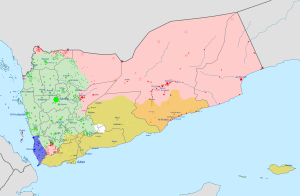
Yemeni Civil War.svg

  Controlled by Houthi (Ansar Allah) and Saleh loyalists
  Controlled by Hadi loyalists
  Controlled by Al-Qaeda/Ansar al-Sharia forces


The bystanders look upon the ongoing war in Yemen as an unnecessary stupid conflict among Muslim states as it has caused over ten thousand deaths in the last two years and in which precious treasure is being frittered away not to save but kill more lives with sophisticated weaponry supplied by the most ‘civilised’ nations of the world. For the onlookers, the Yemen conflagration is nothing more than a saga of colossal human tragedy in which innocent people have been uprooted from their hearths, women widowed, children orphaned and food and medical supplies are becoming extinct, however, to the main players of this war i.e. Saudi Arabia, Iran and the US, their “national interest” is more important than human lives, particularly of Saudi Arabia, which looks upon any political crisis in Yemen as an existential threat to her territorial integrity. That is why Saudis will fight to the last man or till the time they successfully neutralise the existential threat.

What is this existential threat to Saudi Arabia? It is the region of Asir bordering Yemen that has been the Saudi underbelly because even before the formation of Kingdom of Saudi Arabia (KSA), the tribal Emir of Asir and the ruler of Yemen hobnobbed to resist the authority of King Abd al-Aziz. In mid-1920s, when the ruler of Yemen, Imam Yahya and his son Ahmad threatened the main centres of Asir, the Emir of Asir went running for help to Abd al-Aziz and consented to the establishment of Saudi protectorate over his state in 1926, however, when Abd al-Aziz reduced the Emir of Asir to a mere figurehead under a new treaty in 1930, the latter intrigued with Imam Yahya which crystallised in a revolt in 1932 against Abd al-Aziz that was successfully crushed by the Saudis, forcing the Emir of Asir to flee to the sanctuary of Yemen.


Before the “Asir headache” could turn into a “migraine,” the Saudi King Faisal tried to settle the issue, once and for all, when the Treaty of Taif was due for renewal in 1974. He told the Yemeni leadership that though the treaty recognised Saudi sovereignty over over Asir, Najran and Jizan, it was essential that the existing border was recognised as final and permanent


The crisis lingered on because Imam Yahya was in possession of territories of Najran, Harad and a part of Asir-Tihama which the Saudi king regarded as his own and for which he eventually went to war with Yemen, that too, resulted in Saudi victory under the Treaty of Taif in 1934 in which Yemen ceded the disputed territories to Saudi Arabia. Prince (later King) Faisal who headed the Saudi military campaign wanted to conquer the whole of Yemen but his father King Abd al-Aziz ordered him to withdraw. Faisal was flabbergasted and questioned the sagacity of theorder, to which the King replied, “Yemen is not a country that can easily be conquered… If conquering Yemen were a simple undertaking that guaranteed success, Britain, which is stronger than us, in pursuit of its selfish interests, would have tried to conquer Yemen. You should be convinced by the fact that it did not do this.” The Yemenis could not forget the wounds of defeat and the very next year, during the course of Hajj, three of their pilgrims tried to stab Abd al-Aziz, who was saved by his sonEmir Saud.

The Treaty of Taif which had to be renewed after every twenty years stipulated “a state of perpetual peace, firm friendship and everlasting Islamic Arab brotherhood” between the two states and the relationship actually blossomed for many years only to be broken in 1948 by a coup in Yemen in which the coup makers killed the Yemeni ruler Imam Yahya, his prime minister, several dignitaries and promised to usher in a constitutional government which was anathema to the Saudi monarch, who, despite his aversion to Imam Ahmad, the successor of the dead Imam Yahya, supported his claim to the headship of Yemen and helped him to recapture Sanaa to establish his authority and ensured that the coup makers were publicly executed.

After a peaceful stint of fourteen years, there was yet another coup in Yemen in September 1962. Abdallah al-Sallal, the leader of the coup makers was an army officer, who was a republican nationalist by political conviction as well as a strong admirer of the Egyptian President Gamal Abdel Nasser, who was leading the popular pan-Arab wave in the Middle East. The successful coup turned out to be a big headache for the Saudi king because the Yemeni republicans demanded that the Saudi province of Asir be returned to Yemen as it had been forcibly snatched from them by Al-Saud in the 1930s. This claim was anexistential threat to the territorial integrity of Saudi Arabia and so it had to fight a costly protracted war in Yemen for about six years to nullify the Yemini claims against Saudi Arabia.

Before the “Asir headache” could turn into a “migraine,” the Saudi King Faisal tried to settle the issue, once and for all, when the Treaty of Taif was due for renewal in 1974. He told the Yemeni leadership that though the treaty recognised Saudi sovereignty over over Asir, Najran and Jizan, it was essential that the existing border was recognised as final and permanent. Consequently, on 17 March 1973, a joint Saudi-Yemeni communique was issued to this effect but there was a severe backlash against it from the Yemeni nationalists as well as the angry Yemeni students, who seized the Yemeni embassy in Cairo. It was due to such Yemeni claims on Asir in the past and possibly in future that the Saudis built the first modern military base for their defence forces in 1971 at Khamis Mushayt which is close to the Yemeni border.

The ongoing war in Yemen can bring such people in power, who can again stake claims on the Saudi territories bordering Yemen. Saudi Arabia does not want such a situation to arise again and that is why it has gone full throttle in Yemen and is likely to remain engaged till a friendly government is ensconced in power.

Till the last man in Yemen
By Basharat Hussain Qizilbash, www.pakistantoday.com.pk


Saudi Arabian-led intervention in Yemen - Wikipedia

A military intervention was launched by Saudi Arabia in 2015, leading a coalition of nine .... A conflictover a draft constitution resulted in the Houthis consolidating control over the Yemeni capital in January 2015. After resigning from his post ...

Yemeni Civil War (2015–present) - Wikipedia

Abdrabbuh Mansur Hadi (from 2015) Ali Mohsen al-Ahmar (from 2016) Khaled Bahah .... The YemeniCivil War is an ongoing conflict that began in 2015 between two factions ... The Saudi intervention, which has included widespread bombing of civilian areas, has been sharply condemned by the international community.
Smoke rises above Sanaa, Yemen following a Saudi-led coalition air strike targeting a ... The conflicthas its roots in the failure of the political transition that was ..

Middle East Conflict: Why Is Saudi Arabia Attacking Yemen? Important ...

Tribesmen attend a tribal gathering to show support to the Houthi rebel movement in Sanaa, Yemen, Nov. 10, 2016. Photo: Reuters.

Why Saudi Arabia is Hammering Yemen | The National Interest

When Saudi Arabia began bombing Yemen last year, many .... paint this as a religiousconflict the truth is that a regional power is rising from the ...

Why Saudi Arabia Is Continuing Its War In Yemen | HuffPost

Since the start of the Saudi military intervention in Yemen in March 2015 ... the strategic dimensions of the Yemen conflict to the public, insisting ...

Why is Saudi Arabia at War in Yemen? by Ali Al Shihabi - Project ...

Criticism of Saudi Arabia's role in the war against Yemen's Houthi rebels ... What drewSaudi Arabia into the conflict was Iran's effort to build a ...
~ ~ ~ ~ ~ ~ ~ ~ ~ ~ ~ ~ ~ ~ ~ ~ ~  ~ ~ ~  ~


~ ~ ~ ~ ~ ~ ~ ~~ ~ ~ ~ ~ ~  ~ ~ ~  ~
Humanity, Knowledge, Religion, Culture, Tolerance, Peace
انسانیت ، علم ، اسلام ،معاشرہ ، برداشت ، سلامتی 
Books, Articles, Blogs, Magazines,  Videos, Social Media
بلاگز، ویب سائٹس،سوشل میڈیا، میگزین، ویڈیوز,کتب
سلام فورم نیٹ ورک  Peace Forum Network 
Join Millions of visitors: لاکھوں وزٹرز میں شامل ہوں 
Salaamforum.blogspot.com 
سوشل میڈیا پر جوائین کریں یا اپنا نام ، موبائل نمر923004443470+ پر"وہٹس اپپ"یا SMS کریں   
Join 'Peace-Forum' at Social Media, WhatsApp/SMS Name,Cell#at +923004443470
     
  
Facebook: fb.me/AftabKhan.page

Yemen war linked with Syria

Fighting in Yemen is a result of regional crises involving Iran, particularly in Syria and Iraq, where it is fighting in defense of its allies. This war began in the streets, then developed into geopolitical confrontations between an Iranian axis and an Arab Gulf axis. Iran has sacrificed men, and provided arms and funds, out of fear for the survival of the Assad regime, its ally in Syria. It has done the same in Iraq to save its allies. Keep reading>>> http://aftabkhan-net.page.tl/Yemen-war-linked-to-Syria.htm

Yemen colonial cauldron

The Yemen crisis cannot be understood in isolation; this is a conflict that requires understanding of the recent history of the region.
If we were to dismiss history, and what has been played out over the decades post Syke-Picot 1916 and view the Yemeni crisis through a reductionist prism, then yes, the crisis in Yemen is about Saudi and Iran using their proxies to fight it out; yes, it is about a Sunni-Shia conflict which risks spreading in the region; yes, it is about the hegemonic ambitions of the Saudis and Iranians; yes, it is about Saudi trying to flex its muscles while Iran is being brought in from the cold as exemplified by the preliminary nuclear agreement in Lausanne; however, anyone with a insight into the region, colonial penetration and global structures, will come to the conclusion that the Yemeni crisis is just another in a series of conflicts in the region, in which colonial powers are embedded with various factions fighting for influence, penetration and a greater say, with local and regional players subordinate to the interests of the international actors. There is integration between the three, as studied in World Systems Theory, with the top layer (the international actors) being the key determinates of how the local and regional actors position themselves. .... Keep reading >>>>>>


* * * * * * * * * * * * * * * * * * *
Humanity, Religion, Culture, Science, Peace
Peace Forum Network
Books, Articles, Magazines,  Videos
Over 2 Million hits
* * * * * * * * * * * * * * * * * * *

President Obama: Judge, Jury and Executioner for Anwar al-Awlaki


The title may offend some, but here at Loonwatch we do not believe in any sacred cows. By now we have all heard reports about the killing of US citizen Anwar al-Awlaki. The fact that he was on a “hit list” that included other US citizens was reported back in January:

It was first reported in January of last year that the Obama administration had compiled a hit list of American citizens whom the President had ordered assassinated without any due process, and one of those Americans was Anwar al-Awlaki.
After several unsuccessful attempts by the US government Anwar al-Awlaki is finally dead. The indefatigable Glenn Greenwald spells out the tendentious nature of the hunt for Awlaki and all the resultant shadiness:
No effort was made to indict him for any crimes (despite a report last October that the Obama administration was “considering” indicting him).  Despite substantial doubtamong Yemen experts about whether he even has any operational role in Al Qaeda, no evidence (as opposed to unverified government accusations) was presented of his guilt.  When Awlaki’s father sought a court order barring Obama from killing his son, the DOJ argued, among other things, that such decisions were “state secrets” and thus beyond the scrutiny of the courts.  He was simply ordered killed by the President: his judge, jury and executioner.  When Awlaki’s inclusion on President Obama’s hit list was confirmed, The New York Times noted that “it is extremely rare, if not unprecedented, for an American to be approved for targeted killing.”
Awlaki once was a marginal figure, on the run in the mountains of Yemen, his operational role in AlQaeda was nill, now he has been transformed into a martyr with a little help from our brutal friend, the President of Yemen:
After several unsuccessful efforts to assassinate its own citizen, the U.S. succeeded today (and it was the U.S.).  It almost certainly was able to find and kill Awlaki with the help of its long-time close friend President Saleh, who took a little time off frommurdering his own citizens to help the U.S. murder its.  The U.S. thus transformed someone who was, at best, a marginal figure into a martyr, and again showed its true face to the world.  The government and media search for The Next bin Laden has undoubtedly already commenced.
The implications for our civil liberties and checks and balances on the power of the Executive are clear:
What’s most striking about this is not that the U.S. Government has seized and exercised exactly the power the Fifth Amendment was designed to bar (“No person shall be deprived of life without due process of law”), and did so in a way that almost certainly violates core First Amendment protections (questions that will now never be decided in a court of law). What’s most amazing is that its citizens will not merely refrain from objecting, but will stand and cheer the U.S. Government’s new power to assassinate their fellow citizens, far from any battlefield, literally without a shred of due process from the U.S. Government.  Many will celebrate the strong, decisive, Tough President’s ability to eradicate the life of Anwar al-Awlaki — including many who just so righteously condemned those Republican audience members as so terribly barbaric and crass for cheering Governor Perry’s execution of scores of serial murderers and rapists — criminals who were at least given a trial and appeals and the other trappings of due process before being killed.
From an authoritarian perspective, that’s the genius of America’s political culture.  It not only finds way to obliterate the most basic individual liberties designed to safeguard citizens from consummate abuses of power (such as extinguishing the lives of citizens without due process).  It actually gets its citizens to stand up and clap and even celebrate the destruction of those safeguards.
Greenwald’s evaluation is dark because of the uncomfortable truth he relates: we are cheering the destruction of the very liberties that safeguard us from the abuses of power.
This is all being done under the guise of defending our “freedom” and “security.” In reality, as terror expert Professor Charles Kurzman points out, very few Muslims were interested in Awlaki’s message:
Given that Awlaki’s messages is sitting on the internet, easily accessible to millions of English speaking Muslims, it’s very interesting how few have taken him up on his demand that Muslims join the revolutionary movement.
It is time that US citizens stand up for their rights and say we will not allow the government to take the life of our citizens without due process. We are not going to buy the line that our civil liberties and freedoms must be bargained in the interest of “security,” especially from a threat that is overblown in the first place.
http://www.islamophobiatoday.com/2011/09/30/president-obama-judge-jury-and-executioner-for-anwar-al-awlaki/


As President, I would not hesitate to use decisive force to repel any imminent threat. National defense is a primary function of Congress and the commander-in-chief, and, as chief executive, I would carry out my duties as outlined in the Constitution and in accordance with the rule of law. 
President Obama apparently believes he is not bound by the Constitution or the rule of law. When it was reported that Anwar al-Awlaki was killed by U.S. drone strikes in Yemen last week, certainly no one felt remorse for his fate. Awlaki was a detestable person we believe helped recruit and inspire others to kill Americans through terrorist acts.
[BY Ron Paul] More: http://goo.gl/vptUR

Arab Revolutions in danger of Eclipse: الثورات العربية في خطر الكسوف

WebpageTranslator

The historic revolutions that have rippled through the Arab world this year were in danger of eclipse on Friday night as protesters returned to the streets to profess their disgust at how the movement is being stymied by regimes old and new.
كانت الثورات التاريخية التي امتدت لتشمل العالم العربي هذا العام في خطر الكسوف ليلة الجمعة حيث عاد المتظاهرون الى الشوارع في اعتناق سخطهم كيف يتم وضع حرج للحركة من قبل الأنظمة القديمة والجديدة.

Six months after the Arab spring claimed its first dictator, the main squares of Cairo and Tunis were again alive with protest, teargas and fury at the resistance to change shown by interim authorities. In Syria activists said at least 19 people had been killed in the latest crackdown against protests that have convulsed the country for more than four months. At least seven people were killed in Yemen amid a political limbo that appears no closer to resolution. And in Jordan a heavy security presence policed pro- and anti-reform demonstrations which turned violent.

The scenes served as a reminder that little concrete progress towards reform has been made. Elections in Tunisia and Egypt have been postponed. Offers of reform in Yemen and Syria have been rejected as inadequate.
Egypt

Thousands of demonstrators descended on public squares around the country to offer a “Friday of final warning” to the ruling military junta, amid fears that the revolution which toppled Hosni Mubarak is being betrayed by conservative forces.

Rallies and hunger strikes were reported from Alexandria on the Mediterranean all the way down to Luxor in the south and Suez in the east, with the main focus once again on Cairo’s Tahrir Square where a large sit-in is now over a week old.

Protesters accused the Supreme Council of the Armed Forces (SCAF), which assumed power in the aftermath of Mubarak’s fall and promised to make way for a democratically-elected civilian government later this year, of stifling revolutionary demands and working to shield elements of the old regime.

“As many have been saying on Facebook, the relationship between the people and SCAF is the same as the relationship between a wife and a husband who she knows is being unfaithful,” said Shady Alaa El Din, a demonstrator in Tahrir.

“At first we lied to ourselves, we wanted to believe they were with us. But now the street has woken up and it is saying to SCAF ‘we are the rulers, and you follow our orders — not the other way round. We are the red line, you do not cross us’.”

In common with most protesters, El Din was infuriated this week by an address from SCAF spokesman General Mohsen El-Fangari, in which he warned against those seeking to “disrupt public order” and adopted a tone reminiscent of Mubarak in his final speeches to the nation. Pressure is now mounting on interim prime minister Essam Sharaf, who appears unable or unwilling to force through meaningful policy changes in the face of the generals’ intransigence and is now being urged to resign by many of his original supporters.

Tunisia

For anyone new to the Tunisian capital, it was almost as though the past six months had never happened. Balaclava-wearing riot police armed with batons, teargas launchers and dogs squared up against a small crowd of demonstrators who had gathered to express a sentiment widely felt in the city: that the revolution has run into the sand, stymied by a caretaker administration that they say has done little to implement revolutionaries’ demands.

The central government square or Qasbah was protected by coils of barbed wire and armoured vehicles, as demonstrators waving Tunisian flags chanted “peaceful, peaceful”. Then the trouble started. The first gas canister spewed a thick white smoke and was quickly followed by many others. Protesters ran for cover into dark shadows against a white gas screen.

Two men held their ground, kneeling bare-chested and facing the charging police. A third stopped a canister that whirled past, picked it up and threw it back at police lines. As the fumes dispersed, the demonstrators returned, their numbers now swelled into the hundreds. Some began pelting police with small rocks.

“The people who tortured me are still there,” said Malek Khudaira pointing at the ministry where he was held for 10 days during the uprising that toppled the former dictator Zine al-Abidine Ben Ali.

“How can I feel there is change and it’s a full revolution if everything is the same, I see those torturers walking in the streets every day.”

For hours a game of attack and counter attacked ensued. Demonstrators would march, police would fire hails of canisters into their midst. One man in black trousers, white shirt and sunglasses stood facing the police when they fired a small canister point blank at his belly. He fell where he stood. Others helped him away.

The organisers labelled Friday’s event as “the Qasbah 3”. Number 1 was the uprising that toppled Ben Ali and forced him to flee and number 2 was the sit-in that toppled the first caretaker government a month later.

Syria

Activists reported at least 19 deaths across Syria and dozens of injuries as people gathered for the main weekly prayers, which
have been used as a launching pad for dissent for more than four months.

Heavy clashes took place in parts of the capital, according to activists and state media, who offered widely diverging accounts.

At least seven protesters were shot dead in neighbourhoods of Damascus as some of the largest crowds since the uprising poured on to the streets.

Security forces have generally used batons and teargas in Damascus to avoid inflaming protests in the heartland of the regime’s power. Elsewhere, scores of wounded were reported in the cities of Aleppo, Deraa, Idleb and Homs.

Syrian officials again blamed armed gangs for the violence — an indirect reference to Islamists who it claims are trying to ignite sectarian chaos. However, activists said unarmed demonstrators were again attacked by soldiers firing live rounds.

The use of violence has been unpredictable, changing by week and location. In Homs, one resident in the well-off neighbourhood of Inshaat said security forces appeared to be trying to avoid deaths. “They have been shooting but seemed to be aiming at the legs.”

Two of the biggest protests took place in Hama and Deir Ezzor, on a day when activists estimated that up to 1 million people may have openly defied the regime nationwide.

Jordan

Ten people, mostly journalists, were injured on Friday when Jordanian police tried to intervene in clashes between pro-reform demonstrators and government supporters in Amman.

Hundreds of protesters calling for political changes and an end to corruption gathered in the centre of the capital but it was not clear whether they would ignore official warnings against holding a sit-in of the types seen in Egypt and Bahrain.

Jordan has seen sporadic unrest since January but only on a small scale. Opposition demands — supported by youth groups, civil society organisations and Islamists — are for changes within the framework of the Hashemite monarchy. King Abdullah has pledged to pursue reforms that would allow the formation of future governments based on an elected parliamentary majority but gave no date.

The slogan “the people want the reform of the regime” was in striking and deliberate contrast to demands elsewhere for the “overthrow” of rulers.

The Amman protest was held with a heavy security presence, with police, gendarmerie and special forces surrounding the area, the Ammon News website reported.

Rallies for reform and against “rampant corruption” also drew hundreds of demonstrators in the southern cities of Tafileh, Maan and Karak, and in Irbid and Jerash in the north.
Dawn/Guardian News Service. Ghaith Abdul Ahad, Jack Shenker, Nour Ali and Martin Chulov also contributed to this story.
http://www.dawn.com/2011/07/17/arab-revolutions-in-danger-of-eclipse.html


And on Facebook, many have replaced their profile pictures with images of the Tunisian flag, as though draping themselves in the colours of an Arab revolution. Fear and jubilation. The failure of one of the Arab world's most repressive 

None of the uprisings that have shaken the region, from Tunisia`s Jasmine revolution to the ongoing protests against the Assad regime in Syria, has involved significant Islamist activity. Al Qaeda had already looked marginal and on the ...
The hardest part in a revolt as in a novel, says an Arab intellectual, is inventing the end. Reviewing the situation in the Arab world now rocked by an uprising that has already dethroned two dictators, Hassan bin Talal points out some ...
Arab Revolutions in danger of Eclipse: الثورات الع...Related Links:  

Culture Perceptions in US media افة تصورات وسائل الإعلام في الولايات المتحدة

WebpageTranslator

[No Sympathy for Terrorism by [United] States or Groups/Individuals on any pretext]
Other realms are perceived as a threat to western culture, paving the way for a clash of values;  writes Al Kabalan, Special to Gulf  News. Assassination of Osama Bin Laden by US Special Forces last week has once again underlined the importance of culture perceptions in defining US media coverage of Islam and the Arab world. The roots of the cultural dimension, which overwhelm the US media coverage of the Middle East, lie in the European-Islamic centuries-old relations. European writings on the Middle East played a vital role in shaping American perceptions of Islam. After the Second World War, American contacts with the Islamic world substantially increased as the US inherited the dominance and influence of the European colonial powers in the region.
Post-Second World War US-Islamic contacts led to forging contemporary stereotypes — most of them emerged in response to Middle Eastern crises — where pictures of religion, culture and politics have become all mixed. These stereotypes are firmly established now in the US media limiting their ability to respond to changes in the Arab and Islamic world.
In fact, the cultural dimension in the US media coverage is not limited to the Middle East. It affects the world at large and is shaped by two approaches. The first is prescriptive: based on a particular understanding of how the world ought to look. This “ethnocentrism”, Herbert J. Gans, an American sociologist, believes “comes through most explicitly in foreign news, which judges other countries by the extent to which they live up to or imitate American practices and values”. In this respect, Gans presented a list of the hidden social values in the US media coverage of international news. They are ‘ethnocentricism, altruistic democracy, responsible capitalism, individualism, moderatism and order’. If we apply these values to the Arab Middle East, we find that most of them would tend to tilt against it. The second approach in the US media coverage is constructive: based on an interpretative understanding of other cultural realms.
In the Middle East, the cultural dimension is derived from a longstanding tendency to reject, and possibly substitute, what is believed to be a ‘traditional and inferior culture’ that needs to be abandoned, or at least modernised, and a ‘backward people’ who need to be civilised. The reluctance of some Americans to accept the multicultural nature of the world, on one hand, a tendency that has become increasingly clearer since the end of the Cold War, and the unwillingness of Arab Middle Easterners to abandon their own cultural dispositions, on the other hand, have led to a perceived cultural clash, at least on the part of the latter, prompting some fears of western cultural hegemony. Furthermore, when some Americans admit that western culture is unique but not universal, they do recognise other cultural realms but they perceive them as a threat to the western culture, paving the way for the culture clash vision.
Apprehensions
Furthermore, it is widely accepted that the US media tends to reflect the fears and echo the prevalent apprehensions in Israeli circles. It must not be surprising, therefore, that senior Israeli voices are heard loudly in the US media trying to portray Islam as an enemy of the West.
Pro-Israeli journalists in major US newspapers also play a significant role in presenting Islam as an antagonistic religion and culture. Eric Alterman, a well-known US analyst, listed 60 big-name commentators he says are reflexively pro-Israel that “even Benjamin Netanyahu would not be able to complain about the level of support his actions typically receive from the members of the media. For reasons of religion, politics, history and genuine conviction the media debate of the Middle East in America is dominated by people who cannot imagine criticising Israel”, let alone presenting Israel’s own views in the media.
The US media tends also to echo important debates in academic circles. In fact, the academic debate on political Islam has extended to the media and became a matter of great controversy. Here, the US media tends to strengthen certain views through seeking guidance from experts on certain political issues and for political and ideological affiliation most of those experts, not all though, happened to be anti-Arab. It is clear now that a mutual dependency relationship has developed between media and experts where one uses the other to strengthen certain views and tries to influence the public debate on political Islam.
All these reasons prevent the US media from taking an objective stand in covering the world of Islam, something that was absolutely clear in dealing with the killing of Osama Bin Laden.
Dr Marwan Al Kabalan is Lecturer in Media and International Relations, Damascus University, Syria. http://gulfnews.com/opinions/columnists/culture-perceptions-in-us-media-1.806998
More Source:
Bin Laden's Legacy: Options for Muslims: Bin Laden and the US leadership had one thing common; the misguided belief that; ‘End justifies the means’. But if we want to preserve our humanity, it nerve does. The Muslims may respond to the present crisis in two ways; either to follow the clear, unambiguous teachings and guidance from Qur’an and Sunnah to be successful in this and next world by attaining peace with dignity and honour or blindly follow the path leading to destruction by adhering to the concocted irrational pseudo ideologies of extremists satisfying their ambitions and desires. Option A: is rational, Option B is Irrational, emotional response ….Read full …

Related Links: