Featured Post

SalaamOne NetWork

SalaamOne سلام   is   a nonprofit e-Forum to promote peace among humanity, through understanding and tolerance of religions, cul...

Showing posts with label Shia-Sunni. Show all posts

Emergence of Iranian “Shiite Crescent” Across Middle East - WSJ


Arab powers in the Middle East fear that Iran is establishing a “Shiite Crescent” in order to advance its regional ambitions, The Wall Street Journal reported Thursday.

As the Islamic State continues losing territory to Iran-backed militias, Sunni countries are concerned that they may “face a potentially more dangerous challenge: a land corridor from Tehran to Beirut that would reinforce a more capable and no less implacable enemy,” the Journal wrote.

While many in the West regard Iran-backed forces as a preferable alternative to ISIS, “that isn’t how those militias are viewed in Riyadh and other Gulf capitals,” the Journal pointed out.

Prince Turki al-Faisal, the former head of Saudi intelligence and a nephew of Saudi King Salman bin Abdulaziz, told the Journal that Iran-backed militias and ISIS “are equally vicious, equally treacherous, and equally destructive.” He added that the West misunderstood Iranian intentions in the region, saying, “It’s wishful thinking that, if we try to embrace them, they may tango with us. That’s an illusion.”

The Journal explained that the threat of a “Shiite crescent,” first expressed by Jordan’s King Abdullah following the ousting of Saddam Hussein in 2003, has intensified in recent years.

While the dramatic growth of ISIS in western Iraq and eastern Syria after the outbreak of that country’s civil war cut off land communication between the crescent, Tehran has since increased its support of allied forces in the region in order to fortify their positions. In Syria, Iran’s terrorist proxy Hezbollah and other allied groups — primarily composed of Shiites from Afghanistan, Pakistan, and Iran — have been instrumental in keeping Syrian President Bashar al-Assad in power.

“Shiite militias controlled by Iran now play a far greater role than in 2011,” the Journal wrote, with Iraq expelling its Saudi ambassador last month after he criticized the Iran-backed groups. Also known as the popular mobilization forces (PMF), these militias were recently integrated into the Iraqi army and have taken over numerous Sunni areas in Iraq that were “liberated” from ISIS control.

Andrew Tabler, a fellow at the Washington Institute for Near East Policy, told the Journal that “Iran’s power has spread further afield than before in terms of direct military power. We have never had so many Shiite militias operating in so many different areas, and fighting in traditional Sunni strongholds.”

According to some, the threat posed by Shiite militias could lead to a new insurgency in the region. Saleh al-Mutlaq, a Sunni former Iraqi deputy prime minister, told the Journal that the ongoing disenfranchisement of Sunnis could lead to a repeat of history. “Unless you start thinking about the conditions that created ISIS in the first place and try to overcome these conditions,” he said, “there will be a new ISIS again, maybe of a different kind.”

Iran’s recent formation of a Shiite “Liberation Army” has raised fears among observers that Tehran “is asserting itself as a regional or even an imperialistic power,” according to Tallha Abdulrazaq, a researcher at the University of Exeter.

Reuters reported last month that Washington has failed to rein in the PMFs operating in Iraq, even as they “detained, tortured and abused” hundreds of Sunni civilians. In Syria, forces backed by Iran have ethnically cleansed several Sunni neighborhoods in and around Damascus.

In 2014, an Iranian official close to Supreme Leader Ayatollah Ali Khamenei claimed that the Islamic Republic assumed control of four Arab capitals.
Emergence of Iranian “Shiite Crescent” Across Middle East
by 
TheTower.org Staff, thetower.org

~ ~ ~ ~ ~ ~ ~
Islamic Revival رساله تجديد الاسلام ‏

An in-depth study of the Qur’an and Islamic religious history reveals startling facts. “Risala-e-Tajdeed-ul-Islam” is a message to develop positive change in the thought and practices of Muslims.
قرآن اور اسلام کے گہرے مطالعه سےحیران کن حقائق کا انکشاف ہوا، "رساله تجديد الاسلام" مسلمانوں کے انداز فکروعمل میں مثبت تبدیلی کا پیغام ہے:

The "Strategic" Partnership Between India and Iran or The Un-Holy Alliance against Pakistan?


In the worst-case Scenario of war with Pakistan, The Possibility that India might access Iranian Military bases, Thereby encircling and Containing Pakistan, cannot be excluded. [Read full report]
Writes, Jalil Roshandil a well reputed Iranian scholar and researcher. He has been on research penal of many universities in USA, Turkey, and Denmark. He has also been associated with with a well known think tank of University of Iran.
Excerpts:
Iran’s decision to bypass Pakistan and sign an agreement with India was the result of several factors. Of key importance was the old belief that “the enemy of my enemy is my friend.” Iran had simply learned to distrust the West through experiences like the 1953 coup, in which the United States supported the Shah, and even older British and European interventionist policies. In the late 1980s, Pakistan was still seen as a close ally of the despised United States.

Iran and India find themselves coming together not only economically, but also politically. The foreign policies of the two countries have always had commonalities; in particular, both detested Afghanistan’s Taliban and feared the militant Sunni Islam that the Taliban represented. (It is worth remembering that India has more Muslims than either Iran or Pakistan.) Though the Taliban are no
longer in power,Afghanistan remains unstable and a regional concern. Both Iran and India have had difficult dealings with Pakistan as well—it is well known that India blames Pakistan for fanning a secessionist struggle in India’s majority-Muslim state [nore.. its occupied] of Kashmir. One more factor that has helped solder ties between the two countries is Iran’s desire to survive under American pressure and the U.S.-led embargo—in a sense, Iran is still “looking East.”

On the military side, India and Iran agreed  to explore opportunities for joint training and exchange of visits, while declaring that defense cooperation is not aimed against any third country. That the military aspect of the deal will go much further is unlikely. Both India and Iran fear the possible seizure of Pakistan’s nuclear arsenal by Islamic fundamentalists—but both Iran and India have their own religious thugs who might attempt to do the same thing. In the worst-case scenario of war with Pakistan, the possibility that India might access Iranian military bases, thereby encircling and containing Pakistan, cannot be excluded. Such a move would fundamentally alter Islamabad’s strategic calculations. Depending on the strength of India-Iran relations, Iran could get access to advanced Indian military technology.

India keeps its Iran option open for two major reasons:

  1. First, relations with Iran are strategically important for India’s relations with Pakistan. 
  2. Second, even a superficially good relationship with Iran can be sold politically to Muslim Indians who might have some sympathy towards the Islamic Republic of Iran For example, discussion will continue on projects in Iran such as the Chahbahar Free Trade Zone port complex,the Chahbahar-Fahraj-Bam railway link, and the Marine Oil Tanking Terminal. 
Read full >>>


India and Iran—one the object of much wooing from Washington, the other a member of President Bush’s “axis of evil” —announced the creation of a “strategic partnership” in 2003. This Special Report explores the new cordiality in relations between New Delhi and Tehran, as well as the ways this partnership may impact upon the interests of other regional players. Christine Fair explains the calculations that make Iran an attractive partner for New Delhi, and concludes that the bilateral relationship is here to stay. Jalil Roshandel offers an Iranian perspective on the relationship. Pakistan, geographically situated between the two, views closer links between its neighbors with considerable alarm, a subject examined by Sunil Dasgupta. P.R. Kumaraswamy asks how this new Indian-Iranian collaboration may influence New Delhi’s economic and strategic ties with Israel. In addition, all four essays address the implications for the United States of the new -

See more at: https://www.wilsoncenter.org/publication/the-strategic-partnership-between-india-and-iran-pdf#sthash.Sv6zZ6s0.dpuf

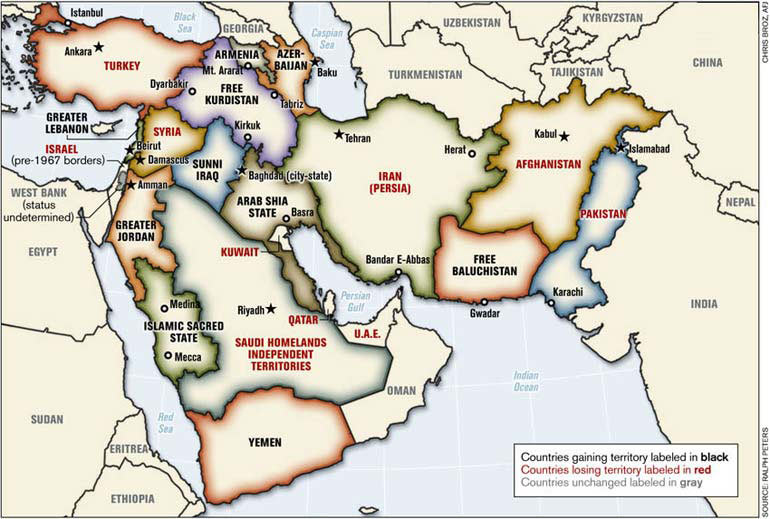
It is common to brush aside the conspiracy theories. However if one critically examines the plans conceived decades back by scholar or groups with close association with the policy makers in USA and UK and the events on ground bear close semblance, its difficult to reject it out rightly. The governments of Muslim countries should consider these aspects seriously and instead of investing in construction of high rise building and other symbols of luxury, should invest in education, and establish think tanks, with genuine intellectuals, analysts and thinkers. They should constantly review the international plans and conspiracies, suggesting concrete counter measures for the national survival and advancement of peace and stability. 
Also read:


The War Within Islam

Members of the self-named Islamic State

Efforts to foster Sunni–Shia unity: In a special interview broadcast on Al Jazeera on February 14, 2007, former Iranian president and chairman of the Expediency Discernment Council of Iran, Ayatollah Akbar Hashemi Rafsanjani and highly influential Sunni scholar Yusuf Al-Qaradawi, "stressed the impermissibility of the fighting between the Sunnis and the Shi’is" and the need to "be aware of the conspiracies of the forces of hegemony and Zionism which aim to weaken [Islam] and tear it apart in Iraq." Even on this occasion there were differences, with Rafsanjani openly asking "more than once who started" the inter-Muslim killing in Iraq, and Al-Qaradawi denying claims by Rafsanjani that he knew where "those arriving to Iraq to blow Shi’i shrines up are coming from: [Wikipedia]

International jihad, in part created and supervised by the U.S. to undermine the Soviet Union, has exacerbated divisions that are fuelling bloodshed.
The bloodiest conflicts on planet Earth today are no longer imperialist wars waged for raw materials, territory, and markets. Instead, religious wars – mostly between Sunni Muslims and Shia Muslims – are ravaging half a dozen countries across the world. The new militancy derives sustenance from religious extremism, which in turn derives from a massive return to the faith. A 2012 Pew Global Report discovered that many Sunni majority states (Egypt-53%|, Tunisia-41%, Jordan-43% etc.) have large fractions of their population who refuse to accept Shias as real Muslims.

In this sectarian war, Pakistan has become one of the most vicious battlegrounds. Its Shia minority, estimated at 20-30% of the population, has seen thousands killed in recent years. This year has been no less tragic than earlier ones: Shikarpur on Jan 30, Peshawar on Feb 13, Rawalpindi on Feb 18; in less than three weeks, suicide bombers successfully targeted three Shia mosques packed with worshippers. Hazara Shias are fleeing Balochistan, some making futile attempts to reach Australia’s distant shores. Barricades surround segregated Shia urban neighbourhoods. But even high security often fails: a suicide bomber made it through to residential Abbas Town in Karachi with a carload of explosives, leaving dozens of broken apartments with flesh and body parts hanging from balconies. Outside of Syria and Iraq, Pakistan is now the world’s deadliest country for Shias.

Unsurprisingly, Pakistan’s Shias see themselves as victims of religious persecution. Some speak dramatically of a Shia genocide. This is surely an exaggeration since the scale is only a thousand or so per year. But the irony should not be lost: Mohammed Ali Jinnah, Pakistan’s founding father, was a Gujrati Shia Muslim. He mobilized millions stating that Muslims and Hindus could never coexist but Muslims, irrespective of sect, could. This eventually turned out to be wrong, but in my childhood things were largely peaceful. Intermarriages were fairly common until the 1980’s, and orthodox Shias had joined orthodox Sunnis into enthusiastically supporting Prime Minister Zulfiqar Ali Bhutto’s 1974 decision to declare Ahmadis, a small persecuted community, as non-Muslim.

Now, in a curious flip of history, a 2012 Pew Global Survey shows that 41% of Pakistanis believe that Shias are non-Muslim. A popular explanation of this change blames the Islamization process started by military dictator General Zia-ul-Haq in the 1980’s. His policies distinguished between different sects and indeed did promote discord. However the massive ongoing fratricide across the Middle East suggests that religious tensions would have anyway boiled over; the phenomenon is now globalized. Shias, being only 12-14 percent of all Muslims, have largely been on the receiving end. But Shia Iran has scarcely been kind to the “heretical” Bahais or Iran’s Sunnis.

At the core of today’s conflicts is the relatively recent insistence, equally by Shias and Sunnis, is that religion must fuse with political power. Sizeable fractions of both sects demand a system that has temporal authority based upon the Qu’ran, and where religion is not confined to an individual’s contemplation of God. However, apart from the Qu’ran, Shia and Sunni agree to nothing else.

What caused dormant differences to explode into war? I think that Islam’s new era owes to three catastrophic events. First, the Iranian Revolution of 1979 converted secular Iran into Islamic Iran and ignited a craving among the orthodox, both Shia and Sunni, for a religious state. Second, international jihad was created and supervised by the United States to counter the Soviet Union’s invasion of Afghanistan but eventually ran amok. Third, the American invasion of Iraq in 2003 destroyed Saddam Hussein but, in seeking to assure their legitimacy and control, the invaders found it expeditious to recognize and then unleash the sectarian monster.

Today, the world’s Shias find inspiration from Ayatollah Khomenei’s political philosophy. On the other hand, Sunni ideals of the caliphate derive from the militant preaching of Egypt’s Syed Qutb and Pakistan’s Syed Abul Ala Maudoodi. Both Sunni and Shia insist that true justice is possible only when religious law replaces secular law and religious practices are enforced in society. Both see the secular West as their mortal enemy. But thereafter the agreement grinds to a halt. There are irreconcilably different versions of early Islamic history, different choices of exemplars, and different religious rituals.

Had the Qur’an prescribed a kind of political system, Shia and Sunni would have argued their cases with that as the reference. But on matters of state and politics, the Holy Book is silent. In fact, as various scholars have pointed out, the Arabic language had no word for “state”. That which came closest was dawlah. But the word acquired its current meaning only after the 1648 Treaty of Westphalia which led to the emergence of geographically defined nation-states in Europe.

Crucially, the Qur’an is silent on how a state’s ruler is to be chosen and what might be legitimate grounds for his removal. It does not specify the limits of the ruler’s power or that of the shura’s (consultative body). Also unmentioned is the manner in which the shura, which could potentially appoint or remove a ruler, is to be chosen. Would there be an executive, judiciary, or government ministries and what should their functions be? Islam’s other source of definitive authority, Prophet Mohammed, did not outline the process for selecting future leaders of the faithful. Whether he actually specified his immediate successor remains deeply contentious and, in fact, lies at the base of centuries-long theological differences between Shia and Sunni. Nevertheless, from time to time, the idea of an Islamic state has been resurrected.

So what is to be done? With the rise of the Da’ish (the Islamic State group) and massive failures in Iraq and Libya, the West must somehow deal with the consequences of its former policies of subjugation, conquest, and extraction of resources. America’s ally, Saudi Arabia, fuels Sunni fundamentalism with petrodollars, and should be firmly dealt with. But it is Muslims, still saddled with ancient animosities and pre-modern ideas, who will have to chart out a new course. At present, the trends are not encouraging.

In Muslim countries around the world, religious faith continues to take a firmer grip over the lives of ordinary citizens. Therefore the question of what constitutes the truest form of faith becomes ever more important. Hence, sympathy for victims of mass killings, or individual assassinations, is limited. This, in turn, gives license to the killers who are implicitly encouraged by television media. Operating on laissez faire, with almost no state control, it panders to the high viewership ratings earned by ranting preachers. This is the flame which sets the abundant dead wood on fire.

There is only one way to end these mad killings. Muslim societies must realize that categorizing fellow citizens according to their religious belief is naught but a prescription for catastrophe. That realization had once existed in many Muslim societies and was articulated by countless Sufis, mystics, and bards.

Iran’s famous poet, Shams of Tabriz (1185-1248) had perhaps put it better than anyone else:

I am not a Muslim
None may call me Christian or Jew
I am not of the East, nor the West
I am neither of earth nor water
I am not of India or China
I am not of the kingdom of Iraq
I am not of this world nor the next,
not of heaven, nor of purgatory.
My place is the placeless,
My trace is the traceless.
It is not the body nor is it the soul,
for I belong to the soul of my love.
If I should win a moment with You,
I will put both worlds under my feet
and dance forever in joy.
O Shams of Tabriz, I am so drunk in the world
that except for revelry and intoxication
I have no tale to tell.

By: Pervez Hoodbhoy. He teaches physics in Lahore and Islamabad.
http://www.telesurtv.net/english/opinion/The-War-Within-Islam-20150306-0039.html


* * * * * * * * * * * * * * * * * * *
Humanity, Religion, Culture, Ethics, Science, Spirituality & Peace
Peace Forum Magazines
Over 1,000,000 Visits
* * * * * * * * * * * * * * * * * * *

Choice to fight IS or Shi'a domination by Iran?

THE prime minister’s visit to Saudi Arabia has sparked a mini-firestorm of speculation about the ‘real’ motives for the trip. Yet Nawaz Sharif is just one of many regional and international leaders invited to Riyadh over the past few days.

The Turkish and Egyptian presidents were recently in the kingdom, while John Kerry also made a quick dash to Riyadh. It seems two main issues were commonly discussed during these visits: Iran and the self-styled Islamic State. There has been talk of forming a ‘Sunni bloc’ as Tehran has started to exercise greater influence across the region and a possible nuclear deal between Iran and the P5+1 emerges on the horizon, which would pave the way for the Islamic Republic’s re-entry into the global financial system. Indeed in both Syria and Iraq, Iran is helping these governments push back against IS. This puts the Arab sheikhdoms in a tough spot: should they still try and contain Iran, or should they focus on defeating IS?

IS, on the other hand, is projecting itself as a champion of the ‘Sunni’ cause, putting up a fight against an expansionist, Shia Iran. Here, the difficulty of the Gulf sheikhdoms becomes apparent: if they take a position against IS they’ll be on the same side as Iran. If they support the Islamic State — overtly or covertly — it will effectively be suicidal. For while IS may come in handy to encircle Iran, it is quite clear the self-styled caliphate seeks to dismantle the current political architecture of the Middle East and remake the region, and indeed the entire Muslim world, in its image. That is why it is important for Sunni-majority states, especially the Gulf sheikhdoms, to firmly oppose IS, and despite their doctrinal and ideological differences with Iran, bury the hatchet and work with Tehran against IS. Moreover, if the Sunni states remain ambiguous about their anti-IS policy, Islamists the world over will gravitate towards the extremist group as it continues to play up its anti-Iran and anti-Shia credentials.

And where does Pakistan fit into this equation? It is indeed a difficult challenge for Islamabad to balance its ties with Riyadh and Tehran. But within this difficulty may be an opportunity. Firstly, Pakistan should not become a party in the Arab-Iran tussle. Iran is a neighbour and should not be estranged while decades of ties with Saudi Arabia must also not be severed. If anything, Pakistan is ideally placed to act as a bridge between the two — should it play its cards right. Coming back to IS, the Iranian action against the group must not be viewed through a sectarian lens, especially when Saudi Arabia and other countries have declared it a terrorist organisation. Ideally, collective action against IS is the best option; for this Iran and Saudi Arabia will need to set aside their differences and focus on the common enemy.
Contents from Editorial by  Dawn.com

The old partition of the Middle East is dead?

The Lebanese Druze leader – who fought in a 15-year civil war that redrew the map of Lebanon – believes that the new battles for Sunni Muslim jihadi control of northern and eastern Syria and western Iraq have finally destroyed the post-World War Anglo-French conspiracy, hatched by Mark Sykes and François Picot, which divided up the old Ottoman Middle East into Arab statelets controlled by the West.
The Islamic Caliphate of Iraq and Syria has been fought into existence – however temporarily – by al-Qa’ida-affiliated Sunni fighters who pay no attention to the artificial borders of Syria, Iraq, Lebanon or Jordan, or even mandate Palestine, created by the British and French. Their capture of the city of Mosul only emphasises the collapse of the secret partition plan which the Allies drew up in the First World War – for Mosul was sought after for its oil wealth by both Britain and France. Keep reading >>>>>


NATO Re-surfaced Map of the New Middle East

By: Chris_Kitze
Mahdi Darius Nazemroaya writes: A relatively unknown map of the Middle East, NATO-garrisoned Afghanistan, and Pakistan has been circulating around strategic, governmental, NATO, policy and military circles since mid-2006. It has been causally allowed to surface in public, maybe in an attempt to build consensus and to slowly prepare the general public for possible, maybe even cataclysmic, changes in the Middle East. This is a map of a redrawn and restructured Middle East identified as the “New Middle East.”

“Hegemony is as old as Mankind…” -Zbigniew Brzezinski, former U.S. National Security Advisor

The term “New Middle East” was introduced to the world in June 2006 in Tel Aviv by Former U.S. Secretary of State Condoleezza Rice (who was credited by the Western media for coining the term) in replacement of the older and more imposing term, the “Greater Middle East.”

This shift in foreign policy phraseology coincided with the inauguration of the Baku-Tbilisi-Ceyhan (BTC) Oil Terminal in the Eastern Mediterranean. The term and conceptualization of the “New Middle East,” was subsequently heralded by the U.S. Secretary of State and the Israeli Prime Minister at the height of the Anglo-American sponsored Israeli siege of Lebanon. Prime Minister Olmert and Secretary Rice had informed the international media that a project for a “New Middle East” was being launched from Lebanon.


* * * * * * * * * * * * * * * * * * *
Humanity, Religion, Culture, Ethics, Science, Spirituality & Peace
Peace Forum Network
Over 1,000,000 Visits
* * * * * * * * * * * * * * * * * * *