Featured Post

SalaamOne NetWork

SalaamOne سلام   is   a nonprofit e-Forum to promote peace among humanity, through understanding and tolerance of religions, cul...

Showing posts with label Russia. Show all posts

The new cold war


The writer is a former Pakistan ambassador to the UN.
WHEN the Soviet Union collapsed in 1991, US President George H. W. Bush and Secretary of State James Baker promised Moscow that Nato would not be moved closer to Russia’s new borders. That promise was broken some years later by the Bill Clinton administration when the Czech Republic, Hungary and Poland were incorporated into Nato, followed soon after by Estonia, Lithuania and Latvia, previously part of the Soviet Union itself.

George Kennan, the famous ‘X’ who anonymously penned the 1947 Foreign Affairs article that provided the blueprint for America’s successful containment of the Soviet Union, was quoted by Tom Friedman (New York Times, May 2, 1998), as saying: “I think it (Nato expansion) is the beginning of a new cold war. ...the Russians will gradually react ... it is a tragic mistake”.

The Russians did react, as Kennan predicted, after Vladimir Putin had consolidated power. When the attempt was made to bring Georgia into Nato, Moscow sliced off two statelets from Georgia. When the pro-Russian president of Ukraine was ousted in a ‘political coup’, Putin took over Crimea and supported the ethnic Russian separatists in eastern Ukraine.

Although the US is no longer the global hegemon, it continues to behave as if it is.

Today, Russia is again a first-rate military power. Its actions in Georgia and Ukraine will not be reversed. Moscow’s forces robustly patrol its western land, air and sea frontiers. The forthcoming large military manoeuvres across Belarus will illustrate Nato’s vulnerability. Russia has also reasserted its political, military and diplomatic role in the world’s ‘hot spots’.

The cerebral president Barack Obama displayed surprising strategic naiveté by simultaneously provoking Russia and announcing his vaunted ‘pivot to Asia’ to contain a rising China.

Despite America’s formidable naval power in the Pacific and its alliances with Japan, India and Australia, the US will be unable to oblige China to relinquish any of the territories or islands it claims unless it resorts to a full-blown war. China’s growing military and economic power also implies that the US will be unable to build reliable alliances to encircle China or block its sea routes.

In the new Cold War, America is pitted against two great powers which, between them, are likely to control the Eurasian ‘heartland’ and thus, if Halford McKinder’s thesis is right, also ‘control the world’. The US, meanwhile, is mired in the self-created quagmires of Afghanistan, Iraq and Syria.

Although Donald Trump is a geopolitical novice, realisation of his desire to normalise relations with Russia (whatever his personal motives) would have reduced America’s great power adversaries from two to one. The US Congress has scuttled this option by imposing the new sanctions against Russia.

Trump’s effort to secure China’s cooperation on North Korea was also sensible. The attempt proved infructuous because the US demand that China apply extreme pressure on Pyongyang to unilaterally give up its nuclear and missile capabilities was exorbitant and unrealistic. Trump’s tweeted rants against China after the latest North Korean missile tests, US weapons sales to Taiwan, and renewed ‘freedom of navigation’ forays in the South China Sea have soured the prospects of Sino-US cooperation.

The early years of the first Cold War, when the US and the Soviet Union sought to consolidate their respective spheres of influence and resorted to brinkmanship, were the most dangerous. It was only after the 1962 Cuban Missile Crisis that both awoke to the danger of a nuclear Armageddon and instituted measures to regulate their competition, including nuclear arms control. Thereafter, the Cold War was fought either in the shadowy world of espionage and sabotage or through proxies.

The second cold war is in an early and dangerous phase and will be difficult to ‘manage’.

First, unlike the first Cold War, it is a trilateral, not bilateral, power struggle. Crisis management will become even more complicated once other militarily significant states align themselves with or against the major powers. Indeed, as at the outbreak of the First World War, international peace and security could be disrupted by the actions of any one of several state and non-state actors.

Second, the US appears to be seriously overestimating its power. Although the US is no longer the global hegemon, it continues to behave as if it is. Coercion and force seem to be Washington’s preferred option to address almost every challenge it confronts. Unless such belligerence is moderated, a great power conflict could erupt in Eastern Europe or the South China Sea; and the US could end up in shooting wars with North Korea and Iran. Some have even advocated US counterterrorist intervention in Pakistan without calculating the consequences.

Third, the potential for catastrophe has been magnified because, unlike the 1950s, now there are not two but nine nuclear weapon states. A conventional conflict in Korea or South Asia could rapidly escalate to the nuclear level.

Fourth, today’s conflicts are mostly ‘hybrid’ wars, encompassing special operations, sabotage and cyber warfare. As Afghanistan, Iraq, Ukraine, Syria, Libya and Yemen have illustrated, it is easy to start such ‘complex’ wars but extremely difficult to prevent their escalation and expansion.

The most tragic consequence of the new cold war will be the erosion of the collective efforts required to address the emerging existential and global threats: poverty and hunger, climate change, nuclear war, mass migration, communicable diseases. Nor will it be possible to collectively exploit the vast opportunities for human progress and wellbeing that technology and innovation now promise.

In the article mentioned, George Kennan added that what bothered him was “how superficial and ill informed the whole US Senate debate was’ (on Nato expansion). The same can be said about recent debates in the US Congress on Russia, Iran, North Korea, Afghanistan, Pakistan and a host of other issues.

The world’s destiny cannot be left to be determined by militarists, political pygmies, or partisan interests. It is imperative that political leaders who possess a global vision of a shared human future forge a new ‘Westphalian’ consensus to circumvent a second cold war, effectively prohibit the resort to force, control armaments and promote active international cooperation to address the common challenges that confront mankind.
The new cold war: by Munir Akram, dawn.com
The writer is a former Pakistan ambassador to the UN.
https://www.dawn.com/news/1349838/the-new-cold-war

World powers jostle in Afghanistan's new 'Great Game'

The security situation is still precarious in many parts of the country. Afghanistan's strategic landscape is changing as regional powers forge links with the Taliban and vie to outdo each other in what's being seen as a new "Great Game".


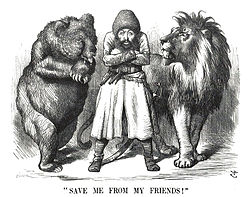
Fifteen years after the US-led intervention in Afghanistan, competition for influence - reminiscent of that rivalry between the Russian and British empires in the 19th and early 20th Centuries, and that during the Cold War in the 1980s - is intensifying, complicating an already precarious security situation.
Political cartoon depicting the Afghan Emir Sher Ali with his
 "friends"  the Russian Bear and British Lion (1878)

Suspicion and mistrust remain the biggest obstacle to stability in strategically-located Afghanistan, which has the potential to destabilise the wider region.
Pakistan, considered the main supporter of the Afghan Taliban, has been accused of playing a double game. But Afghan and Western officials as well as Taliban sources have also spoken about the Taliban's clandestine links with Iran for the past few years.
And recently it emerged that Russia's ties with the Taliban were warming too.


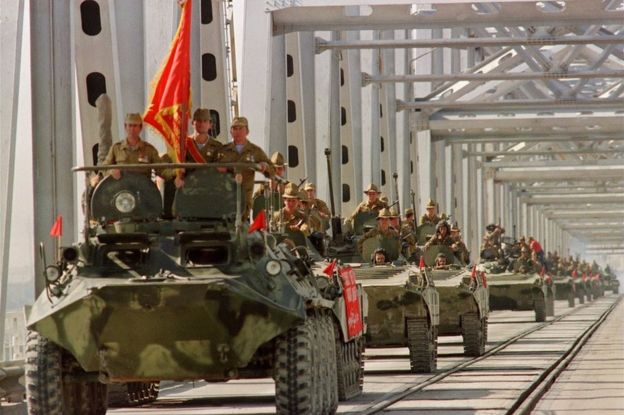
Soviet troops pulled out of Afghanistan in 1988 - Russia now has links with the Taliban
In December the top US commander in Afghanistan, Gen John Nicholson, criticised Russia and Iran for establishing links with the militants, which both countries have confirmed.
The US has also pursued contacts with the Taliban in recent years but those efforts have not brought peace. Several regional powers, most notably Russia and Iran, criticise the US and its allies for "failing" in achieving its original objectives of eliminating violent extremism and drugs in Afghanistan.
Three major factors have contributed to the shifting of regional alliances:
the emergence of so-called Islamic State in Afghanistan;
changes in the approach of the new Afghan government;
and tensions between the US and regional players such as Russia, China, Iran and Pakistan.
Fears over Islamic State
The emergence of IS in Afghanistan - the group announced the creation of its Khorasan Province branch in January 2015 - provided Russia and Iran with the opportunity to make "contacts" with the Taliban.
Army Gen. John Nicholson speaks at a news conference with US Defence Secretary Ash Carter, Friday 9 December 2016 at Bagram Air Base, north of Kabul, Afghanistan.

The US's decreasing military role in Afghanistan and a resurgent Taliban had contributed to creating a sense in regional capitals that Afghanistan's fate was up for grabs. The political infighting in the central government in Kabul also raised concerns about political stability both inside and outside the country.
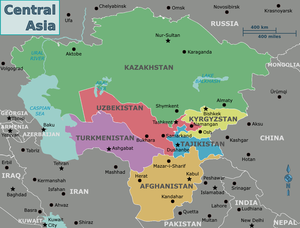
Over the past two years, alarm in Russia and former Soviet Central Asian republics grew as militancy spread to northern Afghan provinces close to their borders as well as to China's Xinjiang region.
Conspiracy theories in Russia, Iran and China paint IS as an American or Western creation aimed at destabilising their countries.

The government says it is cracking down on IS, some of whose alleged members have been paraded by Afghan police
The emergence of IS posed a serious challenge to the supremacy of the Taliban but also encouraged Iran, China and Russia, who were fearful of IS expansion, to review their policies and open dialogue with the Taliban.
Russia's Taliban 'channels'
Softening its approach towards the Taliban is a dramatic and unexpected shift for Russia.
Moscow has for years opposed the Taliban, calling them terrorists, and supported the anti-Taliban "Northern Alliance" in the Afghan civil war of the 1990s.
But faced with a common enemy in the shape of IS, Russia has changed its mind.
In December 2015, a senior Russian diplomat declared that "the Taliban interest objectively coincides with ours" in the fight against IS and that his country and the Taliban "have channels for exchanging information".
Taliban sources also confirmed that the group's representatives met Russians inside Russia and "other" countries several times over the past two years.
But Moscow's current assertiveness in Afghanistan can also be seen as a tactic to put pressure on the US and to enhance its role and regional influence.
Taliban contacts with Russia and Iran might also help Pakistan to distribute and dilute the international pressure it is under for hosting the Afghan Taliban leadership.
Iran and the Taliban make up. Shared animosity towards IS has also brought the Sunni Taliban closer to their historic nemesis, Iran, a Shia powerhouse, whose clerical regime had previously viewed the Afghan Taliban as a major threat.

Iran and its allies have been fighting IS in Syria and Iraq
Like Russia, Iran supported the anti-Taliban groups in the 1990s. Tehran also co-operated with the US-led international coalition to topple the Taliban regime in late 2001. But, at the same time, Taliban sources say Iran sent them a message that it was willing to support them against the US.
When the Taliban insurgency gained momentum in Afghanistan, Iran publically supported the US-backed Afghan government but reportedly kept a link to the Taliban alive. Since the emergence of IS (which considers Shia to be infidels), the Tehran-Taliban relationship has deepened.
A delegation from the Afghan Taliban's political office in Qatar visited Iran in mid-May 2015 where the two sides discussed, among other things, ways to counter IS in Afghanistan.
The Taliban supreme leader, Mullah Akhtar Mansour, was reportedly on his way back from Iran when he was killed in a US drone strike in Pakistan's Balochistan province in May 2016.
Afghanistan's 'imbalanced' foreign policy
The foreign policy of the Afghan government established in September 2014 has also altered political calculations.
Hawks in Russia, Iran and China consider President Ashraf Ghani's government with suspicion and see it as too weak to deal with the multiple security challenges it faces.
They also view Mr Ghani as too close to the US compared with his predecessor, Hamid Karzai.
And some of Mr Ghani's decisions have raised eyebrows in regional capitals.
A convoy of Soviet Army armoured personal vehicles cross a bridge in Termez, Afghanistan, 21 May 1988.
Afghan security forces have launched operations against both Taliban and IS militants
Soon after taking office, he said that improving relations with Pakistan was a top priority. While ignoring India, Pakistan's arch-rival but Afghanistan's traditional ally, the new president made several positive gestures to appease Islamabad. But that rapprochement ended within a year and Kabul and Islamabad reverted to hurling accusations at each other.
Mr Ghani then revived Afghanistan's close relationship with India and on a few occasions seemed to be taunting Pakistan while speaking in India.
His government also pledged support for the Saudi-led military coalition against Shia Houthi rebels in Yemen. That gesture was not received well in Tehran.
These rivalries underline the nature and scale of possible troubles ahead.
The Taliban as Trojan horse?
The Afghan Taliban had been largely dependent on their support base in Pakistan, a country where their leadership is allegedly living. Fears are now growing in Afghanistan that the Taliban are being used as a Trojan horse by state actors in three main ways:
to put pressure on the Afghan government and its US/Nato allies;
to increase the influence of individual countries;
and to outdo one another in a regional competition.
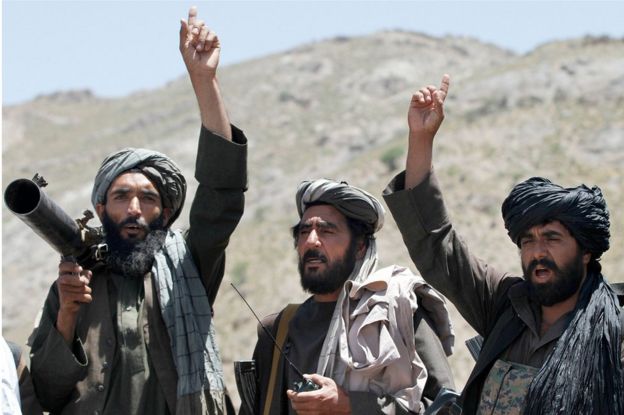
Taliban fighters carrying weapons cheers during a speech by their senior leader in the Shindand district of Herat province, Afghanistan. 27 May 2016.Image copyrightAP
Image caption
Talks have not yet led to peace with the Taliban
The Taliban see their expanding regional portfolio and diplomatic push as evidence of their "legitimate struggle" - in some ways more important for them than material assistance.
The price the Taliban ask has generally been for these countries to help them rid Afghanistan of foreign forces. In return the Taliban offer the following assurances:
not to allow IS to establish a base in Afghanistan;
to prevent foreign militants from using Afghanistan against these states;
to keep their war focused on Afghanistan.
So where will a new 'Great Game' lead?
Taliban fighters carrying weapons cheers during a speech by their senior leader in the Shindand district of Herat province, Afghanistan. 27 May 2016.
Most US military personnel have left Afghanistan - there is little appetite for more losses among the US public
Major regional players seem to have realised that they cannot rely on the US alone to sort out Afghanistan and stabilise the wider region. They are keen to make themselves much more relevant and are looking to play a more assertive role. They also insist that their "contacts" with the Taliban are aimed at promoting regional security.
Afghanistan has been the scene of foreign interventions for a long time. The British and Russian Empires jockeyed for control during the 19th and early 20th Centuries. In the 1980s the US-led Western alliance helped Pakistan provide weapons and funding to Afghan mujahideen fighting to end Soviet occupation.
Recent developments show the extent of a new "Great Game" taking shape.
And once again Afghan civilians are caught in the crossfire.
An artillery gun is air lifted out of a British base in Afghanistan by an American helicopter as the base is closed. 8 May 2014.Image copyrightMOD
Image caption
The UK, one of the original 19th Century "Great Game" players, has once again pulled out of the country
The past few decades have shown that no country has the means to impose its will in Afghanistan on its own, but many actors have created disorder.
Because a big part of the chaos in Afghanistan is rooted in the wider region, the solution needs co-operation and a wider consensus. One positive outcome of the shifting regional alliances might be a more inclusive approach towards stabilising Afghanistan and its neighbourhood.
Many Afghans are hopeful that Russian leader Vladimir Putin and incoming US President Donald Trump will improve bilateral relations, with a positive impact on the situation in Afghanistan.
For many decades during its recent past, when it was left alone, Afghanistan was one of the most peaceful and stable countries. History shows that what Afghanistan needs is less foreign interference, not more of it.
By Dawood Azami ,BBC World Service, Kabul
Source: http://www.bbc.com/news/world-asia-38582323 

…. The Great Game Strategic rivalry between the British and Russian Empires…, in which outside powers struggle for control of Afghanistan, is alive and well…

Afghanistan: The Great Game - A Personal View by Rory Stewart …Rory Stewart tells the story of foreign intervention in Afghanistan from the 19th century to the present day…  Afghanistan: The Great Game - A Personal View by Rory Stewart: Episode 2  …Rory Stewart tells the story of the Soviet invasion of Afghanistan in the twentieth century, and its parallels with the American-led coalition's intervention today. He explains that, quite contrary to popular understanding, the Soviets…  

Afghanistan: The Great Game - A Personal View by Rory Stewart: Episode 1  … became known as "The Great Game". Afghanistan was perceived by Victoria

More:

~ ~ ~ ~ ~ ~ ~ ~ ~ ~ ~ ~ ~ ~ ~ ~ ~  ~ ~ ~  ~

Humanity, Knowledge, Religion, Culture, Tolerance, Peace 

Peace Forum Network
Visited by Millions

       
Facebook Page


 China-Russia-Pakistan axis looks real: What course will Delhi chart vis-a-vis Islamabad?


Before it becomes a 'universal truth', driven by the echo-chamber effects of mass media, it is time to challenge a notion that is of late gaining huge traction in India - that post Uri, Pakistan now lies boxed in a sulky diplomatic corner.

Subscribers of this view point to recent Indian success in leading five Saarc nations into boycotting the host Islamabad. The Narendra Modi government's efforts to boost Bimstec (Bay of Bengal Initiative For Multi Sectoral Technical and Economic Cooperation) ties - a regional realignment excluding Pakistan and comprising Bangladesh, India, Myanmar, Sri Lanka, Thailand, Bhutan and Nepal - and the decision to invite the leaders during the recent Goa Brics Summit have been lauded as a diplomatic masterstroke that further reinforced Pakistan's isolation.

Though Brics and Bimstec declarations refrained from taking Pakistan's name, Indian foreign policy experts have pointed to the meaty stress on terrorism, from what are essentially geo-economic alliances and have interpreted these as more proofs of Pakistan's growing ostracisation.

If anything, China has masterfully sought to fuel this impression. In its state-run mouthpiece Global Times, it accused India of using Brics-Bimstec Summit to "outmaneuver and force Pakistan into becoming a regional pariah", conveniently forgetting its own role in influencing Russia against checkmating India's almost every move of cornering Islamabad.

As usual, the truth is layered and infinitely more complex. Behind India's ceremonial triumphalism and China's smoke-and-mirror game lies the fact that Pakistan is no more isolated on international stage now than it already was before Uri. If anything, the shifting sands of global power and realigning of regional forces indicate that Islamabad now sits more smug than ever due to its close relationship with the world's newest superpower - China.

It was seen as little more than a frustrated bluff from Pakistan when one of Nawaz Sharif's 22 envoys recently visited Washington to 'apprise the world on India's brutalities in Kashmir' and ended up threatening the US over its growing coziness with India. He finished with a typical rhetorical flourish that Pakistan simply doesn't care if US chooses to side with its enemy, because China is on its side. And yet, Special Kashmir Envoy of Pakistan Prime Minister Nawaz Sharif, Mushahid Hussain Syed, who talked aggressively of a new China-Russia-Pakistan axis, wasn't far from truth.

A barely reported fresh development on South China Sea that promises to have far-reaching consequences has gained little attention in India. As we remained fixated on Pakistan, Philippines - America's oldest strategic ally in Asia and among its staunchest - cut off (or at least threatened to) its umbilical cord with US and fell onto rival China's lap like an overripe fruit.

This was a move so little anticipated, dramatic and profound that it left China squeaking in delight like a kid in candy shop and triggered deep tremors in Washington. Consider the significance. It was Philippines, under former president Benigno Aquino III, who dragged China into the international tribunal for its territorial claims and military-strategic advances on South China Sea. And it was only in July this year that Beijing was handed a sound thrashing for breaking international maritime laws.

For Philippines, therefore, to effect what Foreign Policy calls an abrupt "vertigo-inducing change in Manila's orientation" is beyond staggering. It may totally reshape the regional alignments where plucky Philippines set the tone for Malaysia and Vietnam to take on China's increasingly assertive and aggressive dominance. With the biggest US ally moving towards Beijing, China's hegemony on the crucial passage of South China Sea, which facilitates the passage of $5 trillion worth of trade each year, is only going to become near total.

China's sleight of hand was evidently on display by the way it dangled the booties

Strategists in Washington are at a loss to explain Filipino president Rodrigo Duterte's move. Explanations have ranged from his congenital dislike of Barack Obama (he insulted the US president as 'son of a w**re') to China's dangling of a slew of economic carrots which proved irresistible for Manila. Be that as it may, the very fact that Duterte, during the just-concluded visit to Beijing, warmed up to China like a moonstruck lover and talked of Xi Jinping as 'elder brother', point to China's growing clout.

As PTI reported from Beijing last Thursday, after a meeting with Jinping, Duterte perhaps shocked even the room full of Chinese and Filipino business delegates themselves by declaring: "I announce my separation from the United States. Both in military, not maybe social, but economics also. America has lost… I've realigned myself in your ideological flow and maybe I will also go to Russia to talk to [President Vladimir] Putin and tell him that there are three of us against the world - China, Philippines, and Russia. It's the only way."

In Foreign Policy, Max Boot details the history of US-Filipino relationship: "The US ruled the Philippines as a colonial power from 1899 to 1942 and implanted its culture in the archipelago. In World War II, US and Filipino troops fought side by side against the Japanese occupiers. In 1951, Washington and Manila signed a mutual defence treaty. For decades afterward, the Philippines hosted two of the largest US military installations overseas at Clark Air Force Base and Subic Bay Naval Base… In 2014, President Barack Obama signed an agreement with then-president Aquino III that would allow US forces more regular access to bases in the Philippines and increase the tempo of training exercises and military cooperation between the two countries."

So this wasn't just an indication of China's growing clout; it was also an unequivocal symbol of how smaller powers align themselves to whom they feel would better protect their interests. After the Modi government's NSG ambition was vetoed by Beijing, triggering deep resentment in India, China offered a piece of advice to outraged Indians. It said that if India wishes to become a global power, it must first figure out how the big boys operate. China's sleight of hand was evidently on display by the way it dangled the booties.

A report in Bloomberg points out: "China will provide $9 billion in soft loans, including a $3 billion credit line with the Bank of China, while economic deals including investments would yield $15 billion, Trade Secretary Ramon Lopez told reporters in Beijing on Friday. Preliminary agreements in railways, ports, energy and mining worth $11.2 billion were signed between Philippine and Chinese firms.

And The Economist writes: "Duterte wants lots of infrastructure, particularly railways. China is offering cheap loans. He wants the country to export more. China is offering to reopen its markets to Philippine fruit. He wants help with the war on drugs. A Chinese businessman is building a big rehab centre. And he wants Filipino fishermen to be able to return to their traditional fishing grounds around the Scarborough Shoal. China has told Philippine officials that it is open to an accommodation."

Suddenly, the pieces seem to be falling in place. Given the way Russia - now increasingly indebted to Chinese capital, investments and even to tourists from world's most populous nation - has shown every sign of cozying up to Beijing and has even opened new military-strategic ties with Pakistan, that China-Russia-Pakistan axis now looks like an increasing possibility.

India shouldn't count its chickens. Yet.

China-Russia-Pakistan axis looks real: What course will Delhi chart vis-a-vis Islamabad?
by Sreemoy Talukdar, firstpost.com


Related:
~ ~ ~ ~ ~ ~ ~ ~ ~ ~ ~ ~ ~ ~ ~ ~ ~  ~ ~ ~  ~
More:

~ ~ ~ ~ ~ ~ ~ ~ ~ ~ ~ ~ ~ ~ ~ ~ ~  ~ ~ ~  ~

Humanity, Knowledge, Religion, Culture, Tolerance, Peace 

Peace Forum Network
Peace Forum Network Mags
Visited by Millions
Frequently Asked Questions <<FAQ>>
.                                   ......               .


What Is Russia's Plan With India?

Russian president Vladimir Putin visited India for the bilateral meeting of leaders of Russia and India, and the BRICS summit in Goa. As usual, president Putin spent few hours in India.

This made it more difficult to cover all the important issues of the strategic partnership between Russia and India. Russia seemed reluctant to go into details on some issues. Pakistan was one of them.

As ex-speaker of the State Duma Sergey Naryshkin, who is now chief of Foreign Intelligence Service, noted in 2015, the cooperation of Russia and Pakistan has “particular and intrinsic value.” In other words, the most comfortable position for Russians is to have separate tracks and approaches with Pakistan and India.

But it doesn't go down well in south Asia, and it isn't acceptable for Indians, who are following the dramatic development of the military cooperation between Russia and Pakistan with growing concern. Just a week before Putin’s visit, Russia and Pakistan held joint military exercises, Druzhba-2016 (Friendship-2016).

Moscow and Islamabad initially agreed trainings in two places, including Rattu in Gilgit-Baltistan, which is seen by Delhi as an Indian territory, occupied by Pakistan. However, on September 18, there was an attack on a military facility of the Indian Armed Forces in Uri, a town in the Indian-administered state of Jammu and Kashmir. India blamed the attack on a Pakistan-based jihadi group, and the situation added to anger in India over its strategic partner, Russia, deciding to undertake military drills with Pakistan.

In response to the Indian reaction Russia decided to hold Druzhba-2016 exercises only in Cherat in Khyber-Pakhtunkhwa region, rather than in in the disputed region of Gilgit-Baltistan. It would have been wiser to postpone the drills if not to cancel them at all, if Russia sought to take into account the negative feelings of India’s bureaucracy. Yet, to India, Russian authorities seemed almost deaf to voices from Delhi.

In general, before and during Putin's visit to India there was little explanation from the Russian side as to why Russia had decided to boost military cooperation with Pakistan. Indians hardly took seriously the words of the Russian ambassador Alexander Kadakin, as reported in India Times: “"India should not be concerned about military exercises between Russia and Pakistan because the theme of the exercise is anti-terror fighting. [It's] in India’s interests that we teach the Pakistani army not to use itself for terror attacks against India.” The key point of the Indian position, that it considered Pakistan not only part of solution of the terrorist threat in South Asia, but also part of the terrorism problem, was not addressed by the Russian authorities.

For Indian leaders the bilateral summit in Goa became a unique opportunity to convince Russia to change its course in south Asia, and to understand the Russian position about hot topics in the region, including cross-border terrorism and the territorial dispute between India and Pakistan. But when prime minister Narendra Modi explained Indian concerns to president Putin, the Russian response seemed less concerned than expected. Just before Putin’s visit to India, Russia's land force commander-in-chief general Oleg Salyukov confirmed that Russia would hold another round of military exercises with Pakistan in 2017.

As for now it looks like Russia doesn’t want to change its course in south Asia. However, observers could see that the Russian delegation was warmly welcomed by Indian counterparts at the BRICS summit. It might seem like India’s anger over the military cooperation between Russia and Pakistan was over. Yet it would be wrong for Russians to become complacent.

The positive coverage in India could be explained in two ways. First, political leaders of Russia and India decided not to let hot issues leave closed doors. It is in the interests of Putin and Modi to show cordial relations between Russia and India, each for different reasons. At a time of big problems with the West, Moscow tried to show that it has close friends and almost allies around the world. For Modi it was important to show that the foreign policy of India remains diversified and balanced (not pro-American as it’s seen by some inside and outside India).

The second explanation of the positive reaction is that for the Indian side it wouldn't be wise to focus on the drills with Pakistan at a time when they are agreeing the purchase of S-400, stealth frigates, and, reports suggest, the possible lease of a second nuclear submarine. How else could Delhi could give the green light to such strategic projects with the Russians, whose flirting with Pakistan gives them reason for serious concerns?

Being very interested in such projects, India seemed to prefer to stay mute over the issue of the relations between Russia and Pakistan. Moscow could use the planned military-technology cooperation to tackle Delhi's openly negative reaction to the Druzhba-2016 drills. It looks like Moscow succeeded in doing this.

It is widely believed that the Russian leadership is stronger at tactics, short-term planning, than at strategy and long-term foreign policy. If that is the case, the Russian strategic partnership with India may become a victim of this.

Moscow will remain one of the key sources of military technologies for India for many years. No doubt, the Indian path towards acquiring strategic military technologies would be harder and longer without Russian assistance. Moscow played a very important role in the development of the civilian nuclear sector of India. At the summit in Goa, Moscow confirmed its intention to be one of the key players in the oil and gas sector of the Indian economy. And Indians appreciate that.

But the problem is that these long-term projects may be developed separately from the wider relationship between Russia and India, where there is poorer economic interdependence, weaker political contacts, and bigger suspiciousness and even mistrust. Russian tactical gains in the fields of military technologies and energy may be sunk by strategic failures in political and economic relations between Russia and India. To avoid this Russia badly needs to produce a long-term strategy towards India and the region of south Asia, and to stop thinking about India and Pakistan tactically and separately.
by Petr Topychkanov, newsweek.com

Related:
~ ~ ~ ~ ~ ~ ~ ~ ~ ~ ~ ~ ~ ~ ~ ~ ~  ~ ~ ~  ~
Humanity, ReligionCultureSciencePeace

America enters the ‘Old Middle East

What does Russia want from what remains of Syria? Well, one thing is for sure: any bet that Moscow may be willing to implement the Geneva documents – even according to the interpretation of Vladimir Putin and his diplomatic “commissar” Sergey Lavrov – is naïve to say the least. The current political climate in the Middle East is not only suitable, but encouraging for Moscow to flex its muscles.

It is not every day that a president like Barack Obama occupies the White House; and, as long as Obama continues to make the alliance with Iran the focus of his “political legacy,” while his Republican opponents fail to come up with an alternative and meaningful Middle East policy, Washington’s room for maneuver in the region will be limited, and belatedly reactive.

Some claim that behind Obama’s insistence on securing the nuclear deal with Iran is a “carrot and stick” strategy. This means he is betting on improving the chances of a pragmatist “reformists” victory against the “conservative” Mullahs and the Islamic Revolutionary Guard Corps leadership, and bartering Iran’s nuclear weapons with regional influence granted to it at the expense of its neighbors.

America’s inaction towards the Syrian uprising has been the green light that reassured Putin that he could do what he pleased.

Eyad Abu Shakra
Such a scenario is of course possible given the relatively large number of pro-Israel senators whom the White House managed to “convince” and win over, and the “satisfied” silence of Israel’s military and security establishment which – as reported recently – rejected more than once Benjamin Netanyahu’s prodding to attack Iran.

Reformist camp
If the reformist camp does manage to win – as Obama seems to believe it will – I reckon Moscow would have some sort of “arrangement” that would guarantee it enough influence near Russia’s southern borders and in the eastern Mediterranean.

Putin is a politician and former intelligence officer whose political identity matured in the thick of the Cold War and the East-West confrontation. He later witnessed the humiliation suffered by the defeated, and consequently fragmented, USSR at the hands of a jubilant and disrespectful West. Thus, as the slogans of “Socialism,” “Humanity,” and the “Right of self-determination” lectured to us by the old Pravda are today only entertained by imbeciles of the childish left and traded by “intelligence service Arabists,” one must realize that we are dealing with a “neo-Tsarist” Russia.

Inaction
America’s inaction towards the Syrian uprising has been the green light that reassured Putin that he could do what he pleased, whether in Crimea or eastern Ukraine. Today, we are back at full circle; and, again, Washington is reiterating that it is only interested in reassuring Iran and Israel, even if the price is alienating Turkey and the Arabs.

Neo-Tsarist Russia will never forget the Middle East, where old Tsarist Russia had prominent consuls, monasteries, “seminars,” and “Muscovite” schools. And while France thought of itself as the guardian of Catholics and Maronites in the region, and Britain and later America became active in spreading Protestant institutions, Russia became the protector and guide of the Orthodox community in the Middle East.

Tsarist past
So, Putin’s Russia, now that socialism is a profitable commodity no more, is reverting to its Tsarist past, and why not? It is powerful enough not to seek approval, or permission, from anyone to fight the “political Islam” it has fought against for centuries throughout its vast lands and along its long borders extending from the Balkans, through the Caucasus, to central Asia.
There is also another side to the story, this time linked to Russia’s erstwhile tactical alliance with Iran. A few months ago a rumor began to spread that senior Iranian leaders informed a high-ranking Syrian regime official visiting the country that Iran “has paid and continues to pay a lot” in defending Bashar Al-Assad’s regime. They added that Iran needs as collateral lands they have already chosen inside Syria, valued close to their estimate of what Tehran has already spent on the conflict – $26 billion.

Upon his return, the Syrian official reported to Assad what he had heard in Tehran. Assad reacted to the Iranian message – so the rumor goes – by contacting a number of Syrian Christian notables and informing them bluntly that the Iranians “want to take over the country,” and that he was in no position to protect them; thus he may need to rely on Russia!

This rumor was published in the Middle East, but like most rumors no one is willing to own up or give credence to, it soon faded and disappeared. Still, the way Iran is managing the war in Syria through its Revolutionary Guards – including its sectarian Lebanese, Iraqi, and other Shi’ite militias – in Zabadani, the Qalamoun Mountains, Hauran, and northern Syria, and its central role in negotiations concerned with population exchange, confirms that it is fully in charge.

The ‘useful Syria’
Yes, Iran is now actually and effectively running the “useful Syria,” leaving Assad as a mere figurehead. This means that the pre-March 2011 Syria is finished and gone regardless of what happens to Assad and the skeleton of his moribund regime. It also means that if Turkey finds itself forced to pre-empt the establishment of an independent Kurdish entity along its southern border with Syria, extending from northern Iraq to Turkey’s Hatay Province, Russia may decide it wouldn’t be a good idea after all to relinquish its influence in Syria to Iran; more so if victorious Iran’s “reformists” become Washington’s allies.

In the meantime, Washington has just “discovered” that after being quite busy envisaging a “New Middle East” it seems to be looking the “Old Middle East” in the face!

In an assessment that is at odds with official Obama administration policy, Lt. Gen. Vincent Stewart, the head of the Defense Intelligence Agency, said recently at an industry conference that Iraq and Syria may have been permanently torn asunder by war and sectarian tensions, adding that “I’m having a tough time seeing it [Iraq and Syria] come back together.” On Iraq, Stewart said he was “wrestling with the idea that the Kurds will come back to a central government of Iraq,” suggesting he believed it was unlikely. On Syria, he said: “I can see a time in the future where Syria is fractured into two or three parts.” That is not the US goal, he said, but it’s looking increasingly likely.

CIA Director John Brennan, speaking on the same panel, meanwhile said: “Iraqis and Syrians now more often identify themselves by tribe or religious sect, rather than by their nationality . . . I think the Middle East is going to be seeing change over the coming decade or two that is going to make it look unlike it did.”

Brilliant “discoveries” indeed. Pity they do not surprise monitors of Washington’s policies anymore!

This article was first published in Asharq al-Awsat on Sept 16, 2015.

________________
Eyad Abu Shakra (also written as Ayad Abou-Chakra) began his media career in 1973 with Annahar newspaper in Lebanon. He joined Asharq Al-Awsat newspaper in the UK in 1979, occupying several positions including: Senior Editor, Managing Editor, and Head of Research Unit, as well as being a regular columnist. He has several published works, including books, chapters in edited books, and specialized articles, in addition to frequent regular TV and radio appearances.

http://english.alarabiya.net/en/views/news/world/2015/09/19/Obama-in-the-Middle-East-What-we-ve-got-here-is-failure-of-leadership.html

Russia pushing U.S. out of Middle East


 Vladimir Putin’s visit to Egypt marks a low point in U.S.-Egyptian relations, weakening an alliance formed 35 years ago, when President Carter negotiated the Camp David Accords with Egyptian President Anwar El Sadat and Israeli Prime Minister Menachem Begin, contends a retired Army general.
Retired Maj. Gen. Paul Vallely, a founding member of the Citizens’ Commission on Benghazi, told WND the Russians filled a void after the Obama administration cut off military supplies and equipment to Egypt in response to the overthrow of the Muslim Brotherhood-backed president, Mohamed Morsi, which set the stage for Gen. Abdel-Fatal al-Sisi to become president.
Vallely noted that in October 2013, after the Obama administration suspended military aid to Egypt, Sisi turned to Russia. The move was followed by Putin’s first visit to Egypt on Feb. 12-13, 2014, which resulted in Cairo’s decision to purchase some $2 billion of weapons from Russia.
Retired Air Force Lt. Gen. Tom McInerney, another founding member of the Citizens’ Commission on Benghazi, concurred.
“It is amazing how fast the Obama administration has turned some of our most loyal allies against us. Egypt was the keystone of our Mideast Policy for 40 years,” McInerney said.
Egypt is “vital,” he said, “because it controls the Suez Canal, plus airspace to enter and exit the Middle East as well as the crucial partner in the Israeli Peace Treaty, and we have now forced the Egyptians to look to Russia for support. How could we let this happen?”
Clare Lopez, senior vice president for research and analysis at the Center for Security Policy in Washington, warned Putin is a “shrewd operator who, like his predecessors, prioritizes a Russian presence in the Middle East.”
“We must know that wherever the Kremlin is able to establish a foothold will be used to the detriment of our friend and partner, Israel, to perpetuate historical KGB relationships with Islamic terror operatives, and to oppose U.S. strategic interests in the region,” said Lopez, a former CIA officer and another current member of the Citizens’ Commission on Benghazi.
“Squandering our decades-long partnership with Egypt is dangerous, foolish and entirely unnecessary,” she said.
The Washington Institute for Near East Politics reported that between 1979 and Obama’s decision to suspend military aid to Egypt last October, the U.S. provided Egypt with nearly $70 billion in funding. More than half went to purchase American-made equipment. The Washington Institute further reported a $1.3 billion per year U.S. security-assistance grant accounting for 80 percent of Egypt’s military’s annual procurement budget.
“Sisi had no choice but to fill the void left by the Obama administration’s decision with the military aid that Russia was willing to provide,” Vallely said.
Vallely said that since declaring the Muslim Brotherhood a terrorist organization in December 2013, Sisi has been fighting a threat to the Suez Canal, combating ISIS in the Sinai and worrying about ISIS now aligning with the al-Qaida-affiliated militia and the Libyan Muslim Brotherhood in Libya on Egypt’s western border.
Meanwhile, al-Qaida-affiliated terrorists are gaining strength in Nigeria and Somalia to the south of Egypt.
WND reported an interim report by the Citizens’ Commission on Benghazi concluded the Obama administration “switched sides” in the war on terror in Libya in 2011 when the White House and State Department under Hillary Clinton chose to arm al-Qaida-affiliated militia and the Libyan branch of the Muslim Brotherhood in their effort to oust Muammar Gadhafi by force.
“Russia has stepped up to provide the arms Egypt needs to defend itself against the radical Islamic terrorists al-Sisi faces on all sides,” Vallely said.
He was referring to a report that Saudi Arabia has agreed to finance the weapons Egypt purchases from Russia.
Valley said the Obama administration has managed to reverse some nearly 35 years of U.S. foreign policy in the Middle East, with Egypt now returning to Russia. Egypt had a close relationship with the Soviet Union had in era of President Gamal Abdel Nasser, from 1956 to 1970.
“Egypt has a real concern about security, and the United States is not there to help as we should be helping,” Vallely said.
“This is typical of the changes the Obama administration has made in U.S. foreign policy in the Middle East,” he said.
“With the Obama administration supporting the al-Qaida militia in Libya and the Muslim Brotherhood in Egypt, it’s a great illustration how an errant foreign policy undertaken by the U.S. State Department and a White House national security team has managed to drag the United States down lower and lower in credibility throughout the Middle East.”
http://www.wnd.com/2015/02/russia-pushing-u-s-out-of-middle-east/


* * * * * * * * * * * * * * * * * * *
Humanity, Religion, Culture, Ethics, Science, Spirituality & Peace
Peace Forum Magazines
Over 1,000,000 Visits
* * * * * * * * * * * * * * * * * * *

As the US moves closer to India, Pakistan looks to Russia by Tim Craig

As the US forges closer ties to India, neighbouring Pakistan is looking for some new friends. Officials hope they have found one in Russia – a budding partnership that could eventually shift historic alliances in south Asia.

In recent months, Pakistani military and political leaders have reached out to Moscow, seeking to warm ties that have been frosty since the cold war. In November, Russian defence minister Sergei Shoigu visited Islamabad and signed a military cooperation agreement with Pakistani generals. Pakistan now hopes to finalise plans to buy three dozen Russian Mi-35 helicopters and more closely coordinate efforts to counter terrorism and narcotics. Pakistan also wants Russian assistance to stabilise chronic energy shortages.

The moves come as Pakistani leaders grow increasingly nervous that their traditional alliances could erode, if not crumble, in the coming years. For much of its history, Pakistan has been an ally of the US, while Russia had stronger ties to India, even backing it during that country’s 1971 war with Pakistan. But now that most Nato troops have left next-door Afghanistan – and the Pakistani army is straining to overcome Islamist militants on its western border – officials fear that the US’s regional interest is tilting toward India, Pakistan’s eastern neighbour and arch-rival.

“Of course we are concerned,” said one senior Pakistani military leader, who spoke on condition of anonymity. “The balance of power is being tipped toward India, and that is not good, and it’s been done with the help of the western world. That is why we are looking at various markets, because conventional [military] parity is the only recipe for peace and stability.”

Pakistan’s efforts to kindle ties with Moscow come as relations between the west and Russia continue to worsen, which may prompt it to look for new trading partners in Asia. Pakistanis are also worried the Indian army is moving toward dominance in the conventional arms race.

Those concerns were magnified last month, when US President Barack Obama met in Delhi with Indian prime minister Narendra Modi. Obama and Modi vowed to strengthen cooperation on defence and energy matters, and they announced a deal that they said should smooth the way for American companies to invest in Indian civilian nuclear plants.

Since Pakistan was partitioned from India in 1947, the two nuclear-armed countries have fought three major wars. So when Obama was the guest of honour at an elaborate military parade in Delhi, it was viewed with scepticism.

“To be very honest, we think Obama has gone one step too far,” said Maria Sultan, chairwoman of the Islamabad-based South Asian Strategic Stability Institute, an organisation with close links to Pakistani military and intelligence.

US President Barack Obama speaks on US - India relations during a townhall event at Siri Fort Auditorium in New Delhi. US President Barack Obama warned last week that the world does not “stand a chance against climate change” unless developing countries such as India reduce their dependence on fossil fuels. 
In another sign of the unease, Pakistan’s powerful army chief, Raheel Sharif, travelled to China last month to solidify long-standing military and economic ties between the two countries. China is Pakistan’s largest arms supplier, having sold or transferred it nearly $4bn in weapons since 2006, according to the Stockholm International Peace Research Institute (Sipri), which monitors arms sales.

The US, with about $2.5bn in arms sales to Pakistan over the past nine years, is the country’s second-largest arms supplier. In December, Congress also authorised $1bn in additional funds to Pakistan for its continued support of counter-terrorism operations. But it is unclear how much American aid will flow to Pakistan in the coming years.

Tasnim Aslam, spokeswoman for Pakistan’s ministry of foreign affairs, said Pakistan doesn’t want to “put all of its eggs in one basket”.

“It’s a multi-polar world, and it’s in our interest to engage all the poles and forge relationships,” said Aslam, who last month led a high-level Pakistani delegation to Moscow to discuss future ties.

Noting secretary of state John Kerry had a productive visit to Islamabad last month, Aslam said Washington shouldn’t read too much into Pakistan’s outreach to Vladimir Putin. But some Pakistani lawmakers offered a more pointed view of Pakistan’s rapprochement with Russia.

“Pakistan’s historical mistake after its inception was to establish close ties with the United States but to ignore the Russians,” said Haji Muhammad Adeel, a lawmaker who chairs the Pakistani senate’s foreign relations committee. “We went to war with Russia in Afghanistan, and that brought us gifts of terrorism, extremism and drugs. Now Pakistan is trying to forge friendly ties with Russia to correct the mistakes of past.”

Despite that outreach, it remains unclear whether Pakistan’s efforts to bolster ties with Russia will pay off.

Russian diplomats in Islamabad declined to comment on the two countries’ relations. But Russia is India’s largest arms supplier, with $18bn in sales since 2006, according to Sipri.

Yury Barmin, a Russian foreign policy expert based in the United Arab Emirates, said he doubts Russia would risk its relationship with India by also selling arms to Pakistan. He said he suspects Putin, who visited Delhi in December, is using Pakistan as leverage over the Indian government so it doesn’t get too close to the US.

“It’s the way Russian diplomacy works,” Barmin said. “They find a pressure point, but then they go to India and release the pressure and say, ‘Hey, we are not developing that relationship any more.’”

But Rifaat Hussain, an Islamabad-based defence expert, said the west should not underestimate the potential for a realignment of strategic ties in Asia.

“There is now a visible strain with Moscow’s relationship with the United States, and Moscow has moved much closer to China, which I think facilitates Pakistan’s relationship with Russia,” Hussain said.

This article appeared in Guardian Weekly, which incorporates material from the Washington Post

As the US moves closer to India, Pakistan looks to Russia
by Tim Craig for the Washington Post, theguardian.com

Russia and China Really Do Like NATO's Occupation of Afghanistan


The United States is winding down combat operations in Afghanistan and suddenly Russia and China -- who thought the United States had no business there in the first place -- don't want U.S. troops to just turn off the lights behind them.

Senior Russian and Chinese officials have encouraged Afghanistan's leaders to sign the so-called Bilateral Security Agreement with the United States, according to a senior Western diplomat who maintains contact with the Afghan leadership. If signed, the pact would keep U.S. forces playing at least a limited military role for the foreseeable future. Keep reading >>>>>


* * * * * * * * * * * * * * * * * * *
Humanity, Religion, Culture, Ethics, Science, Spirituality & Peace
Peace Forum Network
Over 1,000,000 Visits
* * * * * * * * * * * * * * * * * * *