Featured Post

SalaamOne NetWork

SalaamOne سلام   is   a nonprofit e-Forum to promote peace among humanity, through understanding and tolerance of religions, cul...

Showing posts with label Monotheism and Trinity. Show all posts

How Thomas Jefferson’s secret Bible might have changed history

Thomas Jefferson and his Bible

The 'Jefferson Bible' was Thomas Jefferson's attempt to extract an authentic Jesus from the Gospel accounts.by Marilyn Mellowes.The White House, Washington, D.C. 1804.
Thomas Jefferson was frustrated. It was not the burdens of office that bothered him. It was his Bible. Jefferson was convinced that the authentic words of Jesus written in the New Testament had been contaminated. Early Christians, overly eager to make their religion appealing to the pagans, had obscured the words of Jesus with the philosophy of the ancient Greeks and the teachings of Plato. These "Platonists" had thoroughly muddled Jesus' original message. Jefferson assured his friend and rival, John Adams, that the authentic words of Jesus were still there. The task, as he put it, was one of abstracting what is really his from the rubbish in which it is buried, easily distinguished by its lustre from the dross of his biographers, and as separate from that as the diamond from the dung hill.
With the confidence and optimistic energy characteristic of the Enlightenment, Jefferson proceeded to dig out the diamonds. Candles burning late at night, his quill pen scratching "too hastily" as he later admitted, Jefferson composed a short monograph titled The Philosophy of Jesus of Nazareth. The subtitle explains that the work is "extracted from the account of his life and the doctrines as given by Matthew, Mark, Luke & John." In it, Jefferson presented what he understood was the true message of Jesus.
Jefferson set aside his New Testament research, returning to it again in the summer of 1820. This time, he completed a more ambitious work, The Life and Morals of Jesus of Nazareth Extracted Textually from the Gospels in Greek, Latin, French and English. The text of the New Testament appears in four parallel columns in four languages. Jefferson omitted the words that he thought were inauthentic and retained those he believed were original. The resulting work is commonly known as the "Jefferson Bible."
Who was the Jesus that Jefferson found? He was not the familiar figure of the New Testament. In Jefferson's Bible, there is no account of the beginning and the end of the Gospel story. There is no story of the annunciation, the virgin birth or the appearance of the angels to the shepherds. The resurrection is not even mentioned.
Jefferson discovered a Jesus who was a great Teacher of Common Sense. His message was the morality of absolute love and service. Its authenticity was not dependent upon the dogma of the Trinity or even the claim that Jesus was uniquely inspired by God. Jefferson saw Jesus as
a man, of illegitimate birth, of a benevolent heart, (and an) enthusiastic mind, who set out without pretensions of divinity, ended in believing them, and was punished capitally for sedition by being gibbeted according to the Roman law.
In short, Mr. Jefferson's Jesus, modeled on the ideals of the Enlightenment thinkers of his day, bore a striking resemblance to Jefferson himself.
~~~~~~~~~~~~~~~~~~~~~~~~~~~~~~~~~~~~~~~~~~~~~~~~~~~~~~~~~~~~~~~~~~~~
Editor's noteMitch Horowitz is editor-in-chief of Tarcher/Penguin and editor of Penguin’s new reissue of The Jefferson Bible.
By Mitch Horowitz, Special to CNN
(CNN) – Imagine the following scenario: A U.S. president is discovered to be spending his spare time taking a razor to the New Testament, cutting up and re-pasting those passages of the Gospels that he considered authentic and morally true and discarding all the rest.
Gone are the virgin birth, divine healings, exorcisms and the resurrection of the dead, all of which the chief executive dismissed as “superstitions, fanaticisms and fabrications.”
Such an episode occurred, although the revised version of Scripture remained unseen for nearly seven decades after its abridger’s death. Thomas Jefferson intended it that way.
During most of his two terms in the White House, from 1801 to 1809, and for more than a decade afterward, Jefferson  the third U.S. president and the principal author of the Declaration of Independence  committed himself to a radical reinterpretation of the Gospels.
With a razor and glue brush at this side, Jefferson lined up English, French, Greek and Latin editions of Scripture and proceeded to cut up and reassemble the four Gospels into an exquisitely well-crafted, multilingual chronology of Christ’s life.
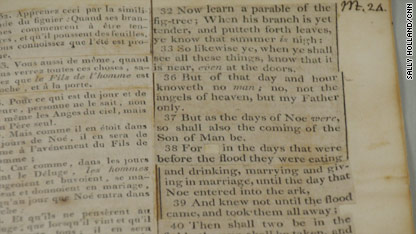
Jefferson lined up different editions of Scripture.
In Jefferson’s view, this revision represented a faithful record of Christ’s moral code, minus the miracles that the Enlightenment-era founder dismissed as historical mythmaking.
The book eventually became known as The Jefferson Bible and is now being rediscovered in new editions, including one published this month by Tarcher/Penguin, and as the focus of a Smithsonian exhibit.
Ask most people today if they have heard of Jefferson’s Bible and you will receive blank stares. Indeed, for much of American history, The Jefferson Bible was entirely unknown. Jefferson intended it as a work of private reflection, not a public statement.
As contemporary readers discover the work, it is tempting to wonder how American history might look different had Jefferson’s radical document come to light closer to its completion.
Jefferson was still working on his Bible during his presidency, so its theoretical publication wouldn’t have compromised his electability. But if the book had been made public after its final completion in 1820, when Jefferson had only six more years to live, it likely would have become one of the most controversial and influential religious works of early American history.
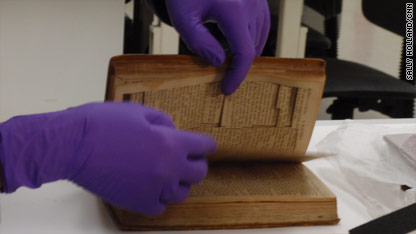
A curator handles a "source" Bible from which Jefferson cut out passages.
That was a scenario Jefferson took pains to avoid. After being called an “infidel” during his 1800 presidential race, Jefferson knew the calumny he could bring on himself if word spread of his “little book.” Although he had his work professionally bound, he mentioned it only to a select group of friends. Its discovery after his death came as a surprise to his family.
Jefferson’s wish for confidentiality held sway until 1895 when the Smithsonian in Washington made public his original pages, purchased from a great-granddaughter. In 1904, Congress issued a photolithograph edition and presented it for decades as a gift to new legislators, a gesture that would likely cause uproar in today’s climate of political piety.
Because of the book’s long dormancy following Jefferson’s death, and its limited availability for generations after  arguably the first truly accessible edition didn’t appear until 1940 The Jefferson Bible has remained a curio of American history.
So how would the earlier publication of The Jefferson Bible have changed American history? It's impossible to know for sure, but the 1820s inaugurated a period of tremendous spiritual experiment in America: It was the age of Mormonism, Unitarian Universalism and Shakerism, among other new faiths.
There’s little doubt that many Americans, who were already fiercely independent in matters of religion, would have seen The Jefferson Bible as the manifesto of a reformist movement call it “Jeffersonian Christianity”  focused not on repentance and salvation but on earthly ethics. Such a movement could have swept America, and also have spread to Europe, where Jefferson was esteemed.
A broad awareness of Jefferson’s work would have surely engendered a more complex view of the religious identity of Jefferson and other founders. Indeed, one of Jefferson’s most trusted correspondents while he was producing his Bible was his White House predecessor, John Adams, who in turn confided to Jefferson his distrust of all religious orthodoxy. These men were impossible to pin pat religious labels on.
Because Jefferson published relatively little during his lifetime, the appearance of The Jefferson Bible would have created a different, and more confounding, public image of the statesman as someone struggling deeply with his own religious beliefs. The Jefferson that appears behind his reconstruction of Scripture is someone who brushed aside notions of miraculous intervention and canonical faith.
As The Jefferson Bible conveys, however, Jefferson considered Jesus’ moral philosophy the most finely developed in history, surpassing the ethics of both the ancient Greeks and the Hebrews. He insisted that Christ’s authentic doctrine was marked by a stark, ascetic tone that clashed with the supernatural powers attributed to him.
“In extracting the pure principles which he taught,” Jefferson wrote in 1813, “we should have to strip off the artificial vestments in which they have been muffled by priests, who have travestied them into various forms. ... There will be found remaining the most sublime and benevolent code of morals which has ever been offered to man.”
Jefferson’s minimalist approach to the Gospels reveals an attitude that he disclosed only privately, just months before his death: “I am of a sect by myself, as far as I know."
In that sense, Jefferson the politician wouldn’t have stood a chance in the current presidential race, where faith and piety are on constant display. The political process might be more open today to candidates of varying degrees and types of belief if The Jefferson Bible were more central to the nation’s history.
The Jefferson Bible opens a window on Jefferson’s struggle to find a faith with which he could finally come to terms. It was this kind of intimate, inner search  not the outward pronouncement and establishment of religious doctrine  that the man who helped shape modern religious liberty sought to protect in America.
The opinions expressed in this commentary are solely those of Mitch Horowitz.
~~~~~~~~~~~~~~~~~~~~~~~~~~~~~~~~~~~~~~~~~~~~~

Jefferson's Bible - C-SPAN Video Library

c-spanvideo.org30 min
In his retirement years Thomas Jefferson compiled his own version of the four ... Former President Jefferson ...


~~~~~~~~~~~~~~~~~~~~~~~~~~~~~~~~~~~~~~~~~~~~~~~~~~~~~~~~~
Jefferson, Thomas, 1743-1826 . The Life and Morals of Jesus of Nazareth: Extracted Textually from the Gospels Greek, Latin, French, and English 
Electronic Text Center, University of Virginia Library
The entire work (15 KB) | Table of Contents for this work |
| All on-line databases | Etext Center Homepage |


  • Header

  • Front Matter

  • Chapter 1 CHAPTER 1

  • Chapter 2 CHAPTER 2

  • Chapter 3 CHAPTER 3

  • Chapter 4 CHAPTER 4

  • Chapter 5 CHAPTER 5

  • Chapter 6 CHAPTER 6

  • Chapter 7 CHAPTER 7

  • Chapter 8 CHAPTER 8

  • Chapter 9 CHAPTER 9

  • Chapter 10 CHAPTER 10

  • Chapter 11 CHAPTER 11

  • Chapter 12 CHAPTER 12

  • Chapter 13 CHAPTER 13

  • Chapter 14 CHAPTER 14

  • Chapter 15 CHAPTER 15

  • Chapter 16 CHAPTER 16

  • Chapter 17 CHAPTER 17

  • Courtesy: http://etext.lib.virginia.edu/toc/modeng/public/JefJesu.html
    ~~~~~~~~~~~~~~~~~~~~~~~~~~~~~~~~~~~~~~~~~~~~~

    Divinity of Jesus? An Inquiry


    By Dr. Laurence B. Brown
    www.LevelTruth.com


    Man is made to adore and to obey: but if you will not command him, if you give him nothing to worship, he will fashion his own divinities, and find a chieftain in his own passions.
                                                          —Benjamin Disraeli, Coningsby
    The critical difference between Jesus’ teachings and the Trinitarian formula lies in elevating Jesus to divine status—a status Jesus denies in the gospels:
    “Why do you call me good: No one is good but One, that is, God.” (Matthew 9:17, Mark 10:18, and Luke 18:19)
    “My Father is greater than I.” (John 14:28)
    “I do nothing of myself, but as the Father taught me, I speak these things.” (John 8:28)
    “Most assuredly, I say to you, the son can do nothing of himself …” (John 5:19)
    “But I know Him, for I am from Him, and He sent me.” (John 7:29)
    “He who rejects me rejects Him who sent me.” (Luke 10:16)
    “But now I go away to Him who sent me …” (John 16:5)
    “Jesus answered them and said, ‘My doctrine is not mine, but His who sent me.’” (John 7:16)
    “For I have not spoken on my own authority; but the Father who sent me gave me a command, what I should say and what I should speak.” (John 12:49)[1]
    What does Pauline theology say?  That Jesus is a partner in divinity, God incarnate. So whom should a person believe?  If Jesus, then let’s hear what else he might have to say:
    “The first of all the commandments is: ‘Hear O Israel, The Lord our God, the Lord is one.” (Mark 12:29)
    “But of that day and hour no one knows, neither the angels in heaven, nor the Son, but only the Father.” (Mark 13:32)
    “‘You shall worship the Lord your God, and Him only you shall serve.’” (Luke 4:8)
    “My food is to do the will of Him who sent me …” (John 4:34)
    “I can of myself do nothing … I do not seek my own will but the will of the Father who sent me.” (John 5:30)
    “For I have come down from heaven, not to do my own will, but the will of Him who sent me.” (John 6:38)
    “My doctrine is not mine, but His who sent me.” (John 7:16)
    “I am ascending to my Father and your Father, and to my God and your God.” (John 20:17)
    My italics in the above verses do not imply that Jesus spoke with that emphasis, although nobody can claim with certainty that he didn’t. Rather, the italics stress the fact that Jesus not only never claimed divinity, but would be the first to deny it. In the words of Joel Carmichael, “The idea of this new religion, with himself as its deity, was something he [Jesus Christ] could never have had the slightest inkling of. As Charles Guignebert put it, ‘It never even crossed his mind.’”[2]
    So if Jesus never claimed divinity, then what was he exactly?  He answered that question himself:
    “A prophet is not without honor except in his own country, among his own relatives, and in his own house.” (Mark 6:4)
    “But Jesus said to them, “A prophet is not without honor except in his own country and in his own house.” (Matthew 13:57)
    “It cannot be that a prophet should perish outside of Jerusalem.” (Luke 13:33)
    Those who knew him acknowledged, “This is Jesus, the prophet from Nazareth of Galilee” (Matthew 21:11), and “A great prophet has risen up among us …” (Luke 7:16). The disciples recognized Jesus as “a prophet mighty in deed …” (Luke 24:19. Also see Matthew 14:5, 21:46, and John 6:14). If these statements were inaccurate, why didn’t Jesus correct them?  Why didn’t he define his divinity if, that is, he truly was divine?  When the woman at the well stated, “Sir, I perceive that you are a prophet’” (John 4:19), why didn’t he thank her for her lowly impression, but explain there was more to his essence than prophethood?
    Or was there?
    Jesus Christ, a mere man?  Could it be?  A good part of the religiously introspective world wonders, “Why not?”  Acts 2:22 records Jesus as “Jesus of Nazareth, a man attested by God to you by miracles, wonders, and signs which God did through him in your midst, as you yourselves also know.”  Jesus himself is recorded as having said, “But now you seek to kill me, a man who has told you the truth which I heard from God …” (John 8:40). Strikingly, a similar quote is found in the Holy Qur’an:
    “He [Jesus] said: ‘I am indeed a servant of Allah: He has given me Revelation and made me a prophet’” (Quran 19:30)
    So was Jesus a “servant of Allah (i.e., servant of God)?”  According to the Bible, yes. Or, at least, that is what we understand from Matthew 12:18: “Behold!  My servant whom I have chosen …” Furthermore, Acts of the Apostles traces the growth of the early church for the first thirty years following Jesus’ ministry, but nowhere in Acts did Jesus’ disciples ever call Jesus “God.”  Rather, they referred to Jesus as a man and God’s servant.[3]
    In fact, the only New Testament verse which supports the doctrine of the Incarnation is 1 Timothy 3:16.[4]  However, with regard to this verse (which states that “God was manifest in the flesh”), Gibbon notes, “This strong expression might be justified by the language of St. Paul (I Tim. iii. 16), but we are deceived by our modern bibles. The word ë (which) was altered to qeèv (God) at Constantinople in the beginning of the sixth century: the true reading, which is visible in the Latin and Syriac versions, still exists in the reasoning of the Greek, as well as of the Latin fathers; and this fraud, with that of the three witnesses of St. John, is admirably detected by Sir Isaac Newton.”[5]
    Fraud?  Now there’s a strong word. But if we look to more modern scholarship, it’s a word well applied, for “some passages of the New Testament were modified to stress more precisely that Jesus was himself divine.”[6]
    The Bible was modified?  For doctrinal reasons?  Hard to find a more appropriate word than “fraud,” given the circumstances.
    In a chapter entitled “Theologically Motivated Alterations of the Text” in his book, Misquoting Jesus, Professor Ehrman elaborates on the corruption of 1 Timothy 3:16, which was detected not only by Sir Isaac Newton, but also by the eighteenth century scholar, Johann J. Wettstein. In Ehrman’s words, “A later scribe had altered the original reading, so that it no longer read “who” but “God” (made manifest in the flesh). In other words, this later corrector changed the text in such a way as to stress Christ’s divinity…. Our earliest and best manuscripts, however, speak of Christ ‘who’ was made manifest in the flesh, without calling Jesus, explicitly, God.”[7]
    Ehrman stresses that this corruption is evident in five early Greek manuscripts. All the same it was the corrupted, and not the “earliest and best,” biblical manuscripts which came to dominate both the medieval manuscripts and the early English translations.[8]  Consequently, from medieval times on, the tenets of Christian faith have suffered the corrupting influence of a church devoted more to theology than to reality.*
    Ehrman adds: “As Wettstein continued his investigations, he found other passages typically used to affirm the doctrine of the divinity of Christ that in fact represented textual problems; when these problems are resolved on text-critical grounds, in most instances references to Jesus’ divinity are taken away.”[9]
    Given the above there should be little surprise that twentieth-century Christianity has expanded to include those who deny the alleged divinity of Jesus. A significant sign of this realization is the following report of the London Daily News: “More than half of England’s Anglican bishops say Christians are not obliged to believe that Jesus Christ was God, according to a survey published today.”[10]  It is worth noting that it was not mere clergy that were polled but bishops, no doubt leaving many parishioners scratching their heads and wondering who to believe, if not their bishops!

    Copyright © 2007 Laurence B. Brown
    Permission granted for free and unrestricted reproduction if reproduced in entirety without omissions, additions or alterations.
    A graduate of Cornell University, Brown University Medical School and George Washington University Hospital residency program, Laurence B. Brown is an ophthalmic surgeon, a retired Air Force officer, and the medical director and chief ophthalmologist of a major eye center. He is also an ordained interfaith minister with a doctorate in divinity and a PhD in religion, and the author of a number of books of comparative religion and reality-based fiction. His works can be found on his website, www.LevelTruth.com.


    Footnotes:
    [1] See also Matthew 24:36, Luke 23:46, John 8:42, John 14:24, John 17:6-8, etc
    [2] Carmichael, Joel, M.A. 1962. The Death of Jesus. New York: The Macmillan Company. p. 203.
    [3] Man: see Acts 2:22, 7:56, 13:38, 17:31; God’s servant: see Acts 3:13, 3:26, 4:27, 4:30.
    [4] In the past, some theologians attempted to validate the Incarnation on the basis of John 1:14 and Colossians 2:9. However, in the face of modern textual criticism these verses have fallen from favor, and for good reason. John 1:14 speaks of “the Word,” which by no means implies divinity, and “the only begotten of the Father,” which by no means is an accurate translation. Both of these subjects were discussed (and discredited) in previous chapters. As for Colossians, problems transcend the incomprehensible wording, beginning with the simple fact that Colossians is now thought to have been forged. For details, see Bart D. Ehrman’s Lost Christianities, page 235.
    [5] Gibbon, Edward, Esq. 1854. The History of the Decline and Fall of the Roman Empire. London: Henry G. Bohn. Vol. 5, Chapter XLVII, p. 207.
    [6] Metzger, Bruce M. and Ehrman, Bart D. The Text of the New Testament: Its Transmission, Corruption, and Restoration. P. 286.
    [7] Ehrman, Bart D. 2005. Misquoting Jesus. HarperCollins. P. 157.
    [8] Ehrman, Bart D. Misquoting Jesus. P. 157.
    * For further clarification, see Metzger, Bruce M. A Textual Commentary on the Greek New Testament. Pp. 573-4.
    [9] Ehrman, Bart D. Misquoting Jesus. P. 113.
    [10] London Daily News. June 25, 1984.
    ~~~~~~~~~~~~~~~~~~~~~~~~~~~~~~~~~~~
    Read more >>>>>>
    Divinity of Jesus Christ is the topic of intense debate from last 2000 years. The Christians theologians support it with verses from Bible. This requires and objective analysis because there are verses in Bible [OT & NT] which goes ...
    Jesus answered them, I told you, and you believed not: the works that I do in my Father's name, they bear witness of me. But you believe not, because you are not of my sheep, as I said unto you. My sheep hear my voice, and I know them, ...
    Jesus & Divinity PDF Book

    Though the Bible is very clear on One, Single God, some Christian theologians developed the doctrine of Trinity assigning title of Godhead to Jesus Christ, as son of God along with Father [God] and Holy Spirit while insisting that the ..
    Where is Christ in Christianity?>>>>>>
    Views from Christian Scholars/Sources


    Jesus and DivinityJesus said: “I and my Father are one”(John;10:30). Trinity is supported through verses: “Go ye therefore, and teach all nations, baptizing them in the name of the Father, and of the Son, and of the Holy Ghost:”(Mathew;28:19). “For there are three that bear record in heaven, the Father, the Word, and the Holy Ghost; and these three [...]
    Bible & Divinity of Jesus Christ: Jesus said: “I and my Father are one”(John;10:30). Trinity is supported through verses: “Go ye therefore, and teach all nations, baptizing them in the name of the Father, and of the Son, and of the Holy Ghost:”(Mathew;28:19). “For there are three that bear record in heaven, the Father, the Word, and the Holy Ghost; and [...]