Featured Post

SalaamOne NetWork

SalaamOne سلام   is   a nonprofit e-Forum to promote peace among humanity, through understanding and tolerance of religions, cul...

Showing posts with label Power Politics. Show all posts

SalaamOne NetWork


SalaamOneسلام  is a nonprofit e-Forum to promote peace among humanity, through understanding and tolerance of religions, cultures & other human values......[.......]

علم اور افہام و تفہیم کے لئے ایک غیر منافع بخش ای فورم ہے. علم،انسانیت، مذہب، سائنس، سماج، ثقافت، اخلاقیات اورروحانیت امن کے لئے.اس فورم کو آفتاب خان،  آزاد محقق اور مصنف نے منظم کیا ہے. تحقیقی کام دس سال سے "ڈیفنس جرنل" میں تسلسل سے چھپ رہا ہے جو کہ بلاگز، ویب سائٹ، سوشل میڈیا، میگزین، ویڈیو چننل اور برقی کتابوں کی صورت میں دستیاب ہے.اس  نیٹ ورک  کو اب تک لاکھوں افراد وزٹ کر چکے ہیں-


The enterprise is managed by Aftab Khan, a freelance researcher and writer. His work and collection is available in the form of e-Books. articles, magazines, videos, posts at social media, blogs & video channels. The  Forum is open to  all the rational, peace loving  people of any faith, gender or race. You may join at social media , invite your friends and share the stuff. The NetWork It has been visited by over  Millions of people around the world. This forum offers a variety of topics for the interest of the readers to choose. Check out Index

This site is focused on humanity in general and the followers of three Abrahamic religions. It provides additional information on religion, history, culture, tolerance, islamophobia, conflicts, opinions and other contemporary issues. Over 200 pages  provide sufficient information on the variety of subjects of interest grouped in 60 categories and 200 tags. 

Index- انڈکس 
  1. Quran Topics قرآن -  مضامین
  2. SalaamOne.com
  3. الخلافة Al Khilafah
  4. Riba Resolved ربا کا حل
  5.  Just One God
  6.  Peace-Forum
  7.  Takfiri Terrorism: Daesh,Taliban,Boko Haram
  8.  Women Folks
  9.  Islamophobia
  10.  Free Books & Articles
  11.  Bible, Christ & Christianity
  12.  Pakistan-Posts
  13.  Aftab Khan-net 
  14. www.Facebook.com/SalaamOne
  15. www.Twitter.com/SalaamOne 
      FAQs >>


      SOCIAL MEDIA:

      VIDEO CHANNELS:

      This was a brief  introduction, for more details  about "SalaamOne" <<<<click here >>>>>

      ~~~~~~~~~~~~~~~~~~~~~~
      SalaamOne.Com


      علم اور افہام و تفہیم کے لئے [سلام SalaamOne]  ایک غیر منافع بخش ای فورم ہے، جو علم کے زریعہ انسانیت کو امن کے قریب لانے کی ایک کوشش ہے .اس فورم کو آفتاب خان نے منظم کیا ہے. تحقیقی کام بلاگز، ویب سائٹ، سوشل میڈیا، میگزین، ویڈیو چننل اور برقی کتابوں کی صورت میں دستیاب ہے. اس Index - انڈیکس  پر منتخب پوسٹس کی مختصر لسٹ ہے ، مزید تفصیلات کے لیے "Search", Categories, Tabs" پر تلاش کریں -   نیٹ ورک  کو اب تک لاکھوں افراد وزٹ کر چکے ہیں, مزید تفصیلات .....

      ~ ~ ~ ~ ~ ~ ~
      Islamic Revival Messages رساله تجديد الاسلام ‏

      An in-depth study of the Qur’an and Islamic religious history reveals startling facts. “Risala-e-Tajdeed-ul-Islam” is a message to develop positive change in the thought and practices of Muslims.
      قرآن اور اسلام کے گہرے مطالعه سےحیران کن حقائق کا انکشاف ہوا، "رساله تجديد الاسلام" مسلمانوں کے انداز فکروعمل میں مثبت تبدیلی کا پیغام ہے:

      Martin McGuinness: The 'super-terrorist who became a super-statesman – like so many others


      Martin McGuinness followed along the familiar trail of so many enemies of Britain’s weary colonial history. A “super-terrorist” becomes a super-statesman. Jomo Kenyatta comes to mind. And Archbishop Makarios. And of course, Menachem Begin. With blood on their hands, they pass through that mist of nobility bestowed by colonial power and former rulers – and re-emerge as statesmen of compromise, eloquence, even humour.

      I’ve never been sure they really changed that much. Begin blew up the King David Hotel, murdered two British army sergeants because the Brits were executing Irgun fighters, and became Prime Minister of Israel. He signed a peace agreement with Egypt, met Margaret Thatcher – then invaded Lebanon in 1982: 17,000 died.

      In fact, most of these folk recalled their past with a certain amount of caution. “Father of the Nation”, they liked to be called – although that hardly applied to McGuinness. Michael Collins went through a similar transmogrification. There he was, killing Churchill’s Cairo Gang intelligence men in Dublin and then sitting in Downing Street with Lloyd George and Churchill himself, who told of meeting Collins whose hands had “touched directly the springs of terrible deeds”. Doubtless, he would have said the same of McGuinness.

      In 1972 I saw him first, standing beside a table on the Creggan – already no-go Derry after Bloody Sunday – for a frantic press conference. They said he was the IRA commander in Derry (he was actually number two), but he was a rather frightening young man, 22 at the time, high cheekbones, fluffy, curly hair, red-faced, sharp, narrow eyes, unsmiling. A very dangerous man, I thought at the time – to his enemies, at least. There was a rifle in the room, though I don’t think he touched it. People later said it was a Kalashnikov, but there weren’t many AKs around at the time and I rather think it was an old American Garand. 

      The British were claiming at the time that McGuinness was the most wanted man in Derry or Northern Ireland or all of Ireland – but they did that on a regular basis to all their most tenacious enemies. That’s what they once called Begin. That’s what they said about Collins in the early 1920s, who passed through that infamous mist of nobility when he signed the grim Treaty which the Brits had prepared for him, Griffith and the others. It cost him his life, of course, so he never travelled to Buckingham Palace to meet the King. But Collins did meet James Craig, one of Northern Ireland’s most sectarian Protestant prime ministers, before he was killed by his own people. Avoiding assassination, McGuinness was to sit down with Ian Paisley and his cronies and become deputy minister of the state he tried so hard to destroy. That alone was worth a handshake from the British monarch. 

      But we should not be too romantic about violent men who pass through the archway of British political acceptance. Sadat was a German spy in Cairo in the Second World War. Then he became the beloved peace-maker. Nasser was at first greeted by Eden, who only later called him the Mussolini of the Nile, although Nasser did for the British Empire at Suez. Yasser Arafat was a “super-terrorist” when I first met him in Beirut in the 1980s, blathering on about the “Zionist military junta”; then he signed the Oslo agreement and became a “super-statesman” and shook hands with Bill Clinton and Yitzhak Rabin. Yet under the brutal Sharon, he reverted to “super-terrorist” status, up to and including his moment of death. What moral transformartions! His body must have been “spinning” even before it was put in the grave.

      It’s a heady, giddy business to undergo these constant conversions. Saddam was our man when he sent his Iraqi legions into revolutionary Iran in 1980 but then became the Hitler of the Tigris when he invaded the wrong country (Kuwait) 10 years later and got bombed for it, and was then invaded in 2003 for the one crime he didn’t commit (9/11). Off with his head, we cried, and the noose surely strangled him. Then take Muammar Gaddafi, whose Libyan coup was at first welcomed by the Foreign Office. But then he went a bit mad, issuing Trump-like statements of mind-numbing inanity, and then tried to fix up McGuinness and his mates with explosives and organised a bomb in a Berlin nightclub where it killed an American serviceman – and then got bombed by Ronald Reagan who dubbed him the “Mad Dog of the Middle East”.

      But the “Mad Dog” outlived Saddam and got slobbered over by the Brits for deconstructing nuclear weapons he never had, and Saint Tony bestowed a kiss upon him and all was well until the Libyans decided they’d had enough and the much-kissed Muammar was butchered by a mob. No wonder he had a strange, puzzled look in his eyes at the time. Then there was Bashar al-Assad, son of the ferocious Hafez, invited to Bastille Day but then – post-Arab Awakening – loathed by the French, whose foreign minister declared that he did not deserve to live “on this earth”. The Quai d’Orsay did not suggest which particular planet he should fly to. But reader alert: with the Europeans back-peddling on their demands for his overthrow and Putin welcoming him to the Kremlin, we may yet see Bashar back in the halls of western Europe.

      McGuinness, of course, maintained his statesmanship to the end, seeing off the grousing old Paisley, watching Peter Robinson slip in the Unionist mire and then observing the Democratic Unionists swamped in financial scandal. A good time to go, you might say, and join all the other “most wanted men” in the sky. But one of them, we would do well to remember, had a wanted poster all his own more than 100 years ago, way back in the Boer War: his name was Winston Churchill. And much to talk about they’ll have, I’m sure.

      By Robert Fisk, independent.co.uk

      http://www.independent.co.uk/voices/martin-mcguinness-dies-super-terrorist-becomes-super-statesman-like-so-many-others-a7640676.html
      ~ ~ ~ ~ ~ ~ ~ ~ ~ ~ ~ ~ ~  ~ ~ ~  ~


      ~ ~ ~ ~ ~ ~ ~ ~~ ~ ~ ~ ~ ~  ~ ~ ~  ~
      Humanity, Knowledge, Religion, Culture, Tolerance, Peace
      انسانیت ، علم ، اسلام ،معاشرہ ، برداشت ، سلامتی 
      Books, Articles, Blogs, Magazines,  Videos, Social Media
      بلاگز، ویب سائٹس،سوشل میڈیا، میگزین، ویڈیوز,کتب
      سلام فورم نیٹ ورک  Peace Forum Network 
      Join Millions of visitors: لاکھوں وزٹرز میں شامل ہوں 
      Salaamforum.blogspot.com 
      سوشل میڈیا پر جوائین کریں یا اپنا نام ، موبائل نمر923004443470+ پر"وہٹس اپپ"یا SMS کریں   
      Join 'Peace-Forum' at Social Media, WhatsApp/SMS Name,Cell#at +923004443470
           
        
      Facebook: fb.me/AftabKhan.page

      Agitation and uncertain politics

      If political confrontation persists for some time, the political situation will become uncertain. The simmering discontent will then persist. However, some sudden triggering development either because of the confrontation between the PML-N and the opposition or because of adventurism on the part of the prime minister in his interaction with the establishment can create an entirely new political scenario. 》》》
      http://tribune.com.pk/story/1157615/agitation-uncertain-politics/

      The crisis of Muslim nationalisms

      Nationalism was a Western construct mainly designed and driven by the rise of the mercantile/trader classes. As an idea, it was a revolt against the feudal mindset and the traditional influence of the aristocratic sections who dominated Europe in alliance with the church.

      The American and French revolutions in the 18th century were both prompted by the growing number of men and women sandwiched between powerful aristocrats and the downtrodden. This section would eventually rise as a separate and distinct class, described by Karl Marx as the bourgeoise and/or the middle-class.

      The architects of both revolutions rejected colonialism, monarchism and political aspects of religion as central signifiers of a people’s identity. Instead, to express their growing political ambitions triggered by their economic successes, the architects of nationalism began to construct notions of identity based on shared political and economic interests, languages and cultural memories.

      To American and French nationalists, this meant devising a system which would make the people direct participants in the state-building process; a people united by certain common political, economic and social interests derived through a consensus, which defined them as a single nationalistic entity.

      In the Muslim regions, when Muslim imperial powers began to erode from the 19th century onwards, various concerned Muslim thinkers and activists responded by rejecting the decaying memories of a glorious imperial past.

      They adopted notions of nationalism to find their peoples’ place in the rapidly changing paradigms of international order. For example, from within the decaying Ottoman Empire emerged the ‘Young Turks’ movement, which searched for a squarely Turkish identity based on a common language and cultural memories. Turkish nationhood was the result, which eschewed the imperial pretensions of the eroding Empire and defined Turkish nationalism as a modern, progressive component of Europe.

      In the Arab world emerged a nationalism that was anti-colonial and revolutionary, but one that rejected old Muslim imperialism and notions of so-called ‘Pan-Islamism’ — a 19th century concept which attempted to stem the collapse of Muslim empires by advocating the modernisation of the concept of Muslim universalism and the caliphate.

      Arab nationalism was strongest in Egypt, Algeria, Syria and Iraq. It painted its people and borders with exclusively nationalistic strokes but, at the same time, also adopted an Arab universalism based on the history and memory of a once powerful, enlightened and progressive nature of the Arab peoples.

      In India, a region with a Hindu majority but with a 500-year history of Muslim rule, certain Muslim thinkers also adopted nationalistic notions after the demise of Muslim rule. Rejecting the decaying past, Muslim nationalism in India advocated the adoption of modern political thought and sciences so that an ‘enlightened’ Muslim nation could emerge in India to face the challenge of British colonialism, and, later, ‘Hindu majoritarianism’.

      This nationalism was intellectually driven by the modern Muslim bourgeoise and bankrolled by the Muslim landed elite. It saw the Muslims of India as a separate nationalistic entity, united by memories of a once glorious past and an urge to revitalise its shared faith through a more rational, modern, and flexible reading and implementation.

      Indian Muslim nationalism also largely bypassed Pan-Islamism because it believed that Muslim culture in the region had bearings which were separate from how Islam had evolved elsewhere.

      Nationalism was the main engine behind the creation and liberation of various Muslim regions in the 20th century. But its influence and impact began to lose hold from the early 1970s onwards. Failed economies, and some disastrous wars, polarised the Muslim societies created on the basis of nationalism. And with the absence of democracy this polarisation began to be expressed by radical alternatives such as neo-Pan-Islamism, offered by a new generation of bourgeoise and petty-bourgeoise Muslims, and bankrolled by oil-rich Arab monarchies that had always seen Muslim nationalism as a threat.

      The state in various Muslim countries tried to retain the status quo by rapidly adopting various aspects of Pan-Islamism, even to the extent of sacrificing many nationalist notions with which most Muslim liberation movements had originally been constructed.

      The erosion of the nationalist narratives created wide open spaces. These spaces were rapidly occupied and then dominated by ideas initially rejected by the nationalists. These ideas were opposed to the nationalist narrative, criticising it for going against the grain of Islamic universalism and creating separatism based on indigenous cultures and languages in Muslim regions.

      Ideas which offered alternative political and social models (as opposed to the ones based on nationalism) were largely based on a contemporary understanding of pan-Islamism. But some three decades after these ideas had managed to engrain themselves in the polity, state and psyche of various Muslim countries, from the 1970s onwards, these countries were left grappling with a new crisis.

      For example, the new generation of Turks, Egyptians, Iraqis, Syrians, Pakistanis, etc, are now completely disconnected with the original notions of their countries’ nationhood and nationalist identities. In the past few decades they were more exposed to ideas of Islamic universalism, pushed aggressively by oil-rich Arab monarchies and their political allies.

      In Pakistan, a young millennial is not quite sure what being a Pakistani now constitutes. Does it mean being a citizen of a Muslim-majority nation in South Asia, which evolved on the banks of River Indus and is part of the region’s 5,000-year-old history; or is he or she a member of some approaching universal Islamic set-up who should just see Pakistan as a temporary abode to mark time in, till that universal empire emerges? Is he or she first a Pakistani and then a Muslim, or vice versa? What about a non-Muslim citizen of Pakistan? Who or what is he?

      Such confusion was triggered by the gradual erosion of the initial nationalist ideas in Muslim countries and the rise of a rather ill-defined and overtly ambitious notion of universalism in a world still defined by nationalistic boundaries. It made a whole generation vulnerable to the ways of those who promise the same universal utopia — but through unprecedented violence against the state and a number of imagined ‘enemies’.

      Maybe the solution now lies in reinvigorating and updating the original notions of nationalism in Muslim countries so that future generations would feel more comfortable, sure and confident of being entities defined by their shared cultural heritage of a region that was carved, encapsulated and bordered by nationalist notions of state, society and nation — and not as some epic launching pad to jump-start a utopia from.
      By Nadeem F Paracha

      http://epaper.dawn.com/DetailImage.php?StoryImage=26_06_2016_424_002
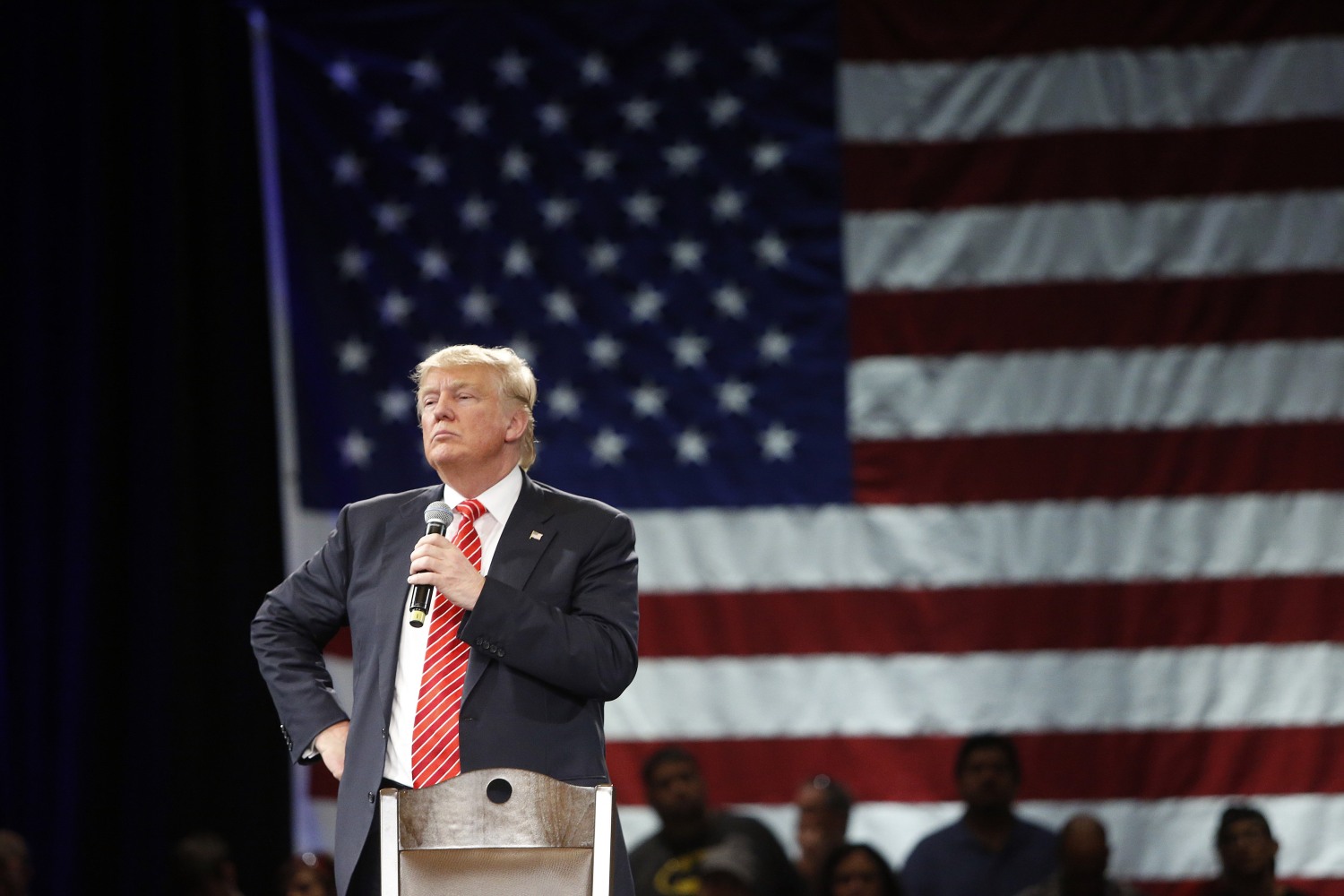
      Trump Presidency Is a Global Threat, Economist Intelligence Unit Warns

      A British research organization has warned that a Donald Trump presidency could have a dangerous impact on the world economy, increasing the potential of Islamic terror attacks and of a trade war with Mexico and China.
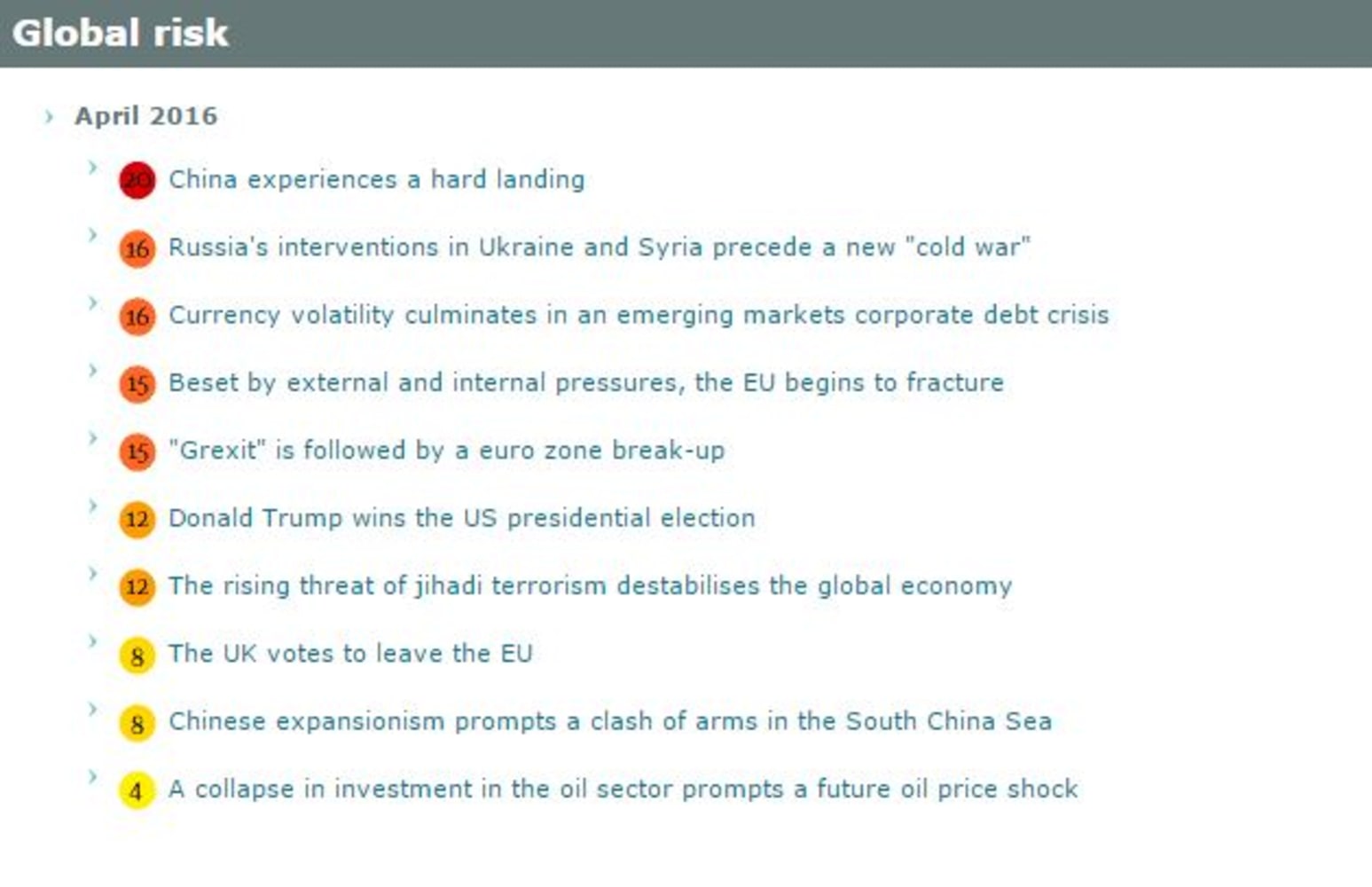
      The Economist Intelligence Unit released its updated global risk assessment, ranking the election of Trump a 12 on a scale of one to 25 — the same number it assigned to the possibility that jihadi terrorism would destabilize the global economy.
      The firm pointed to a number of reasons, including Trump's hostility toward free trade, his accusing China of being a "currency manipulator, his advocating the killing of terrorists' families, and his proposal to move troops into Syria to fight ISIS and take its oil.


      Image: Donald Trump Holds Campaign Town Hall In Tampa


      Republican presidential candidate Donald Trump speaks to supporters 

      This appeared to be the first time the EIU had rated a presidential candidate's election as a global risk, the firm told Politico.
      "His militaristic tendencies towards the Middle East (and ban on all Muslim travel to the U.S.) would be a potent recruitment tool for jihadi groups, increasing their threat both within the region and beyond," the EIU said.
      The organization ranks risks by impact and probability. A Trump presidency bore high impact, but moderate probability, the EIU said.


      The threat list. Economist Intelligence Unit

      "Although we do not expect Mr. Trump to defeat his most likely Democratic contender, Hillary Clinton, there are risks to this forecast, especially in the event of a terrorist attack on U.S. soil or a sudden economic downturn," the authors wrote.
      Trump also will likely face stiff opposition in Congress, both from Democrats and Republicans, the EIU said.
      That "internal bickering," however, could weaken the country's policymaking, the firm said.
      Other global threats on the list included a "sharp economic slowdown in China," a collapse of investment in the oil sector, the break up of the European Union, the further rise of jihadi terrorism, and Russian actions in Ukraine and Syria leading to "a new 'cold war.'"
      The Trump campaign did not immediately respond to requests for comment.
      Also Wednesday, the Washington Post editorial board called for the Republican Party to aim for as brokered convention to prevent a Trump nomination, arguing that Trump "presents a threat to American democracy."
      "Mr. Trump resembles other strongmen throughout history who have achieved power by manipulating democratic processes," the editorial board wrote. "Their playbook includes a casual embrace of violence; a willingness to wield government powers against personal enemies; contempt for a free press; demonization of anyone who is not white and Christian; intimations of dark conspiracies; and the propagation of sweeping, ugly lies." 
      Related:
      ~ ~ ~ ~ ~ ~ ~ ~ ~ ~ ~ ~ ~ ~ ~ ~ ~  ~ ~ ~  ~
      Humanity, ReligionCultureSciencePeace
       A Project of 
      Peace Forum Network
      Peace Forum Network Mags
      BooksArticles, BlogsMagazines,  VideosSocial Media
      Overall 2 Million visits/hits

      The Grave Threats to World Peace

      Image result for threat to world peace
      One cannot quote just one factor as threat to the world peace. There are series of factors and reasons which has resulted to massive killings, displacement of people and destruction at unprecedented scale in modern history, with no end in sight. Here is a selection of articles which may help to understand some possible reasons of present turmoil:-
      1. Why America Is the Gravest Threat to World Peace: By Noam Chomsky
      2. Rise of Imperial USA
      3. Islamophobia has a long history in US
      4. Islamophobia
      5. US at war with an imaginary Islam: Lies, propaganda and the real story of America and the Muslim world

      Image result for threat to world peace

      1. Bernard Lewis Plan to Carve up Middle East and Pakistan
      2. “Greater Israel”: The Zionist Plan for the Middle East The Infamous "Oded Yinon Plan"
      3. How One Man Laid the Groundwork for Today’s Crisis in the Middle East
      4. ISIS, Vanguard of the Global Elite & Plan to Redraw the Middle East 
      5. The Protocols of the elders of Zion  
      6. How to Counter Zionist Plans to divide Middle East: 
      7. America enters the ‘Old Middle East   
      8. Neo-colonialism, a Threat to World Peace
      9. Why Isis fights 
      10. The Refugee Crisis is a Crisis of Imperialism  
      11. World Caliphate: 
      12. Tribulation and Discord in Muslim World
      13. Religion cause wars
      14. Jihad, Extremism?
      15. Illiteracy, Greatest Threat to World Peace  
      16. Poverty As a Great Threat to the World Peace and Economy ...
      17. ISIS, Daesh, Boko Haram, Taliban - Illogical Logic of Terrorists to kill innocent people on name of Islam - Refuted  
      18. Is Pakistan the biggest threat to world peace? 
      19. Frankenstein the CIA created - From Mujahideen to Al-Qaida , Takfiri Taliban ...
      20. The Dreadful Doctrine of Terror : Takfeer عقيدة المروعة من الإرهاب: التكفير
      21. Refutation of Takfiris form Quran & Hadiths
      22. Who are the Khawarij in Pakistan? A critical note on TTP and their ideology
      23. EU poll: “Israel poses biggest threat to world peace”: Flash Eurobarometer survey carried out in October 2003 for the European Commission in the fifteen member states of the EU found that nearly 60 percent of European citizens believe Israel poses the biggest threat to world peace. Iran is considered the second biggest threat, North Korea the third and the United States the fourth. The survey was carried out by EOS Gallup Europe. 
      24. Apartheid's Threat to World Peace: World Conference for ... 
      25. Kashmir - Serious Threat to World Peace    
      26. Are Colonial Empires a Threat to World Peace?  
      27. The major reasons for which India is ranked 8th in the list of ... 

      United States Greatest Threat to World Peace 09 ... - YouTube

      www.youtube.com/watch?v=FOekshZo3wM
      Sep 22, 2015 - Uploaded by Separation of Corporation and State
      Noam Chomsky discusses how the United States (not Iran) is the biggest threat to world peace, when people ...

      Why is Russia a threat to world peace? - YouTube

      https://www.youtube.com/watch?v=puZZoKkv2Nk
      Jul 22, 2015 - Uploaded by ANUchannel
      Since Russia's invasion of Crimea and eastern Ukraine last year, President Putin has continued to have a ...

      Poll: US seen as biggest threat to world peace - YouTube

      www.youtube.com/watch?v=l5ddMn6Yows

      Jan 2, 2014 - Uploaded by RT America
      A Worldwide Independent Network/Gallup poll found that 24 percent of people around the world think the US ...

      Why Israel Is A Threat To World Peace - YouTube

      www.youtube.com/watch?v=4fuIXc74Zn0

      Jun 26, 2012 - Uploaded by Brother Nathanael
      http://www.realjewnews.com/ http://brothernathanaelfoundation.org/ http://brovids.com/

      Which Country Is the Biggest Threat To World Peace ...

      www.youtube.com/watch?v=VltLpcEYxY4
      Sep 18, 2015 - Uploaded by ThinkTank
      You might be surprised who a lot of countries see as the most threatening. John and Brett Erlich discuss. Don't ...

      PressTV-US wages war on humanity: Author

      www.presstv.com/.../US-war-on-humanity-Lendman-
      Aug 2, 2015
      The United States has waged war on humanity and has become the greatest threat to world peace and ...

      Harvard students: US bigger threat to world peace than ISIS ...

      video.foxnews.com/.../harvard-students-us-bigger-t...

      Harvard students: US bigger threat to world peace than ISIS. Oct. 08, 2014 - 1:40 - Campus Reform interviews ...

      'Radical Islam' threat to world peace - YouTube

      www.youtube.com/watch?v=MDXGLfUTBbA

      Apr 24, 2014 - Uploaded by PressTV News Videos
      Tony Blair, Britain's highly controversial former Prime Minister, is back in the spotlight once more, following a ...
      View my Flipboard Magazine.
      ~ ~ ~ ~ ~ ~ ~ ~ ~ ~ ~ ~ ~ ~ ~ ~ ~  ~ ~ ~  ~
      Humanity, ReligionCultureSciencePeace
       A Project of 
      Peace Forum Network
      Peace Forum Network Mags
      BooksArticles, BlogsMagazines,  VideosSocial Media
      Overall 2 Million visits/hits