Featured Post

SalaamOne NetWork

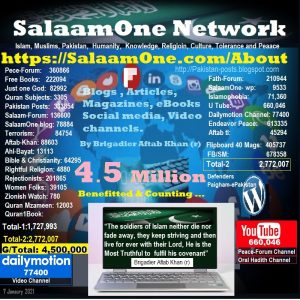
SalaamOne سلام   is   a nonprofit e-Forum to promote peace among humanity, through understanding and tolerance of religions, cul...

Showing posts with label Culture. Show all posts

SalaamOne NetWork


SalaamOneسلام  is a nonprofit e-Forum to promote peace among humanity, through understanding and tolerance of religions, cultures & other human values......[.......]

علم اور افہام و تفہیم کے لئے ایک غیر منافع بخش ای فورم ہے. علم،انسانیت، مذہب، سائنس، سماج، ثقافت، اخلاقیات اورروحانیت امن کے لئے.اس فورم کو آفتاب خان،  آزاد محقق اور مصنف نے منظم کیا ہے. تحقیقی کام دس سال سے "ڈیفنس جرنل" میں تسلسل سے چھپ رہا ہے جو کہ بلاگز، ویب سائٹ، سوشل میڈیا، میگزین، ویڈیو چننل اور برقی کتابوں کی صورت میں دستیاب ہے.اس  نیٹ ورک  کو اب تک لاکھوں افراد وزٹ کر چکے ہیں-


The enterprise is managed by Aftab Khan, a freelance researcher and writer. His work and collection is available in the form of e-Books. articles, magazines, videos, posts at social media, blogs & video channels. The  Forum is open to  all the rational, peace loving  people of any faith, gender or race. You may join at social media , invite your friends and share the stuff. The NetWork It has been visited by over  Millions of people around the world. This forum offers a variety of topics for the interest of the readers to choose. Check out Index

This site is focused on humanity in general and the followers of three Abrahamic religions. It provides additional information on religion, history, culture, tolerance, islamophobia, conflicts, opinions and other contemporary issues. Over 200 pages  provide sufficient information on the variety of subjects of interest grouped in 60 categories and 200 tags. 

Index- انڈکس 
  1. Quran Topics قرآن -  مضامین
  2. SalaamOne.com
  3. الخلافة Al Khilafah
  4. Riba Resolved ربا کا حل
  5.  Just One God
  6.  Peace-Forum
  7.  Takfiri Terrorism: Daesh,Taliban,Boko Haram
  8.  Women Folks
  9.  Islamophobia
  10.  Free Books & Articles
  11.  Bible, Christ & Christianity
  12.  Pakistan-Posts
  13.  Aftab Khan-net 
  14. www.Facebook.com/SalaamOne
  15. www.Twitter.com/SalaamOne 
      FAQs >>


      SOCIAL MEDIA:

      VIDEO CHANNELS:

      This was a brief  introduction, for more details  about "SalaamOne" <<<<click here >>>>>

      ~~~~~~~~~~~~~~~~~~~~~~
      SalaamOne.Com


      علم اور افہام و تفہیم کے لئے [سلام SalaamOne]  ایک غیر منافع بخش ای فورم ہے، جو علم کے زریعہ انسانیت کو امن کے قریب لانے کی ایک کوشش ہے .اس فورم کو آفتاب خان نے منظم کیا ہے. تحقیقی کام بلاگز، ویب سائٹ، سوشل میڈیا، میگزین، ویڈیو چننل اور برقی کتابوں کی صورت میں دستیاب ہے. اس Index - انڈیکس  پر منتخب پوسٹس کی مختصر لسٹ ہے ، مزید تفصیلات کے لیے "Search", Categories, Tabs" پر تلاش کریں -   نیٹ ورک  کو اب تک لاکھوں افراد وزٹ کر چکے ہیں, مزید تفصیلات .....

      ~ ~ ~ ~ ~ ~ ~
      Islamic Revival Messages رساله تجديد الاسلام ‏

      An in-depth study of the Qur’an and Islamic religious history reveals startling facts. “Risala-e-Tajdeed-ul-Islam” is a message to develop positive change in the thought and practices of Muslims.
      قرآن اور اسلام کے گہرے مطالعه سےحیران کن حقائق کا انکشاف ہوا، "رساله تجديد الاسلام" مسلمانوں کے انداز فکروعمل میں مثبت تبدیلی کا پیغام ہے:

      These 63 Websites Will Make You Incredibly Smarter

      “Intellectual growth should commence at birth and cease only at death.” — Albert Einstein


      Learning should not end after formal education. Lifelong learning, the ongoing, voluntary, and self-motivated pursuit of knowledge can enrich your understanding of different topics and make you a better person every day. Your career, personal life, and total well-being will never be the same if you can commit to some of these awesome resources.
      Peace Forum - : Knowledge, Humanity, Religion, Culture, Science, Tolerance, Peace
      1/ BBC — Future — In-depth coverage of science, health and technology
      2/ 5-minute Drops: Learn a new language for no more than 5 minutes per day.
      3/ Makezine: DIY projects, how-Tos, electronics, crafts and ideas for makers.
      4/ Peace-Forum: Knowledge, Humanity, Religion, Culture, Science, Tolerance, Peace
      5/ Daily Bits Of: Learn anything, anywhere, with daily courses via email.
      6/ Skillshare for Mobile: Learn just about anything.
      7/ Medium: Don’t miss the amazing pieces here every week.
      8/ The School of Life: A place that tries to answer the great questions of life with the help of culture.
      9/ Chalk Street: Learn the things that are important to you.
      10/ Guides.co: Modern “How To” guides.
      11/ University of Reddit: Learn 1,000’s of new things, from reddit.
      12/ Highbrow: Expand your knowledge universe in just 5 minutes a day.
      13/ InstaNerd: Be smart, instantly.
      14/ Degreed: A lifelong learning platform.
      15/ Daily Curiosity: Get informed with 5 new amazing
      topics, delivered daily.
      16/ Lrn: Learn to code at your convenience.
      17/ Flowkey: The easiest way to learn piano.
      18/ Big Think: Articles and videos featuring expert “Big Thinkers.”
      19/ Code School: Learn to code by doing
      20/ Lookmunk: Find the best websites to learn something new everyday!
      21/ Greatist: Real facts and doable steps for your happiest life
      22/ 99U (YouTube) — Actionable insights on productivity, organization, and leadership to help creative people push ideas forward.
      23/ Youtube EDU — The education videos that unlock knowledge.
      24/ WikiWand — A slick new interface for Wikipedia.
      25/ The long read (The Guardian) — In-depth reporting, essays and profiles.
      26/ TED Ideas— Insighful essays on creativity, ideas and global issues.
      27/ iTunes U — Learning on the go, from some of the world’s top universities.
      28/ InsightfulQuestions (subreddit) — Intellectual discussions that are not necessarily genre-specific.
      29/ Cerego — Cerego helps you build personalized study plans based on your strengths and weaknesses to retain knowledge.
      30/ University of the People — Tuition-free online university that offers higher education in multiple course streams.
      31/ OpenSesame — Marketplace for online training, now with 22,000+ courses.
      32/ CreativeLive — Take free creative classes from the world’s top experts.
      33/ Thinkful — 1-on-1 coding mentorship to help advance your career.
      34/ Zidbits: Huge collection of fun facts, weird news, and articles on a variety of topics.
      35/ Quora — You ask, the net discusses — with top experts and fascinatingback and forth on everything.
      16. Digital Photography School — Read through this goldmine of articles to improve your photography skills.
      36/ Scientific American: Explores issues that matter including the human mind, earth, and space.
      37/ Brain Pickings — Insightful long form posts on life, art, science, design, history, philosophy, and more.
      38/ Peer 2 Peer University or P2PU, is an open educational project that helps you learn at your own pace.
      39/ MIT Open CourseWare is a catalog of free online courses and learning resources offered by MIT.
      40/ Gibbon — This is the ultimate playlist for learning.
      41/ Investopedia — Learn everything you need to know about the world of investing, markets, and personal finance.
      42/ Udacity offers interactive online classes and courses in higher education.
      43/ Mozilla Developer Network offers detailed documentation and learning resources for web developers.
      44/ Future learn — enjoy free online courses from top universities and specialist organisations.
      45/ Google Scholar — provides a search of scholarly literature across many disciplines and sources, including theses, books, abstracts and articles.
      47/ Brain Pump — A place to learn something new everyday.
      47/ Mental Floss — Test your knowledge with amazing and interesting facts, trivia, quizzes, and brain teaser games.
      48/ Learnist — Learn from expertly curated web, print and video content.
      49/ DataCamp — Learn data science online.
      50/ edX — Take online courses from the world’s best universities.
      51/ CoffeeStrap: Learn a language by meeting cool people.
      52/ Coursmos — Take a micro-course anytime you want, on any device.
      53/ Platzi — Live streaming classes on design, marketing and code.
      54/ Alison: Free online courses from the world’s top publishers.
      55/ Course Buffet: Find and compare hundreds of free online courses.
      56/ Now I Know: Learn something new every day, via email.
      57/ Curious: Play the game of lifelong learning.
      58/ Memrise: Learning, made joyful.
      59/ Snapguide: How-to guides on all your favourite topics.
      60/ 99U: Actionable insights on productivity and creativity.
      61/ Nautilus: A magazine on science, culture, and philosophy for the intellectually curious.
      62/ Aeon: A magazine of ideas and culture.
      63/ Psychology Today is devoted exclusively to everybody’s favorite subject: Ourselves.
      What is your favourite learning website or app that is not on this list?
      If you enjoyed this post, you will love Peace Forum. It’s my FREE  digest of the best productivity, life and life improvement posts from around the web. It challenges you to become the best version of yourself.
      The-pleasures-of-seeking-knowledge:
      ~ ~ ~ ~ ~ ~ ~ ~ ~ ~ ~ ~ ~ ~ ~ ~ ~  ~ ~ ~  ~
      Humanity, Religion, Culture, Science, Peace

      8 Beliefs You Should Have About Money And the 14 you should give up

      “Very few people can afford to be poor.”
      -- George Bernard Shaw

      I talk about the Law of Attraction and what it takes to really become the magnet that activates this Law. Many of us have been unconsciously magnetizing what we don’t want to come to us. I think this is particularly apparent when it comes to money—or the lack of money. So let’s tackle it:
      Why aren’t you wealthy?
      》》》》》》
      https://www.psychologytoday.com/blog/focus-forgiveness/201604/8-beliefs-you-should-have-about-money

      What Is Religion?

      Image result for religion
      What is religion? People of all places, colors and socioeconomic statuses have espoused a world view that we in this country (and most of "Western civilization") call "religion." And now I'm writing about it. But what is it, exactly? While it seems like something too obvious for most people to question, scholars in the field of religious studies have struggled with this question for decades.
      Anthropologist EB Tyler defined it as "belief in spiritual beings" in the 19th century. Renowned theologian Paul Tillich defined it as a person's "ultimate concern," whatever it may be. Anthropologist Clifford Geertz defined it, more technically, as a "system of symbols which acts to establish powerful, pervasive, and long-lasting moods and motivations in men by formulating conceptions of a general order of existence and clothing these conceptions with such an aura of factuality that the moods and motivations seem uniquely realistic." What Tyler lacks in specificity, Geertz makes up for in obscurity. After 7 years in graduate school, this question still plagues classroom discussion, threatening to bog down dialogues ad infinitum until a working thesis can be settled. So why on Earth would I attempt to answer this in a 1000 word internet blog? Spoiler: I won't. In my field of early Christianity, "religion" has stopped being a useful analytic category for me, and in my own work I have ceased using the word altogether. 

      This has not been a burden, because as soon as I say it I would be obligated to tell the reader what I mean by it, which I do not want to do. Greater minds than mine have dug much further down this rabbit hole than I care to. "Surely," you may ask, "ancient Greeks and Romans were religious too, right?" The short answer is yes, but the long answer is that they were not religious in any way our current conceptions can appreciate without radically changing what we mean by "religion." In a world where civic duty was a religious duty, and the emperor was a quasi-divine figure to whom subjects were expected to sacrifice, what good would carving out a conceptual realm that I could call "religion" as opposed to "politics" do? This is the issue. Today, in a secularized government and society, we think of religion and politics as separate spheres. This is not a theocracy (despite the wishes of some!), nor is it a papacy. 

      The American government is a secular democracy in which religion is (supposedly) free to thrive but not affect secular politics. We cannot make laws out of religious preferences. Religion is something we do "at home" and "in church." Whether for good or for bad, this is just not the case. As a democracy, the law of the land is (supposedly) the will of the people, and vice versa. I propose that if the majority of the people are religious, a democracy is, de facto, no longer secular. This can be demonstrated by how, on both sides, politicians are elected as Christians. We all remember the fear mongered by many in this country when Obama was a "Muslim." In the 113th senate (2013-2015), there were 2 people out of 100 who were not religiously affiliated. 88 Christians, 9 Jews, and 1 Buddhist. Our House of Representatives is 93% Christian. Our president is Christian (nor have we had a non-Christian president in almost 150 years). Seventy-something percent of our population is Christian. How then are we a secular nation? We are not. We have the delusion of separating religion from politics, but when we vote for leaders who match our chosen faith because they will then make laws that reflect that faith, we shouldn't keep telling ourselves that there is some inherent divide between religion and politics. 

      Religion cannot be separated from politics in a democracy so long as the majority of the population is religious and votes on their religious convictions. To pose a crude hypothetical situation, say 51% of our country is Christian, the other 49% is Jewish, atheist, Hindu, etc. If everybody votes and Christians will only vote for a Christian who will make laws which are acceptable to them, then no non-Christian will ever be elected, and no law that does not pass Christian scrutiny will ever pass. Is that a secular democracy? Before I lose you in the abstract, I'm writing this to demonstrate that this is in fact our reality. Non-heterosexual marriage and abortion have taken the national spotlight this century in unprecedented ways. While I admit that there are certainly non-religious arguments that are made against these issues, the vast majority of dissent comes from religious people, on religious grounds, and the politicians who fought/fight these issues are by and large Christians, coming at them with Christian rhetoric. Turning it up a notch, we see this in action with Syrian refugees and Muslim terrorism. Current presidential candidate Donald Trump has proposed closing our borders to Muslims because there might be a terrorist among them. He has a lot of support and he is not the only politician proposing this. But this is a secular democracy, right? To return to the topic with which I began this blog, what is religion? Religion exists as a category that we, as a culture, have separated from politics, but this just cannot be done. Politics are religious. In future posts, I will be talking about a mix of ancient and modern topics that can be deemed "religious" in nature. I hope that this serves as an introduction that, despite how we have chosen to define "religion" in our world, it is far more complicated than we generally allow, and inherently implicated in our daily life, whether we participate in "secularism" or not. Religion, among other designations, is how we vote. To quote James 2.26 (my translation), "Faith without action is dead.
      Ryan Austin Fitzgerald Religion scholar, amateur movie critic, bedroom guitar hero. http://m.huffpost.com/us/entry/8760882
      More: http://peace-forum.blogspot.com/p/pragmatic-faith.html

      ~ ~ ~ ~ ~ ~ ~ ~ ~ ~ ~ ~ ~ ~ ~ ~ ~  ~ ~ ~  ~
      Humanity, Religion, Culture, Science, Peace
       A Project of 
      Peace Forum Network
      Peace Forum Network Mags
      Books, Articles, Blogs, Magazines,  Videos, Social Media
      Overall 2 Million visits/hits

      FEATURED POSTS

      Image result for featured posts
      1. The Current State of Total Madness : "Nothing comes from violence and nothing ever could." Sting. We are all mad. Not just angry, crazy or furious; we have all begun to go stark raving mad and there's even some proof to this trend. .... OK, now that we're on the same page, here's my plan - the one I'd love to convince a few people in power to consider seriously. How radical is this: Stop killing innocent children, cease the bombing everywhere, bring the planes back. Now, load them up with healthy food, medical supplies, children's clothing, warm blankets, cooking supplies, fresh water, protective shelters, seeds, good books. Drop these things into every neighborhood that we've destroyed. Shower them with love, kindness, stuff that supports life. Give enough people things they need and you will win them back from those who are trying to rule their country with violence and killing as they attempt to convince them we're the bad guys. Surprise the enemy with big love and start taking care of the children we've harmed. Keep reading  >>>>
      2. Peace Forum NetWork
      3. Donald Trump
      4. Prophet Muhammad's Everlasting Promise of peace and security to Christians - St. Catherine's Monastery, Sinai  
      5. Genesis of Terrorism 
      6. Muslims -- Take Back Your Religion from "Hackers"
      7. Defeat religious terrorism with power of Islam:
      8. Why America Is the Gravest Threat to World Peace by Noam Chomsky 


      ~ ~ ~ ~ ~ ~ ~ ~ ~ ~ ~ ~ ~ ~ ~ ~ ~  ~ ~ ~  ~
      Humanity, Religion, Culture, Science, Peace
       A Project of 
      Peace Forum Network
      Peace Forum Network Mags
      Books, Articles, Blogs, Magazines,  Videos, Social Media
      Overall 2 Million visits/hits

      The Paris massacre and its fallout

      Image result for paris attacks 2015
      WHEN French President Francois Hollande issued a declaration of war against the self-styled militant Islamic State group in the aftermath of the recent bloody attacks in Paris, he perhaps forgot that France has been at war with these terrorists for over a year. Ever since France joined the US-led coalition last year, the French air force has been regularly bombing targets in Syria.

      And before this campaign, French forces have been active in Libya and Mali. So while I was horrified by the slaughter IS, also known by its Arabic acronym Daesh, has carried out in Paris, I was hardly surprised. In politics, just as in physics, Newton’s third law of motion applies: to every action, there is an equal and opposite reaction. In politics, the reaction is not as immediate or as easily quantifiable as in physics, and can come in a different form, and may take years, but sooner or later, it does surface.

      Thus, much of the mayhem and madness we witness in the Middle East is happening as a result of Western policies and wars in Afghanistan, Iraq, Syria and Libya, to mention only a few Muslim states. By upsetting the delicate balance between Shias and Sunnis, the Americans and their allies have triggered a violent sectarian conflict in which the two sides are backed by Saudi Arabia and Iran respectively. IS can trace its beginning to the early days of the Syrian civil war when jihadists were openly supported by the US, Turkey, Saudi Arabia, Kuwait and several of the Gulf states.

      None of this is meant to justify or defend the bloody campaign carried out by IS; the idea is to explain the context in which this violence is taking place, as well as the birth and startling growth of the jihadist movement. Beginning life as Al Qaeda in Iraq during the American occupation, it earned a fearsome reputation for the bloodbath it triggered against Shias, as well as its attacks on American and Iraqi forces. The Americans responded by killing its leader, Abu Musab al-Zarqawi, a Jordanian petty criminal who drew a rebuke from the Al Qaeda leadership for his excessive violence. After his death, he was replaced by Abu Bakr al-Baghdadi. By the time the Americans pulled out, Al Qaeda in Iraq was seen as a spent force.

      However, when the civil war in Syria broke out, the organisation gained a toehold there and soon became the dominant force among the various groups fighting the Assad regime. Following a split with Al Qaeda, Baghdadi renamed his group the Islamic State after it swept across the border and captured Iraq’s second biggest city of Mosul. He also announced he was the caliph of all Muslims. In Mosul, the jihadis grabbed a rich haul of American arms including tanks and heavy artillery. They also looted the Iraqi state bank of a billion dollars.

      Since then, they have been highly effective in their recruitment drive on social media that has attracted thousands of young Muslims from around the world. A significant number of these came from France and Belgium. When the fighting in Syria drove hundreds of thousands to seek asylum in Europe, there is little doubt that several IS militants joined them to gain entry into countries like France.

      As it is, France is home to the biggest concentration of Muslim migrants in Europe. A large number of them, especially the young, feel marginalised and discriminated against. Unemployment is very high, and they mostly live in bleak, depressing council flats that have come to resemble vast ghettos where the police are reluctant to enter. From time to time, riots erupt, and there are well-meaning vows to improve conditions in these depressed areas. But little actually happens, and young Muslims lose whatever hope for the future they might have had.

      Many turn to crime, and when they are arrested and jailed, they come across members of jihadist organisations, and are recruited to their cause. Others are radicalised on the internet. Few, it would seem, are influenced in mosques that are now heavily monitored by security services.

      There has been much criticism of French and Belgian intelligence services for letting several of those involved in the Paris massacre slip though their fingers, even though they had been on the anti-terror radar. They are also accused of ignoring warnings of an impending attack. But the truth is that terror threats are now so common that it’s hard to react to each one received from friendly intelligence agencies. And there are now literally thousands of suspects on the watch-lists maintained by security services, making it impossible to monitor every one of them. Prioritising them is essential to allocate resources, and often, somebody deemed to be a low risk individual turns out to be a key figure in an attack.

      In the wake of the Paris attacks, French leaders have promised to tighten up security laws. Already, a three-month state of emergency is in force. Borders have been sealed, and the Schengen agreement that permits the free movement of EU citizens and those with Schengen visas has been suspended. It is very likely that the agreement might well be scrapped.

      Suddenly, it’s a very different Europe, with fear and anger stalking the land. Angela Merkel and her generous open-door policy for asylum seekers stand repudiated. If anything, the reaction in the US has been even more extreme than in France, with 24 governors announcing they will not permit Syrian asylum seekers to be settled in their states. A bill has just been passed in the House of Representatives, calling for rigorous scrutiny of asylum seekers. Extreme rhetoric bordering on racism is being heard from Republican presidential candidates.

      And for those of us who seek to justify the Paris killings, here’s a question: had a group of, say, Christians carried out a massacre in Lahore on the scale Paris has witnessed, what would have been the reaction of the public and the state?
      By Irfan Hussain Dawn.com
      http://www.dawn.com/news/1221523/view-from-abroad-the-paris-massacre-and-its-fallout
      Image for the news result
      ... as search for Paris attacks fugitive Salah Abdeslam and 'several others' goes on - latest.

      More: Paris Attacks & Genesis of Terrorism

      ~ ~ ~ ~ ~ ~ ~ ~ ~ ~ ~ ~ ~ ~ ~ ~ ~  ~ ~ ~  ~
      Humanity, Religion, Culture, Science, Peace
       A Project of 
      Peace Forum Network
      Peace Forum Network Mags
      Books, Articles, Blogs, Magazines,  Videos, Social Media
      Overall 2 Million visits/hits