Featured Post

SalaamOne NetWork

SalaamOne سلام   is   a nonprofit e-Forum to promote peace among humanity, through understanding and tolerance of religions, cul...

Showing posts with label extremism violence. Show all posts

If I were Muslim ... Bakha Dutt, explains the agony of Muslims in India under grip of Hindu extremists

82-Muslim

I am agnostic and entirely non-religious; I do not self-identify with any religion and leave the required column blank in application forms. I suppose you could call me—as my beloved Twitter trolls will—(that dreaded word) a liberal, deracinated by her own lack of cultural roots. I concede that my secularism has suffered from a lack of mooring in faith. So I am not best qualified to see life through the prism of any religious identity. Yet, for the last week, a question has been gnawing at me, nibbling away, bit by bit, at my conscience and sense of comfort: what if I were Muslim?
Image result for hindu violence against muslims on cow

What would I feel to discover that my voice is now barely audible in the country’s political discourse because I am no longer needed to win elections? Or, that in the most populous state of India, not a single candidate of the party that stormed home with a mammoth majority was Muslim? Would I be able to celebrate Eid after seeing the photograph of Junaid’s blood-spattered body lying lifeless on a railway platform in north India? A teenager, Junaid was coarsely taunted for his religion in a squabble that started over an elusive seat on a crowded train, but eventually became only about Being Muslim. What would I tell myself after seeing the cattle trader, Pehlu Khan, flung to the side of a pavement by a murderous mob, his tear-stained face crying out for help that never came? Would I be able to share the optimism of Mohammed Sartaj, a proud corporal in the Air Force, who told me, “Saare Jahan se Accha Hindustan Hamara,” his belief in justice intact even after his father, Akhlaq, was murdered over beef rumours, and the body of a man accused of killing him was draped in the national flag, with a senior minister present at the village? What sense would I make of this new lexicon where words like ‘vigilantes’ and ‘lynching’ are casual normalisations of collective bigotry?

If I were Muslim, how much helpless rage might I feel about radical Islamists and terrorists who soil the name of my faith and then leave me to carry the cross of condemning them, like I am somehow responsible for their monstrous acts? What would I say to the family of Ayub Pandith, a brave Kashmiri police officer, beaten to death outside a mosque on the holiest night of Shab-e-Qadr? Or, to the family of strappingly handsome Umar Fayaz, a young soldier, killed while home for a family wedding? How would I deal with the self-appointed custodians of my religion—the orthodoxy that defends retrograde practices like triple talaq—only to embarrass me and strengthen the bigots who attack my community?

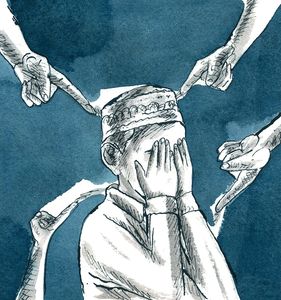
 82-Muslim Illustration: Bhaskaran
If I were Muslim, what might I feel as a citizen to learn that no Central minister attended an iftar evening hosted by India’s President? I would remind myself that even heroes of my community, President Abdul Kalam among them, said no to the wastefulness of iftar parties, donating money to orphanages instead. And, I would tell myself that my identity need not be reduced to such tokenism. But a small part of me would wonder if the same (welcome) political separation between religion and state would apply to all other festivals, too, like Diwali, Christmas and Holi.

If I were Muslim, I would look back in dismay at parties that claimed to speak for me but manipulated me and then abandoned me. I would think of Shah Bano, who went to court for the right to alimony, only to have the decision reversed by the Rajiv Gandhi government, in what would be the first, but not the only, instance of ‘secular’ malpractice. And I would think: are these my only options—a party that pushes me to the margins of irrelevance and a party that uses me?

If I were Muslim, I would remind myself of all the million reasons I love my country. But, just like every time they told me that I as a ‘moderate’ must speak up, I would ask, will the moderate Hindus—the vast majority of India—speak up for me?
...
By Barkha Dutt | From issue dated July 09, 2017 twitterlinkedingooglefacebook
http://www.theweek.in/columns/barkha-dutt/if-i-were-muslim.html   editor@theweek.in

More:

  1. https://en.wikipedia.org/wiki/Violence_against_Muslims_in_India
  2. The decline of Indian Muslims
  3. Just less than 3% Muslims in Indian Army
  4. Indian Muslims reject extremist creeds- Wiki-leaks
  5. Indian Muslims: Sachar Committee Report on latest social, economic and educational condition of the Muslim community of India

How are Indian Muslims different from other Muslims around the world ...

https://www.quora.com/How-are-Indian-Muslims-different-from-other-Muslims-arou...
The difference from social science prospective. for example, Inter faith and ... Indian Muslims as a minority group of India could be an interesting case study in the ...

'Isn't this our country?' Why Indian Muslims feel shaken and 'harassed ...

www.hindustantimes.com/india...muslims.../story-JuOWUrpN8uMPcvJ13GzoVI.html
May 30, 2017 - The feeling of distrust between the BJP government and Muslims in Uttar Pradesh has grown after the recent assembly elections.

al-Qaeda operative Zakir Musa: Zakir Musa slams Indian Muslims for ...

timesofindia.indiatimes.com › India News
Jun 6, 2017 - Al-Qaeda operative Zakir Musa asked Indian Muslims to join Jihad; He said that most of their tragedies are triggered by the United Nations ...

Indian Muslims in the Age of Muslim Uprisings | HuffPost

www.huffingtonpost.com/.../indian-muslims-in-the-age-of-muslim-uprisings_b_7213...
In this ocean of despair, one finds the Indian Muslim community, an island of calm moderation. Its not a small island either, it is a pretty big chunk. Indian Muslims ...

How oppressed are Muslims in India? - In Review - Herald

herald.dawn.com › In Review › Review essay
Aug 2, 2016 - In that sense, then, Indian Muslims certainly are a minority, particularly when one considers the growing influence of Hindu right-wing forces ..

~ ~ ~ ~ ~ ~ ~
Islamic Revival رساله تجديد الاسلام ‏

An in-depth study of the Qur’an and Islamic religious history reveals startling facts. “Risala-e-Tajdeed-ul-Islam” is a message to develop positive change in the thought and practices of Muslims.
قرآن اور اسلام کے گہرے مطالعه سےحیران کن حقائق کا انکشاف ہوا، "رساله تجديد الاسلام" مسلمانوں کے انداز فکروعمل میں مثبت تبدیلی کا پیغام ہے:

Imperialism justifications

Whether old or new, imperialism will always find some moral justification for its expansion, occupation, loot and plunder and enslaving of defeated people. Modern European imperialism traced its legitimacy not only in its ideology of the civilising nations but also to the past. In this capacity, they justified the colonisation of North African countries, which in the ancient period were a part of the Roman Empire. David John Mattingly in his book Imperialism, Power and Identity points out that in the 19th century, when the French and the Italians invaded North African countries and annexed them as colonics, they claimed their right to rule over these territories as inheritors of the Roman Empire. They asserted that after the fall of the Romans, North Africa was conquered and ruled by the Arabs and the Turks. As a result it relegated the local civilisation to backwardness. 

The European arrivals made attempts to connect the past with the present and renew the Roman mission to `civilise` the `barbarians. Historians and archaeologists reconstructed the history of the Roman Empire and revived its grandeur. The archaeological sites of the Roman period were excavated and set as reminders of the past when the Romans developed their territories as colonies. They rediscovered the achievement and contribution of the Romans to the civilisation and culture of the colonised societies. T
hey pointed out that the Romans built aqueducts, improved the irrigation system, set up factories for pressing olive oil and laid down the foundation of cities and maintained law and order. According to them, the Roman imperialism was benevolent and enlightened which converted North Africa to a civilised society. 

Both the French and Italians wanted to revisit the old power and glory of the Roman Empire. They emulated most of the coercive methods and applied them during their rule. The French forced the people of Algeria to abandon their culture and assimilate into French civilisation. Claiming to be the inheritors of the Roman Empire, the Italians dominated Libya under the Fascist rule of Mussolini and quelled all resistance movements that broke out against their rule. European imperialism was not enlightened and benign but exploitative and despotic for the colonised people. After the independence of North African countries from European imperialism, post colonial historians critically examined imperialism of the past and the present and their impact on the society. Responding to the argument that the Roman rule was enlightening, they proved that during this period, the colonies suffered immensely. 

The colonised people did not accept Roman domination and continued to resist it. A number of resistance movements were brutally crushed by the Roman generals. They also established that the Romans annexed the agricultural land and allotted it to their aristocracy, extracted taxes from people, forced peasants and workers to build roads and public buildings without any remuneration. They exploited the natural resources of the colonies, enslaved people and sexually abused women. Postcolonial intellectuals also condemned modern European imperialism for emulating the Romans. Europeans too ruled over their colonies with an iron hand, committed genocide and massacred the colonised people. They made attempts to wipe out the locals` religious and cultural identity in order to make them history-less. This response created historical consciousness among the colonised people and provided them an opportunity to understand the impact of old and new imperialism. Interestingly, when the British started to rule over India, they also claimed to be relatives of Indians as both belong to the Aryan race. Max Muller, the Sanskrit scholar, while addressing selected Indian Civil Service officers, told them that they were going to serve their brothers in India. The reason for this relationship was that the British were not foreigners or strangers therefore they should be accepted as new-found relatives. However, it was said that although the Indians belong to the Aryan race, as a result of mixing with other races they had lost the purity and characteristics of the Aryan race. The British as pure Aryan had the right to rule over India. This is how British imperialists used hi.story to justify imperialism.
"Imperial intent" by Mubarak Ali, dawn.com


Story image for european imperialism in middle east from Sputnik International

ISIL a Tool of Wall Street Plutocrats Aimed at Destabilizing Middle East

Sputnik International-2 hours ago
ISIL and its supporters from the US-aligned Middle Eastern regimes ... Wall Street tycoons and banking institutions of Western Europeplay the first fiddle. ... armed detachment of Western capitalism andimperialism," aimed at ...

Story image for european imperialism from Center for Research on Globalization

Refugee Crisis: Brought to You by Western Imperialism

Center for Research on Globalization-22-Sep-2015
Refugee Crisis: Brought to You by Western Imperialism .... That is what you reduced the world to, Europe – you, and your huge, insatiable ...

European Imperialism: Characteristics, Motives & Effects ...

study.com/.../european-imperialism-characteristics-...
This lesson will explore European imperialismin the 19th and 20th centuries. In doing this it will define New ...

EUROPEAN IMPERIALISM IN AFRICA - YouTube

www.youtube.com/watch?v=OJe1W_HIWmA
Feb 16, 2009 - Uploaded by HistoryTubeTV
European Imperialism in Africa. ... The Europeans came to africa to civilise the black people. Second blacks ...

Dutch, British and Russian Colonies in Asia: European ...

study.com/.../dutch-british-and-russian-colonies-in-a...
This lesson will explore Europe's NewImperialism, which swept across Asia in the 19th and 20th centuries ...

European Imperialism in India & the British East India ...

study.com/.../european-imperialism-in-india-the-brit...
Jan 22, 2015
In this lesson, we will learn about European imperialism in India. We will explore the relationship between ...
~ ~ ~ ~ ~ ~ ~ ~ ~ ~ ~ ~ ~ ~ ~ ~ ~  ~ ~ ~  ~
Humanity, ReligionCultureSciencePeace
 A Project of 
Peace Forum Network
Peace Forum Network Mags
BooksArticles, BlogsMagazines,  VideosSocial Media
Overall 2 Million visits/hits

Lords of the land by Ali Arqam

Maulana Attaur Rehman has been leading prayers at Faroogi Mosque in Kharadar, Karachi`s old city area, for more than 20 years. He is the principal of Jamia Ahya ul Uloom, a madressah built in Sector 9/A, Baldia Town. He is considered a devout religious leader.

Except that the land where the Jamia Ahya ul Uloom has been constructed was not meant for the seminary to begin with. Located in the centre of a formal settlement, the plot was allotted for a mosque named Yaseen Masjid. It never remained restricted to the mosque; today, the plot houses several buildings which have no legal sanction.

The official land-use map, designed for every formal settlement in Karachi, reserves land for a mosque, a public dispensary, two STplots, a playground and a high school.

In reality, there is no dispensary, but a mosque with a madressah, two residential blocks on the ST plot (one for boys and the other for girls), while the playground is marked as an Eidgab. The land allocated for a high school now has houses built on it, after property was allegedly sold out by local workers of a political party.

`When the ST plots (16 and 18) were acquired by the madressah, people initially raised some objections. But then they negotiated the matter with some people there, and it was allowed. The place allocated for the school was sold out later,` narrates a resident of the area, speaking on condition of anonymity.

A few blocks away, another madressah, named Jamia Mahadul Jameel, located in Sector 17/A was expanded from Masjid Hadi-i-Alam to the adjacent plot allocated for park by crecting a boundary around it.

Both these examples are from formal settlements in Karachi, which still have a modicum of government administration. But in informal settlements around the city, land-grabbing mafias have occupied land through nominally legal, quasi-legal and illegal means. One of those methods is by the construction of illegal mosques and madressahs; away from the public gaze, land across Karachi has been grabbed by madressahs of various sects.

Of the community, for the community, by the community Mosques have always been described as community organisations, designed and built to involve the neighbourhood in the management of its affairs. Many madressahs in Karachi arrived as mosques too, run and administered by mosque committees.

Locals of a neighbourhood would constitute the committee, with the purpose of getting the mosque registered as a trust with the Auqaf Department. Prayer leaders, or peshimams, as well as muezzins were simple employees of the mosque with no role in the administration; both were paid salaries by the mosque committee for their jobs.

`The well-known madressah of Jamia Uloom Islamia, New Town, commonly known asJamia Binori Town, used to be a mosque,` narrated a lawyer who requesting anonymity. `The founder of the madressah, Maulana Yousuf Binori, was just an employee of the mosque committee, but he went on to build a madressah too. He then claimed the madressah`s ownership.

This claim gave birth to a decade-long legal dispute between the mosque committee and the madressah administration.

`There was no dispute over the madressah; the mosque committee was insisting that the authority to appoint the peshimam rests with them and cannot be exercised by the madressah. This principle is practiced even today, says Qari Fazal Shah, a leader of the Jamiat Ulema-i-Islam-Fazl (JUI-F), who was part of the arbitration committee to resolve the dispute.Matters came to a head when local representatives of the Muttahida Qaumi Movement (MQM) got dragged into the dispute.

`Some people associated with the MQM became involved with the dispute between the mosque committee and the madressah. But all issues between the MQM and the madressah were settled after our delegation met Farooq Sattar, who then stopped his party workers from interfering in a religious dispute,` recalls Shah.

While Jamia Binori Town officials have no qualms about admitting that much of their funding is received from local and foreign donors, the seminary also earns revenue byrenting out the many shops constructed along its outer boundary wall. This dynamic allows the mosque and seminary to build clout and business relationships in the area.

Not that all money is unaccounted for: Jamia Binori Town officials explain that all monetary exchange is overseen and checked by a trustees board.

The fissure between the mosque committee and the madressah administration grew to such an extent that there was talk of moving the seminary away from the Jamia Binori Town premises. Such a plan was even deemed workable; when madressahs built alongside mosques in formally developed settlements run out of room for horizontal or vertical expansion, clerics would acquire land at the outskirts of the city to build madressah campuses there.

The burgeoning of madressahs at the outskirts of the city meant that trained and taught peshimams were readily available for hire to lead prayers elsewhere in the city. It is for this reason that most prayer leaders in posh localities of the city and in many cantonment areas belong to the Deobandi sect, have their own madressahs, teach there, or have been deputed by those madressabs.

`These peshimams are efficient in making contacts and connections with businessmen living in these posh localities. They trace guiltridden individuals among the devotees, and coax them to donate hundreds of thousands of rupees for madressahs and mosques,` argues journalist Taha Siddiqui.

Mufti Zarwali Khan, principal of Jamia Ahsan ul Uloom, Gulshan-i-lqbal Town, once proudly boasted in one of his dars (lecture) that a businessman, on his advice, had built a large mosque in the scarcely-populated locality of Maripur, Kemari Town by spending mil-lions of rupees. To get the mosque filled with devotees, he crected a madressah there as well.

The mosque, therefore, left the purview of the community. Slowly but surely, the peshimam`s power and influence grew. When disputes now rise between a committee of residents and the prayer leader, the imam often dominates through much manoeuvring and arm-twisting.

`In one such case, a dispute rose between the peshimam and the committee of a mosque in Sultanabad,` narrates a lawyer currently in litigation on this issue. `The imam managed to constitute a parallel committee of cherrypicked devotees and had it registered throughbackdating.

He refused to give details of the mosque and the parties involved.

Exit community, enter land-grabber During the days when the Muttahida Majlisi-Amal (MMA) had representation in the Sindh Assembly, elements from JUl-F allegedly managed to establish connections with notorious land-grabbers in Baldia, Kemari and Gadap Town. These grassroots relationships allowed them to multiply the number of madressahs in these areas, and acquire more land for the already established ones.

`These clerics invested in the booming property business on behalf` of` others in a f`ew cases, and were also able to acquire lands for personal use, as well as to build mosques and madressahs on it,` recalls a local broker from Baldia Town, speaking on condition of anonymity.

When clerics build mosques and madressahs on lands acquired through personal conneetions, they exercise unbridled power to the extent that locals living around these mosques with madressahs of`ten complain of` alienationfrom the affairs of their mosque.

`When I bought a plot here, it took me three years to turn it into a place for living. But a mosque and madressah were already built here,` narrates a resident of Muhammad Khan Colony, a locality bordering Ittehad Town.

`We cannot object or question the imam for any activities carried out, as he singlehandedly raises funds required for the construction and expansion of the mosque and madressah from his contacts in the business and traders communities,` says another resident.

`Our only role is to attend one or two prayers a day,` explains a labourer living in the area.

`We go to pray when we are off from jobs, and sometimes contribute a paltry amount in donations at Jumma or Eid prayers.

Not that these sums are enough for the mosque. As a member of a nearby mosque committee argued: `Donations from those attending Friday prayers are hardly enough to pay the mosque`s electricity bills, so we have to rely on other sources to meet our expenses.

In situations where attempts to illegally acquire land in the name of a mosque or madressah were thwarted, some seminaries responded with creating an `other` saying that those who thwart their plans must be some version of an `anti-Islam` voice.

In SITE Town, for example, an officer with administrative authority once obstructed Jamia Binoria Al Alamia`s attempts to grab a plot. Commercial plots worth millions were allegedly being acquired by various forces at the time, with the madressah also notorious in the area as being among the offenders and beneficiaries.

While the officer must have believed the law sided with him, graffiti appeared overnight on walls across the area, claiming the officer was an `Ahmadi` and demanding his removal from the position. Fearing persecution, the officer `apologised` for his mistake. A ceremony was then held in his honour some jokingly called it a `conversion ceremony` to validate the officer`s Muslim credentials. In hisspeech, one of the teachers of Jamia Binoria disclosed that the family roots of the officer could be traced back to one of the rightly guided caliphs.

Battle because of the mosque Mosques located in commercial and business localities have a great advantage: traders and businessmen readily contribute to the income of the mosques and its peshimam.

Rent received from shops constructed along their boundary walls and other space leased out makes the mosque financially stable, and thereby, makes it easier to turn the mosque into a madressah.

Taking control of such lucrative mosques is crucial and often becomes a battle for power between competitors, played out on the streets of Karachi and killing many in its wake. The violent conflict between the Sunni Tehrik and the Ahle Sunnat Wal Jamat (ASWJ) is a prime example.

It is alleged that the founder of Sunni Tehrik, Allama Saleem Qadri, a Sunni Barelvi hardliner, was assassinated by militants of the banned sectarian outfit, Sipah Sahaba Pakistan(SSP), now renamed as the ASWJ, after a clash erupted over the control of a mosque situated in Bahadurabad.

Sunni Tehrik spokesman Faheem Sheikh denies this, but argued that the Sunni Tehrik was founded to reclaim and recover dozens of mosques in Karachi that had been established by members of the Barelvi sect but `captured` by Deobandi organisations. In many instances, Deobandis invaded these mosques by using militants from banned outfits.

`Allama Saleem Qadri was against sectarian jihadi organisations involved in acts of terrorism and violence against other sects. He was punished for speaking against them,` says Sheikh. `A few years later, the first-tier leadership of Sunni Tehrik and other Barelvi clerics were killed in a suicide attack by these militants during an event at Nishtar Park on the day of Eid Miladun Nabi.

Noor Masjid in Jubilee Market and Qadeemi Masjid in Jamia Cloth Market are among the other lucrative mosques located close to trade centres, which have witnessed violent encounters between these groups.

Jamia Binoria Al Alamia in SITE Town is another example of a madressah established at the centre of commercial activities. The madressah was first established as a campus of the well-known Jamia Binori Town, Jamshed Road but it later became a separate institution, owned and administered by Mufti Muhammad Naeem.

Owing to the confusion of similar names, many people mistook it as the original madressah of Binori Town and referred to Mufti Naecm as its principal. Being a beneficiary of this confusion, the madressah contributed to this misunderstanding. It kept receiving funding from other countries that was meant for Jamia Binori Town.

Lords of the land by Ali Arqam dawn.com

The writer is a freelance journalist and researcher based in Karachi. He can be reached at aliaryam80@gmail.com. You can also interact with him on 1ïvitter @aliarqam

[