Featured Post

SalaamOne NetWork

SalaamOne سلام   is   a nonprofit e-Forum to promote peace among humanity, through understanding and tolerance of religions, cul...

Massacre at Gaza by Israel, Great Tragedy - An Analysis

Its really sad, sorry state. Innocent people being killed mercilessly and world is silent.... Arabs are silent, Muslims are silent .... BUT let's analyse it briefly... Does the commonsense demand to initiate war while Hamas is not prepared? Is it not suicidal? Do we have such examples in the Sunnah ? Muslims at MAdina only fought defensive battles, they only moved to Makkah when they were strong well prepared.
A believer should not involve himself in matters, which he is unable to deal with effectively:
The Prophet (pbuh) once said: “It is not for a believer to humiliate himself,” “How does one humiliate oneself?” The Prophet (pbuh) was asked and to this he replied, “By falling foul of a situation from which one cannot extricate oneself.”
Gauging one’s own strength before testing it on others:
Abdullah ibn Umar relates how once, when he was listening to a sermon preached by Hajjaj ibn Yusuf, he took objection to something Hajjaj had said, and was just about to air his own views on this, when he recalled what the Prophet (pbuh) had once said that it did not befit a believer to disgrace himself. Abdullah ibn Umar had asked the Prophet (pbuh) what was meant by disgracing oneself, and the Prophet (pbuh) had replied: “It means attempting to deal with a problem which is quite beyond one’s capacities.”
The problem with religious fanatics is that they consider themselves to be as good as the Companions [R.A] [God forbid, we are weak in faith]. Only Faith is not required to win battles, preparations and fighting skills tactics is required. Remember... Hudabia, .. AND Uhad when people got busy in booty collection and Khalid bin Walid [then non Muslim ] attacked and Muslims suffered losses. Allah could have have out rightly helped Muslims, but the the law of Cause and affect works.
Hamas and PLO fight among themselves, there is no unity. All Arabs. Muslims are fighting among themselves. No one has power to unite them by use of force. Its through diplomacy, talks they may get closer.
SO THERE IS TIME OF RETROSPECTION, LEARN SOME LESSONS, PREPARE WELL IN POLITICAL, DIPLOMATIC AND MILITARY FRONT TO RESOLVE. SAVE LIVES TO DESTROY ENEMY .. USE WISDOM, HIKMAH...

إِنَّ شَرَّ الدَّوَابِّ عِندَ اللَّـهِ الصُّمُّ الْبُكْمُ الَّذِينَ لَا يَعْقِلُو

نَیقیناً خدا کے نزدیک بدترین قسم کے جانور وہ بہرے گونگے لوگ ہیں جو عقل سے کام نہیں لیتے

Verily, the worst of all creatures in the sight of God are those deaf, those dumb people who do not use their intellect.(Quran;8:22)

لِّيَهْلِكَ مَنْ هَلَكَ عَن بَيِّنَةٍ وَيَحْيَىٰ مَنْ حَيَّ عَن بَيِّنَةٍجو

ہلاک ہو، دلیل پر ہلاک ہو اور جو زنده رہے، وه بھی دلیل پر زنده رہے

Who would perish might perish by clear proof, and he who would live might live by clear proof(Quran;8:42)
Wisdom should go hand in hand with bravery:
Khalid ibn Walid was one of the greatest warriors and leaders of the Muslim army in its early days. Yet, in the year 17 AH, while he was still riding high after his mighty conquests, he was removed from his post by the second Caliph Umar. Khalid was a brave and extremely daring commander. But there were times when his bravery would lead him into hasty decisions. A case in point was siege of Hims, (16 AH) when the Roman Emperor Heraclius, alongwith his North African troops, attacked the forces of Khalid and besieged them within the town. Contrary to orders from the Caliphate, Khalid immediately sallied forth to do battle with the attacking forces, without waiting for the arrival of reinforcements. On this particular occasion, the Muslims, by the sheer grace of God, were victorious. But Umar considered that Khalid had been hasty and imprudent in this action. Shah Waliullah comments: “Courage is not everything in the field of battle. Patience to await the necessary assistance is also a virtue, otherwise courage, on its own, can lead one straight to defeat. (SHAH WALIULLAH, IZALA AL-KHAFA)
Retreat and fight another day:
It was at Mutah, a village situated in present-day Jordan, that” a battle took place in 8 AH between the 3,000-strong Muslim and Byzantine forces, numbering 100,000. Three commanders of the Muslim army were slain one after another, whereupon the standard of the Muslims was handed over to Khalid ibn Walid, who took a command and knit the ranks together. The enemy advance was so firmly checked that they drew back enough for the Muslims to beat an orderly retreat. Considering it unwise to advance again, Khalid then returned to Madinah with the one thousand troops who had survived. As they entered Madinah, crowds of men and women lined the route, jeering and throwing dust in their faces as they passed. “Runaways!” they shouted. “No” said the Prophet (pbuh); “they are not runaways but soldiers who will return to the fight if God wills it so.”

http://freebookpark.blogspot.com/2014/06/treasury-of-islamic-virtues.html


Post by Aftab Khan.


* * * * * * * * * * * * * * * * * * *
Humanity, Religion, Culture, Ethics, Science, Spirituality & Peace
Peace Forum Network
Over 1,000,000 Visits
* * * * * * * * * * * * * * * * * * *
The Muslim Exodus

The last millennia has seen the persecution of Jews, their exodus and their search for land to the extent that it has been mythologised, fictionalised and sensationalised. But this new millennium belongs to the Muslims. Where Muslims are persecuted, and demonised since 2001. The Jews fought for their land, and are winning their battle while Muslims are losing ground, homes and lives in Palestine, Iraq, Pakistan, China, Sri Lanka. An unending list. But lets focus on Palestine for now. 
It is all about land, wrote Robert Fisk a few days ago. Israel was once populated by Palestinians before 1948. Before an Israeli Army arranged a mass expulsion to the Gaza strip. The Muslims and Jews were not traditional enemies. Since the 17th century, international law has carried on the tradition that a “just” war has three causes: self-defense, recovery of what is owned, and punishment for losses. The UN in Article 51 uses the same list, for a just war; that it is in self-defense. And before Israel started its recent attacks it has used the excuse of self-defense, a flimsy justification since it is the occupier. At least this much can be admitted by the international community; that Gaza is a camp for storing Palestinians. And that Israel is the first aggressor. 
Isreal does not want peace; it wants total control of land. And this battle for land holds religious meaning for them, and symbolic meaning for the west. It is not just about territorial power but a grand destiny. It is unacceptable to them- the thought that Jesus Christ will be resurrected on the site of a mosque. So in the grand scheme of things, most of the world is against Palestine. Couple a religious destiny with unending military power, and we have Israel as an almost unstoppable force. This is the moment for American demonstrators to come pouring into the streets, protesting before their President, but there is too little of that happening. Instead, all the world seems to be left with are editorials, twitter updates, columns and photographs to lodge our official protests. Only, they count for nothing of significance for the Palestinians dying.
http://www.nation.com.pk/editorials/13-Jul-2014/the-muslim-exodus

Muslim exodus in Central African Republic revives ethnic ...

www.theguardian.com › ... › Conflict and development
by Mark Tran - Feb 12, 2014 - Human rights groups are warning that there will be no Muslims left in the Central African Republic (CAR) unless international peacekeepers ..

* * * * * * * * * * * * * * * * * * *
Humanity, Religion, Culture, Ethics, Science, Spirituality & Peace
Peace Forum Network
Over 1,000,000 Visits
* * * * * * * * * * * * * * * * * * *

Pakistan’s ‘war on terrorism’

FINALLY, Pakistan has declared its own ‘war on terrorism’. The North Waziristan operation, the prime minister’s pronouncements and the adoption of the Protection of Pakistan Bill by the National Assembly are significant signals of serious intent to rid the country of the terrorist menace.

To succeed, the government will have to plan and pursue a comprehensive strategy and utilise all relevant instruments of state power — military, police, intelligence, diplomatic and economic.

The North Waziristan operation was long in coming. The political reticence was overcome by the failure of the talks with the Tehreek-i-Taliban Pakistan (TTP) and its relentless acts of terrorism. The attack on the Karachi airport was the final straw.

The North Waziristan operation is unlikely to be fully successful since it lacked the vital element of surprise. Most of the militants, it must be presumed, have slipped out of the agency. Even so, the military operation will disrupt the militant groups that are affiliated with the TTP and cleanse the epicentre of anti-Pakistan terrorism.

The North Waziristan operation is unlikely to be fully successful since it lacked the vital element of surprise.

However, the presumed dispersal of the motley group of TTP militants will require the elimination of their external (Afghan) safe havens and their ‘internal’ hideouts within Pakistan. Both objectives are challenging.

Prime Minister Nawaz Sharif rightly, if belatedly, requested Afghan President Hamid Karzai to seal the escape routes from North Waziristan into Afghanistan. Given the known and self-declared support given by Afghan Intelligence to elements of the TTP and the safe haven provided to Mullah Fazlullah, the current TTP ‘leader’, Karzai’s unhelpful response was not surprising.

To eliminate the Afghan safe havens, and end the support to the TTP and the so-called Balochistan Liberation Army from Afghan (and Indian) intelligence, Pakistan might find itself considering both soft and hard options.

Like Washington, Pakistan can hope that Afghanistan’s next president will be more helpful than Karzai. Pakistan can reciprocate Kabul’s cooperation by using its presumed ‘influence’ with the Afghan Taliban to promote reconciliation within Afghanistan. Unfortunately, if the Afghan election ends in controversy and crystallizes that country’s ethnic and regional divisions, the likelihood of any cooperation from Kabul to eliminate the TTP’s safe havens will recede further.

Failing to secure such cooperation, Pakistan could press the United States to use its vaunted drones to attack the TTP safe havens inside Afghanistan. This would be an acid test of America’s sincerity in combating all terrorists. If such US action is not forthcoming, a much harder option might be considered: Pakistan’s acquisition of armed drones (from China) to target the TTP’s safe havens in Afghanistan.

Since elements of the TTP consist of Uzbeks and Chechens, who also threaten Russia and Central Asia, and Uighurs, who threaten China, Pakistani authorities might seek support from Moscow and Beijing — both military and political — to eliminate the TTP safe havens. (Collaboration with Moscow and Beijing may also be useful in promoting internal reconciliation within Afghanistan.)

Eliminating the TTP’s ‘havens’ in Pakistan will be equally if not more difficult. A priority aim must be to smoke out the TTP terrorists from their hideouts in Karachi. Further terrorist attacks like the one on the airport in Karachi could stifle all chances of investment and economic revival in Pakistan.

A second priority should be to neutralise the Punjabi Taliban. This will need bold decisions by the ruling party, some of whose members have well-known political links with sectarian groups. These groups should be pressed to break with the TTP and renounce terrorist violence or suffer the consequences of security action by the state.

Among the Pakistani groups, the Lashkar-i-Taiba has a unique position. It is not a part of the TTP. Its agenda is pro-Kashmir and anti-Indian. A dialogue can be attempted with the LeT to dissuade it from embarking on adventures, like Mumbai, which do not serve the larger interests of the Kashmiris, the Indian Muslims or Pakistan. It should be encouraged to pursue its agenda through political means.

Combating terrorism in Fata and adjacent areas of Khyber-Pakhtunkhwa will involve winning over insurgent factions, such as the Sajna group, and tribal leaders, through a combination of incentives and disincentives. The incentives could include: provision of speedy justice, electricity, health services and education, political representation, monetary rewards and job creation, especially through infrastructure projects. A parallel endeavour is essential in Balochistan.

Halting terrorist financing is crucial. All the three main sources of such financing need to be addressed: criminal activities, such as kidnapping and drugs; contributions from religious zealots, both foreign and domestic, and money supplied by hostile foreign agencies and governments. With a determined, honest and intelligent effort, most if not all terrorist financing can be controlled.

Success in the counterterrorism campaign will depend considerably on effective intelligence and police functions. Existing structures are not up to the task. One or more special units, equipped with honest and qualified personnel, modern investigative and operational capabilities, and the intimate involvement of the armed forces and the intelligence agencies, will need to be created to address the multi-dimensional objectives of the counter-terrorist campaign.

It also seems essential to create an apex body, similar to the Nuclear Command Authority, where the political, armed forces, intelligence and diplomatic leadership can jointly formulate and oversee the execution of an agreed national counterterrorism strategy.

Ultimately, Pakistan’s ‘war on terrorism’ will be won only if it addresses and resolves the root causes of extremism and terrorism in the country: poverty, unemployment, injustice, inequality, ignorance and the erosion of tolerance, decency, humanity and nationalism within our society and polity.

This will be a long ‘war’. It will entail suffering and sacrifice. But it is a war worth fighting to achieve peace and prosperity for Pakistan’s 200 million people and to reclaim the soul of the country that was created by Pakistan’s founding fathers.

Pakistan’s ‘war on terrorism’
by Munir Akram, dawn.com
The writer is a former Pakistan ambassador to the UN.

Pakistan Launches Decisive Battle Against Terrorism

The government and the military must institute a comprehensive policy to eliminate terrorism root and branch.

After years of uncertainty over how to handle its militant insurgency, Pakistan’s army finally launched an all-out military offensive on June 15 against the local and foreign militants based in North Waziristan agency, the second largest tribal region of Pakistan’s seven Federally Administered Tribal Areas located along the Pakistani-Afghan border. The operation, named Zarb-e-Azb, (or the Strike of the Prophet Muhammad’s Sword) seems to be a crucial fight in Pakistan’s long war against terrorism and militancy, aimed at rooting out militant hideouts associated with the Tehrik-i-Taliban Pakistan (TTP), the Islamic Movement of Uzbekistan (IMU), the East Turkestan Islamic Movement (ETIM), Al-Qaeda and other terrorist organizations.

For more than a decade North Waziristan has remained a safe haven for regional and global terrorist organizations. A place from which to plan and execute deadly attacks on their main targets, most importantly coalition troops in Afghanistan and Pakistan’s public places and security installments. Considered by many as the epicenter of terrorism, North Waziristan is the territory that militants used as a headquarters for planning and coordinating most of the terror acts that reportedly took the lives of 50,000 Pakistanis, including more than 5,000 security personnel, and cost more than $1 billion in financial losses.

There has always been demand for action against militants. Despite popular support, the military’s insistence on launching an operation, and the international community’s calls to eliminate the sanctuaries of terrorists in North Waziristan, Pakistan’s confused political leadership could not make up its mind about how to tackle the issue. Since September last year, Prime Minister Nawaz Sharif’s civilian government pursued elusive peace talks instead of handling the issue militarily, while the Taliban resorted to acts of terrorism, targeting civilians, minorities and security forces.

With the formidable attack on the country’s biggest and busiest international airport in Karachi on June 8, the army lost patience and decided to launch a full-scale military offensive against the militants. Since the peace dialogue had already failed, a military operation became inevitable, compelling the political leadership and even the biggest critics of the use of force to accept it.

The North Waziristan operation is significantly different from the Swat, Bajaur and South Waziristan operations conducted in the last decade in two ways. First, it enjoys the support of a majority of the people and almost all political parties endorse the operation. There also seems to be a consensus among the civilian and military leadership on this issue. Second, it seems that the military has abandoned the policy of keeping the “good” Taliban – those who undermine the interests of Pakistan’s adversaries on the directives of the Inter-Services Intelligence Directorate (the military’ s premier spy agency) – and eliminating the “bad” Taliban – those that direct their guns at the Pakistani state – as it understands that the recalcitrant proxies often morph into enemies and make alliances with anti-state militants.

After realizing that the good and the bad Taliban are two sides of the same coin, the military has decided to “eliminate all terrorists regardless of hue and color, along with their sanctuaries.” In the first phase of the operation, it is successfully conducting air strikes on terrorist hideouts, destroying their infrastructure and killing hundreds of suspected foreign and local militants. Troops have cordoned off many areas of North Waziristan to prevent the relocation of militants to adjacent regions, and aerial strikes have been extended to those regions as well. To make the operation more successful, the military has boosted security near the Pakistani-Afghan border to stop militants from crossing over into Afghanistan, and requested the Afghan Army to strengthen security on its side to keep militants from fleeing to the neighboring province of Khost. Most recently, Islamabad and Kabul agreed to “to take action against all terrorists without making any discrimination among them and their hideouts on their respective sides.” As soon as the evacuation of civilians is completed in North Waziristan, the military plans to launch a ground offensive to wipe out the terrorists and establish order in the state.

There is a serious concern that the immediate reaction to the operation could be violent terrorist attacks across the country, mostly on places of worship, vital public buildings and security installments. To deal with the threat, the government has beefed up security in large cities and other sensitive areas, though perhaps not as much as it should. Law enforcement agencies have also conducted some raids on terrorist hideouts in Islamabad, Peshawar, Karachi and other major cities on the basis of intelligence information.

If the operation successfully concludes in the coming weeks – as some expect – it could significantly reduce terror incidents across the country. However, merely clearing North Waziristan will not be sufficient to root out terrorism. For a permanent solution, Pakistan needs to develop a comprehensive counter-terrorism strategy.

The most crucial part of fighting the militancy is to wage and win the battle of ideas. A forceful national narrative needs to be developed to counter the Taliban’s regressive and intolerant narrative, in order to win the ideological conflict and garner support for counter-terrorism operations

The government must try to increase the efficiency of and cooperation among its various intelligence and law-enforcement agencies in order to carry out counter-terrorism operations more effectively, and limit the activities of terrorist groups. There is also an urgent need to initiate a crackdown on the TTP and other terrorist outfits’ sleeper cells in major cities and towns across the country. It is equally important for the government to eliminate Sunni sectarian militant groups such as Lashkar-e-Jhangvi and Sipah-e-Sahaba, and anti-Indian militant outfits such as Lashkar-e-Taiba and Hizbul Mujahideen.

The operation in North Waziristan is the beginning of a decisive battle against militancy and terrorism. To survive as a nation state, it is a battle Pakistan must win.

Deedar Hussain Samejo is pursuing a Masters in Political Science at The University of Sindh,  Jamshoro, Pakistan. His commentaries have appeared in Asia Times Online, Global Post, and Express Tribune.

The old partition of the Middle East is dead?

The Lebanese Druze leader – who fought in a 15-year civil war that redrew the map of Lebanon – believes that the new battles for Sunni Muslim jihadi control of northern and eastern Syria and western Iraq have finally destroyed the post-World War Anglo-French conspiracy, hatched by Mark Sykes and François Picot, which divided up the old Ottoman Middle East into Arab statelets controlled by the West.
The Islamic Caliphate of Iraq and Syria has been fought into existence – however temporarily – by al-Qa’ida-affiliated Sunni fighters who pay no attention to the artificial borders of Syria, Iraq, Lebanon or Jordan, or even mandate Palestine, created by the British and French. Their capture of the city of Mosul only emphasises the collapse of the secret partition plan which the Allies drew up in the First World War – for Mosul was sought after for its oil wealth by both Britain and France. Keep reading >>>>>


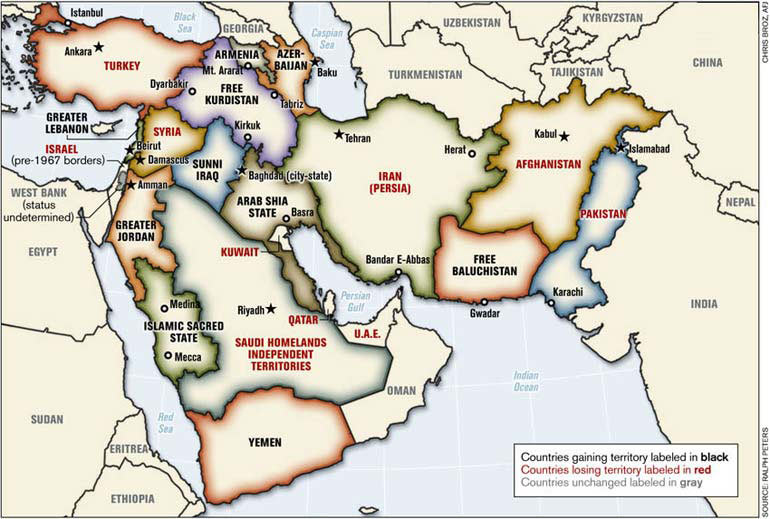
NATO Re-surfaced Map of the New Middle East

By: Chris_Kitze
Mahdi Darius Nazemroaya writes: A relatively unknown map of the Middle East, NATO-garrisoned Afghanistan, and Pakistan has been circulating around strategic, governmental, NATO, policy and military circles since mid-2006. It has been causally allowed to surface in public, maybe in an attempt to build consensus and to slowly prepare the general public for possible, maybe even cataclysmic, changes in the Middle East. This is a map of a redrawn and restructured Middle East identified as the “New Middle East.”

“Hegemony is as old as Mankind…” -Zbigniew Brzezinski, former U.S. National Security Advisor

The term “New Middle East” was introduced to the world in June 2006 in Tel Aviv by Former U.S. Secretary of State Condoleezza Rice (who was credited by the Western media for coining the term) in replacement of the older and more imposing term, the “Greater Middle East.”

This shift in foreign policy phraseology coincided with the inauguration of the Baku-Tbilisi-Ceyhan (BTC) Oil Terminal in the Eastern Mediterranean. The term and conceptualization of the “New Middle East,” was subsequently heralded by the U.S. Secretary of State and the Israeli Prime Minister at the height of the Anglo-American sponsored Israeli siege of Lebanon. Prime Minister Olmert and Secretary Rice had informed the international media that a project for a “New Middle East” was being launched from Lebanon.


* * * * * * * * * * * * * * * * * * *
Humanity, Religion, Culture, Ethics, Science, Spirituality & Peace
Peace Forum Network
Over 1,000,000 Visits
* * * * * * * * * * * * * * * * * * *

Russia and China Really Do Like NATO's Occupation of Afghanistan


The United States is winding down combat operations in Afghanistan and suddenly Russia and China -- who thought the United States had no business there in the first place -- don't want U.S. troops to just turn off the lights behind them.

Senior Russian and Chinese officials have encouraged Afghanistan's leaders to sign the so-called Bilateral Security Agreement with the United States, according to a senior Western diplomat who maintains contact with the Afghan leadership. If signed, the pact would keep U.S. forces playing at least a limited military role for the foreseeable future. Keep reading >>>>>


* * * * * * * * * * * * * * * * * * *
Humanity, Religion, Culture, Ethics, Science, Spirituality & Peace
Peace Forum Network
Over 1,000,000 Visits
* * * * * * * * * * * * * * * * * * *

Can Russia Sell Arms to Both India and Pakistan?

If this is indeed the case, Russia would have an easier time charting a balanced political course in South Asia. This can be done, for example, with the help of energy projects that connect Russia to the Central and South Asia. Besides, the launch of military-technological cooperation between Russia and Pakistan, in addition to the long-existing ties with India, would provide balance to Moscow’s relations with New Delhi and Islamabad. Russia could start its military-technological cooperation with Pakistan even before there is complete trust between that country and India. It needs to be very careful though.
Pakistan is interested in such cooperation. First, following the diminished American interest, the country fears greater dependency on its “any-weather friend,” China, and thus needs Russia to balance against the Chinese influence. Second, Islamabad is clearly interested in Russian arms. Third, the Pakistani armed forces have used Soviet and Russian military technologies in the past, receiving them either through occasional contracts with Russia (for instance, military transport helicopters) or through third countries, which include Belarus, Ukraine, and, of course, China.

Russia, too, would benefit from such cooperation. First, Moscow would thus be able to control the transfer of Soviet and Russian military technologies that presently end up in Pakistan by way of other countries. Second, stronger armed forces would allow Pakistan to more effectively counteract security threats in its tribal territories, which also negatively affect Russia’s own security. Some terrorists that are active in Pakistan come from Russia and the former Soviet republics, and may later return to their places of origin. Third, long-term cooperation with one of the largest armed forces in Asia offers prospects of hefty rewards for the Russian military industrial complex.

Because of the intimate nature and large scale of defense ties between Moscow and New Delhi, Russia’s cooperation with India will remain a priority regardless of prospects for military-technological cooperation between Russia and Pakistan. Therefore, if India raises reasonable objections to some prospective Russian arms or military technology transfers to Pakistan, the transfers would be unlikely to materialize.

Moscow can take a few steps to make New Delhi’s position more flexible. First, any negotiations on military-technological cooperation between Moscow and Islamabad should be made fully transparent for New Delhi. If necessary, the negotiations can be conducted in conjunction with the Russian-Indian consultations. This rarely happens on the international level; however, Russia might have to do it in the context of South Asia. Besides, Russia must ensure Pakistan’s strict compliance with the ban on transferring arms, military technologies, and documentation to third countries. This will alleviate New Delhi’s concerns about possible transfer of technologies Pakistan obtains through contacts with Russia to Beijing.

Second, since China’s potential concerns India no less, and perhaps even more, than Pakistan’s military capabilities, Russia could take India’s position on this issue into account and accommodate it whenever possible. It does not mean Moscow should curtail its military-technological cooperation with Beijing, but it may want to consider India’s concerns when signing its future contracts with China.

Third, while developing military-technological cooperation with Pakistan, Russia should also significantly enhance its relations with India in all areas. As far as military-technological cooperation is concerned, Moscow and New Delhi could initiate new strategic projects, similar to the BrahMos missile project. This would help Russia to strengthen its positions on the Indian arms market, since it would cooperate with India on the aspects of military technologies which other countries are not yet ready to cooperate on.

Developing new strategic projects would not only serve to expand the current military-technological cooperation between the two countries but would also bring their relations to a new level. Joint efforts by Moscow and New Delhi could enable them to produce components for strategic weapons systems or the systems themselves. Under the current conditions, such cooperation would be in Russia’s interests. Russia’s relations with a host of countries have been adversely affected by the Ukraine crisis, thus the country is now experiencing difficulties with receiving certain components necessary for its arms and military technology production. In addition, it would be imprudent to cooperate with China in this field given its record of technological espionage. Finally, India has acquired extensive experience in developing and using high technology in the military industrial sector during the last few decades thanks to its cooperation with Russia, Israel, France and a number of other countries.

Russian-Indian defense cooperation needs to intensify irrespective of the prospects for developing the Russian-Pakistani military-technological cooperation. Otherwise, the collaboration between Moscow and New Delhi may enter the period of stagnation. In this case, no contracts with Pakistan will offset the losses Russia is likely to suffer.

As this post was being written, a news item that both confirms and contradicts some of its contents appeared. The head of Rostec Corporation Sergey Chemezov informed the public that Moscow is open to military-technological cooperation with Pakistan, and the negotiations on the sales of Mi-35 multipurpose military transport helicopters to that country are already underway.

On one hand, Chemezov’s statement indicates that Russian authorities no longer see any obstacles to exporting arms and military technology to both India and Pakistan. On the other hand, such statements may harm military-technological cooperation between Russia and India, especially at the present time when Russia is trying to establish ties with the newly-elected Indian government. Perhaps, more fertile ground for such pronouncements should first be created through consultations with New Delhi officials and informing the Indian press. Quite frequently, the exact opposite is the case: such statements are followed by tardy explanations. To a great extent, the negative effect of the Russian-Pakistani military-technological cooperation on the Russian-Indian relations can be counteracted by consistently moving military-technological cooperation between Moscow and New Delhi into the truly strategic realm.
By Petr Topychkanov, carnegie.ru
  1. Russia lifts arms embargo to Pakistan: report - Yahoo New ...

    https://nz.news.yahoo.com/.../russia-lifts-arms-embarg...
    6 days ago
    Moscow (AFP) - Russia has lifted its embargo on arms supplies toPakistan and is holding talks on supplying ...


* * * * * * * * * * * * * * * * * * *
Humanity, Religion, Culture, Ethics, Science, Spirituality & Peace
Peace Forum Network
Over 1,000,000 Visits
* * * * * * * * * * * * * * * * * * *