Featured Post

SalaamOne NetWork

SalaamOne سلام   is   a nonprofit e-Forum to promote peace among humanity, through understanding and tolerance of religions, cul...

Showing posts with label Philosophy. Show all posts

Race, Truth and Our Two Realities


The correspondence theory of truth no longer reigns supreme in philosophical circles when it comes to the study of knowledge and judgment. But it remains handy for everyday people, especially citizens. That theory says, simply, a proposal is true if it corresponds to an observation in the world. Not a bad way to go when people are trying to figure out the stuff of democratic living. After a week in which we have seen the unwarranted killing by police of two black men — Philando Castile in Minnesota and Alton Sterling in Louisiana — I’d like to think the correspondence theory of truth would get all Americans on the same page. But this has consistently failed to be the case. Maybe we can figure out why together.

So, I say: In America, black lives don’t matter. You say: That is false. I respond, implicitly invoking the correspondence theory of truth: Just look at the rate at which blacks are killed by the police and the rate at which police officers are exculpated. You respond with a number of points: the justice system works; blacks kill one another at tragic rates; the people killed sometimes had questionable backgrounds; if the officer pulled his weapon (for it almost always a man who does the shooting), he had a reason related to enforcing the law, and we must respect that. After I claim that black lives don’t matter in America and you respond with any of the above, one idea becomes clear: We are no longer talking about the same thing. At this point I realize the mistake I’ve made.

When I claim that black lives don’t matter in America, I mean to say something that to my mind is abundantly clear. Here’s how it works. We live in a liberal democracy that is founded on the sanctity of liberty. This implies that fairness is essential; indeed, that proposition is often explicitly at the heart of many democratic debates. The very idea of democracy reaches back to ancient Greece and is the foundation for our deepest principles concerning human rights. We believe that democracies are superior to other systems of government largely because they intrinsically respect the rights of the men and women who live in them.

I must then take into account the history of racial dominance in this country — the centuries of slavery; the decades of Jim Crow; the continuation of systemic racial inequality in wealth, jobs, education and public services. Then there are the deaths — the body count at the hands of the police that ticks these days almost as regularly as a national clock. I take all of these basic observations together and my considered position is that the claim that black lives don’t matter in America corresponds to the facts.

I then offer you this claim. But then it all goes wrong. You say I am not right, that I am not speaking the truth.

Where does the problem lie? The fiction writer George Saunders, considering not race relations but the divide between the political left and right, wrote in The New Yorker recently: “Not only do our two subcountries reason differently; they draw upon non-intersecting data sets and access entirely different mythological systems.” But our case is different. The distance between the left and right is represented by ideology and self-interest. While ideology and self-interest have something to do with our differences on racial truth, it crucially has more to do with the moment at which my experience enlivens my perception of how the racial past makes the racial present and how your experience leaves race in the past and renders the present as something unrecognizable to me but comforting to you.

Here’s one way of making sense of the misfire between us. You are with me when I am making my general comments about America’s foundational aspects. You are likely still with me on the observations about slavery. You may begin to edge away from our shared space of critical judgment somewhere around Jim Crow, but the horrors of lynching may persuade you to stay. The place, or the time rather, I mostly likely lose you is 1964. In your mind, our celebrated Martin Luther King Jr. made the world right in helping to usher in the era of formal equality when he cornered Lyndon B. Johnson into pushing for the Civil Rights Act of 1964.

In your mind, that moment introduced a new world order in which blacks could no longer be victims. The law had set them free and listed the bad things that people could no longer do. Moreover, it said that those people would be held responsible for the bad things they did. Thus, even if bad things happened to black people, the law would settle all accounts; therefore, no one could ever claim again that blacks were at the special mercy of racism. You, at this point, are sure that my proposition cannot be true since it fails to correspond.

As I said, I see the mistake I’ve made, but it’s not in my construction of the truth. It is in presuming that you and I were ever speaking about the same thing. And the reason we weren’t speaking about the same thing is that we were not looking in the same direction; thus, our basis for correspondence is mismatched.

The direction I was looking toward was the internal life of a black person in America. The very real anxieties and fears we have in whether our ambitions are as secure as any other American’s. Whether our opportunities are equal. Whether our health care is of sufficient quality. Whether our college degrees are of equal worth. Whether our spouses will make it home from the grocery store. Whether our children will one day counsel a parent that everything will be O.K. while someone is slumped over in the car seat in front of her, bleeding to death after being shot by a police officer.

You were looking in an altogether different direction. You were looking in the direction of your own innocence. Though you bought a house in an entirely segregated neighborhood, it’s not your fault the schools are better where you live. Though you have only one black friend, it’s not your fault because your friends are your co-workers and your company or university is doing poorly on diversity. Though it’s a shame that this black man or woman died (pick one, any one), it’s not your fault that the police officer you pay with your tax dollars and who is sworn to protect you did so at the expense of an unnecessary killing.

And none of these are your fault because that day in 1964 made it all right – the law said what could not happen, and thus, it must not be happening. Your sense of America is predicated on the assumption of a reliable and stable democratic system. We cannot possibly speak about the same thing given these conditions.

That is a problem. A core idea of democratic life is consensus citizens coming to a wide agreement on contentious issues. Americans disagree on all kinds of issues, but this one, whether black lives matter, is genuinely special and momentous. We have the facts: systemic racial inequality and rampant police-perpetrated killings. Then we have the observation of those facts seen from our distinct perspectives. Everything depends on you and I not only agreeing in our judgment but also taking up the proper positions to get genuine buy-in for the sake of justice. If you insist on standing where you do while I stand where I stand, there will never be agreement that black lives don’t matter in America.

The terrible events Thursday night in Dallas, where five police officers were slain by a sniper at a rally to protest police shootings, has complicated things still more, as do the charged and sometimes violent protests still arising in cities around the country. From where I stand — and maybe here we can stand together — I see once again that violence tragically begets violence, and that if America had faced its history of racial violence many decades ago, maybe even a few years ago when Eric Garner was seen by millions of Americans being strangled by a police officer on YouTube, we’d all be better for it today. If America had decided that black lives do matter when it had the chance, the cycle of violence that has robbed us and threatens to continue to rob us of precious lives could have been broken.

One reason the correspondence theory of truth has lost favor among professional philosophers is that we can’t always rely on our senses to corroborate facts. But we’ve seen the videos. The difference between you and me isn’t a matter of error, but of will.

http://www.nytimes.com/2016/07/11/opinion/race-truth-and-our-two-realities.html?_r=0

Plato: Most Profound Quotes


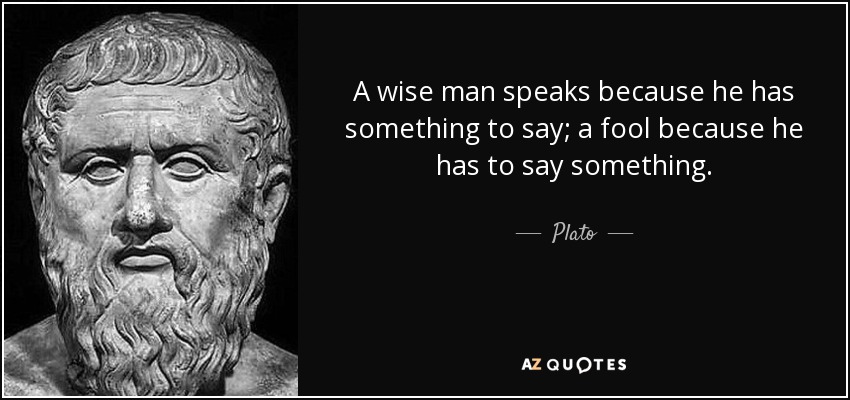
  1. Wise men speak because they have something to say; fools because they have to say something.”
  2. “We can easily forgive a child who is afraid of the dark; the real tragedy of life is when men are afraid of the light.”
  3. “Only the dead have seen the end of war.”
  4. “The price good men pay for indifference to public affairs is to be ruled by evil men.”
  5. “Do not train a child to learn by force or harshness; but direct them to it by what amuses their minds, so that you may be better able to discover with accuracy the peculiar bent of the genius of each.”
  6. “The heaviest penalty for declining to rule is to be ruled by someone inferior to yourself.”
  7. “According to Greek mythology, humans were originally created with four arms, four legs and a head with two faces. Fearing their power, Zeus split them into two separate parts, condemning them to spend their lives in search of their other halves.”
  8. “Love is a serious mental disease.”
  9. “Never discourage anyone…who continually makes progress, no matter how slow.”
  10. “One of the penalties of refusing to participate in politics is that you end up being governed by your inferiors.”
  11. “good people do not need laws to tell them to act responsibly, while bad people will find a way around the laws”
  12. Read: 30 of the Greatest Quotes from Abraham Lincoln about Life and Success
  13. “I am the wisest man alive, for I know one thing, and that is that I know nothing.”
  14. “There is truth in wine and children”
  15. “Ignorance, the root and stem of every evil.”
  16. “I’m trying to think, don’t confuse me with facts.”
  17. “If women are expected to do the same work as men, we must teach them the same things.”
  18. “…and when one of them meets the other half, the actual half of himself, whether he be a lover of youth or a lover of another sort, the pair are lost in an amazement of love and friendship and intimacy and one will not be out of the other’s sight, as I may say, even for a moment…”
  19. “The measure of a man is what he does with power.”
  20. “Those who tell the stories rule society.”
  21. “The madness of love is the greatest of heaven’s blessings”
  22. “Human behavior flows from three main sources: desire, emotion, and knowledge. ”
  23. “There are three classes of men; lovers of wisdom, lovers of honor, and lovers of gain.”
  24. “Education is teaching our children to desire the right things.”
  25. “When men speak ill of thee, live so as nobody may believe them.”
Read: 60 Timeless Inspirational Quotes
  1. “There are two things a person should never be angry at, what they can help, and what they cannot.”
  2. “In politics we presume that everyone who knows how to get votes knows how to administer a city or a state. When we are ill… we do not ask for the handsomest physician, or the most eloquent one.”
  3. “How can you prove whether at this moment we are sleeping, and all our thoughts are a dream; or whether we are awake, and talking to one another in the waking state? ”
http://flip.it/8gNeV


~ ~ ~ ~ ~ ~ ~
Islamic Revival رساله تجديد الاسلام ‏

An in-depth study of the Qur’an and Islamic religious history reveals startling facts. “Risala-e-Tajdeed-ul-Islam” is a message to develop positive change in the thought and practices of Muslims.
قرآن اور اسلام کے گہرے مطالعه سےحیران کن حقائق کا انکشاف ہوا، "رساله تجديد الاسلام" مسلمانوں کے انداز فکروعمل میں مثبت تبدیلی کا پیغام ہے:

The Arab Awakening: Islam and the new Middle East: Tariq Ramadan الصحوة العربية: الإسلام والشرق الأوسط الجديد: طارق رمضان

The Arab Awakening: Islam and the New Middle East from Middle East Institute, Singapore on Vimeo.
Public intellectual and Islamic philosopher Tariq Ramadan has written extensively about Muslims in contemporary Western societies, the troubled relationship between Islam and the West more generally, and how he believes it can be mended. His latest book, The Arab Awakening: Islam and the New Middle East, takes up similar themes against the backdrop of the Arab uprisings of 2011, asking how these Muslim majority countries can leverage this historic political opening to bring about comprehensive social and cultural change.
------------------------------------------------------------------------------------
  1. The Arab Awakening : Islam and the New Middle East - YouTube

    www.youtube.com/watch?v=TPC_1k056TE
    Middle East Institute, Singapore Dr. Tariq Ramadan for a talk on "The Arab Awakening:Islam and the New ...
---------------------------------------------------------------------------------

Ramadan begins the book by outlining his position of “cautious optimism” regarding the mass mobilisations against dictatorial regimes that shook many countries of the Middle East and North Africa. This interpretation of events lies between two extremes: a premature celebration of radical reform and renewal that has yet to unfold, and a cynical dismissal of popular protest movements as being manipulated and engineered by external forces. Ramadan takes pains to identify the role played by US and European governments and media, such as the selective coverage and diplomatic support granted to opposition movements in some Arab countries versus others, and how economic and geopolitical concerns dictated these choices rather than humanistic ones. He makes special mention of the training in pro-democracy, non-violent activism that young Arab bloggers and cyber-dissidents had received in certain Western countries in the decade leading up to the unrest. These enabling factors, he suggests, should not be seen as controlling the agenda and outcomes of the broad-based mobilisations.

Tunisia and Egypt are two cases that figure most prominently in this account, with occasional references to events in Libya, Syria, Bahrain, Morocco, Yemen and others. The author repeatedly urges a holistic understanding of the extraordinary developments unfolding across the region. Yet his analysis ultimately adds little that is new or especially insightful by way of sociological, economic or geopolitical explanation. The book becomes much more interesting in the second half as Ramadan moves to his core concerns: critique of the ideological narratives deployed by insiders and outsiders to frame events, outline of an intellectual project to guide the future course of action, and the special contribution that Islam can make.

Two salient characteristics of the Arab movements — they remained largely peaceful, and were joined by people of various ages, classes, and genders without being taken over by any one political party — rendered them especially palatable to Western observers. The dominant discourse portrayed the protestors’ demands for democracy, justice and freedom as an embrace of quintessentially Western values, leading to the conclusion that the Middle East is finally ready to democratise, modernise and become more like the West. Ramadan is quick to denounce such a reading of events as imperialistic and ahistorical, one that deliberately erases the Muslim identity of activists. He finds it even more problematic that protagonists within Muslim majority societies subscribe to this understanding of their own history.

Ramadan reserves the bulk of his criticism for the current condition of public discourse within the Arab world. It is marked by a polarisation between ‘secularists’ and ‘Islamists’ on the one hand, and between ‘us’ Muslims perceived as victims and ‘them’ in the West who are blamed for all our problems. Those who advocate secularisation as the solution for Middle Eastern societies oversimplify and are out of touch with real social issues, he shows, just as those espousing Islamist platforms have little to offer other than emotive appeals to tradition to enhance their own credibility. An instructive section of the book discusses why secularism has become a much-loathed and feared term across the Muslim world where processes of secularisation were experienced as repressive control and loss of freedoms, as opposed to the political democratisation and religious pluralism that defines the history of secularisation in Western societies. A similar discussion of political Islam situates it within the early-20th century context of nationalist, anti-colonial resistance where it first arose and traces the evolution of its many ideological currents across time and place.

Ramadan challenges Arabs and, more broadly, Muslims to abandon a counter-productive debate between outmoded conceptual categories and to overcome their intellectual colonisation. He calls for a sustained project of self-criticism and intellectual reconstruction, one that engages with indigenous histories, cultures and identities and promises to restore dignity. He sees lasting change resulting from the mass uprisings only if they don’t stop at the removal of oppressive political regimes and instead go on to launch a comprehensive programme of cultural, economic, social and political transformation.

This ambitious call for social and cultural renewal contains many standard elements from a reformist’s wish list: full rights and participation for women, revamped educational systems, democratic political processes, religious freedoms and pluralism, and an end to poverty, corruption and military interference. The emphasis on social justice also includes a strident critique of the global neo-liberal economic order and the control exerted by international financial institutions, multinational corporations and powerful states on countries of the global South. In fact, Ramadan identifies the shifting realignment of global powers — with the decline of Western economies and the increasing significance of China, Brazil, Russia, India and others — as another critical enabling factor in the toppling of Middle Eastern dictatorships. He sees this moment of multiple overlapping crises as an opportunity for Arab and other third world countries to press for more equitable economic relations, without really specifying how that will come about.

The distinctive part of Ramadan’s proposals concern the role that Islam is to play in the new Middle East that he envisions. The “Islamic reference,” as he calls it, is ever-present as oppositional mobilisations in Egypt and Tunisia have given way to elections, and the formation of new governments and new constitutions but these debates about the place of religion continue to engage in formal, procedural details and tinkering at the margins. He advocates a fundamental re-thinking whereby Islam becomes an ethical framework guiding political conduct and ensuring social justice, an alternative simultaneously more expansive and more limited than what we have been accustomed to. Instead of providing laws, rules and prohibitions, Islamic teachings are to serve as a source of spirituality and meaning. It is an elegant formulation but not easily translatable into actual practice. Unfortunately, Ramadan has developed this notion of Islam as applied ethics in his other works and it is only briefly showcased here (along with his other postulates, such as the distinction between the concepts of religion and culture).

What he does clearly reject is the concept of an “Islamic state,” insisting that a separation between divine and worldly authority has always been present in Islamic jurisprudential thought. He prefers the alternative “civil state” that some Islamist movements are now advocating, i.e. a democratic, secular state de-coupled from religious authority, the closest contemporary approximation of which is the Turkish model. Yet without a flourishing civil society and an active engagement with their Islamic heritage, he warns, Muslim societies will not experience real emancipation and peace.

In the midst of his cautious optimism about the future of the Muslim world, Ramadan downplays the potential threat of radical and militant Islam or the ongoing ‘war on terror’ that is warping relations with the West. He might be correct that the style and substance of the Arab uprisings signal an end to earlier confrontational paradigms, but that assertion still merits some more careful examination. Similarly, he assumes the continuing salience of the Israeli-Palestinian conflict in the new paradigm rather than demonstrating it. This slim volume was written even as the events it describes were still unfolding, and serves primarily to clarify the religious and political positions that the author has been a passionate proponent of. It is full of exhortations for its readers and frequently becomes repetitive and tendentious. The careful middle ground that Ramadan tries to chart might still, however, appear too bold or controversial to some within his Western or Muslim/Arab audiences who will no doubt find something here to be offended by.

Charting a middle ground, Reviewed by Faiza Mushtaq: The reviewer holds a PhD in Sociology and is affiliated with the Collective for Social Science Research, Karachi

The Arab Awakening: Islam and the New Middle East, (Religion/Politics) By Tariq Ramadan. Allen Lane, UK, ISBN 184614650X, 288pp.
Related:
Free-eBooks: http://goo.gl/2xpiv
Peace-Forum Video Channel: http://goo.gl/GLh75


Why America Failed?


Why America Failed shows how, from its birth as a nation of "hustlers" to its collapse as an empire, the tools of the country's expansion proved to be the instruments of its demise
Why America Failed is the third and most engaging volume of Morris Berman's trilogy on the decline of the American empire. In The Twilight of American Culture, Berman examined the internal factors of that decline, showing that they were identical to those of Rome in its late-empire phase. In Dark Ages America, he explored the external factors—e.g., the fact that both empires were ultimately attacked from the outside—and the relationship between the events of 9/11 and the history of U.S. foreign policy.
  • In his most ambitious work to date, Berman looks at the "why" of it all
  • Probes America's commitment to economic liberalism and free enterprise stretching back to the late sixteenth century, and shows how this ideology, along with that of technological progress, rendered any alternative marginal to American history
  • Maintains, more than anything else, that this one-sided vision of the country's purpose finally did our nation in
Why America Failed is a controversial work, one that will shock, anger, and transform its readers. The book is a stimulating and provocative explanation of how we managed to wind up in our current situation: economically weak, politically passe, socially divided, and culturally adrift. It is a tour de force, a powerful conclusion to Berman's study of American imperial decline.
~~~~~~~~~~~~~~~~~~~~~~~~
During the final century of the Roman Empire, it was common for emperors to deny that their civilization was in decline. Only with the perspective of history can we see that the emperors were wrong, that the empire was failing, and that the Roman people were unwilling or unable to change their way of life before it was too late. The same, says Morris Berman, is true of twenty-first century America. The nation and its empire are in decline and nothing can be done to reverse their course. How did this come to be?
In Why America Failed, Berman examines the development of American culture from the earliest colonies to the present, shows that the seeds of the nation's "hustler" culture were sown from the very beginning, and reveals how the very tools that enabled the country's expansion have become the instruments of its demise.
At the center of Berman's argument is his assertion that hustling, materialism, and the pursuit of personal gain without regard for its effects on others have been powerful forces in American culture since the Pilgrims landed. He shows that even before the American Revolution, naked self-interest had replaced the common good as the primary social value in the colonies and that the creative power and destructive force of this idea gained irresistible momentum in the decades following the ratification of the Constitution. As invention proliferated and industry expanded, railroads, steamships, and telegraph wires quickened the frenetic pace of progress—or, as Berman calls it, the illusion of progress. An explosion of manufacturing whetted the nation's ravenous appetite for goods of all kinds and gave the hustling life its purpose—to acquire as many objects as possible prior to death
The reign of Wall Street and the 2008 financial meltdown are certainly the most visible examples today of the negative consequences of the pursuit of affluence. Berman, however, sees the manipulations of Goldman Sachs and others not as some kind of aberration, but as the logical endpoint of the hustler culture. The fact that Goldman and its ilk continue to thrive in the wake of the disaster they wrought simply proves that it is already too late: America is incapable of changing direction.
Many readers will take exception to much of Why America Failed—beginning, perhaps, with its title. But many more will read this provocative and insightful book and join Berman in making a long, hard reassessment of the nation, its goals, and its future.

"Morris Berman is one of our most prescient and important social and cultural critics. He marries a laser-like intelligence with a deep moral core. His writing is as lucid and crisp as it is insightful.His newest book, Why America Failed, rips open the dark and dying carcass of empire.His analysis is sobering and often depressing .But the truth at this stage in the game is depressing, very depressing. Those who refuse to face this truth because it is unpleasant, because it does not inspire happy thoughts or offer false hope, are in flight from the real. The collective retreat into self-delusion has transformed huge swaths of the American populace into a peculiar species of adult-children who live in aPeter Pan world of make believe where reality is never permitted to be animpediment to desire. It is too bad Berman, who sees and writes about all this with a stunning clarity, lives in Mexico.It gets lonely up here."
—Chris Hedges, author of Death of the Liberal Class and Empire of Illusion
"Morris Berman's masterpiece is a brutally honest, wonderfully crafted,exceptionally well-documented treatise on how America was spawned, several hundred years ago, to devour its offspring—financially, socially, and technologically. Why America Failed shines a harsh, unavoidable light upon the cunning business mindset at the core of America's creation, expansion, and devolution. Berman describes with stunning clarity how and why the 'hustler'mentality, upon which our country was predicated, eviscerated alternative moral or social doctrines, and thus incorporated the seeds of our self-destruction from its very inception. This book is as uncomfortable to read as it is impossible to miss."
—Nomi Prins, author of It Takes a Pillage and Other People's Money
"Morris Berman noticed that it's not morning in America anymore. His message may wake up the millions who are oversleeping while the late-day storm cloudsgather over this land."
—James Howard Kunstler, author of The Long Emergency
"As the decline of America's empire becomes both starker and graduallyevident, nothing is more important than accessible analyses of the causes of that decline. Far too few such works exist because of the taboos against writing them. All the more welcome then is Morris Berman's clear, bluntly but cogently written work. Sensitive to the contradictions of U.S. history and how they arenow playing themselves out in a changed world, this book will challenge and provoke in all the best senses of those words. Genuinely important to read and to think about."
—Richard D. Wolff, Emeritus Professor of Economics,University of Massachusetts Amherst

Morris Berman (born 1944) is an American historian of culture and science and is considered a social critic. Berman was born in Rochester, New York. He earned his BA in mathematics at Cornell University in 1966 and his Ph.D. in the history of science at The Johns Hopkins University in 1972. He is an academic humanist cultural critic who specializes in Western cultural and intellectual history. Despite his status as an academic, Berman's books are written for a general audience. They are concerned with the state of Western civilization and with an ethical, historically responsible, or enlightened approach to living within it. Emphasized in his work are the legacies of the European Enlightenment and the historical place of present-day American culture.

~~~~~~~~~~~~~~~~~~~~~~~

Americans live in a dream world that has been Manufactured by Cooperation's. While more importantly given consent by the Political LEFT&RIGHT. Sad truth is, that when AMERICANS wake up, they will find the world that was fed to them...is no more real then their idea of American Democracy. Beginnings of an American CIVIL WAR which is also what Chomsky has been hinting on.

Atheism, Humanism or Religion?

مذہب اور الحاد
 عملی منطقی گفتگو
پروفیسر احمد رفیق اختر


Humanism is the retort by desperate pragmatic Christian scholars [Unitarian Universalists], to the mythical, unscientific and illogical traditional Christian Doctrines, however they have gone far away from one extreme to another. A balanced, scientific and rational solution is available, while maintaining the unity and existence of God, who has not created any thing without a purpose. 

The Humanists intend to serve the humanity, but with atheist concepts, devoid of accountability upon resurrection, it will remain a distant dream because people will lack inner motivation. People who suffer in this life being poor, or due to birth defects, incurable diseases, or fall prey to calamites [both natural or man made] can never be happy unless they hope to be compensated in hereafter. No system can work if it is without checks and balances, which do put some limits on the freedom. Islam is the only faith which provides guidance for successful way of life for both worlds, not restricted to rituals and dogmas but actions and performance of good deeds, while avoiding evils. Every noble act done for the betterment of humanity is considered as worship because it pleases the God. The history is witness that Islamic civilization and society even partially based upon Qur’anic principles ensured attainment of the good life in a harmonious society, each individual seeking to contribute to the welfare of the community. In Islam human values are given high priority for peaceful coexistence in this and hereafter. Equality of humanity and justice disregarding race or colour is hallmark of Islam. There is no restriction in attaining scientific knowledge, rather Qur’an encourages it by drawing attention to explore the signs of wonders the in the cosmos and in human self. The affairs in Islamic state are to be conducted through mutual consultation (shura, a form of democracy). The materialistic approach of Humanism discarding spirituality is deemed to failure like the communist ideology. Spirituality and belief in One Supreme Being is part of human nature, Humanist while advocating ‘nature’ in the same breath go against it - a paradox, self-denial.
Finally just for the sake of argument. if hypothetically one may consider the Humanism viz Monotheism, and grant probability of either being right or wrong as 50:50 [irrespective of strength of arguments of monotheist]. If 50% probability of Humanists being false materialise the Humanists are big losers because they have to suffer in hell fire for ever being unbelievers, while the true monotheists believers will ultimately be in a state of promised pleasure. In other situation assuming, if 50% probability of Humanists being ‘true’ materializes, the monotheists have nothing to loose, they had lived as good human in this world, performed good deeds to please their God and fellow human by establishing an equitable society. Hence believers are at win-win situation. Humanists and atheists need to give serious thought to this aspect, because the risk is too high to accept any error of judgement which shall result in timeless sufferings.  

************************
Don't base your opinion upon conjecture, discover yourself ! 
The book revered by 1.5 Billion people, the most read book in the world “The Holy Qur’an” translated in to English by a European scholar with commentary. The Message of The Qur’an’, has been acclaimed as one of the best, English translations and commentary of Qur'an by Leopold Weiss’ [Muhammad Asad]. It is based on his own knowledge of classical Arabic and on the authoritative classical commentaries.
3 in 1 - English Translation and commentary of Holy Qur’an by M.Asad, with "Quick Guide for the Study" and "Topical Index", in PDF , Size: 8 MB, Download Now absolutely Free Click here >>>>>
http://faithforum.wordpress.com
.............................................................................................

Atheism: Video Playlist

Embed code:

<iframe width="560" height="315" src="http://www.youtube.com/embed/videoseries?list=PL7980D4C29D4F9AC7&amp;hl=en_GB" frameborder="0"allowfullscreen></iframe>

Iqbal the ideologue علامہ اقبال: تجدیدِ فکر اسلامی کے نقیب


Barely half an hour before his death on April 21, 1938, Allama Iqbal recited a quatrain which reads like an epitaph (translated): The melodies bygone may come again; or nevermore/ The zephyr from Hijaz may come again; or nevermore/ The days of this Faqir are ended now; forevermore/ And yet another seer may come or not; forevermore!

This quatrain sums up Iqbal’s supreme significance for Muslims, for then and for centuries beyond. After all, men like Iqbal are born but in centuries. To quote Amir Shakib Arsalan, the world of Islam had not thrown up a thinker of his calibre during the last few centuries.
Iqbal had ample opportunities to assimilate eastern and western thought. His education included study of Arabic, English literature and philosophy, besides social sciences. His quest for knowledge took him to Europe where he also became familiar with the groundwork of western civilisation and contemporary western thought.

Iqbal made his debut as a rising poet in 1899, when he recited the Nala-i-Yatim (The Cry of the Orphan) at the annual session of the Anjuman-i-Himayat-i-Islam in Lahore. For the next six years, Iqbal, for the most part wrote, under a patriotic impulse, and became an advocate of the emergent Indian nationalism. To this period belongs the Tarana-i-Hindi, which according to Iqbal Singh, “remains to this day [1947] the best patriotic poem in modern times”. Hence, he came to be hailed as the ‘National Poet of India’.

His studies and a three-year (1905-08) sojourn in Europe opened for him new vistas, inducing him to disorient himself from his erstwhile orientation. First, his study of the development of metaphysics in Persia, the topic of his doctorial dissertation at Munich, disoriented him from mysticism, as it had no place in Islam. Deeply influenced by European thought, Iqbal was, for now, all for endeavour, initiative, and action — attributes antithetical to Sufism.

Second, he joyously admired Europe’s soaring vitality, creativity, initiative, inquisitiveness, and confident restlessness, for a better tomorrow, and readily realised the tremendous possibilities before man, opened up by science but undreamt of in India. But he also found that undiluted capitalism, aggressive nationalism and blind racism had undermined western civilisation. The triad concepts had divided mankind, entailed endless competition and bred bitter rivalries between nations and races. What, then, was the answer?

To Iqbal, Islam was the only answer — because Islam envisages a world brotherhood which transcends racial, national and class affiliations. Thus, Iqbal’s European sojourn brought him to the threshold of a paradigmatic shift: from an Indian nationalist he turned into a pan-Islamist. In a conceptual sense, he was for now treating the seldom trodden path, delineated by Albert Schiller, when he proclaimed, “I write as a citizen of the world who serves no prince. I lost my fatherland to exchange it for the great world. What is the greatest of nations but a fragment?”

The Prophet (PBUH) had once said, “The whole of this earth is a mosque (unto me)”. Iqbal would, for now, say, “Every country is ours because it is the country of our God”. The fatherland to which he belonged was the sprawling Muslim world — the vast belt from Morocco to Indonesia, and far beyond. To quote Dr Nafisy, the learned Iranian intellectual, Iqbal took upon himself the immense task of a poet-prophet. His poems, for now, shifted ground: he sang of the glory of Islam and Muslims.

Over the years, Iqbal’s poems increasingly reflected the travails of the Muslim world; they also mirrored the agitated mood of Indian Muslims. To quote Professor Hamilton A R Gibb, the famed Orientalist, “… Iqbal … reflected and put into vivid words the diverse currents of ideas that were agitating the minds of Indian Muslims. His sensitive poetic temperament mirrored all that impinged upon it… Every Indian Muslim, dissatisfied with the state of things — religious, social or political — could and did find in Iqbal a sympathiser with his troubles and his aspirations and an adviser who bade him seek the way out by self-expression.”

Iqbal’s claim to be the foremost Muslim philosopher of the present age rests chiefly on his Reconstruction of Religious Thought in Islam (1930). Therein he tried “to re-think the whole system of Islam without completely breaking away with the past”. Actually, he tried to do what St Augustine had done for Catholicism several centuries ago.

His significance as a poet and thinker apart, Iqbal was also the ideologue of Pakistan. To this day, his presidential address to the Allahabad (1930) League session stands out as the intellectual justification for Muslim nationhood in India.

— An HEC distinguished National Professor, the writer is the co-editor of Unesco’s History of Humanity, vol. VI, The Jinnah Anthology (2010) and In Quest of Jinnah (2007).
smujahid107@hotmail.com
http://www.dawn.com/2011/11/06/iqbal-day-iqbal-the-ideologue.html

~~~~~~~~~~~~~~~~~~~~~~~~~~
The Reconstruction of Religious Thought in Islam

The Reconstruction of Religious Thought in Islam is a compilation of lectures delivered by Muhammad Iqbal on Islamic philosophy; it was published in 1930. These lectures were delivered by Iqbal in Madras, Hyderabad, and Aligarh. The last chapter, "Is Religion Possible", was added to the book from the 1934 Oxford Edition onwards.

In Reconstruction, Iqbal called for a re-examination of the intellectual foundations of Islamic philosophy. The book is a major work of modern Islamic thought. It was a major influence on Iranian sociologist Ali Shariati and other contemporary Muslim reformers, including Tariq Ramadan.

Quotes from the book
  • ...To have a succession of identical thoughts and feelings is to have no thoughts and feelings at all. Such is the lot of most Muslim countries today. They are mechanically repeating old values...
  • ...space, time, and matter are interpretations which thought puts on the free creative energy of God.
  • If the aim of religion is the spiritualisation of the heart, then it must penetrate the soul of man, and it can best penetrate the inner man . . . We find that when Muhammad Ibn Tumart—the Mahdi of Muslim Spain—who was Berber by nationality, came to power and established the pontifical rule of the Muwahhidun, he ordered for the sake of the illiterate Berbers that the Quran should be translated and read in the Berber language and that the call to prayer should be given in Berber.
  • Such is the attitude of the modern Turk, inspired as he is by the realities of experience, and not by the scholastic reasoning of jurists who lived and thought under different conditions of life. To my mind these arguments, if rightly appreciated, indicate the birth of an International ideal, which forming the very essence of Islam, has been hitherto overshadowed or rather displaced by Arabian Imperialism of the earlier centuries in Islam.
  • The republican form of government is not only thoroughly consistent with the spirit of Islam, but has also become a necessity in view of the new forces that were set free in the world of Islam.
  • The more genuine schools of Sufism have, no doubt, done good work in shaping and directing the evolution of religious experience in Islam; but their latter-day representatives, owing to their ignorance of the modern mind, have become absolutely incapable of receiving any fresh inspiration from modern thought and experience. They are perpetuating methods which were created for generations possessing a cultural outlook differing, in important respects, from our own
  • Hard his lot and frail his being, like a rose leaf, yet no form of reality is so powerful, so inspiring, and so beautiful as the spirit of man.          
The Qur’ān is a book which emphasizes ‘deed’ rather than ‘idea’. There are, however, men to whom it is not possible organically to assimilate an alien universe by re-living, as a vital process, that special type of inner experience on which religious faith ultimately rests. Moreover, the modern man, by developing habits of concrete thought– habits which Islam itself fostered at least in the earlier stages of its cultural career– has rendered himself less capable of that experience which he further suspects because of its liability to illusion.  The more genuine schools of Sufism have, no doubt, done good work in shaping and directing the evolution of religious experience in Islam; but their latter-day representatives, owing to their ignorance of the modern mind, have become absolutely incapable of receiving any fresh inspiration from modern thought and experience. They are perpetuating methods which were created for generations possessing a cultural outlook differing, in important respects, from our own. ‘Your creation and resurrection,’ says the Qur’ān, ‘are like the creation and resurrection of a single soul.’ (Quran;31:28.  A living experience of the kind of biological unity, embodied in this verse, requires today a method physiologically less violent and psychologically more suitable to a concrete type of mind. In the absence of such a method the demand for a scientific form of religious knowledge is only natural. In these Lectures, which were undertaken at the request of the Madras Muslim Association and delivered at Madras, Hyderabad, and Aligarh, I have tried to meet, even though partially, this urgent demand by attempting to reconstruct Muslim religious philosophy with due regard to the philosophical traditions of Islam and the more recent developments in the various domains of human knowledge. And the present moment is quite favourable for such an undertaking. Classical Physics has learned to criticize its own foundations. As a result of this criticism the kind of materialism, which it originally necessitated, is rapidly disappearing; and the day is not far off when Religion and Science may discover hitherto unsuspected mutual harmonies. It must, however, be remembered that there is no such thing as finality in philosophical thinking. As knowledge advances and fresh avenues of thought are opened, other views, and probably sounder views than those set forth in these lectures, are possible. Our duty is carefully to watch the progress of human thought, and to maintain an independent critical attitude towards it.

Chapters:
    • Knowledge and Religious Experience
    • The Philosophical Test of the Revelations of Religious Experience
    • The Conception of God and the Meaning of Prayer
    • The Human Ego - His Freedom and Immortality
    • The Spirit of Muslim Culture
    • The Principle of Movement in the Structure of Islam
    • Is Religion Possible?
    ~~~~~~~~~~~~~~~~~~~
    Read online

    ~~~~~~~~~~~~~~~~~~~~~~~~~~~~~~~~~~~~~~~~~~~~~~~~~~~~~~~~~~~~~

    علامہ اقبال: تجدیدِ فکر اسلامی کے نقیب

    پروفیسر خورشید احمد


    بیسویں صدی میں جن شخصیات نے اسلامی فکرو تہذیب پر ٹھوس علمی لٹریچر پیش کیا، جنھوں نے فکرِاسلامی کی تشکیلِ نو کے احساس اور جذباتی رجحان کو تبدیل کرنے میں اہم کردار اداکیا، ان میں ایک نمایاں ترین شخصیت علامہ محمد اقبال (۱۸۷۷ء۔۱۹۳۸ء) کی ہے۔ اس بنا پر ہم ان کو دورِ جدید میں تجدیدِ فکر اسلامی کی روایت کا بانی اور بیسویں صدی میں ملّت اسلامیہ پاک و ہند کے ذہن کا اوّلین معمار قرار دیتے ہیں۔
    علامہ محمد اقبال کی علمی اور ادبی زندگی کا آغاز انیسویں صدی کے آخری عشرے میں ہوگیا تھا، فروری ۱۹۰۰ء سے وہ انجمن حمایت اسلام لاہور کے جلسوں میں شریک ہونے لگے تھے۔ لیکن قومی زندگی پر ان کے اثرات یورپ سے واپسی (۱۹۰۸ء) کے بعد مرتب ہونا شروع ہوئے۔ ۱۹۱۵ء میں انھوں نے اسرارِخودی شائع کی، جس نے مسلم تصوف سے منسوب جامد سوچ میں ایک تحرک پیدا کیا، اور افرادِ اُمت کو ’اپنی دنیا آپ پیدا کر۔۔۔‘‘ کا زریں نکتہ سمجھایا۔ اس سے ہماری ملّی زندگی کے نئے باب کا افتتاح ہوا۔ پھر انھوں نے ۲۰جولائی ۱۹۲۶ء کو مجلس قانون ساز پنجاب کے انتخاب میں حصہ لے کر اور اس طرح عملی سیاست میں شریک ہوکر تغیر اور تعمیر کے عمل میں مؤثر کردار ادا کیا۔ ان کی مساعی کا ثمرہ اسلامی فکر کی تشکیلِ نو، ملّت کی مزاجی کیفیت کی نئی تعمیر، ایک آزاد قوم کے احیا اور ایک عظیم مسلم مملکت کے قیام کی صورت میں دیکھا جاسکتا ہے۔۱؂
    ساتویں صدی ہجری (تیرہویں صدی عیسوی) میں جو کام مولانا جلال الدین رومیؒ (۱۲۰۷ء۔۱۲۷۳ء) نے مثنوی کے ذریعے انجام دیا تھا، اسے بیسویں صدی عیسوی میں علامہ محمد اقبالؒ نے اوّلاً اسرارِخودی (۱۹۱۵ء) اور رموزِ بے خودی (۱۹۱۸ء) اور پھر جاویدنامہ (۱۹۳۲ء) اور پس چہ باید کرد اے اقوام شرق (۱۹۳۶ء) کے ذریعے انجام دیا۔ اسرارِخودی میں جمود اور انحطاط کے اصل اسباب کی نشان دہی کی گئی، تصوف پر یونانی اور عجمی اثرات کی وجہ سے جو حیات کُش تصور مسلمانوں پر مسلط ہوگیا تھا، اس کی تباہ کاریوں کو واضح کیا۔ اسرارِ خودی کا مرکزی تصور: ایمان کی یافت اور اس کی قوت سے ایک نئے انسان (مرد مومن) کی تشکیل ہے۔ رموز بے خودی میں اس اجتماعی، اداراتی اور تاریخی تناظر کو بیان کیا گیا ہے، جس میں یہ انسان اپنا تعمیری کردار ادا کرتا ہے۔ فرد اور ملّت کا تعلق، اجتماعی نصب العین، خلافتِ الٰہی کی تشریح و توضیح، اجتماعی نظم اور ادارات (خاندان، قانون، شریعت وغیرہ) کی نوعیت اور خودی کی پرورش اور ملّی شخصیت کے نمو میں تاریخ کے حصے پر روشنی ڈالی گئی ہے۔
    جاوید نامہ علامہ محمد اقبال کے روحانی سفر کی داستان ہے، جس میں وہ عالمِ افلاک کی سیر کرتے ہیں، دنیا اور اس کے ماورا پر بصیرت کی نظر ڈالتے ہیں اور مشرق و مغرب کی نمایندہ شخصیات کی زبان سے آج کی دنیا کے حالات، مسائل و افکار اور مسلمانوں کے ماضی، حال اور مستقبل کے نقوش کو نمایاں کرتے ہیں۔ پس چہ باید کرد اے اقوام شرق میں مغربی تہذیب کے چیلنج کا مطالعہ کرکے بتایا گیا ہے کہ یورپ کی ترقی کا اصل سبب کیا ہے اور مغربی تہذیب کے روشن اور تاریک پہلو کیا ہیں۔ مغرب کی اندھی تقلید سے قوم کو متنبہ کیا گیا ہے، اور ترقی کے راستے کی نشان دہی کی گئی ہے۔ پیامِ مشرق اور ارمغانِ حجاز میں یہی پیغام دوسرے انداز میں بیان کیا گیا ہے، اور اس کا اظہار اُردو کلام میں بھی ہوا ہے۔ خصوصیت سے بانگِ درا کی قومی نظموں میں اور بال جبریل کی ولولہ انگیز غزلوں میں۔ ضربِ کلیم کے بے باک رجز کو خود اقبال نے: ’دورِحاضر کے خلاف اعلانِ جنگ ‘ قرار دیا ہے۔
    علامہ محمد اقبال کی نثر کا بہترین حصہ انگریزی میں ہے۔ ڈاکٹریٹ کا تحقیقی مقالہ انھوں نے The Development of Metaphysics in Persiaکے نام سے پیش کیا ہے۔ یہ محض ایک فکری تاریخ نہیں ہے، بلکہ اس کے آئینے میں اسلام پر عجمی اثرات کی پوری تصویر دیکھی جاسکتی ہے۔ اقبال نے تصوف کا جو تنقیدی جائزہ لیا ہے، وہ اصل مآخذ کے وسیع مطالعے پر مبنی ہے۔
    علامہ محمد اقبال نے اسلام کے تصورِ مذہب کی علمی اور فلسفیانہ تعبیر اپنے معروف انگریزی خطبات The Reconstruction of Religious Thoughts in Islam(تشکیلِ جدید الٰہیاتِ اسلامیہ) میں پیش کی ہے۔ اس کتاب میں بنیادی طور پر مغرب کے فکری رجحانات کو سامنے رکھ کر انسان، کائنات اور اللہ تعالیٰ کے بارے میں اسلامی تصور کی وضاحت کی گئی ہے، مذہب اور سائنس کے تعلق سے بحث کی گئی ہے اور ذرائع علم کا تنقیدی جائزہ لے کر بتایا گیا ہے کہ عصرِحاضر کے یک رُخے پن کے مقابلے میں اسلام کس طرح عقل، تجربے اور وجدان کی ہم آہنگی قائم کرتا ہے۔ اس بنیادی فکر کی روشنی میں آزادی اور عبادت کے تصور کو واضح کیا گیا ہے، اور ان تصورات کی بنیاد پر قائم ہونے والے تمدن کی خصوصیات پر روشنی ڈالی گئی ہے۔ نیز اسلامی قانون کی مثال دے کر یہ دکھایا گیا ہے کہ اسلامی تمدن میں ثبات اور تغیر کا حسین امتزاج کس طرح قائم ہوتا ہے اور اس کے اندر ہی سے زندگی اور حرکت کے چشمے کس طرح پھوٹتے ہیں۔
    مذکورہ بالا انگریزی کتابوں کے علاوہ، وقت کے علمی، تہذیبی، سیاسی اور معاشی مسائل کے بارے میں محمد اقبال نے اپنے خیالات کا اظہار متعدد مضامین، تقاریر، بیانات اور خطوط کے ذریعے بھی کیا ہے۔ یہ سارا نثری ذخیرہ اُردو اور انگریزی مجموعوں کی صورت میں شائع ہوچکا ہے۔۲؂
    اگرچہ محمد اقبال کی مخاطب پوری ملت اسلامیہ بلکہ پوری انسانیت ہے، لیکن انھوں نے خصوصیت سے مسلم قوم کے ذہین اور بااثر تعلیم یافتہ طبقے کو خطاب کیا۔ یہ مؤثر اور کارفرما طبقہ، ذہنی اور لسانی روایات سے وابستہ تھا۔ محمد اقبال نے اپنے افکار کے اظہار کے لیے بنیادی طور پر شعر کا پیرایہ اختیار کیا۔ غالباً اس کی وجہ یہ تھی کہ ایک شکست خوردہ قوم کو حرکت اور جدوجہد پر اُبھارنے کے لیے عقلی اپیل کے ساتھ ساتھ جذباتی اپیل کی ضرورت تھی۔ وقت کے چیلنج کا تقاضا محض عقل کو مطمئن کرنا نہیں تھا، بلکہ اہمیت اس امر کو بھی حاصل تھی کہ جذبات میں تموج برپا کرکے اس جمود کو توڑا جائے، جس میں یہ ملّت گرفتار تھی۔ نیز ایک مدت سے برعظیم پاک و ہند کی ملّت اسلامیہ دولخت شخصیت (split personality) کے مرض میں مبتلا تھی، یعنی اس کے عقیدے اور عقل میں یکسانی اور مطابقت باقی نہ رہی تھی۔۳؂
    دوسرے لفظوں میں عقیدہ تو موجود تھا، مگر اس میں وہ حرارت نہ تھی جو جذبے کی خنکی یا سردمہری کو دُور کرسکے اور بے عملی اور مایوسی کی برف کو پگھلا دے۔ عقیدے کا چراغ اگر ٹمٹما رہا تھا تو عشق کی روشنی بھی باقی نہ رہی تھی۔ اس کیفیت نے ’روحانی فالج‘ کی صورت اختیار کرلی تھی، جس سے دین داری کی حِس مجروح ہورہی تھی ؂
    بُجھی عشق کی آگ، اندھیر ہے
    مسلماں نہیں، راکھ کا ڈھیر ہے
    اس کیفیت میں دیرپا تبدیلی اور دُور رس انقلاب کے لیے صرف عقل کی روشنی کافی نہیں ہوسکتی، بلکہ اس کے لیے جذبے کی تپش بھی درکار تھی (یہی، اقبال کے پیش کردہ تصورِ عشق کا پس منظر ہے)۔ علامہ محمداقبال نے جذبے کو مہمیز لگا کر انقلاب پیدا کرنے کے لیے شعر کا جادو جگایا (دوسری جانب اسی زمانے میں مولانا ابوالکلام آزاد نے اس کام کو انجام دینے کے لیے خطابت کا طوفانی راستہ اختیار کیا تھا)۔
    مسلم فکر کے زندہ موضوعات، لوازمے اور مباحث میں اقبال کا جو منفرد حصہ ہے، ذیل میں اس کے چند اہم پہلوؤں کی طرف مختصراً اشارہ کیا جاتا ہے:
    lتقلید نھیں ، تخلیقی اجتھاد: قدیم و جدید کے درمیان کش مکش کو علامہ محمداقبال نے ’دلیل کم نظری‘ قرار دیا ہے۔ اگرچہ انھوں نے خود ان دونوں مآخذ سے پورا پورا استفادہ کیا، مگر کسی ایک کے سامنے آنکھیں بند کرکے سپر نہیں ڈالی۔ علامہ محمد اقبال کی نگاہ میں زندگی ایک ناقابلِ تقسیم وحدت ہے جس میں ثبات اور تغیر دونوں کا اپنا اپنا فطری مقام ہے۔ اسلام کا اصل کارنامہ ہی یہ ہے کہ اس نے فطرت کے اس اصول کو تسلیم کرتے ہوئے اعتدال کے راستے کو نمایاں کیا۔ علامہ اقبال نے بتایا کہ صحت مند ارتقا اسی وقت ممکن ہے، جب تمدن کی جڑیں ایک جانب ماضی کی روایت میں مضبوطی کے ساتھ جمی ہوئی ہوں، اور دوسری طرف یہ بھی ضروری ہے کہ وہ حال کے مسائل اور مستقبل کے رجحانات سے پوری طرح مربوط ہوں۔ اقبال کی نگاہ میں فدویانہ تقلید، خواہ وہ ماضی کی ہو یا اپنے ہی زمانے کے چلتے ہوئے نظاموں کی، فرد اور قوم دونوں کے لیے تباہ کن ہے۔ صرف تعمیری اور تخلیقی اجتہاد ہی کے ذریعے ترقی کی منزلیں طے کی جاسکتی ہیں۔ یہی وہ راستہ ہے، جو علامہ محمد اقبال نے اختیار کیا۔۴؂
    lتصوف نھیں، حرکت و عمل: علامہ محمد اقبال نے مسلمانوں کے ماضی اور حال دونوں پر تنقیدی نگاہ ڈالی۔ ان کے خیال میں مسلمانوں کے زوال کا بنیادی سبب یہ تھا کہ انھوں نے غیر اسلامی اثرات کے تحت ایک ایسے تصورِ حیات کو شعوری طور پر اختیار کرلیا جو اسلام کی کھلم کھلا ضدپر مبنی تھا۔ اس سے ان کی صلاحیتیں زنگ آلودہ ہوگئیں، اس طرح وہ تاریخ اور زمانے کی اہم ترین قوت ہوتے ہوئے بھی تمدنی زوال، سیاسی غلامی اور فکری انتشار کا شکار ہوگئے۔ اس سلسلے میں یونانی اور عجمی مآخذ سے حاصل کیا ہوا تصوف اور اشراق، حددرجہ مہلک اور حیات کُش ثابت ہوا، جس نے مسلمانوں میں زندگی کا غیرحرکی اور جمود زدہ تصور رائج کر دیا۔۵؂ نفی ذات کے فلسفے نے یہاں بھی گھر کرلیا۔ یوں دیکھتے ہی دیکھتے ترکِ دنیا، ترکِ آرزو اور ترکِ عمل کی بنیاد پر جمود اور انحطاط کے مہیب سایے مسلط ہوگئے۔
    lمرد مومن کے لیے لائحہ عمل: بگاڑ کے اسباب کی تشخیص کے بعد، علامہ محمد اقبال نے اسلام کے تصورِ حیات اور اس کی بنیادی اقدار کو ان کی اصل شکل میں پیش کیا۔ اسلام کی جو تشریح و توضیح اقبال نے کی ہے، اس کی امتیازی خصوصیت اس کا حرکی (dynamic) اور انقلابی (revolutionary) پہلو ہے۔ کائنات کی سب سے اہم خصوصیت یہ ہے کہ اس میں تخلیقی عمل اور ارتقا جاری ہے۔ کائنات کسی تخلیقی حادثے کا مظہر نہیں ہے، بلکہ اس میں خالق کائنات کی جانب سے کن اور فیکون کا سلسلہ جاری و ساری ہے، گویا جاوداں، پیہم رواں، ہر دم جواں ہے زندگی‘۔ پھر کائنات کی حقیقت کو ’خلق‘ اور ’امر‘ کی نوعیت پر غور کرکے ہی سمجھا جاسکتا ہے۔۶؂ اگر ’خلق‘ میں پیدایش اور وجود کی طرف اشارہ ہے تو ’امر‘ میں سمت اور منزل کی طرف رہنمائی ہے۔
    ہر چیز ایک مقصد کے لیے سرگرمِ عمل ہے۔ وجود کا اساسی پہلو بھی احساسِ سمت، مقصدیت، حرکت اور مطلوب کی طرف سعیِمراجعت ہے۔ کائنات، انسان اور تاریخ، ہر ایک میں یہی حرکی اصول کارفرما ہے۔ جسم اگر خلقت کا مظہر ہے، تو روح امن کی آئینہ دار ہے۔ خودی اور اس کی تعمیر اس حرکی اصول کا لازمی تقاضا ہے۔ ترقی اور بلندی کی راہ نفیِ ذات نہیں، اثباتِ خودی ہے، جو خود ایک ارتقائی (evolutionary) اور حرکی عمل ہے۔ روح کی معراج، ذاتِ باری تعالیٰ میں فنا ہوجانا نہیں، بلکہ خالقِ حقیقی سے صحیح تعلق استوار کرنا ہے۔ ایمان اس کا نقطۂ آغاز ہے، عمل اس کا میدانِ کار ہے، اور عشق اس کی ترقی کا راستہ۔
    یہی اصولِ حرکت تاریخ میں بھی کارفرما ہے۔ تاریخی اِحیا محض ماضی کے صحت مند رجحانات کے بقا و استحکام کا نام نہیں ہے، بلکہ ابدی اقدار اور تمدّنی نصب العین کی روشنی میں انفرادی اور اجتماعی زندگی کے میدانوں میں تخلیقی اظہار اور تعمیر اور تشکیلِ نو سے عبارت ہے۔ انسان ہی اس ارتقائی عمل کا اصل کارندہ ہے۔ اگرچہ کائنات کی ہر شے اس کی مدد کے لیے فراہم کی گئی ہے، لیکن انسانی زندگی کے کچھ اعلیٰ ترین مقاصد کے حصول کے لیے ہے، اور یہ مقصد ہے منصبِ نیابتِ الٰہی۔۷؂
    اسلام وہ طریق زندگی ہے، جو انسان کو اس کام کے لائق بناتا ہے اور تاریخ میں اس حرکت کو صحیح سمت دیتا ہے۔ مردِ مومن اور ملتِ اسلامیہ، کائنات کی اصلی معمار قوتیں ہیں۔ اگر وہ اپنی ذمہ داری صحیح طور پر انجام نہ دیں تو بگاڑ رونما ہوگا، خود ان کے درمیان بھی اور کائنات میں بھی۔
    lعقل اور وجدان کا تعلّق: علامہ محمد اقبال نے مذہب کی بنیاد عقل یا سائنس پر نہیں رکھی، بلکہ انھوں نے عقل، تجربے، سائنس اور وجدان، ہر ایک کی اصل حقیقت کو واضح کیا، اور ان کی مجبوریوں اور دقتوں پر روشنی ڈالی۔ اقبال نے بتایا کہ جبلت، عقل اور وجدان کے نقائص کو وحی کی روشنی اور تربیت کے ذریعے ہی دُور کیا جاسکتا ہے۔ ان تینوں کو ایک دوسرے سے ہم آہنگ کر کے انسان کی خدمت اور رہنمائی کے صحیح مقام پر فائز کیا جاسکتا ہے۔۸؂ نومعتزلائی عقلیت اور مغرب کی بے جان سائنس کے مقابلے میں یہ عقلِ سلیم کی فتح تھی۔ اس طرح نبی کریم صلی اللہ علیہ وسلم کا تجربہ اور مشاہدہ مذہبی فکر میں ایک اساسی حیثیت قرار پایا۔ روحانی اور مادی تقسیم کا باطل نظریہ ترک ہوا، اور دونوں کے امتزاج (synthesis) سے متوازن اسلامی زندگی کی تعمیر کی راہ روشن ہوئی۔
    lحرکی تصور میں خودی کا مقام:ایمان اور عمل کا باہمی تعلق واضح کرنے کے لیے علامہ محمداقبال نے غیرمعمولی ندرت (innovation) کا ثبوت دیا۔ اقبال کے نظامِ فکر کے مطابق زندگی کا حرکی تصور آپ سے آپ عمل کو مرکزی حیثیت دیتا ہے۔ پھر مذہبی تجربے کی اساسی اہمیت بھی اس سمت میں اشارہ کرتی ہے۔ اثباتِ خودی اور تعمیر شخصیت ایک مسلسل عمل ہے، جس کے بغیر انسان مقامِ انسانیت کو حاصل نہیں کرسکتا۔ نیابتِ الٰہی کے تقاضے صرف تسخیرکائنات اور اصلاحِ تمدّن ہی کے ذریعے انجام دیے جاسکتے ہیں۔ ’خودی‘ ایک بے لگام قوت کا نام نہیں ہے، بلکہ یہ خداپرستی اور اخلاقی تربیت سے ترقی پاتی ہے۔ عشق اس کی قوتِ محرکہ ہے، جب کہ مادی قوت کو دین کی حفاظت اور پوری دنیا میں نظامِ حق کے قیام کے لیے استعمال کرنا اس کی اصل منزل ہے۔ یہی خلافتِ الٰہی ہے، اور یہی انسان کا مشن ہے۔۹؂ اقبال نے مذہب کا یہ انقلابی تصور دیا، جس نے ملّتِ اسلامیہ میں حرکت اور ہلچل پیداکر دی۔
    lاسلامی ریاست، بنیادی تقاضا: اس تصورِ حیات اور اس مشن کا لازمی تقاضا ہے کہ خود سیاسی اقتدار اسلام کے تابع ہو۔ نہ صرف یہ کہ اسلام میں دین و دنیا کی کوئی تقسیم نہیں ہے، بلکہ مذہب اور ریاست ایک ہی تصویر کے دو رُخ ہیں۔ اگر دین اور سیاست جدا ہوجائیں تو دین صرف رہبانیت بن جاتا ہے اور سیاست چنگیزیت میں تبدیل ہوجاتی ہے۔ مسلمانوں کی ذہنیت ان کے دین اور دین سے ذہنی وابستگی ہی سے تشکیل پاتی ہے۔ ان کی ریاست، معاشرت اور معیشت، دین کے مقاصد ہی کے حصول کا ذریعہ ہیں۔ اس لیے ضروری ہے کہ اسلام اپنے اظہار کے لیے ریاست اور تمدن کے روپ میں ظاہر ہو۔ مسلمانوں کو ایسے خطۂ زمین کی ضرورت ہے، جہاں وہ اغیار کے اثرات سے آزاد ہوکر اپنے تمدنی وجود کا مکمل اظہار کرسکیں، اور پھر اس روشنی کو باقی دنیا میں پھیلا سکیں۔ اسی عمل کو اقبال نے اسلام کی مرکزیت کہا ہے، اور اسی کے لیے انھوں نے ایک آزاد خطۂ زمین کا مطالبہ کیا۔ آزاد اسلامی ریاست صرف مسلمانوں کی سیاسی ضرورت ہی نہیں بلکہ خود اسلام کا بنیادی تقاضا ہے۔۱۰؂
    lتھذیبی غلامی، ایک زھر قاتل: علامہ اقبال نے مغربیت اور اس کے بطن سے رونما ہونے والی مختلف تحریکوں، خصوصیت سے لادینیت، مادّیت پسندی، قومیت پرستی، سرمایہ داری، اشتراکیت اور اباحیّت پسندی پر کڑی تنقید کی۔ انھوں نے بتایا کہ ان باطل افکار و نظریات کے لیے اسلام میں کوئی گنجایش نہیں ہے، نیز یہ کہ فی الحقیقت یہی تحریکیں انسان کے دکھوں اور پریشانیوں کا سبب ہیں۔۱۱؂ مسلمانوں کی نجات ان کی پیروی میں نہیں، بلکہ اپنی خودی کی یافت اور دین اسلام کے احیا میں ہے۔ اقبال نے بار بار خبردار کیا کہ اگر انھوں نے مغرب کی تقلید کی روش کو اختیار کیا، تو یہ راستہ ان کی خودی کے لیے زہرقاتل ہوگا۔ زندگی اور ترقی کا راستہ نہ تو ماضی کی اندھی تقلید میں ہے اور نہ وقت کے نظاموں کی فدویانہ پیروی اور جاہلانہ غلامی میں۔۔۔ یہ راستہ اسلامی تعمیرنو کا راستہ ہے، جو اثباتِ خودی، احیاے ایمان، تعمیراخلاق، اجتماعی اصلاح اور سیاسی انقلاب کے ذریعے حاصل ہوسکتا ہے۔ اس کے ذریعے نہ صرف سیاسی غلامی سے بھی نجات حاصل ہوسکے گی، بلکہ اس سے زیادہ خطرناک ذہنی، تمدنی اور تہذیبی غلامی سے بھی رہائی مل جائے گی۔ پھر وہ جو ’زمانے کے غلام‘ بننے پر قناعت کر رہے ہیں وہ آگے بڑھ کر ’زمانے کی امامت‘ کا فریضہ انجام دے سکیں گے، اور یہی ملت اسلامیہ کے کرنے کا اصل کام ہے۔
    علامہ محمد اقبال نے ایک طرف دینی فکر کی تشکیلِ نو کی اور اسلامی قومیت کے تصور کو نکھارا، دوسری طرف ملّی غیرت اور جذبۂ عمل کو بیدار کیا۔ مغربی افکار کے طلسم کو توڑا اور قوم کو تمدنی اور سیاسی اعتبار سے اسلام کی راہ پر گامزن کرنے میں رہنمائی دی۔ یہی اقبال کا اصل کارنامہ ہے اور اسی بنا پر وہ بیسویں صدی کی اسلامی فکر کے امام اور اس میں تجدید کی روایت کے بانی اور رہبر ہیں۔
    _______________
    حواشی
    ۱۔ یہاں علامہ اقبال کی فکربلند کا تجزیہ پیش نظر نہیں۔ تاہم اختصار کے ساتھ اس امر کا جائزہ پیش کیا جا رہا ہے کہ فکرِاقبال نے ادبی اور فکری روایت پر کس کس پہلو سے اثر ڈالا۔(دیکھیے: جسٹس (ر) ڈاکٹر جاوید اقبال: زندہ رود۔ سید علی گیلانی: اقبال، روح دین کا شناسا۔ ڈاکٹر افتخار احمد صدیقی:عروجِ اقبال، پروفیسر محمد منور: میزانِ اقبال، ایقانِ اقبال۔پروفیسر رفیع الدین ہاشمی: علامہ اقبال، شخصیت، فکراور فن۔ ڈاکٹر خالد علوی: اقبال اور احیاے دین۔ حیران خٹک: اقبال اور دعوتِ دین)
    ۲۔ تفصیل کے لیے دیکھیے: رفیع الدین ہاشمی: تصانیف اقبال کا تحقیقی و توضیحی مطالعہ۔
    ۳۔ ڈاکٹر اشتیاق حسین قریشی: برعظیم پاک و ہند کی ملّت اسلامیہ، ص ۴۳ ٭ڈاکٹر سید عبداللہ: میرامن سے عبدالحق، ص ۲۳۷۔۲۴۶۔
    ۴۔ The Reconstruction، باب ششم ٭سید ابوالحسن علی ندوی: نقوشِ اقبال۔ ٭پروفیسر خورشیداحمد، اقبال اور اسلامی قانون کی تشکیلِ جدید، مشمولہ چراغ راہ، اسلامی قانون نمبر، ج۲، ۱۹۵۸ء۔
    ۵۔ علامہ اقبال مکتوب بنام محمد اسلم جیراج پوری (۱۷؍مئی ۱۹۱۹ء) میں لکھتے ہیں: ’’تصوف سے اگر اخلاص فی العمل مراد ہے (اور یہی مفہوم قرونِ اولیٰ میں اس سے لیا جاتا تھا) تو کسی مسلمان کو اس پر اعتراض نہیں ہوسکتا۔ ہاں، جب تصوف فلسفہ بننے کی کوشش کرتا ہے اور عجمی اثرات کی وجہ سے نظامِ عالم کے حقائق اور باری تعالیٰ کی ذات کے متعلق موشگافیاں کرکے کشفی نظریہ پیش کرتا ہے، تو میری روح اس کے خلاف بغاوت کرتی ہے‘‘۔ (اقبال نامہ [یک جا] مرتبہ: شیخ عطا محمد، اقبال اکادمی پاکستان، طبع نو و تصحیح شدہ،ص ۱۰۰)۔ سید سلیمان ندوی کے نام (۱۹۱۷ء) لکھتے ہیں: ’’تصوف کا وجود ہی سرزمینِ اسلام میں ایک اجنبی پودا ہے، جس نے عجمیوں کی دماغی آب و ہوا میں پرورش پائی ہے‘‘ (ایضاً)۔ بنام اکبر الٰہ آبادی: (۲۵؍اکتوبر ۱۹۱۵ء): ’’صوفیا کی دکانیں ہیں ، مگر وہاں سیرتِ اسلام کی متاع نہیں بکتی‘‘۔ (اقبال نامہ[یک جا]، ص۳۸۱۔۳۸۲) بنام اکبرالٰہ آبادی (۱۱؍جون ۱۹۱۸ء): ’’عجمی تصوف سے لٹریچر میں دل فریبی اور حسن و چمک پیدا ہوتا ہے۔ مگر ایسا کہ طبائع کو پست کرنے والا ہے‘‘ (ایضاً، ص ۳۸۷)۔ ٭پروفیسر حمیداحمد خاں: اقبال کی شخصیت اور شاعری lڈاکٹر صابر کلوروی: تاریخ تصوف۔
    ۶۔ اشارہ ہے قرآنی آیت اَلَا لَہُ الْخَلْقُ وَ الْاَمْرُ (اعراف۷:۵۴) کی طرف۔
    ۷۔ ڈاکٹر محمد اقبال : The Reconstruction، باب اوّل، دوم، سوم۔٭اسرارِ خودی٭رموزبے خودی ٭خضرراہ، در بانگِ درا٭ساقی نامہ اور زمانہ، دربال جبریل، نوائے وقت، درپیامِ مشرق۔
    ۸۔ The Reconstruction، باب دوم و ہفتم۔
    ۹۔ اسرارِ خودی اور رموز بے خودی۔
    ۱۰۔ ڈاکٹر محمداقبال: خطبۂ صدارت ۱۹۳۰ء۔ ٭نیز ملاحظہ ہو: The Reconstruction، باب ششم و ہفتم ٭رموز بے خودی۔ ٭پروفیسر محمدسلیم: علامہ اقبال کی سیاسی زندگی٭محمد احمد خاں: اقبال کا سیاسی کارنامہ ٭محمد حمزہ فاروقی: اقبال کا سیاسی سفر۔
    ۱۱۔ پس چہ باید کرد اے اقوامِ شرق ٭ضربِ کلیم ٭جاوید نامہ ٭پیامِ مشرق۔ اس سلسلے میں دیکھیے: جنوری ۱۹۳۸ء کا سالِ نو کا پیغام، جو اقبال کی آخری تحریروں میں بڑی اہمیت کا حامل ہے۔

    Free books, please visit: http://aftabkhan.blog.com