Featured Post

SalaamOne NetWork

SalaamOne سلام   is   a nonprofit e-Forum to promote peace among humanity, through understanding and tolerance of religions, cul...

Massacre of Muslims in Assam India


Dozens have been killed and tens of thousands more displaced as violence breaks out in India's northeastern Assam state.

"The central government pumps in money for economic progress and military but there is a total disregard to the history of the northeast… The root cause remains that there has been unchecked infiltration over the years and a change in the demographics of the region."

Indian security forces are patrolling the streets in the state after days of rioting, with thousands of soldiers sent to secure the region after clashes between Bodo tribesmen and Muslim settlers.
Authorities have ordered security forces to shoot on sight, but the state police chief denies that such an order was given.
The fighting has left at least 40 people dead. Residents say the troops have come too late.
Surrounded by China, Myanmar, Bangladesh and Bhutan, Assam is home to more than 200 ethnic and tribal groups. Muslim Bangladeshis make up most of the immigrants.

The latest wave of violence was sparked on Friday night when unidentified men killed four youths in Kokrajhar, a Bodo tribe-dominated district near the borders of Bangladesh and Bhutan.

"The problem between the Bodos and other communities over land and natural resources is a continuing issue that has been going on for the last 100 years… Unless the government of India finds a political solution to this problem, this will continue."

Violence has now spread to Chirang and Baska districts. More than 170,000 people have fled their homes for relief camps.

The Bodo community however told Al Jazeera's Prerna Suri that it is only protecting its people.
Anjali Daimary, of the Bodo Women's Justice Group, said: "It is for us to ask the question [of] how much we are safe in our own land. This is an example that the government of India, what we expect, what we deserve we are never given, we are never given the same status as other people."

Inside Story asks: Can a security solution work despite past failures? And what is required of the Indian government to settle this issue once and for all?

Joining the discussion with presenter Nick Clark are guests: Suhas Chakma, the director of the Asian Centre for Human Rights (ACHR); Namrata Goswami, a research fellow at the Institute for Defence Studies and Analyses (IDSA); and Shisir Basumatari, a native Bodo, an artist and a writer.

"What policy makers in Delhi are worrying about is how to bring the violence down and ensure that it does not escalate…there are more districts [facing] armed violence and it could become a problem that could be completely unmanageable."

TIMELINE OF THE ASSAM CONFLICT:

  • The conflict is not new. It goes back a long way, starting off as an anti-immigration movement.
  • Since the late 1970s there have been protests against illegal migration from Bangladesh. The All Assam Students Union was one of the main campaign groups.
  • In 1983 more than 2,000 Muslim women, men and children were killed in Nellie district.
  • The Assam Accords in 1985 provided for the sealing of the border, and for setting up a national citizens database using DNA testing to determine citizenship.
  • The failure to implement provisions of the accord has been blamed for continued violence.
  • In 1994 a relief camp for migrants was attacked in Barpeta district, killing 100 people. Thousands more have since been made homeless.

Badruddin Ajmal is Assam’s tallest Muslim leader. S.N.M. Abdi talks to the Dhubri MP and president of the All India United Democratic Front (AIUDF), the state’s principal opposition party, about casualties and the efficacy of relief operations.
The official death toll is 56. What is your figure?

There are hundreds of corpses rotting in remote areas where well-planned cleansing drives were executed with the blessings of the administration. A proper headcount of the dead or missing will take a very long time.
Any idea of the Bodo/Muslim break-up of casualties?
Ninety per cent of those killed are Muslims. If I even attempt an estimate of the factual toll, I’ll be accused of making provocative statements and obstructing the return of normalcy. So I don’t want to go public with the information collected by my party. But I’ll open my mouth after the government comes up with its final death toll.
Your party has accused the state of turning a blind eye to the massacre of Muslims. It’s a very serious charge.
Tarun Gogoi has betrayed those he is constitutionally bound to protect. He is not only the CM but also the home minister. So he has no excuses. It’s now as clear as daylight that the CM had advance information of preparations to kill Muslims. But he did not act. Now he is transferring DCs, SPs, SDOs, SDPOs and officers-in-charge. FIRs should be immediately filed against the guilty officials and they must be tried. If the CM has a conscience, he should resign. He’s solely responsible.
Why demand a CBI inquiry?
Because Muslims have no faith in the state government. The PM is an MP from Assam. He must order an impartial, independent investigation instead of being misguided and misinformed by the CM who has much to hide.
Are you satisfied with the pace of relief and rehabilitation measures?
The whole exercise is a farce. Even the victims of the 1993 violence are yet to be rehabilitated. India has no idea of what’s going on in Assam.
There are reports that infiltrating Bangladeshis instigated the current flare-up.
These are cock-and-bull stories spun by the BJP. R.K. Singh, the union home secretary, shot down these conspiracy theories no sooner than they were aired. Anyone propagating that Bangladeshis infiltrated India and ignited trouble is insulting our armed forces guarding the country’s international border. These are patently anti-national theories to shield the guilty; they have nothing to do with reality.
~~~~~~~~~~~~~~~~~~~~~~~~~~~~~~~~~~~~~~~

What lies behind Assam violence?


An ethnic violence affected child looks on at a relief camp at Bhot Gaon village in Kokrajhar, Assam state, India, Wednesday, July 25, 2012. Police say dozens have died in violence over the past week

Related Stories

India's north-eastern state of Assam is a veritable tinder-box. So why does it periodically erupt into violence and blood-letting?
The latest bout has left about 40 dead and displaced tens of thousands. The state remains tense as the army has been issued with "shoot on sight" orders.
At the heart of Assam's troubles is a debate over so-called "infiltration" by outsiders, which has led to ethnic tension between the state's indigenous population and Bengali migrants.
Changing demography, loss of land and livelihood and intensified competition for political power has added a deadly potency to the issue of who has a right to Assam.
'Infiltration' anger
The migrants say they are mostly descended from East Bengali Muslims brought to Assam by the British to boost agricultural output by taming the "Chars" (river islands) - and that they are as Indian as the ethnic Assamese or the tribespeople in the state.
But the others do not accept that argument and groups representing them say more and more poor peasants from Bangladesh are flooding Assam, taking advantage of a porous riverine border.
The worst violence prompted by such tensions erupted during a controversial election in February 1983 - nearly 3,000 people were left dead in that episode.
The indigenous Assamese were joined by many local tribal groups in opposing the state assembly elections because they alleged that the electoral rolls were full of "infiltrators" - the expression locally used to describe illegal migrants from neighbouring Bangladesh.
It came after four years of a determined campaign to drive out the migrants, hundreds of whom were killed in the village of Nellie in central Assam that February.

After the 1983 elections, India's federal government tried to placate local sentiments by signing an accord with the All Assam Students Union (AASU) in 1985 which was leading the campaign against the migrants.
The accord promised to disenfranchise migrants who came after 1966 for a period of 10 years, after which they would be included in electoral rolls.
The hardline Assamese described the 1985 accord as a "betrayal" and decided to wage an armed campaign against India.
Twenty years later, a faction of the separatist United Liberation Front of Assam (Ulfa) is negotiating with Delhi, asking for more concrete protection for indigenous populations against what they describe as "relentless illegal migration from across the border".
Groups representing Bodo, Rabha, Tiwa and other tribespeople support the Ulfa's call for stopping illegal migration and protecting the lands and livelihoods of the local populations.
Delhi has reportedly promised a replay of the 1985 Assam accord - disenfranchisement of the migrants who came between 1966 and 1971 for a period of 10 years, but not much more.
The latest clashes have affected four districts of western Assam, where the migrants - or their descendants from East Bengal (now Bangladesh) - are pitted against tribespeople such as the Bodos, Rabhas and Garos.
Bodo-Muslim tension
In Kokrajhar, the Bodo heartland, Muslim migrants are regularly attacked by Bodo separatist rebels and this periodically erupts into full-scale riots.
More than 100 migrants were killed in one such raid at Bansbari, a makeshift camp for displaced Muslims in 1993.
The Bodos now have an autonomous territorial council which one of their parties, the Bodoland People's Front (BPF), controls. But many feel migrants have taken over much of the land they traditionally occupied.
The migrants and their descendants have also become more assertive with the formation of the Assam United Democratic Front which seeks to protect the rights of minorities and their periodic ousting from settlements through violence.
The Front, led by a charismatic religious leader Maulana Badruddin Ajmal, has increased its tally in the state legislature over the last two state elections.
In 2011, it emerged as the main opposition to Assam's ruling Congress party, winning three times the number of seats won by regional Assamese parties and the Hindu nationalist BJP.
Four years ago, different local tribes people and ethnic Assamese were involved in bitter rioting in the district of Darrang, in which the army had to be called out to stop the blood-letting.
Trouble in Assam is not simply a regional issue - the violence has also affected railway traffic between India's mainland and its north-eastern states because violence-torn Kokrajhar district sits in the "chicken neck", the strategically vital corridor that connects the north-east to the rest of the country.
Subir Bhaumik is an independent journalist and writer based in Calcutta
Comments:
Muslims are being killed in Burma, India. Kashmir, Palestine, Chechenia, Afghanistan, FATA Pakistan by US Drones and elsewhere. World is silent....  when they rise up to defend themselves will be called terrorists .... 
Visit: http://freebookpark.blogspot.com

How Muslims, Christians and Jews See Each Other


1 In four of the six largely Christian nations included in the study, most say they have a positive opinion of Muslims. The exceptions are Germany (45% favorable) and Spain (37%), although views toward Muslims have improved in both countries since 2006. Also, solid majorities in Western countries have a favorable opinion of Jews. … Continue reading


Visit: http://freebookpark.blogspot.com

The Future of the Global Muslim Population Projections for 2010-2030


md2-lede_large
Executive Summary
The world’s Muslim population is expected to increase by about 35% in the next 20 years, rising from 1.6 billion in 2010 to 2.2 billion by 2030, according to new population projections by the Pew Research Center’s Forum on Religion & Public Life.
Globally, the Muslim population is forecast to grow at about twice the rate of the non-Muslim population over the next two decades – an average annual growth rate of 1.5% for Muslims, compared with 0.7% for non-Muslims. If current trends continue, Muslims will make up 26.4% of the world’s total projected population of 8.3 billion in 2030, up from 23.4% of the estimated 2010 world population of 6.9 billion.
While the global Muslim population is expected to grow at a faster rate than the non-Muslim population, the Muslim population nevertheless is expected to grow at a slower pace in the next two decades than it did in the previous two decades. From 1990 to 2010, the global Muslim population increased at an average annual rate of 2.2%, compared with the projected rate of 1.5% for the period from 2010 to 2030.
md2-1 
These are among the key findings of a comprehensive report on the size, distribution and growth of the global Muslim population. The report by the Pew Forum on Religion & Public Life seeks to provide up-to-date estimates of the number of Muslims around the world in 2010 and to project the growth of the Muslim population from 2010 to 2030. The projections are based both on past demographic trends and on assumptions about how these trends will play out in future years. Making these projections inevitably entails a host of uncertainties, including political ones. Changes in the political climate in the United States or European nations, for example, could dramatically affect the patterns of Muslim migration.
md2-2 
If current trends continue, however, 79 countries will have a million or more Muslim inhabitants in 2030, up from 72 countries today.1 A majority of the world’s Muslims (about 60%) will continue to live in the Asia-Pacific region, while about 20% will live in the Middle East and North Africa, as is the case today. But Pakistan is expected to surpass Indonesia as the country with the single largest Muslim population. The portion of the world’s Muslims living in sub-Saharan Africa is projected to rise; in 20 years, for example, more Muslims are likely to live in Nigeria than in Egypt. Muslims will remain relatively small minorities in Europe and the Americas, but they are expected to constitute a growing share of the total population in these regions.
md2-0
In the United States, for example, the population projections show the number of Muslims more than doubling over the next two decades, rising from 2.6 million in 2010 to 6.2 million in 2030, in large part because of immigration and higher-than-average fertility among Muslims. The Muslim share of the U.S. population (adults and children) is projected to grow from 0.8% in 2010 to 1.7% in 2030, making Muslims roughly as numerous as Jews or Episcopalians are in the United States today. Although several European countries will have substantially higher percentages of Muslims, the United States is projected to have a larger number of Muslims by 2030 than any European countries other than Russia and France. (See the Americas section for more details.)
In Europe as a whole, the Muslim share of the population is expected to grow by nearly one-third over the next 20 years, rising from 6% of the region’s inhabitants in 2010 to 8% in 2030. In absolute numbers, Europe’s Muslim population is projected to grow from 44.1 million in 2010 to 58.2 million in 2030. The greatest increases – driven primarily by continued migration – are likely to occur in Western and Northern Europe, where Muslims will be approaching double-digit percentages of the population in several countries. In the United Kingdom, for example, Muslims are expected to comprise 8.2% of the population in 2030, up from an estimated 4.6% today. In Austria, Muslims are projected to reach 9.3% of the population in 2030, up from 5.7% today; in Sweden, 9.9% (up from 4.9% today); in Belgium, 10.2% (up from 6% today); and in France, 10.3% (up from 7.5% today). (See the Europe section.)
Several factors account for the faster projected growth among Muslims than non-Muslims worldwide. Generally, Muslim populations tend to have higher fertility rates (more children per woman) than non-Muslim populations. In addition, a larger share of the Muslim population is in, or soon will enter, the prime reproductive years (ages 15-29). Also, improved health and economic conditions in Muslim-majority countries have led to greater-than-average declines in infant and child mortality rates, and life expectancy is rising even faster in Muslim-majority countries than in other less-developed countries. (See the section on Main Factors Driving Population Growth for more details. For a list of Muslim-majority countries and definitions for the terms less- and more-developed, see the section on Muslim- Majority Countries.)

Growing, But at a Slower Rate

The growth of the global Muslim population, however, should not obscure another important demographic trend: the rate of growth among Muslims has been slowing in recent decades and is likely to continue to decline over the next 20 years, as the graph below shows. From 1990 to 2000, the Muslim population grew at an average annual rate of 2.3%. The growth rate dipped to 2.1% from 2000 to 2010, and it is projected to drop to 1.7% from 2010 to 2020 and 1.4% from 2020 to 2030 (or 1.5% annually over the 20-year period from 2010 to 2030, as previously noted).
md2-3 
The declining growth rate is due primarily to falling fertility rates in many Muslim-majority countries, including such populous nations as Indonesia and Bangladesh. Fertility is dropping as more women in these countries obtain a secondary education, living standards rise and people move from rural areas to cities and towns. (See the Related Factors section for more details.)
md2-4
The slowdown in Muslim population growth is most pronounced in the Asia- Pacific region, the Middle East-North Africa and Europe, and less sharp in sub-Saharan Africa. The only region where Muslim population growth is accelerating through 2020 is the Americas, largely because of immigration. (For details, see the charts on population growth in the sections of this report onAsia-PacificMiddle-East-North AfricaSub-Saharan AfricaEurope and the Americas.)
Falling birth rates eventually will lead to significant shifts in the age structure of Muslim populations. While the worldwide Muslim population today is relatively young, the so-called Muslim “youth bulge” – the high percentage of Muslims in their teens and 20s – peaked around the year 2000 and is now declining. (See the Age Structure section for more details.)
In 1990, more than two-thirds of the total population of Muslim-majority countries was under age 30. Today, people under 30 make up about 60% of the population of these countries, and by 2030 they are projected to fall to about 50%.
At the same time, many Muslim-majority countries will have aging populations; between 2010 and 2030, the share of people age 30 and older in these countries is expected to rise from 40% to 50%, and the share of people age 60 and older is expected nearly to double, from 7% to 12%.
Muslim-majority countries, however, are not the only ones with aging populations. As birth rates drop and people live longer all around the globe, the population of the entire world is aging. As a result, the global Muslim population will remain comparatively youthful for decades to come. The median age in Muslim-majority countries, for example, rose from 19 in 1990 to 24 in 2010 and is expected to climb to 30 by 2030. But it will still be lower than the median age in North America, Europe and other more-developed regions, which rose from 34 to 40 between 1990 and 2010 and is projected to be 44 in 2030. By that year, nearly three-in-ten of the world’s youth and young adults – 29.1% of people ages 15-29 – are projected to be Muslims, up from 25.8% in 2010 and 20.0% in 1990.
Other key findings of the study include:

Worldwide

  • Sunni Muslims will continue to make up an overwhelming majority of Muslims in 2030 (87- 90%). The portion of the world’s Muslims who are Shia may decline slightly, largely because of relatively low fertility in Iran, where more than a third of the world’s Shia Muslims live.
  • As of 2010, about three-quarters of the world’s Muslims (74.1%) live in the 49 countries in which Muslims make up a majority of the population. More than a fifth of all Muslims (23.3%) live in non-Muslim-majority countries in the developing world. About 3% of the world’s Muslims live in more-developed regions, such as Europe, North America, Australia, New Zealand and Japan.
  • Fertility rates in Muslim-majority countries are closely related to women’s education levels. In the eight Muslim-majority countries where girls generally receive the fewest years of schooling, the average fertility rate (5.0 children per woman) is more than double the average rate (2.3 children per woman) in the nine Muslim-majority countries where girls generally receive the most years of schooling. One exception is the Palestinian territories, where the average fertility rate (4.5 children per woman) is relatively high even though a girl born there today can expect to receive 14 years of formal education.
  • Fewer than half (47.8%) of married women ages 15-49 in Muslim-majority countries use some form of birth control. By comparison, in non-Muslim-majority, less-developed countries nearly two-thirds (63.3%) of all married women in that age group use some form of birth control.

Asia-Pacific

md2-asia(2)
  • Nearly three-in-ten people living in the Asia-Pacific region in 2030 (27.3%) will be Muslim, up from about a quarter in 2010 (24.8%) and roughly a fifth in 1990 (21.6%).
  • Muslims make up only about 2% of the population in China, but because the country is so populous, its Muslim population is expected to be the 19th largest in the world in 2030.

Middle East-North Africa

md2-middle
  • The Middle East-North Africa will continue to have the highest percentage of Muslim-majority countries. Of the 20 countries and territories in this region, all but Israel are projected to be at least 50% Muslim in 2030, and 17 are expected to have a population that is more than 75% Muslim in 2030, with Israel, Lebanon and Sudan (as currently demarcated) being the only exceptions.
  • Nearly a quarter (23.2%) of Israel’s population is expected to be Muslim in 2030, up from 17.7% in 2010 and 14.1% in 1990. During the past 20 years, the Muslim population in Israel has more than doubled, growing from 0.6 million in 1990 to 1.3 million in 2010. The Muslim population in Israel (including Jerusalem but not the West Bank and Gaza) is expected to reach 2.1 million by 2030.
  • Egypt, Algeria and Morocco currently have the largest Muslim populations in the Middle East-North Africa. By 2030, however, Iraq is expected to have the second-largest Muslim population in the region – exceeded only by Egypt – largely because Iraq has a higher fertility rate than Algeria or Morocco.

Sub-Saharan Africa

md2-africa-(2)

  
  • The Muslim population in sub-Saharan Africa is projected to grow by nearly 60% in the next 20 years, from 242.5 million in 2010 to 385.9 million in 2030. Because the region’s non- Muslim population also is growing at a rapid pace, Muslims are expected to make up only a slightly larger share of the region’s population in 2030 (31.0%) than they do in 2010 (29.6%).
  • Various surveys give differing figures for the size of religious groups in Nigeria, which appears to have roughly equal numbers of Muslims and Christians in 2010. By 2030, Nigeria is expected to have a slight Muslim majority (51.5%).

Europe

md2-europe(2)
  • In 2030, Muslims are projected to make up more than 10% of the total population in 10 European countries: Kosovo (93.5%), Albania (83.2%), Bosnia-Herzegovina (42.7%), Republic of Macedonia (40.3%), Montenegro (21.5%), Bulgaria (15.7%), Russia (14.4%), Georgia (11.5%), France (10.3%) and Belgium (10.2%).
  • Russia will continue to have the largest Muslim population (in absolute numbers) in Europe in 2030. Its Muslim population is expected to rise from 16.4 million in 2010 to 18.6 million in 2030. The growth rate for the Muslim population in Russia is projected to be 0.6% annually over the next two decades. By contrast, Russia’s non-Muslim population is expected to shrink by an average of 0.6% annually over the same period.
  • France had an expected net influx of 66,000 Muslim immigrants in 2010, primarily from North Africa. Muslims comprised an estimated two-thirds (68.5%) of all new immigrants to France in the past year. Spain was expected to see a net gain of 70,000 Muslim immigrants in 2010, but they account for a much smaller portion of all new immigrants to Spain (13.1%). The U.K.’s net inflow of Muslim immigrants in the past year (nearly 64,000) was forecast to be nearly as large as France’s. More than a quarter (28.1%) of all new immigrants to the U.K. in 2010 are estimated to be Muslim.

The Americas

md2-amer(2)
  • The number of Muslims in Canada is expected to nearly triple in the next 20 years, from about 940,000 in 2010 to nearly 2.7 million in 2030. Muslims are expected to make up 6.6% of Canada’s total population in 2030, up from 2.8% today. Argentina is expected to have the third-largest Muslim population in the Americas, after the U.S. and Canada. Argentina, with about 1 million Muslims in 2010, is now in second place, behind the U.S.
  • Children under age 15 make up a relatively small portion of the U.S. Muslim population today. Only 13.1% of Muslims are in the 0-14 age group. This reflects the fact that a large proportion of Muslims in the U.S. are newer immigrants who arrived as adults. But by 2030, many of these immigrants are expected to start families. If current trends continue, the number of U.S. Muslims under age 15 will more than triple, from fewer than 500,000 in 2010 to 1.8 million in2030. The number of Muslim children ages 0-4 living in the U.S. is expected to increase from fewer than 200,000 in 2010 to more than 650,000 in 2030.
  • About two-thirds of the Muslims in the U.S. today (64.5%) are first-generation immigrants (foreign-born), while slightly more than a third (35.5%) were born in the U.S. By 2030, however, more than four-in-ten of the Muslims in the U.S. (44.9%) are expected to be native-born.
  • The top countries of origin for Muslim immigrants to the U.S. in 2009 were Pakistan and Bangladesh. They are expected to remain the top countries of origin for Muslim immigrants to the U.S. in 2030.

About the Report

This report makes demographic projections. Projections are not the same as predictions. Rather, they are estimates built on current population data and assumptions about demographic trends; they are what will happen if the current data are accurate and the trends play out as expected. But many things – immigration laws, economic conditions, natural disasters, armed conflicts, scientific discoveries, social movements and political upheavals, to name just a few – can shift demographic trends in unforeseen ways, which is why this report adheres to a modest time frame, looking just 20 years down the road. Even so, there is no guarantee that Muslim populations will grow at precisely the rates anticipated in this report and not be affected by unforeseen events, such as political decisions on immigration quotas or national campaigns to encourage larger or smaller families.
The projections presented in this report are the medium figures in a range of three scenarios – high, medium and low – generated from models commonly used by demographers around the world to forecast changes in population size and composition. The models follow what is known as the cohort-component method, which starts with a baseline population (in this case, the current number of Muslims in each country) divided into groups, or cohorts, by age and sex. Each cohort is projected into the future by adding likely gains – new births and immigrants – and subtracting likely losses – deaths and emigrants. These calculations were made by the Pew Forum’s demographers, who collaborated with researchers at the International Institute for Applied Systems Analysis (IIASA) in Austria on the projections for the United States and European countries. (For more details, see Appendix A: Methodology.)
The current population data that underpin this report were culled from the best sources available on Muslims in each of the 232 countries and territories for which the U.N. Population Division provides general population estimates. Many of these baseline statistics were published in the Pew Forum’s 2009 report, Mapping the Global Muslim Population, which acquired and analyzed about 1,500 sources of data – including census reports, large-scale demographic studies and general population surveys – to estimate the number of Muslims in every country and territory. (For a list of sources, see Appendix B: Data Sources by Country.) All of those estimates have been updated for 2010, and some have been substantially revised. (To find the current estimate and projections for a particular region or country, seeMuslim Population by  Country, 1990-2030.) Since many countries are conducting national censuses in 2010-11, more data is likely to emerge over the next few years, but a cut-off must be made at some point; this report is based on information available as of mid-2010. To the extent possible, the report provides data for decennial years – 1990, 2000, 2010, 2020 and 2030. In some cases, however, the time periods vary because data is available only for certain years or in five-year increments (e.g., 2010-15 or 2030-35).
The definition of Muslim in this report is very broad. The goal is to count all groups and individuals whoself-identify as Muslims. This includes Muslims who may be secular or nonobservant. No attempt is made in this report to measure how religious Muslims are or to forecast levels of religiosity (or secularism) in the decades ahead.2 
The main factors, or inputs, in the population projections are:
  • Births (fertility rates)
  • Deaths (mortality rates)
  • Migration (emigration and immigration), and
  • The age structure of the population (the number of people in various age groups)
Related factors – which are not direct inputs into the projections but which underlie vital assumptions about the way Muslim fertility rates are changing and Muslim populations are shifting – include:
To fully understand the projections, one must understand these factors, which the next section of the report will discuss in more detail.
Readers can also explore an online, interactive feature that allows them to select a region or one of the 232 countries and territories – as well as a decade from 1990-2030 – and see the size of the Muslim population in that place and time.

Footnotes 
1 The seven countries projected to rise above 1 million Muslims by 2030 are: Belgium, Canada, Congo, Djibouti, Guinea Bissau,Netherlands and Togo. (return to text) 
2 In other reports, the Pew Forum and the Pew Research Center have used large-scale public opinion surveys to measure the beliefs and practices of many religious groups, including Muslims in several countries. See, for example,Tolerance and Tension: Islam and Christianity in Sub-Saharan Africa, 2010, and Muslim Americans: Middle Class and Mostly Mainstream, 2007. 

Bad days in Burma


 By Gwynne Dyer

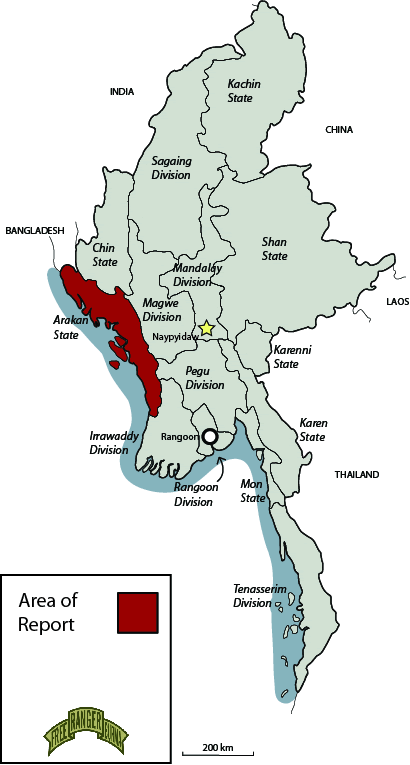
At last somebody in an official position has said something. United Nations human rights chief Navi Pillay has called for an independent investigation into claims that Burmese security forces are systematically targeting the Rohingya, a Muslim minority community living in the Arakan region. Even the Burmese government says at least 78 Rohingya were murdered; their own community leaders say 650 have been killed.
Nobody disputes the fact that about 100,000 Rohingyas (out of a population of 800,000) are now internal refugees in Burma, while others have fled across the border into Bangladesh. As you would expect, the Buddhist monks of Burma have stood up to be counted. Unfortunately, this time they are standing on the wrong side.

This is perplexing. When the Pope lectures the world about morality, few non-Catholics pay attention. When Ayatollah Khamenei of Iran instructs the world about good and evil, most people who aren’t Shia Muslims just shrug. But Buddhist leaders are given more respect, because most people think that Buddhism really is a religion of tolerance and peace.

When the Dalai Lama speaks out about injustice, people listen. Most of them don’t share his beliefs, and they probably won’t act on his words, but they listen with respect. But he hasn’t said anything at all about what is happening to the Rohingyas ― and neither has any other Buddhist leader of note.

To be fair, the Dalai Lama is Tibetan, not Burmese, but he is not usually so reserved in his judgments. As for Burma’s own Buddhist monks, they have been heroes in that nation’s long struggle against tyranny ― so it’s disorienting to see them behaving like oppressors themselves.

Buddhist monks are standing outside the refugee camps in Arakan, turning away people who are trying to bring food and other aid to the Rohingya. Two important Buddhist organizations in the region, the Young Monks’ Association of Sittwe and the Mrauk U Monks’ Association, have urged locals to have no dealings with them. One pamphlet distributed by the monks says the Rohingya are “cruel by nature.”

And Aung San Suu Kyi, the woman who spent two decades under house arrest for defying the generals ― the woman who may one day be Burma’s first democratically elected prime minister ― has declined to offer any support or comfort to the Rohingyas either.

Recently a foreign journalist asked her whether she regarded Rohingyas as citizens of Burma. “I do not know,” she prevaricated. “We have to be very clear about what the laws of citizenship are and who are entitled to them.”

If she were honest, she would have replied: “Of course the Rohingya are citizens, but I dare not say so. The military are finally giving up power, and I want to win the 2015 election. I won’t win any votes by defending the rights of Burmese Muslims.”

Nelson Mandela, with whom she is often compared, would never have said anything like that, but it's a failure of courage on her part that has nothing to do with her religion. Religious belief and moral behavior don’t automatically go together, and nationalism often trumps both of them. So let’s stop being astonished that Buddhists behave badly and just consider what’s really happening in Burma.

The ancestors of the Rohingya settled in the Arakan region between the 14th and 18th centuries, long before the main wave of Indian immigrants arrived in Burma after it was conquered by the British empire during the 19th century. By the 1930s the new Indian arrivals were a majority in most big Burmese cities, and dominated the commercial sector of the economy. Burmese resentment, naturally, was intense.

The Japanese invasion of Burma during the Second World War drove out most of those Indian immigrants, but the Burmese fear and hatred of “foreigners” in their midst remained, and it then turned against the Rohingya. They were targeted mainly because they were perceived as “foreigners,” but the fact that they were Muslims in an overwhelmingly Buddhist country made them seem even more alien.

The Rohingya of Arakan were poor farmers, just like their Buddhist neighbors, and their right to Burmese citizenship was unquestioned until the Burmese military seized power in 1962. However, the army attacked the Rohingya and drove some 200,000 of them across the border into Bangladesh in 1978, in a campaign marked by widespread killings, mass rape and the destruction of mosques.

The military dictator of the day, Ne Win, revoked the citizenship of all Rohingyas in 1982, and other new laws forbade them to travel without official permission, banned them from owning land, and required newly married couples to sign a commitment to have no more than two children. Another military campaign drove a further quarter-million Rohingyas into Bangladesh in 1990-91. And now this.

On Sunday former general Thein Sein, the transitional president of Burma, replied to U.N. human rights chief Navi Pillay: “We will take responsibilities for our ethnic people but it is impossible to accept the illegally entered Rohingyas who are not our ethnicity.” Some other country must take them all, he said.

But the Rohingya did not “enter illegally,” and there are a dozen “ethnicities” in Burma. What drives this policy is fear, greed and ignorance ― exploited, as usual, by politicians pandering to nationalist passions and religious prejudice. Being Buddhist, it turns out, doesn’t stop you from falling for all that. Surprise.

Gwynne Dyer is a London-based independent journalist whose articles are published in 45 countries. http://www.koreatimes.co.kr/www/news/opinon/2012/08/137_116673.html
MORE; Genocide, Ethnic Cleansing of Muslims in Myanmar- Burma by Buddhist Terrorists
Visit: http://freebookpark.blogspot.com

Palestine History: Just on a Billboard


Part I – History On A Billboard
For the past few weeks, those taking local trains from New York City’s wealthier suburbs into Manhattan have encountered a succinct billboard history of the Israeli-Palestinian conflict. The lesson comes in the form of four aligned maps showing the absorption of Palestinian land by Israel from 1946 to the present, along with a declaration that “4.7 million Palestinians are classified by the U.N. as refugees.” In all respects, the ad is historically correct.


This was made possible thanks to the efforts of Mr. Henry Clifford, chairman of the area’s local Committee for Peace in Israel/Palestine, who purchased the billboard space so as to educate readers to what really is happening under the Israeli regime of occupation so generously supported by U.S. dollars.
Immediately the ads were labeled “anti-Semitic” by area rabbis and Jewish community leaders. Here is the reasoning of Dovid Efune, “editor of the Manhattan-based Jewish newspaper, The Algemeiner.”

“This is anti-Semitic because when people think of the Jews they think of the
Jewish state. Jews have seen this happen many times. It always starts with
messaging that says Jews are committing a crime.”

Three things are to be said about Mr. Efune’s reaction: 1) On one hand, he seems not to care that the map display and UN statistic are accurate and what that means for the lives of millions of people. 2) On the other, and no doubt quite inadvertently, he does infer that what the ad reveals is criminal behavior. 3) Finally, if there is any truth to the assertion that “when people think of the Jews they think of the Jewish state” it is because Zionist propagandists have, for over 64 years, incessantly insisted on that identification. Those Jews who have publically denied the connection have been abused and libeled. So, to the extent that Jews in general are identified with Israel’s “committing a crime,” you can thank the Zionists for that.

Rabbi Joshua Davidson (no relation to this blogger), senior Rabbi of Temple Beth El in northern Westchester, N.Y., says the map ad presents “a distorted and skewed view of a complicated conflict.” Actually, that is untrue. The ad simply puts forth historical truth. In addition, the conflict really is not as complex as Zionists say it is. It is the consequence of a rather straightforward, post-World War I, imperialist land grab that, in the case of Palestine, is on-going even now. It was and continues to be justified by religious mythology on the one hand and the history of anti-Semitic persecution on the other. The land grab was originally abetted by the British imperial politicians, some of whom imagined that they were helping to fulfill biblical prophecy, and others who saw a Jewish homeland in Palestine as a way of solving the “Jewish problem” in Europe. The Palestinians, being seen as inferior natives, were then and are now, still pushed aside.

Part II – Fanaticism On The Ground
Rabbi Davidson might object to such simplicity, but Dani Dayan would not. Dayan is the leader of the “Yesha Council of Jewish Communities,” a leading organization espousing Israeli settlement of the West Bank. Unlike Rabbi Davidson, Dayan does not seek refuge in historical complexity. He lays it on the line in a recent New York Times Op-ed.

“Arabs called for Israel’s annihilation in 1967, and Israel legitimately
seized the disputed territories, and the right of Israelis to call them home
today, is therefore unassailable.”

Unfortunately, the days when conquest automatically resulted in a transfer of sovereignty ended with World War II. The primary rationale for the creation of the United Nations and the expansion of international law was to prevent just the sort of behavior Dayan describes.

Also, like the statement of Dovid Efune, Dayan’s argument is logically confused. He is claiming that the hyperbolic rhetoric of Arab leaders in the run-up to the 1967 war somehow frees Israel from its obligations as a signatory to such international treaties as the 4th Geneva Convention. Article 49(3) of that treaty prohibits an occupying power from “transferring parts of its own civilian population into the territory it occupies.” Successive Israeli governments, both of the left and the right, have energetically violated that law by transferring civilians into these conquered lands. Dani Dayan now proudly points out there are some 350,000 of these illegal squatters (the number goes up by 200,000 if we include the Israeli transfers into Jerusalem). And, because this now constitutes the new “status quo,” Mr. Dayan proclaims that Israelis have the “right…to call” such territories “home.”  Where did he get that right? From his god? From very ancient history? From the fact he walks about the area with an Uzi submachine gun strapped over his shoulder? There is certainly no basis for it in international law.

Dayan presents these illegally accomplished facts on the ground as “irreversible” and the two-state solution to the Israeli-Palestinian conflict as “unattainable.” He challenges his readers to understand the “realpolitik” truth of his position. And, according to Richard Falk, United Nations Special Rapporteur for Palestinian Human Rights, it is hard to “doubt the force of Dayan’s reasoning on this central issue.” Well, if not settler leader's reasoning, which is faulty, then certainly one cannot doubt Israel’s physical possession of increasing amounts of Palestinian land. Apparently, the governments of the world have capitulated to Dani Dayan and vigilante squatters. Hamas, which would gladly defy them, is confined, also with international blessings, to Gaza, the world’s largest outdoor prison. Thus, there is no military presence on the ground that can gainsay Mr. Dayan. So what does this imply, that might makes right? Is that Mr. Dayan’s version of Israel acting as a “light unto the nations”? Apparently so.
Part III – The Need for Outside Pressure
However, Dani Dayan and his settler movement have not written the final act in this tragedy. Even if we take note of his present position in the West Bank, and also admit that the “peace process” is a pitiful fraud, it is premature for Dayan to proclaim that he has won the struggle and we must all accept his “status quo.” Colonialist ventures can be defeated in more than one way. The “usual” way is through prolonged and bloody armed struggle. Thanks to the world-class military machine the United States has helped Israel create and maintain, this is not a likely path to success. But such regimes have also been forced to transform themselves into more equitable, more democratic, and less repressive ones through concerted outside pressure. And such pressure is now as real and growing as Dayan’s squatter movement.

A major effort at outside pressure is the worldwide BDS (boycott, divestment and sanctions) campaign against Israel. Ilan Pappe, an Israeli born professor at Exeter University in England,notes that this “campaign’s elasticity has made it into a broad process powerful enough to produce a new public mood and atmosphere….” As someone who has spent the last 35 years espousing the Palestinian cause, I can testify to the truth of that statement, even here in the United States.


It might very well be that Israel is here to stay. But that does not mean that it will always be the racist, oppressive society it is now. Consistently applied outside pressure, growing in scope and strength, can wear down support for ideologues such as Dani Dayan and his backers both in and outside of today’s Israel. It can, slowly but surely, convince ordinary Israelis that they have a choice: go along with their expansionist leaders and face increasing international isolation or, as Pappe puts it, cooperate willingly in “finding a formula for joint living” – that is, creating a better society that is tolerant and mindful of the need for justice, first and foremost for Israel’s victims, the Palestinian people. Also a nation that can be trusted to honor their obligations under international law.

Part IV – The Fate of International Law

It should be clearly understood that it is not just Israel’s future or that of the Palestinians that is at stake here. All of us have to ask what value we place on international law.  What value do we place on a world that recognizes the primacy of law born sane human reason, rather than religious mythology, apocalyptic fantasies, and tribal nationalism? It is all wrapped up together; as goes the Israeli-Palestinian conflict, so goes the viability of international law.

It is ironic in the aftermath of the Holocaust that international law was strengthened and now, as the history so simply displayed on Mr. Clifford’s billboards tells us, it is the Israelis who choose to cast it aside. If we allow this to happen, the world becomes more dangerous for all of us.
More >>>>

If you are as puzzled as I am as to how a true Christian could possibly be taken in by Zionism, a short paper on the phenomenon is available from the Irish-Palestinian alliance, Sadaka. Sadaka sums up the Christian Zionist ...
The Nakba is the Palestinian catastrophe. It means upheaval, violence and cataclysmic loss; it describes the terror, which drove almost one million people out of their homeland, as well as the perpetual terror in exile ...
According to the Old Testament, God pledged much of what is now Palestine and Israel to the 'children of Israel'. And the influential, pro-Israel Evangelical Christians in the United States believe that until the ancient land of ...
This religious interference greatly increased after the Oslo agreement signed in 1993, between Israel and the Palestine Liberation Organisation (PLO). As a matter of fact, Rabbis call the Israeli withdrawal from the West Bank ...
The 1988 charter of Hamas, a Palestinian Islamist group, states that The Protocols of the Elders of Zion embodies the plan of the Zionists. Recent endorsements in the 21st century have been made by the Grand Mufti of ...
The Zionist Jews consider Zionist Fundamentalist Christians as useful idiots, serving their purpose of colonial Zionist existence in Palestine and world domination through control of world economy & USA, while Zionist ...

After sober reflection on what I had discovered about Jewish supremacy and Zionism, I had to abandon all my previously held notions as to the history of Jewish persecution. What I have trouble understanding is why they ...

Türkiye'nin Birmanya oppreaaed Müslümanlara yardım yol açar


Türk Başbakanı bayım bir Türk dışişleri bakanı ve karısı onları teselli ve yardıma Birmanya mazlum Müslümanların ziyaret etti. Türkiye, Müslüman çoğunluğa sahip laik bir ülke ama; nereye kadar liderleri ve İslam ve Müslümanların neden şampiyon olduğunu iddia eden Müslüman ülkelerin yöneticileri denir? Bunların haram zenginlik ve güç korumak için kendi Masters lütfen Meşgul! Mevcut Türk hükümetinin gerçekten insanlarını ve üzerinde Müslümanlar dünyanın duyguları temsil eder.Başlığı Halifeliğin veya OLMADAN, İslam dünyasının liderliği rolünü üstlenmesi için öne çıkmaya Türkiye için zamanı. Onun değil başlığı önemli ruhu ... Allah, Türkiye'nin tam insanlar ve mevcut liderlik kutsasın 
زار وزير الخارجية التركي وزوجة سيد رئيس الوزراء التركي المسلمين المضطهدين في بورما لتعزية ومساعدتهم. تركيا دولة علمانية ذات غالبية مسلم لكن، أين هي ما يسمى قادة وحكام الدول مسلم الذين يدعون أنهم من بطل قضية الإسلام والمسلمين؟ مشغول لإرضاء أسيادهم لحماية هذه الثروات غير المشروعة، والسلطة! الحكومة التركية الحالية تمثل حقا مشاعر شعوبهم والعالم أكثر من المسلمين. في وقت لتركيا على المضي قدما لتولي الدور القيادي للعالم مسلم، مع أو من دون لقب الخلافة. في 
الروح التي لا يهم عنوان ... صلى الله على قيادة peole والحاضر من تركيا

The Turkish foreign minister and wife of Turkish Prime mister visited oppressed Muslims of Burma to console and help them. Turkey is a secular country with Muslim majority but; Where are the so called the leaders and rulers of Muslim countries who claim to be champion of cause of Islam and Muslims?  Busy to please their Masters to protect their ill-gotten wealth and Power! Present Turkish government truly represents the sentiments of their people and the Muslims world  over. Its time for Turkey to come forward to take on the leadership role of Muslim world, with or  WITHOUT the title Caliphate. Its the spirit which matters not the title... Allah may bless the peole and present leadership of Turkey. 


Visit: http://freebookpark.blogspot.com