Featured Post

SalaamOne NetWork

SalaamOne سلام   is   a nonprofit e-Forum to promote peace among humanity, through understanding and tolerance of religions, cul...

Banned’ Ramadan for Uighur Muslims in China Violation of Human rights: 禁止在中国维吾尔族穆斯林斋月违反人权

禁止在中国维吾尔族穆斯林斋月违反人权
如果你不想极端主义,然后允许快速穆斯林斋月期间在和平


It’s not exactly breaking news that China has serious issues with freedom of religion and as an officially Atheist state is often very repressive against those observing religious rites.

China has once again leveled restrictions on the persecuted Uighurs when it comes to practicing Ramadan.

BEIJING – Unlike millions of Muslims around the world, Uighur students returning for summer vacations in northwestern China are banned from fasting during the holy month of Ramadan.

“They are extracting guarantees from parents, promising that their children won’t fast on Ramadan,” Dilxat Raxit, Sweden-based spokesman for the exile World Uighur Congress (WUC), told Radio Free Asia on Thursday, June 13.

Chinese authorities have reportedly imposed restrictions on Uighur Muslim students returning for summer vacations in the northwestern region of Xinjiang ahead of Ramadan.

Under the restrictions, Uighur students under 18 are banned from fasting during Ramadan or taking part in religious activities.

Students defying the restrictions are being reported to authorities for punishment.

“They have also made groups of 10 households responsible for spying on each other, so that if a single child from one family fasts for Ramadan, or takes part in religious activities, then all 10 families will be fined,” Raxit said.

“It’s called a 10-household guarantee system.”

Religious officials have confirmed that Ramadan fasting is banned for Uighur Muslim students.

“[Fasting] is not allowed,” an official at a religious affairs bureau in Hotan’s Yutian County told Radio Free Asia.

“The students and the teachers have to report to their schools every Friday, even during the vacation.

“It’s like regular lessons,” he said, adding that the students would also be eating there.

Activists have also complained that Uighur students are being stripped off their mobile phones ahead of Ramadan.

“After the students get back to their hometowns, those with cell phones and computers must hand them in to the police for searching,” said Raxit.

“If they don’t hand them over and are reported or caught by the authorities, then they will have to bear the consequences.”

The pre-Ramadan restrictions come ahead of the fourth anniversary of deadly riots in Xinjiang, which left nearly 200 people dead.

Chinese authorities have convicted about 200 people, mostly Uighurs, over the riots and sentenced 26 of them to death.
If you do not want extremism, then allow Muslims to fast during Ramadan at peace
如果你不想极端主义,然后允许快速穆斯林斋月期间在和平
Related:
Throughout the history of Islam in China, Chinese Muslims have influenced the course of Chinese history. Chinese Muslims have been in China for the last 1,400 years of continuous interaction with Chinese society. Muslims ...
Free-eBooks: http://goo.gl/2xpiv
Peace-Forum Video Channel: http://goo.gl/GLh75

As we came from the Holy Land

“As a writer based in Jerusalem, I have an intense relationship with history. I feel that now, in a time of occupation and checkpoints, what I write is necessary in order to encapsulate and diffuse the present, but also how this period will be understood in the future.” [Aamer Hussein is a fiction writer, critic and professor of literature.]

At the border with Jordan, they took away five passports. I was the first to get mine back. The others — an American Palestinian, a British Palestinian, a London-born Turk, another Londoner who was half-Egyptian, and a young man from Manchester — were kept waiting until it was time to close the checkpoint. One or two had been called into a room and questioned; I’d only been asked to spell my grandfather’s name over and over again though I said he had nothing to do with this country.

We were a group from England — writers, a cameraman, a blogger, travelling for the sixth annual Palestine Festival of Literature. From the border we took the bus into what seemed to be no man’s terrain: rocks, deserts, a few villages, some Arab, some Israeli. And then we were in Area A, designated Palestinian Territories, signposted with a warning that no Israeli citizen should enter. (And yet they do. They pockmark the landscapes with their buildings, their antennae, their flags.)

We reached Ramallah, a haven on a hill. That evening, novelist Gillian Slovo read from her novels in a garden. She was accompanied by a singer and two musicians. When she left the stage, the haunting music went on; the garden was full of people, both local Europeans and Palestinian, moving around and sipping fresh fruit juice and coffee from paper cups. The breeze was bracing, cool. With just a stroke or two of the brush this picture could be changed into one of many literary gatherings I’ve attended.

The next morning, at Birzeit University, I met a group of students to talk about the short story. I soon realised they knew most of what I had to tell them and tried to go deeper. I read a passage from one of my stories and they all recognised the Surah Maryam from the Quran. The exchanges soon moved from the normal stuff of workshops to the subject of history and myth, experience and memory. One young woman in a headscarf said she’d had a very normal life — no relatives murdered, no one in prison or in exile, and yet she couldn’t escape history. A young man said he wrote Sufi parables to escape the absurdity of existence. He must have been about 19. As they left, he handed me a sheaf of stories.

Then, a few hours later, Qalandiya: one of the infamous checkpoints. Nothing I had heard or read had prepared me for the experience. Adolescent Israeli soldiers barking over mikes from their glass booths. Narrow corridors in which you waited until a green light came on and then you had to walk single file, dragging your luggage towards revolving gates so oddly angled and narrow that you were sometimes stuck in them with your suitcase as you tried to get through. At the other end, a boy behind a window told me three times to take my spectacles off while he checked my passport.

We reached East Jerusalem, and were driven to the neighbourhood called Shaikh Jarrah. Two women at a local community centre told us how people who’d been living here for decades had been chased out of their family homes on the pretext that they were settled there illegally, to make room for more and more settlers. They took us to meet Hajja Fatima, who had come back to Jerusalem after ’48 with her husband to live with her ailing parents. After their death she had been constantly beleaguered by the authorities who told her she had no right to live there. (Try to repair, rebuild, renovate and the Israeli authorities crack down and make you pay to undo what you’ve done.) As we walked away, I put my arm around Sara’s shoulder, the Palestinian-American I’d known for a day, who like many of us was crying.

We walked down the Via Dolorosa, lined with people selling fruit, spices and souvenirs, to the church where Jesus’s body had rested when he was taken down from the cross. A group of South Indian pilgrims bent, one by one, to kiss relics. Deeper, in the belly of the church, a choir of Armenian boys sang. At some point of their chant they began walking, still singing. When they stopped, a group of worshippers bent to touch the earth, kiss their fingers, and bring their fingers to their foreheads.

At the exit, another checkpoint. Behind me, I heard the sound of altercation: an Israeli soldier had grabbed the documents of Muna Hasan, the young activist who was with us, and pushed her back from the barrier when she took them from him. As she stepped away, a soldier with an American accent told her she had to go the long way round. I guessed that her Hebrew, though she wasn’t speaking it, was better than his.

The next morning we went to the Mount. I’d been told that we probably couldn’t visit Al-Aqsa, but as we entered the courtyard Sara and I looked at each other and decided to stand in the doorway to see if we could look in. An elderly man approached us and spoke to us in Arabic. “You want to go in?” Yes. “Go then.”

From the side, two young men called out and asked me to say a prayer as proof of my Muslim identity. I recited the Fatiha; after hearing me read the first two lines they let me pass. Epochs converged in the serene space of the mosque’s great hall where I stood for a few minutes.

We went to Bethlehem. As we got off our coach, a woman who looked as if she might have stepped out of a fashion magazine approached us and took us to the emporium where her family had been selling Christian souvenirs for decades. But Claire Anastas — that was her name — wasn’t selling us souvenirs. She was telling us about how she couldn’t enter parts of her own house because the Israelis had decreed them out of bounds. Too close to the wall. Her story had been honed and polished by multiple tellings; no one has done anything for her, to relieve her pain, and she seemed destined to endless repetition. Part of the house, I seem to remember, had once been a guest house, but now her business has slumped; hardly anyone visits that divided corner any more.

In front of her shop is the wall that cuts off a part of Bethlehem from its natives — the tomb of Rachel, the Jewish matriarch, lay beyond it. This wall was once a blank page, which residents of the town have covered now with their testimonies of exile and return. There are messages, too, from those who, like Claire and her family, refused to leave.

“What we all want is the right to live in dignity and safety, to live where we belong,” novelist Ibtisam Azem said as we looked over the rooftops of Hebron the next morning. “And the choice to leave freely, without constraint.” (I had first met Ibtisam the night before; she read from her work in Jerusalem, and spoke about the uses of documentary material for the imaginative writer. For some years she lived in Germany and then moved to New York.)

As we walked down the streets of Hebron to the mosque of Abraham, a child followed us and asked me in Arabic, “Ya Haj, where have you come from?” Ibtisam explained. When he heard I came from London, he remarked: “Why would you come here to Hebron, of all places?” His eyes were so blue they were almost violet. “It’s a ghost town,” his friend added in English.

It was indescribable. A settler woman dreamed that Sarah had once bathed from a well on a hall on the other side of the town’s main shopping street. So the settlers decided to take over the main part of the town. They blocked access to Palestinians who wanted to move from one part of the town to another. We walked through the main artery of the town, with its shops selling everything you can imagine. Above our heads were ugly additions settlers had built to old houses so that they could squat there. They liked to provoke the locals by flinging rubbish at them: broken bottles, rotting food and even excreta. As we looked above our heads we saw nets the locals had built to protect themselves from the shower of trash; they were burdened with detritus, as if some mad artist was trying to create a crazy installation to cover the entire town.

We passed through another checkpoint to get to the other side of Hebron. As we waited for the younger, darker members of our group to come through — this had become a predictable occurrence — an Israeli guard (they say there are two or three guards in the town for each settler) said: “Move away, they might throw stones.” “Who are they?” Gillian asked. “Oh, them,” the boy, who looked about 18, muttered as he moved away. And “they” were glaring down at us as we sat on the terrace of Issa Amro’s hilltop house; a man with a long orange beard and his guard (or two? I couldn’t tell because the afternoon sun was in my eyes.) Sometimes the guard would point his gun in our direction. The settlers are trying to chase the locals away from the hill. From the town.

In the ancient mosque, surrounded by the sanctuaries of Abraham and his family, I found myself praying again, every prayer I could remember, for freedom and protection and for the time the town would be safe and whole and undivided again.

Hebron, or al-Khalil as the locals call it, was a beautiful Palestinian town, with its winding lanes and its stone walls built to welcome the breeze in summer and give shelter from the wind in winter. And the people of the town are trying to rebuild it. As we walked down the streets, Walid, who was leading us through his city — or through those parts of it he could enter — remembered a young boy in his teens, deaf perhaps, who was shot down here for no reason. It was his birthday; his 17th, I think.

On the way back to Jerusalem, two Israeli soldiers jumped into our coach and wanted to see our passports. They seemed to have an instinct for spotting Palestinians, even a generation or two away from their origins. This time they targeted Ibtisam and started asking questions about her papers. She responded in what sounded like fluent, idiomatic Hebrew. After the usual delays, they let us pass.

In the evening we reached Haifa, where it was to be my turn to read from my work, but I was too drained to shower or change. I sat on the terrace and looked out at the sea, sipping a Turkish coffee. The concert hall was packed when we got there, late. The programme had been altered and I was one of the last to perform. The night before, writer Haneen Namnih, who had translated my story, ‘The Tree at the Limit,’ and poet Najwan Darwish, who had selected it for translation, had suggested I read it to the audience. Haneen, in particular, was taken by the story’s central image, of Sidrat-ul-Muntaha, the tree with the leaves on which the names of those who are to die are written. By the time I was on — between a ventriloquist and a violinist, as one of my companions later quipped — I was exhausted and wondering what relevance this imagistic fiction of another time in Pakistan, when religious scholars were accused of transgression for interpreting certain traditional stories as allegories, could have for my audience; I couldn’t tell, and I couldn’t hear the translation on the earphones. I hadn’t been writing since I got here, and though I was officially visiting the West Bank as a writer I hadn’t been thinking about writing at all. I told the audience I felt that it was an anticlimax to read a short story after everything I’d seen in the past three days.

But the next day we were back in Palestine, in the resplendent city of Nablus. In a courtyard we watched the sun set while the iconic band al-Turab played songs with inflections of jazz to an enormous audience. Many of the songs were poems set to music, some by Najwan who was supposed to make it from Jerusalem. Halfway through the concert we heard he had been held up at a checkpoint and wouldn’t be there. Basil, the lead singer, picked up his oud and sang a song that sounded like an ancient dirge, as if it had been crafted from stones and the memory of a river not far away.

The next night in Ramallah would be our last in Palestine. As I sat talking to Basil at dinner we heard Najwan had arrived. Their delayed performance took place in that garden in Ramallah.

I was thinking how, in these few days I’d been in their land, I’d heard Palestinians make music and poetry and stories, and on the way across the border Jerusalem-based journalist  Maath Musleh had told me stories of the land from Ottoman times until the present. I’d kept expecting to hear the familiar lines “but you wouldn’t understand, you haven’t lived through this,” but instead I heard the opposite: stories that included the listener, songs that drew me in, poems that made me feel I lived within them.

Late that night, I was dropped at my hotel by poet and novelist Mustafa Mustafa, who had been asking me my impressions of his country and answering my questions. When I reached my London flat less than 20 hours later I had a message from him, continuing our conversation. I had been too busy to take notes on my trip, too absorbed in what was around me to write in my journal. So I thought I’d end this piece with his words. I want you to tell my Pakistani readers something about yourself, I said to him. Here is his reply:

“As a writer based in Jerusalem, I have an intense relationship with history. I feel that now, in a time of occupation and checkpoints, what I write is necessary in order to encapsulate and diffuse the present, but also how this period will be understood in the future.”
By Aamer Hussein is a fiction writer, critic and professor of literature.
http://x.dawn.com/2013/06/16/column-as-we-came-from-the-holy-land-by-aamer-hussein/
Related:
http://en.wikipedia.org/wiki/Palestine
Some of these political ideas had affected him personally, in particular Zionism. As a schoolboy in London and a Cambridge undergraduate, Judt had been not only a committed supporter but also an energetic activist in Dror, ...
Jerusalem, Covenant, Chosen Race רושלים, האמנה, גזע הנבחר; Zionism or Racism ציונות או גזענות; Promise Land & 13Th Tribe יעוד קרקע השבט השלושה עשר; Islam & Judaism האסלאם והיהדות. Related Links: ...
The Khazars, he contends, engendered those Askhenazi Jews of central and eastern Europe who would later invent the myths of Zionism to justify their colonization of Palestine, a land to which they had no “ethnic” connection ...
Free-eBooks: http://goo.gl/2xpiv
Peace-Forum Video Channel: http://goo.gl/GLh75

USA and Peace


The most important goal for America is to reduce the size, expenditure, and use of its military Can we be number one? No, not number one in military spending (which we are). Not number one in incarceration rates (which we are as well).

What if, instead of these things, the United States became hyper-focused on becoming the most peaceful nation on earth?

The recently released 2013 Global Peace Index (GPI) placed the US 100th out of 162 countries. That’s not so spectacular.


The GPI, which is endorsed by a number of Nobel Peace laureates, eminent individuals, and renowned academics, considers factors related to both negative peace, that is, the absence of violent conflict, and positive peace, or characteristics of just and humane societies, like ample housing, access to education, lack of poverty, healthcare, and gender equality.

The GPI’s Positive Peace Index measures attitudes, institutions and structures that either promote or prohibit a peaceful environment.

The 2013 GPI noted that, since the 2008, 110 countries have become less peaceful. The US is one of these. The US scores particularly poorly in regards to its high prison and jail population, its large and active military, the number of conflicts it is engaged in overseas and the number of combat deaths, its heavy weapons capacity and ease of access to small arms.

The US rates moderately on measures related to gender equality, education, and infant mortality.

This failure to commit to peace is a global catastrophe, and a costly one at that. The GPI report calculates the total economic impact of containing violence to have been $9.46 trillion in 2012.

According to the report, cutting the cost of violence in half would be enough to repay all the debts of the developing world, provide for European financial stability, and fully fund the Millennium Development Goals.

So, what does it take to get to the top, to be a ‘peace’ country? The top ten of the GPI is dominated by small Nordic countries, although New Zealand, Canada and Japan are included as well. Despite being far different geographically and in its population, the US can perhaps draw a thing or two from these countries.

Difficult economic times notwithstanding, Iceland is number one for its low crime rates, its minimal military, and its resistance to getting involved in global violent conflict.

In general, the high peace countries tend to have, among other qualities, more equitable distribution of resources, greater trust between citizens, and more social cohesion.

They invest in health and education and seek alternatives to retributive justice. In essence, nations that score high on positive peace tend also to be high on the overall GPI.

Perhaps the most important goal for the US is to reduce the size, expenditure, and use of its military. It is this militarism that is the underlying cause of the country’s poor ranking. Yet 57 percent of President Obama’s proposed 2014 budget is devoted to the military. Not a step in the right direction.

All the more reason, however, for anyone who wants peace to remain vocal and vigilant. How about if we try to be number one at something else for a change?
By
Laura Finley, Courtesy: Commondreams.org

Related:
More Video >> Peace Index
Free-eBooks: http://goo.gl/2xpiv
Peace-Forum Video Channel: http://goo.gl/GLh75

Nanotechnology and religion: a complex relationship

There is much evidence that public views on nanotechnology will be shaped by religious beliefs. In the science fiction short story Halo, a panel of Muslim scholars discuss a strip of bacon made by a "molecular assembler", a device capable of producing the meat directly from individual atoms, instead of slicing the meat from an animal. All meat from a pig is forbidden according to Islam's halal laws. Synthetic bacon is identical to the real one, but it has never been part of a living pig. Is it still forbidden?
"The story may look like a joke, but it shows how the capacity of nanotechnology to manipulate atoms may change the material world in such a way to raise religious questions," says Chris Toumey, a cultural anthropologist at the University of South Carolina, who has studied in depth the relation between nanotechnology and faith.
It is mostly secular voices who have expressed their thoughts and concerns on nanotechnology until now, but there is a lot of evidence that public views on it will be shaped by religious beliefs. For example, a 2009 survey found that strength of religious beliefs in the US is negatively related to support for funding of nanotechnology. A study of the same year found that the more religious a country is, the less it tends to find nanotechnology morally acceptable.
Until now, religions have been remarkably silent on nanotechnology, Toumey points out. Nothing compared to the harsh bioethical controversies about in vitro fertilisation in the Catholic world, for example. "Nanotechnology is a heterogeneous body of sciences and technologies: few faith communities have enough universities or journals to examine such a complicated issue," says Toumey. "Their attention may be attracted if some dramatic event happens: either positive, something like a cure for a cancer, or negative, like an environmental disaster." The scarcity of official documents makes it difficult to guess religious views, but it is an opportunity for scientists to get prepared in advance.
"I think there has not been much concern about nanotechnology in religious thinking, because if you look into it in detail, the concerns that arise don't come from nanotechnology in itself, but rather from specific applications, like those to food and environment," says Donald Bruce, founder of the Edinethics consultancy based in Edinburgh, which has worked for the Church of Scotland.
Toumey's analysis of the few studies done on believers' opinions has found a worry shared by several religions: that nanotechnology will reshape human nature. "Faith communities are reacting to the representation of nanotechnology made by a popular group of writers, called transhumanists," Toumey points out.
Transhumanism is a cultural current that thinks that technology (including nano) will steer human evolution artificially, eliminating diseases, extending life indefinitely, and using information technology to achieve cyberimmortality, something like storing a person's "soul" on a hard-disk. One of its most famous proponents is the futurist Ray Kurzweil. Transhumanists' ideas about immortality and the soul clash directly with postulates shared by most religions. "However, identifying nanotechnology with the kind of human enhancement that transhumanists talk about is a mistake," says Bruce.
A second shared concern is the fear that nanotechnology may take away individual control of one's life, by creating environmental impacts without people's consent, or by providing tools for a better life only to the rich. "These worries echo the general concerns of believers with respect to technology in general," says Toumey. "Some of them may be even shared by non-religious people, but studies show that believers are more articulate in discussing them." The vocabulary of God, soul, spirit, and eternal life provides a whole set of metaphors, symbols, narratives, and figures of speech which are useful to navigate ethical issues raised by technology, according to those studies.
Beyond shared worries, different religious denominations display a variety of approaches, in the few official documents available. Catholics relate the issue with classical bioethics problems: will new embryo diagnostics coming from nanotchnology lead to abortion? Will nanomedicine respect human dignity, even when health conditions deteriorate up to a point where euthanasia could be considered?
Non-Catholic Christians express their concerns about human hubris: for example, one author compares nanotechnology to alchemy, warning about the dangers of "total control over nature in the ability to transmute any substance into any other". Muslims take a very different path: rather than debating whether nanotechnology is right or wrong, they discuss who has the authority to make a decision: the question is casted in terms of ijtihad, the Islamic procedures for issuing legal rulings. Jewish writers frame the debate in the narrative of the Golem, This is a human-shaped creature assembled by men with religious or magic powers, whose behaviour can be beneficial or dangerous, in different stories: the baseline is that technology can improve creation, but this comes with a burden of responsibility for humans.
"I think that neither the scientific nor the faith communities are prepared for a debate on nanotechnology," says Toumey. "Believers are reacting to the extravagant ideas of transhumanism, which in fact have little to do with real nanotechnology. They would be wise to dedicate some attention to nanotechnology before making a decision. On the other hand, scientists should recognise that religion can bring thoughtful and constructive opinion. It would be wonderful if everybody knew a lot about nanotechnology, and if decisions could be taken based on this information, but unfortunately this is extremely unlikely."
According to Toumey, non-experts will form their opinion based on their values – well established and polarised positions on technology, which bring in concepts such as privacy, autonomy, justice – rather than on objective information.
"It would be good to steer a two-way dialogue between scientists and non-experts, where they could exchange information and concerns," says Toumey. He thinks that this dialogue is urgent. It will not be necessary to wait for transhumanists' promises to become true: something as prosaic as a slice of synthetic bacon may trigger the controversy.
Michele Catanzaro is a freelance journalist based in Barcelona with a PhD in physics. He is co-author of Networks: A Very Short Introduction .
~~~~~~~~~~~~~~~~~~~~~~~~~~~~~~~~~~~~~~~~~~~~~~~~~~~~
Craig Venter and his team have built the genome of a bacterium from scratch and incorporated it into a cell to make what they call the world's first synthetic life 
Genetic entrepreneur Craig Venter explains how his team of researchers created a new life form – and what happens next.
Video: Science Link to video:

Scientists have created the world's first synthetic life form in a landmark experiment that paves the way for designer organisms that are built rather than evolved.

The controversial feat, which has occupied 20 scientists for more than 10 years at an estimated cost of $40m, was described by one researcher as "a defining moment in biology".

Craig Venter, the pioneering US geneticist behind the experiment, said the achievement heralds the dawn of a new era in which new life is made to benefit humanity, starting with bacteria that churn out biofuels, soak up carbon dioxide from the atmosphere and even manufacture vaccines.

However critics, including some religious groups, condemned the work, with one organisation warning that artificial organisms could escape into the wild and cause environmental havoc or be turned into biological weapons. Others said Venter was playing God.

The new organism is based on an existing bacterium that causes mastitis in goats, but at its core is an entirely synthetic genome that was constructed from chemicals in the laboratory.

The single-celled organism has four "watermarks" written into its DNA to identify it as synthetic and help trace its descendants back to their creator, should they go astray.

"We were ecstatic when the cells booted up with all the watermarks in place," Dr Venter told the Guardian. "It's a living species now, part of our planet's inventory of life."

Dr Venter's team developed a new code based on the four letters of the genetic code, G, T, C and A, that allowed them to draw on the whole alphabet, numbers and punctuation marks to write the watermarks. Anyone who cracks the code is invited to email an address written into the DNA.

The research is reported online today in the journal Science.

"This is an important step both scientifically and philosophically," Dr Venter told the journal. "It has certainly changed my views of definitions of life and how life works."

The team now plans to use the synthetic organism to work out the minimum number of genes needed for life to exist. From this, new microorganisms could be made by bolting on additional genes to produce useful chemicals, break down pollutants, or produce proteins for use in vaccines.

Julian Savulescu, professor of practical ethics at Oxford University, said: "Venter is creaking open the most profound door in humanity's history, potentially peeking into its destiny. He is not merely copying life artificially ... or modifying it radically by genetic engineering. He is going towards the role of a god: creating artificial life that could never have existed naturally."

This is "a defining moment in the history of biology and biotechnology", Mark Bedau, a philosopher at Reed College in Portland, Oregon, told Science.

Dr Venter became a controversial figure in the 1990s when he pitted his former company, Celera Genomics, against the publicly funded effort to sequence the human genome, the Human Genome Project. Venter had already applied for patents on more than 300 genes, raising concerns that the company might claim intellectual rights to the building blocks of life.
http://www.guardian.co.uk/science/2010/may/20/craig-venter-synthetic-life-form

Related:
Free-eBooks: http://goo.gl/2xpiv
Peace-Forum Video Channel: http://goo.gl/GLh75

Conflict within Arabs in the Middle East is about more than just religion:


Recently, Shia-Sunni conflicts have seen Hezbollah help Syrian government forces to recapture Qusair. Battles rage between the two sides in Lebanon while in Iraq the monthly death toll from Sunni-Shia violence has topped 1,000. But religion alone does not explain the escalating tensions. Fundamental political shifts begun by the Arab spring are helping create new regional disputes in the Middle East
Nine days ago the influential Sunni cleric Yusuf al-Qaradawi denounced the Lebanese Shia Hezbollah movement – whose fighters helped Bashar al-Assad's regime retake the Syrian city of Qusair last week – as the "party of Satan".

Speaking in Doha not long before Qusair's fall, Qaradawi did not stop there: the cleric, whose speeches and sermons are heard by millions, went a dangerous step further, calling on Sunni Muslims with military training to support the Syrian uprising against Assad.

It was a sermon that not only marked a sharp shift in the sectarian tensions in the Middle East between Sunni and Shia but an escalation in Qaradawi's own rhetoric. When I heard him preach on Syria at Cairo's crowded al-Azhar mosque last autumn, he was sharp in his condemnation of the Assad regime, but stopped short of endorsing a jihad.

In Doha, however, Qaradawi's remarks embraced a more dangerous sectarian notion. "The leader of the party of the Satan comes to fight the Sunnis … now we know what the Iranians want … they want continued massacres to kill Sunnis," Qaradawi said. "How could 100 million Shias defeat 1.7 billion [Sunnis]? Only because [Sunni] Muslims are weak."

Qaradawi's comments – endorsed last week by Saudi Arabia's grand mufti, Abdul Aziz al-Asheikh – did not come out of nowhere. They were a direct response to a speech made by Hezbollah's general secretary, Hassan Nasrallah, in Beirut, not only admitting that his fighters were in Syria but pledging that his men would help Assad – a member of the Shia Alawite sect – to final "victory".

If ever evidence was needed of the escalating sectarian dimension to the growing regional instability in the Middle East – in which the worsening conflict in Syria is playing a large part – it was visible last week.

It is visible in the rubble of Syria's Qusair, emptied now of much of its population, and taken by a joint force of Hezbollah and Assad government forces, as well as in Lebanon's seaside city of Tripoli, the country's second largest, where gun battles between Alawites and Sunni militias are continuing.

It has been visible, too, in Iraq, where lethal tensions, in part inspired by Syria but more largely by the country's own political tensions, have been growing almost by the week, witnessing more than 1,000 deaths in May, the highest monthly toll since 2008.

And it has been Syria – above all – that has acted as a magnet for those looking to fight, for both Sunni jihadis and for Iraqi and Lebanese Shias alike.

It has become a cliche in recent months to talk of an inevitable and intractable sectarian divide between Sunni and Shia, over a schism in Islam that occurred 1,400 years ago. The reality is that the present rising tensions in the Middle East are far more complex than simple religious hatred. Rather, they reflect a growing friction rooted in more recent competitions over power, rights and identity which have been exacerbated both by the war in Iraq and by the reconfigurations of the Arab spring.

At the very heart of the debate is how much sectarian tensions themselves are driving the new conflicts or whether Sunni-Shia tensions have been co-opted into local and regional competitions whose nature is as much about power, politics and the distribution of resources as it is religious.

The split in the two branches of Islam is almost as old as Islam itself, resulting from a political struggle for leadership between followers of the Prophet Muhammad after his death. What emerged were sometimes subtly different – and sometimes quite radically different – interpretations of Muhammad's teachings. Despite that, there has been no equivalent in Islamic history of the Thirty Years' War that pitted Protestant against Catholic in Europe, while for long periods and in many places – not least Iraq despite its recent problems – Shia and Sunni have not only coexisted but widely intermarried.

Marc Lynch, director of the Institute for Middle East Studies at George Washington University, writing recently in Foreign Policy, cautioned that the narrow emphasis on sectarianism was unhelpful. "The sectarian master narrative," wrote Lynch, "obscures rather than reveals the most important lines of conflict in the emerging Middle East. The coming era will be defined by competition between (mostly Sunni) domestic contenders for power in radically uncertain transitional countries, and (mostly Sunni) pretenders to the mantle of regional Arab leadership. Anti-Shia-ism no more guarantees Sunni unity than pan-Arabism delivered Arab unity in the 1950s." In other words, the emerging conflicts are largely inter-Sunni rather that Sunni-Shia. Lynch also points to the rivalry between Qatar and Saudi Arabia to arm different rebel factions, a competition, he suggests, that has undermined Syrian opposition unity.

Geneive Abdo, a fellow at the Stimson Centre thinktank and author of The New Sectarianism, however, admits to being "fairly pessimistic" about the current trajectory of Sunni-Shia tensions, arguing that it comes amid a wider "intensification" of sectarian identity across the Middle East that cannot be explained easily with reference to social, economic or political context.

"One mustn't forget that some of the new sectarianism began with Iraq [following the invasion]. The fall of the authoritarian regimes during the Arab spring," she adds, "coincided with an increased interest in identity politics of all kinds, including sectarian identity."

Abdo – like a number of other analysts – traces the roots of the present Shia-Sunni tensions back to the 1960s and 1970s, rather than further back in time. That period saw the beginning of the Shia revival movement in Lebanon which – like the opposition movement in Syria today – argued for equality and inclusive rights for Shias in Sunni-ruled states.

Abdo believes, however, that the new sectarianism is being driven by competing factors, including both the way in which Sunni and Shia states are engaged in Syria, sectarian tensions in Syria itself and "the perception" in places such as Bahrain, where a Sunni monarchy is in competition with a Shia majority over political rights, that the competition is sectarian in nature – a self-fulfilling prophecy.

The issue of how sectarianism is playing in the region's emerging conflicts – not least in Syria – is made doubly difficult by the fact that the spectre of widening Sunni-Shia conflict is also being cynically exploited, a claim made by the Iraqi scholar Harith al-Qarawee, writing in National Interest earlier this year about Iraq.

There, he argues, "sectarian identities are used by political entrepreneurs to achieve political goals. Although cultural symbolism and collective narratives are a part of this process, the real objectives are political – and largely calculated."

Qarawee and others also point to a recent process of "Sunnification". On a local level in Iraq, this has seen minority Sunnis – who once dominated the country and have been politically and economically excluded in a Shia-dominated post-Saddam Iraq – increasingly embrace a sectarian identity.

More widely, if much less dangerously, that has coincided with the emergence of new Islamist governments across the region closely associated or dominated by the Muslim Brotherhood.

Others argue that the sense of a sectarian crisis – most notably over Syria – has been confected by the Assad regime.

"The sectarian element was introduced into the revolution in March 2011 by the Assad regime itself, which wants to identify it with sectarian strife," says Syrian writer and analyst Rime Allaf. "It deliberately embraced this idea because it knows people are afraid of it … The regime and its allies in Hezbollah have tried to present their position as a defensive one, but people are not buying it." She argues, too, that Assad's recent co-option of Hezbollah is as much to do with his lack of trust in sections of his own armed forces as a pan-regional strategic alliance spreading from Iran to Lebanon.

And if it has been Hezbollah's overt intervention in the fighting in Qusair that has set the alarm bells ringing ever more loudly, it is worth noting that the Hezbollah's interest in Syria has less to do with the fate of its Alawite co-religionists and everything to do with its own survival and interests.

A Lebanese client of Iran, Hezbollah has long relied on the Assad regime as a conduit for the sophisticated arms and other support that has allowed the movement to exert a disproportionate influence in Lebanon.

It has not only been in Syria where the alleged danger of sectarian interference has been used to justify human rights abuses. In Bahrain, which has seen intermittent protests for two years and a continuing crackdown by Sunni rulers on marginalised Shias, the ruling family has tried to paint legitimate protests as Iranian-inspired interference.

Vali Nasr, a member of the US state department's foreign policy board and author of The Shia Revival, who has charted the increasing importance of Shia influence and politics since the fall of Saddam, suspects there may be more subtle doctrinal considerations as well at work in the increasingly febrile comments of those like Qaradawi. Nasr points to Qaradawi's remark that Sunnis can only be beaten if "they are weak".

"Hezbollah and Iran pulled something big off. They showed [over Qusair] that they are more capable of fighting than Sunnis. For those like Qaradawi – for whom the discourse is about empowerment for followers of the true religion – it cannot be allowed that Sunnis are shown as somehow feeble."

While Nasr has long predicted a decisive shift in the centre of gravity in the Middle East towards Shia Iraq and Iran, he is careful to distinguish between the motivations of individual Shia fighters who are being drawn to Syria from places like Iraq, and Sunni jihadis who have travelled to fight for Sunni jihadi groups like Jabhat al-Nusra, following recent claims of the new emergence of a kind of "Shia jihadism".

"For Shias, Syria is not the Spanish civil war or Afghanistan. Many of those Shia who are going to fight are going from places like Lebanon and Iraq because they believe they are fighting for themselves.

"It is seen as a forward deployment by those who fear that, if Assad loses, Sunnis will come after them. They see it as a pre-emptive defence." He adds: "People in the wider Middle East care about Syria not because they necessarily care about Syrians but because they care about their own fights."

Nasr, who is more optimistic than most, suggests, too, that the current tensions can be seen as marking the final unravelling of the shape of the region first conceived in the Anglo-French Sykes-Picot agreement that foresaw the dismemberment of the Ottoman Turkish empire.

"Those structures are now coming undone: first under the boots of US soldiers in Iraq and more recently under the heels of the democracy protesters of the Arab spring."
By Peter Beaumont: http://www.guardian.co.uk/world/2013/jun/08/middle-east-full-blown-religious-war

Related:
Free-eBooks: http://goo.gl/2xpiv
Peace-Forum Video Channel: http://goo.gl/GLh75

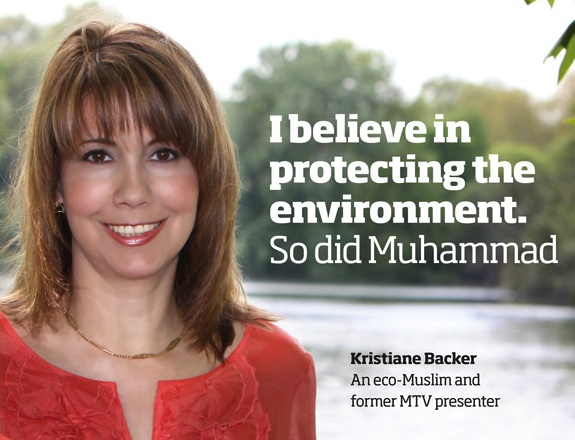
"Inspired by Muhammad" is Islam's Green Message to Break Terrorism Link


The relationship between human beings & his... by Islamicinvitation
Muslims everywhere can be at “peace with the earth and be at peace with heaven” by adopting environment message from the Qu’ran, advocates new UK campaign launched by Muslim convert.
Shocking statistics and a love for the environment have inspired a new campaign which highlights Islam’s Eco message in order to break the link between Islam and extremism.Inspired by Muhammed is a new campaign which showcases Muslims who have been inspired by their faith to contribute positively to society and focuses on areas such as women’s rights, social justice as well as the environment. Its message can impact the Middle East and the world.
Launched by the Muslim convert Kristiane Backer (pictured above) on behalf of the Exploring Islam Foundation, the campaign hopes to improve public understanding of the more positive aspects of Islam.
The campaign was prompted by shocking finds from a May 2010 national poll in Britain which found that more than half the British population associated Islam with extremism (58%) and terrorism (50%). The opinion poll also discovered that just 6% of the British population believe that Islam promotes active measures to protect the environment.

Kristiane, the former MTV presenter from Germany, is one of the campaign profiles and talks about her awareness of green issues and how she’s adopted an environmentally-friendly lifestyle to suit her Islamic beliefs.

She explains: “Green living and the preservation of our resources are essential principles of Islam. ‘Don’t be wasteful, for God does not like the wasters,’ the Qur’an tells us. Prophet Muhammad reminded his companions to respect nature and use its resources moderately, not to waste water even when next to a flowing river.”
The high profile media campaign is really hoping to change people’s perceptions of Islam in the UK and includes adverts at bus stops, tube stations and even on London’s iconic black cabs. A fun and informative website www.inspiredbymuhammad.com has been launched to explain Islam’s ethical principles and includes short videos to explain Islam’s more environmentally-friendly aspects.


Following Muhammad’s “green” ethics
The prophet Muhammad’s ethic that the planet is sacred and should be cared for is highlighted as is his respect for the environment. Muhammad encouraged water conservation (see Waqf for Water), planting trees and turning forests into protected conservation areas called hima as well as limiting waste.
Other high-profile Muslims on the website also discuss how Islam has inspired animal welfare through the prophet’s example who taught that animals should be treated with the same respect as a person.
The campaign is a great way of getting the message of peace and understanding within Islam to the wider general public and also reminding Muslims of their duties towards the environment. Its affects could reverberate to the entire Middle East.
As Kristiane says, “Today we can all draw inspiration from Muhammad and try a little harder to live green, to recycle and to conserve energy. And to re-establish harmony between us and the world around us.”
http://www.greenprophet.com/2010/07/inspired-muhammad-environment/
Related:
Free-eBooks: http://goo.gl/2xpiv


The Arab Awakening: Islam and the new Middle East: Tariq Ramadan الصحوة العربية: الإسلام والشرق الأوسط الجديد: طارق رمضان

The Arab Awakening: Islam and the New Middle East from Middle East Institute, Singapore on Vimeo.
Public intellectual and Islamic philosopher Tariq Ramadan has written extensively about Muslims in contemporary Western societies, the troubled relationship between Islam and the West more generally, and how he believes it can be mended. His latest book, The Arab Awakening: Islam and the New Middle East, takes up similar themes against the backdrop of the Arab uprisings of 2011, asking how these Muslim majority countries can leverage this historic political opening to bring about comprehensive social and cultural change.
------------------------------------------------------------------------------------
  1. The Arab Awakening : Islam and the New Middle East - YouTube

    www.youtube.com/watch?v=TPC_1k056TE
    Middle East Institute, Singapore Dr. Tariq Ramadan for a talk on "The Arab Awakening:Islam and the New ...
---------------------------------------------------------------------------------

Ramadan begins the book by outlining his position of “cautious optimism” regarding the mass mobilisations against dictatorial regimes that shook many countries of the Middle East and North Africa. This interpretation of events lies between two extremes: a premature celebration of radical reform and renewal that has yet to unfold, and a cynical dismissal of popular protest movements as being manipulated and engineered by external forces. Ramadan takes pains to identify the role played by US and European governments and media, such as the selective coverage and diplomatic support granted to opposition movements in some Arab countries versus others, and how economic and geopolitical concerns dictated these choices rather than humanistic ones. He makes special mention of the training in pro-democracy, non-violent activism that young Arab bloggers and cyber-dissidents had received in certain Western countries in the decade leading up to the unrest. These enabling factors, he suggests, should not be seen as controlling the agenda and outcomes of the broad-based mobilisations.

Tunisia and Egypt are two cases that figure most prominently in this account, with occasional references to events in Libya, Syria, Bahrain, Morocco, Yemen and others. The author repeatedly urges a holistic understanding of the extraordinary developments unfolding across the region. Yet his analysis ultimately adds little that is new or especially insightful by way of sociological, economic or geopolitical explanation. The book becomes much more interesting in the second half as Ramadan moves to his core concerns: critique of the ideological narratives deployed by insiders and outsiders to frame events, outline of an intellectual project to guide the future course of action, and the special contribution that Islam can make.

Two salient characteristics of the Arab movements — they remained largely peaceful, and were joined by people of various ages, classes, and genders without being taken over by any one political party — rendered them especially palatable to Western observers. The dominant discourse portrayed the protestors’ demands for democracy, justice and freedom as an embrace of quintessentially Western values, leading to the conclusion that the Middle East is finally ready to democratise, modernise and become more like the West. Ramadan is quick to denounce such a reading of events as imperialistic and ahistorical, one that deliberately erases the Muslim identity of activists. He finds it even more problematic that protagonists within Muslim majority societies subscribe to this understanding of their own history.

Ramadan reserves the bulk of his criticism for the current condition of public discourse within the Arab world. It is marked by a polarisation between ‘secularists’ and ‘Islamists’ on the one hand, and between ‘us’ Muslims perceived as victims and ‘them’ in the West who are blamed for all our problems. Those who advocate secularisation as the solution for Middle Eastern societies oversimplify and are out of touch with real social issues, he shows, just as those espousing Islamist platforms have little to offer other than emotive appeals to tradition to enhance their own credibility. An instructive section of the book discusses why secularism has become a much-loathed and feared term across the Muslim world where processes of secularisation were experienced as repressive control and loss of freedoms, as opposed to the political democratisation and religious pluralism that defines the history of secularisation in Western societies. A similar discussion of political Islam situates it within the early-20th century context of nationalist, anti-colonial resistance where it first arose and traces the evolution of its many ideological currents across time and place.

Ramadan challenges Arabs and, more broadly, Muslims to abandon a counter-productive debate between outmoded conceptual categories and to overcome their intellectual colonisation. He calls for a sustained project of self-criticism and intellectual reconstruction, one that engages with indigenous histories, cultures and identities and promises to restore dignity. He sees lasting change resulting from the mass uprisings only if they don’t stop at the removal of oppressive political regimes and instead go on to launch a comprehensive programme of cultural, economic, social and political transformation.

This ambitious call for social and cultural renewal contains many standard elements from a reformist’s wish list: full rights and participation for women, revamped educational systems, democratic political processes, religious freedoms and pluralism, and an end to poverty, corruption and military interference. The emphasis on social justice also includes a strident critique of the global neo-liberal economic order and the control exerted by international financial institutions, multinational corporations and powerful states on countries of the global South. In fact, Ramadan identifies the shifting realignment of global powers — with the decline of Western economies and the increasing significance of China, Brazil, Russia, India and others — as another critical enabling factor in the toppling of Middle Eastern dictatorships. He sees this moment of multiple overlapping crises as an opportunity for Arab and other third world countries to press for more equitable economic relations, without really specifying how that will come about.

The distinctive part of Ramadan’s proposals concern the role that Islam is to play in the new Middle East that he envisions. The “Islamic reference,” as he calls it, is ever-present as oppositional mobilisations in Egypt and Tunisia have given way to elections, and the formation of new governments and new constitutions but these debates about the place of religion continue to engage in formal, procedural details and tinkering at the margins. He advocates a fundamental re-thinking whereby Islam becomes an ethical framework guiding political conduct and ensuring social justice, an alternative simultaneously more expansive and more limited than what we have been accustomed to. Instead of providing laws, rules and prohibitions, Islamic teachings are to serve as a source of spirituality and meaning. It is an elegant formulation but not easily translatable into actual practice. Unfortunately, Ramadan has developed this notion of Islam as applied ethics in his other works and it is only briefly showcased here (along with his other postulates, such as the distinction between the concepts of religion and culture).

What he does clearly reject is the concept of an “Islamic state,” insisting that a separation between divine and worldly authority has always been present in Islamic jurisprudential thought. He prefers the alternative “civil state” that some Islamist movements are now advocating, i.e. a democratic, secular state de-coupled from religious authority, the closest contemporary approximation of which is the Turkish model. Yet without a flourishing civil society and an active engagement with their Islamic heritage, he warns, Muslim societies will not experience real emancipation and peace.

In the midst of his cautious optimism about the future of the Muslim world, Ramadan downplays the potential threat of radical and militant Islam or the ongoing ‘war on terror’ that is warping relations with the West. He might be correct that the style and substance of the Arab uprisings signal an end to earlier confrontational paradigms, but that assertion still merits some more careful examination. Similarly, he assumes the continuing salience of the Israeli-Palestinian conflict in the new paradigm rather than demonstrating it. This slim volume was written even as the events it describes were still unfolding, and serves primarily to clarify the religious and political positions that the author has been a passionate proponent of. It is full of exhortations for its readers and frequently becomes repetitive and tendentious. The careful middle ground that Ramadan tries to chart might still, however, appear too bold or controversial to some within his Western or Muslim/Arab audiences who will no doubt find something here to be offended by.

Charting a middle ground, Reviewed by Faiza Mushtaq: The reviewer holds a PhD in Sociology and is affiliated with the Collective for Social Science Research, Karachi

The Arab Awakening: Islam and the New Middle East, (Religion/Politics) By Tariq Ramadan. Allen Lane, UK, ISBN 184614650X, 288pp.
Related:
Free-eBooks: http://goo.gl/2xpiv
Peace-Forum Video Channel: http://goo.gl/GLh75