Featured Post

SalaamOne NetWork

SalaamOne سلام   is   a nonprofit e-Forum to promote peace among humanity, through understanding and tolerance of religions, cul...

Showing posts with label Ethics. Show all posts

The Current State of Total Madness

Image result for war of terror
"Nothing comes from violence and nothing ever could." Sting
We are all mad. Not just angry, crazy or furious; we have all begun to go stark raving mad and there's even some proof to this trend.
French historian and philosopher Michel Foucault first wrote about this phenomenon in 1961 in which he documented the history of insanity from the Middle Ages to present day. Varying states of lunacy from both a cultural and scientific perspective included the creative and liberating forces of great artists Vincent Van Gogh, Salvador Dalí and Francisco Goya), famous writers (Friedrich Nietzsche, Antonin Artaud), legendary rulers (King Charles IV of France, Martin Luther, Irma Grese and Queen Mary), brilliant inventors (Nikola Tesla and Benjamin Franklin) and fictional villains (the tragic King Lear and horrific Hannibal Lecter). While most of these eccentrics had some redeeming qualities that competed with their maniacal behavior, nearly all made significant marks on our collective psyches - some more pleasant than others. There is indeed a fine line between genius and insanity.
Today's cast of characters now includes a hugely disproportionate number of corrupt government officials from every country, economists whose policies could destroy their own country, religious leaders and educators who urge congregants and students to arm themselves and kill, and pseudo-intellectuals who applaud the fascist remarks of candidates. Crazed.
Whether you believe that the greatest threat the human race faces now is climate change or terrorism, it's easy to find madness on both sides of every debate. Small-minded politicians with bizarre beliefs and nothing to display beyond clever slogans and their immense egos promote quick fixes with total disregard for any long-term implications. It's as if the past has no meaning at all and history taught us nothing. Madness.
How can we forget decades of unjustified war and violent aggression -- carefully orchestrated to obscure the real purpose of securing the very commodity that led us to the brink of widespread cataclysm? This was no solution to either threat, but instead it accelerated both terrorism and climate change. Is our rage so blind, our vengeance so stupefying that together they have erased the memory of our past folly? Do we truly think something good can come from more violence or believe something ever could? Absurdity.
The leaders of fanatical cults must be celebrating in their hideaways as we load more ordnance onto B-2 Spirit Bombers, artillery that costs taxpayers more than $900,000,000 for each aircraft. "We will do everything we can to minimize collateral damage," declare our military experts, conveniently avoiding any mention of our war on terror that thus far has killed more than two million people and wounded millions more. Senselessness.
As issue spin pivots our attention from jobs and the economy to terror and security, fear again becomes the driving force, protection from danger delivered by bigger armaments both on the battlefield and in our basements. Gun sales skyrocket, defense budgets quietly escalate, schools prepare for slaughter. Insanity.
* * * * *
So what can we do? How can we begin to turn the tide with some degree of reason, employ even the slightest measure of hope, make a modest course correction if not for ourselves then for future generations who will inherit this crazy world we've created out of our own ignorance? The ideas themselves will appear to many as the epitome of foolishness, but then again, what do we have to lose since we've already lost our collective mind?
First, at whatever personal cost, let's acknowledge the reality that we have been the architects of our own destiny. We are not the victims of alien spaceships filled with tiny green people who took over our brains and made us act in these ways. No, my friends, we did this to ourselves. Let's own it and name it. We've gone off the rails, we've lost our marbles, we're cray cray, irrational, mad as hatters beyond anything even Lewis Carroll could have dreamt up. Only when we name the infirmity can we begin to develop a treatment plan.
Second, let's all take a few deep breaths. A little more oxygen never hurt anyone, and too much carbon dioxide hampers clear thinking and can create brain fog. Let's face it - we're in some pretty thick smog right now, and we could all use some fresh air. So get yourself to a city park, take a walk in the woods, get some exercise, take a stroll by the river. Get out of the city or if you can't, get yourself to the gym, an online yoga class, or do some good old, no cost calisthenics. Get that blood pumping- we're going to need every heart we can open.
Third, stop complaining - contrary to what some people may suggest, it doesn't help at all and may actually be harmful. It rarely makes any difference when you complain about things you cannot change -- like getting caught in rush-hour traffic or stuck in the security line at the airport. Most people don't want to hear you complain anyway.
Fourth, show a little gratitude for what you have. The very fact that you are reading this on a computer, tablet or phone is amazing enough, isn't it? Sure, there are problems with technology - we all know that - but isn't it mind blowing even to be able to read when 775 million people in the world can't? Maybe they are all luckier than we are - ignorance is bliss and all that -- but still, I'd bet you're happy about the gift of literacy. Are there other gifts you can acknowledge? Vision? Children? Parents? Friends? Weekends?
Fifth, commit a few acts of random kindness and senseless beauty. How does it make you feel when you're on the receiving end of one of those? Why not give back, pay it forward, do it for no reason at all. It's free and probably will take no more time than reading the next paragraph. Go ahead.
* * * * *
OK, now that we're on the same page, here's my plan - the one I'd love to convince a few people in power to consider seriously. How radical is this:
Stop killing innocent children, cease the bombing everywhere, bring the planes back. Now, load them up with healthy food, medical supplies, children's clothing, warm blankets, cooking supplies, fresh water, protective shelters, seeds, good books. Drop these things into every neighborhood that we've destroyed. Shower them with love, kindness, stuff that supports life. Give enough people things they need and you will win them back from those who are trying to rule their country with violence and killing as they attempt to convince them we're the bad guys. Surprise the enemy with big love and start taking care of the children we've harmed.
How novel! How extraordinary! How utterly mad it would be to promote love and turn away from war.
And now admit it - is this really crazier than what we've been doing over and over again expecting the outcome to change? I don't think so. Maybe - just maybe - we could actually start acting like there's only one of us here.
Now go ahead and tweet this, share it, spread the word. Post it on your home page, write a song about it, shout it from the rooftops -- we're in this together. One planet, one world, that one heart we all share. This is the current state of mad love.
The Current State of Total Madness
by William Spear, huffingtonpost.com
Follow William Spear on Twitter: www.twitter.com/williamspear
Humanity, Religion, Culture, Science, Peace
 A Project of 
Peace Forum Network
Peace Forum Network Mags
Books, Articles, Blogs, Magazines,  Videos, Social Media
Overall 2 Million visits/hits

Nanotechnology and religion: a complex relationship

There is much evidence that public views on nanotechnology will be shaped by religious beliefs. In the science fiction short story Halo, a panel of Muslim scholars discuss a strip of bacon made by a "molecular assembler", a device capable of producing the meat directly from individual atoms, instead of slicing the meat from an animal. All meat from a pig is forbidden according to Islam's halal laws. Synthetic bacon is identical to the real one, but it has never been part of a living pig. Is it still forbidden?
"The story may look like a joke, but it shows how the capacity of nanotechnology to manipulate atoms may change the material world in such a way to raise religious questions," says Chris Toumey, a cultural anthropologist at the University of South Carolina, who has studied in depth the relation between nanotechnology and faith.
It is mostly secular voices who have expressed their thoughts and concerns on nanotechnology until now, but there is a lot of evidence that public views on it will be shaped by religious beliefs. For example, a 2009 survey found that strength of religious beliefs in the US is negatively related to support for funding of nanotechnology. A study of the same year found that the more religious a country is, the less it tends to find nanotechnology morally acceptable.
Until now, religions have been remarkably silent on nanotechnology, Toumey points out. Nothing compared to the harsh bioethical controversies about in vitro fertilisation in the Catholic world, for example. "Nanotechnology is a heterogeneous body of sciences and technologies: few faith communities have enough universities or journals to examine such a complicated issue," says Toumey. "Their attention may be attracted if some dramatic event happens: either positive, something like a cure for a cancer, or negative, like an environmental disaster." The scarcity of official documents makes it difficult to guess religious views, but it is an opportunity for scientists to get prepared in advance.
"I think there has not been much concern about nanotechnology in religious thinking, because if you look into it in detail, the concerns that arise don't come from nanotechnology in itself, but rather from specific applications, like those to food and environment," says Donald Bruce, founder of the Edinethics consultancy based in Edinburgh, which has worked for the Church of Scotland.
Toumey's analysis of the few studies done on believers' opinions has found a worry shared by several religions: that nanotechnology will reshape human nature. "Faith communities are reacting to the representation of nanotechnology made by a popular group of writers, called transhumanists," Toumey points out.
Transhumanism is a cultural current that thinks that technology (including nano) will steer human evolution artificially, eliminating diseases, extending life indefinitely, and using information technology to achieve cyberimmortality, something like storing a person's "soul" on a hard-disk. One of its most famous proponents is the futurist Ray Kurzweil. Transhumanists' ideas about immortality and the soul clash directly with postulates shared by most religions. "However, identifying nanotechnology with the kind of human enhancement that transhumanists talk about is a mistake," says Bruce.
A second shared concern is the fear that nanotechnology may take away individual control of one's life, by creating environmental impacts without people's consent, or by providing tools for a better life only to the rich. "These worries echo the general concerns of believers with respect to technology in general," says Toumey. "Some of them may be even shared by non-religious people, but studies show that believers are more articulate in discussing them." The vocabulary of God, soul, spirit, and eternal life provides a whole set of metaphors, symbols, narratives, and figures of speech which are useful to navigate ethical issues raised by technology, according to those studies.
Beyond shared worries, different religious denominations display a variety of approaches, in the few official documents available. Catholics relate the issue with classical bioethics problems: will new embryo diagnostics coming from nanotchnology lead to abortion? Will nanomedicine respect human dignity, even when health conditions deteriorate up to a point where euthanasia could be considered?
Non-Catholic Christians express their concerns about human hubris: for example, one author compares nanotechnology to alchemy, warning about the dangers of "total control over nature in the ability to transmute any substance into any other". Muslims take a very different path: rather than debating whether nanotechnology is right or wrong, they discuss who has the authority to make a decision: the question is casted in terms of ijtihad, the Islamic procedures for issuing legal rulings. Jewish writers frame the debate in the narrative of the Golem, This is a human-shaped creature assembled by men with religious or magic powers, whose behaviour can be beneficial or dangerous, in different stories: the baseline is that technology can improve creation, but this comes with a burden of responsibility for humans.
"I think that neither the scientific nor the faith communities are prepared for a debate on nanotechnology," says Toumey. "Believers are reacting to the extravagant ideas of transhumanism, which in fact have little to do with real nanotechnology. They would be wise to dedicate some attention to nanotechnology before making a decision. On the other hand, scientists should recognise that religion can bring thoughtful and constructive opinion. It would be wonderful if everybody knew a lot about nanotechnology, and if decisions could be taken based on this information, but unfortunately this is extremely unlikely."
According to Toumey, non-experts will form their opinion based on their values – well established and polarised positions on technology, which bring in concepts such as privacy, autonomy, justice – rather than on objective information.
"It would be good to steer a two-way dialogue between scientists and non-experts, where they could exchange information and concerns," says Toumey. He thinks that this dialogue is urgent. It will not be necessary to wait for transhumanists' promises to become true: something as prosaic as a slice of synthetic bacon may trigger the controversy.
Michele Catanzaro is a freelance journalist based in Barcelona with a PhD in physics. He is co-author of Networks: A Very Short Introduction .
~~~~~~~~~~~~~~~~~~~~~~~~~~~~~~~~~~~~~~~~~~~~~~~~~~~~
Craig Venter and his team have built the genome of a bacterium from scratch and incorporated it into a cell to make what they call the world's first synthetic life 
Genetic entrepreneur Craig Venter explains how his team of researchers created a new life form – and what happens next.
Video: Science Link to video:

Scientists have created the world's first synthetic life form in a landmark experiment that paves the way for designer organisms that are built rather than evolved.

The controversial feat, which has occupied 20 scientists for more than 10 years at an estimated cost of $40m, was described by one researcher as "a defining moment in biology".

Craig Venter, the pioneering US geneticist behind the experiment, said the achievement heralds the dawn of a new era in which new life is made to benefit humanity, starting with bacteria that churn out biofuels, soak up carbon dioxide from the atmosphere and even manufacture vaccines.

However critics, including some religious groups, condemned the work, with one organisation warning that artificial organisms could escape into the wild and cause environmental havoc or be turned into biological weapons. Others said Venter was playing God.

The new organism is based on an existing bacterium that causes mastitis in goats, but at its core is an entirely synthetic genome that was constructed from chemicals in the laboratory.

The single-celled organism has four "watermarks" written into its DNA to identify it as synthetic and help trace its descendants back to their creator, should they go astray.

"We were ecstatic when the cells booted up with all the watermarks in place," Dr Venter told the Guardian. "It's a living species now, part of our planet's inventory of life."

Dr Venter's team developed a new code based on the four letters of the genetic code, G, T, C and A, that allowed them to draw on the whole alphabet, numbers and punctuation marks to write the watermarks. Anyone who cracks the code is invited to email an address written into the DNA.

The research is reported online today in the journal Science.

"This is an important step both scientifically and philosophically," Dr Venter told the journal. "It has certainly changed my views of definitions of life and how life works."

The team now plans to use the synthetic organism to work out the minimum number of genes needed for life to exist. From this, new microorganisms could be made by bolting on additional genes to produce useful chemicals, break down pollutants, or produce proteins for use in vaccines.

Julian Savulescu, professor of practical ethics at Oxford University, said: "Venter is creaking open the most profound door in humanity's history, potentially peeking into its destiny. He is not merely copying life artificially ... or modifying it radically by genetic engineering. He is going towards the role of a god: creating artificial life that could never have existed naturally."

This is "a defining moment in the history of biology and biotechnology", Mark Bedau, a philosopher at Reed College in Portland, Oregon, told Science.

Dr Venter became a controversial figure in the 1990s when he pitted his former company, Celera Genomics, against the publicly funded effort to sequence the human genome, the Human Genome Project. Venter had already applied for patents on more than 300 genes, raising concerns that the company might claim intellectual rights to the building blocks of life.
http://www.guardian.co.uk/science/2010/may/20/craig-venter-synthetic-life-form

Related:
Free-eBooks: http://goo.gl/2xpiv
Peace-Forum Video Channel: http://goo.gl/GLh75

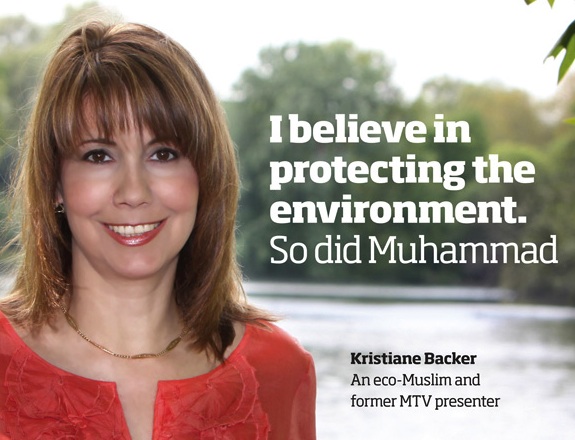
"Inspired by Muhammad" is Islam's Green Message to Break Terrorism Link


The relationship between human beings & his... by Islamicinvitation
Muslims everywhere can be at “peace with the earth and be at peace with heaven” by adopting environment message from the Qu’ran, advocates new UK campaign launched by Muslim convert.
Shocking statistics and a love for the environment have inspired a new campaign which highlights Islam’s Eco message in order to break the link between Islam and extremism.Inspired by Muhammed is a new campaign which showcases Muslims who have been inspired by their faith to contribute positively to society and focuses on areas such as women’s rights, social justice as well as the environment. Its message can impact the Middle East and the world.
Launched by the Muslim convert Kristiane Backer (pictured above) on behalf of the Exploring Islam Foundation, the campaign hopes to improve public understanding of the more positive aspects of Islam.
The campaign was prompted by shocking finds from a May 2010 national poll in Britain which found that more than half the British population associated Islam with extremism (58%) and terrorism (50%). The opinion poll also discovered that just 6% of the British population believe that Islam promotes active measures to protect the environment.

Kristiane, the former MTV presenter from Germany, is one of the campaign profiles and talks about her awareness of green issues and how she’s adopted an environmentally-friendly lifestyle to suit her Islamic beliefs.

She explains: “Green living and the preservation of our resources are essential principles of Islam. ‘Don’t be wasteful, for God does not like the wasters,’ the Qur’an tells us. Prophet Muhammad reminded his companions to respect nature and use its resources moderately, not to waste water even when next to a flowing river.”
The high profile media campaign is really hoping to change people’s perceptions of Islam in the UK and includes adverts at bus stops, tube stations and even on London’s iconic black cabs. A fun and informative website www.inspiredbymuhammad.com has been launched to explain Islam’s ethical principles and includes short videos to explain Islam’s more environmentally-friendly aspects.


Following Muhammad’s “green” ethics
The prophet Muhammad’s ethic that the planet is sacred and should be cared for is highlighted as is his respect for the environment. Muhammad encouraged water conservation (see Waqf for Water), planting trees and turning forests into protected conservation areas called hima as well as limiting waste.
Other high-profile Muslims on the website also discuss how Islam has inspired animal welfare through the prophet’s example who taught that animals should be treated with the same respect as a person.
The campaign is a great way of getting the message of peace and understanding within Islam to the wider general public and also reminding Muslims of their duties towards the environment. Its affects could reverberate to the entire Middle East.
As Kristiane says, “Today we can all draw inspiration from Muhammad and try a little harder to live green, to recycle and to conserve energy. And to re-establish harmony between us and the world around us.”
http://www.greenprophet.com/2010/07/inspired-muhammad-environment/
Related:
Free-eBooks: http://goo.gl/2xpiv


In 1 minute - 20 Happenings

Every minute in world:
  • 250 babies are born- 113 are born into poverty, 15 have birth defects.
  • The average American household makes $0.096.
  • Oprah Winfrey makes $523.
  • The average person in the world makes $0.013.
  • The average person in the Unites States with an IT career makes $0.13.
  • The average person in India with an IT career makes $0.025.
  • Someone working in a Nike factory in Vietnam makes $0.0014.
  • Nike makes $36,505.
  • 3 violent crimes are committed in the United States.
  • There are 2 auto thefts committed in the Unites States.
  • 55,757 barrels of oil are used.
  • Lightning strikes the Earth 360 times.
  • There are 5 earthquakes.
  • 120,673 pounds of edible food is thrown away in the United States.
  • 950,186 pounds of trash is thrown away in the United States.
  • There are 9 new AIDS/HIV infections.
  • There are 107 deaths- 18 die of starvation.


http://cdn-www.i-am-bored.com/media/94893_every-minute.jpg
<<Free-eBooks Click here>>> 

Leadership criteria


IT is often stated that the real reason behind the world’s perennial financial, economic and political crises is the lack of ethical leadership.
If one ponders over the state of affairs in Pakistan as well, it becomes clear that it is also the singular lack of leadership that is driving the country into the abyss.

Leadership can be commonly defined as directly or indirectly influencing others, by means of formal authority or personal attributes, to act in accordance with one’s intent or a shared purpose.

There is an emphasis on the role of ‘transformational’ leadership in academic circles these days. It has been preferred as a better mode of leadership than ‘transactional’ leadership, which is characterised by a swapping, trading or bargaining motive in an exchange process between a leader and the led.

Transactional leadership lacks lasting engagement between the two sides as both ‘use’ one another as we commonly see in material exchanges. On the contrary, transformational leadership involves the mutual ‘raising’ of both sides to higher levels of motivation and morality.

It is acknowledged that authentic transformational leadership must rest on a moral foundation of legitimate values. The difference between authentic and pseudo-transformational leadership lies in the presence or absence of such a moral foundation of the leader.

In addition, leaders in different spheres of life may impart ethical values to followers who seek guidance from authorities they respect and trust. However, if the values spread are unethical, these authorities are pseudo-transformational, as we commonly see in Pakistan. Ironically, although still eyed with suspicion, spirituality at the workplace has gained currency in the West and there is even talk of spiritual leadership in Western academic circles.

Spirituality based leadership, academically, does not differ much from leadership, but rather proposes that leadership must be based on self-realisation, personal character, and foster integrity and character throughout the organisation. Besides virtuous behaviour, spirituality looks for transcendence in human life. Consciousness and affirmation of the higher self is considered essential in spiritual leadership behaviour for engendering care for others.

The moral development of the leader, thus, embraces the individual, familial and spiritual dynamics of the personality. Small wonder, then, that transformational leadership incorporates terms such as ethics, character, transcendence etc. Such leaders receive power without seeking it.

We can find accounts of these leadership styles in spiritual and religious traditions. We find authentic transformational leadership to be more consistent than transactional leadership with Islamic traditions. In Islam, the general philosophy of life centres on Tawhid — the oneness of the Creator.

From this unity of the Creator follows the unity of creation, and unity of purpose in the life of a human being. In the Islamic concept of the universe, man has been appointed as a vicegerent (khalifah) on this earth by God and everything has been given to him in trust (amanah).

As part of society, he has to perform his duties while being conscious of that trust. In fact, there are verses of the Quran pointing to the same concept: “Behold, thy Lord said to the angels: “I will create a vicegerent on earth. …” (2:30).

Leadership in Islam is considered a trust. A leader is entrusted with leading a group of people or managing an organisation. The leader is responsible as well as accountable. There are two levels of trust: responsibility and accountability. Trust goes with responsibility and accountability as is depicted in the following verse: “O David! We did indeed make thee a vicegerent on earth: so judge thou between men in truth (and justice): Nor follow thou the lusts (of thy heart), for they will mislead thee from the path of Allah: for those who wander astray from the path of Allah, is a penalty grievous, for that they forget the Day of Account” (38:26).

Islam acknowledges that leadership is exercised at different levels. A well-known prophetic tradition outlines the concept of multi-level leadership: “Each of you is a guardian and is responsible for his subjects. The ruler, who has authority over people, is a guardian and is responsible for them. … So, all of you are guardians and are responsible for your charges” (Muslim, 2000, 663).

Thus, leadership has to be exercised at the level of the family, community, organisation and country. A leader is accountable to God primarily, but he/she is accountable to the people/follower as well. The Prophet (PBUH) has been quoted to have said: “If a person dies having cheated the people he/she was entrusted with, he/she will not smell the scent of paradise” (Muslim, 2000).

In fact, one should not seek a leadership role in Islam for the sake of power but only when one has the expertise to help others in a crisis situation. Interestingly, it is quite contrary to what we see these days when all and sundry make a beeline for the corridors of power for any potential benefit.

Many prophetic traditions emphasise that appointments to leadership positions should be mainly based on qualifications and the ability to do the job. A Quranic verse states: “…Verily the most honoured of you in the sight of Allah is (he who is) the most righteous of you. …” (49:13).

The preceding discussion informs us that the world in general and Pakistan in particular urgently needs transformational leadership bordering on spiritual leadership which must rest on moral foundations.

More importantly, only those must be considered for positions of leadership who are competent and qualified for the job and who are not only conscious of their immense responsibilities but also mindful of ultimate accountability to the higher (divine) self.

The writer is member of the adjunct faculty at Stirling Management School, University of Stirling, Scotland.
http://dawn.com/2013/02/08/leadership-criteria/
<<Free-eBooks Click here>>> 

Islam on good governance

NO nation can dream of development without good governance. It is an essential prerequisite for all state and non-state organisations to abide by the principles of good governance in order to move forward and attain the goal of public welfare.

At the state level, it is considered important and connected with a nation’s overall development and its sustainability. People cannot make progress unless they follow the principles of good governance. Good governance is a culture that makes people act responsibly, thoughtfully and conscientiously.

They behave with restraint and avoid abuse of power. People in authority act within the parameters of the law and take upon themselves the country’s concerns and hardships. They remain impersonal in the discharge of their duties and imperturbable in front of critics. They respect popular will but never go beyond their tether.

Unfortunately, during the course of Muslim history we have hardly seen any worthwhile examples of good governance. The majority of Muslim lands remained under dynastic rule; most rulers were despots, self-serving and a law unto themselves.

Their princes used to fight for the throne and their infighting often led outsiders to invade. They were least concerned about the welfare of their subjects. Common people had very limited access to the corridors of power.

However, we have a shining example when the Holy Prophet (PBUH) became head of the state of Madina and exemplified good governance. He created a bond of brotherhood among the Muslim citizens, concluded agreements with non-Muslims and remained concerned about their welfare. He upheld the Islamic value system in which justice remains central. He declared that all humans are the offspring of Adam and that there is no difference between Arab and non-Arab (Ajam).

Islam is a religion which guides us in all aspects of human life. Our value system originates mainly from the Holy Quran and our progress is forever dependent on its application. We find a number of Quranic injunctions considered to contain the essentials of good governance.

First is the concept of amanah (trust). Allah says that to Him belongs whatever is in the heavens and whatever is on earth.

Every human being is a trustee on earth. All his possessions, including health, wealth, livelihood, power and status belong to Allah. One who performs his or her duties honestly and diligently is upholding his amanah.

Allah enjoins believers to “…Betray not Allah and His Messenger, nor betray knowingly your amanah [things entrusted to you and all the duties which Allah has ordained for you]” (8:27). In the light of this concept, no one in authority is absolute; one has to remain answerable to his conscience.

Another important principle of good governance is that the ruler must be sincere and of impeccable character. He must consider himself not a ruler but a servant. Similarly, he should be mindful of his every act, that it should not harm his subjects. Those who transgress their limits are the most disgraceful, and the Quran refers to them as zalimoon.

Merit is also one of the important principles of good governance, whereby all appointments in state and non-state organisations are made on the basis of competence. Every human is born with certain inherent competencies and those who actualise their competencies with hard work, integrity and honesty get a premium.

Nature rewards them for being active and hardworking. The Quran says “And that man can have nothing but what he does” (53:39). In meritocratic societies people upgrade themselves professionally and grow economically due to their performance, competence and ability.

Islam encourages Muslims to acquire knowledge and occupy the best position in their societies. We read the life story of Hazrat Yousuf who was in captivity but was called to head the food ministry because of his high degree of competence and knowledge. He was thus able to prevent the impending famine.

Here knowledge became fundamental in governance. Many Western societies are ahead of us because of knowledge and it is the demand of the present time that our parliament and all lawmaking and law-enforcing bodies be occupied by knowledgeable people.

Similarly, the concept of taqwa is also closely linked to good governance. It is an all-inclusive concept which says that every believer should be mindful of Allah’s omnipresence and be aware of accountability. We live in the constant presence of Allah. No act goes unrecorded and no one escapes the accountability of his or her doings. If a public servant develops such a sense of Allah’s presence in his mind and heart, it would result in peace and well-being in society.

The absence of taqwa in any society often leads towards unethical practices. For example, our present-day society is in the grip of widespread corruption. This is the result of poor governance over the years.

When a politician submits a fake degree to stand in elections, when a police party kills a person in a fake encounter, when a businessman evades taxes, when a builder uses outdated material, when a teacher skimps on class work in order to sell his time privately and when a doctor recommends a drug to gain commission from a pharmaceutical firm then the concept of taqwa is grossly violated. The foundations of society are undermined and the nation’s future is ruined.

Many think they will escape judgement but the Quran says “And We have fastened every man’s deeds to his neck and on the Day of Resurrection We shall bring out for him a book which he will find wide open” (17:13).

The writer is an educationist. amin.valiani@itrebp.org
http://dawn.com/2012/12/14/islam-on-good-governance/

David Petraeus scandal , Morality, Ethics & Security

Gen David Petraeus, one of America's most prominent military officers, resigned after admitting he had had an affair with his biographer Paula Broadwell. Now the top US commander in Afghanistan, Gen John Allen, has been linked to another woman already tied to both Gen Petraeus and Mrs Broadwell.
The David Petraeus scandal Updates <<<click>>>

Petraeus: Victim of American infantilism


Robert Grenier
By: Robert Grenier
Former CIA station chief Robert Grenier heads ERG Partners, a financial consultancy firm.
A feckless violation of the General's personal life has cost the US one of its top public servants.


Bordel Militaire Controle: That was the rather bureaucratic term applied to official "supervised military bordellos" run by the French Army during much of the 20th century. Clear-eyed French defence officials of the First World War conceded that some proportion - and perhaps a large proportion - of the soldiers whom they deployed in expeditionary settings would seek to satisfy their carnal urges when and where they could, and that generally no good would come of it.
They considered that burgeoning prostitution, a hostile and alienated local populace, and rampant disease would undermine social support for the troops, and their fighting abilities. And so, exercising the rigorous logic characteristic of the culture which gave us Descartes, they reasoned that rather than wringing their hands, it would be better to set up medically-supervised institutions that would at least limit the negative results of behaviour which they could not otherwise hope to adequately control. 
Such an unsentimental application of moral reason is foreign to tender American sensibilities, but even puritanical US officials - after being forced during World War II to deal with the undisciplined appetites of conscript armies - eventually had to accommodate the fact that unless they took preventive measures, venereal disease would do to American armies what the Axis Powers could not.
Perhaps a bit closer to home, earnest American moralists of the current day who preach "abstinence-only" sex education in a sex-obsessed culture, and who have questionably passing acquaintance with relevant statistics concerning teen pregnancy, are being badly embarrassed by those more practical souls who supplement their preaching with ready access to contraceptives.
"In the absence of a crime and dereliction of professional responsibility, the matter should have ended there, with none of us the wiser, and a highly dedicated and competent public official still at work for his country."
I mention these as examples of the reasoned efforts of honest, clear-minded people to accommodate high-minded moral values to the practical realities of ordinary human behaviour. They stand in sharp contrast to the latest spate of puerile nonsense currently on such garish display in Washington.
One doubts that there is anywhere on the planet so remote as to have been spared the myriad details of the sex scandal that has claimed the career of General David Petraeus, most lately Director of the CIA. Still, it is worth briefly reviewing the core facts of the case, as they have been revealed to us: A woman in Tampa complains to the Federal Bureau of Investigation of threatening e-mails sent from an anonymous source. The FBI investigates, and finds them to have been sent by another woman residing in North Carolina. Scrutiny of this woman's e-mail reveals that she is involved in an illicit affair with General Petraeus. After a thorough investigation, including interviews with both Petraeus and the woman, it is determined that the offending e-mails neither meet the threshold for criminal harassment, nor has there been any security breach involving Director Petraeus's communications with his paramour.
CIA director Petraeus quits over extramarital affair 
That is where this investigation should have ended. It was appropriate that FBI officials, who might have been concerned about the future potential for blackmail of a senior US official with access to highly sensitive national security information (of whom, by the way, there are many thousands of others), should inform that person's superior (in Petraeus's case General James Clapper, the Director of National Intelligence). In the natural course of these events, CIA security officials - whose duty it is to guard such confidential personal information zealously - would have insisted that General Petraeus make a clean breast of the matter to them in order to help ensure that he could not be suborned later by, say, a hostile intelligence service that might independently learn of his affair. In the absence of a crime and dereliction of professional responsibility, the matter should have ended there, with none of us the wiser and a highly dedicated and competent public official still at work for his country.
Yes, it would be better if all those many thousands of individuals entrusted with safekeeping of America's national security secrets - and the rest of us, as well - could be relied upon to lead unerringly virtuous lives, both public and private. It would be better if they never abused drink, felt financial difficulty, or succumbed to the lure of messy sexual dalliances. But the fact is that some of them will: It is an actuarial certainty. The US Intelligence Community has long understood this, and has mechanisms in place to deal with such peccadilloes privately, while limiting the scope for others to exploit the personal vulnerabilities thus revealed. This is only sensible.
But in the case of General Petraeus, none of what should have happened did happen. The FBI did not close down its investigation. Instead, it continued to search, we are told, "for some link between Petraeus and the harassing e-mails", the ones that they had already found not to be criminal. Why this degree of solicitousness on the part of these over-dedicated public servants? Well, let us not forget that a criminal case involving a high-profile figure is the sort of thing that gets faceless Justice Department bureaucrats noticed.
Such opportunities should not be passed up. Before long, FBI agents were sharing information concerning General Petraeus's private life quite liberally as their feckless "investigation" continued. By the time word reached General Clapper, one presumes that it was the certainty of imminent mass public mortification that induced him to suggest Petraeus resign. At that point the floodgates of salacious gossip, invariably sourced in a fully complicit media to "anonymous" government sources, opened wide - a perfect example of "your American tax dollars at work".
"The most celebrated military officer of his generation - a public servant of rare competence and dedication - has been unnecessarily hounded from public life."
The reader should not be fooled by the supposed trove of "classified documents" subsequently found in a raid of the former mistress' home. The FBI, stung by the nascent criticism of having thoroughly violated the privacy of two citizens who have committed no crimes and then driving a campaign of public opprobrium in the bargain, is hell-bent to find some wrongdoing to which it can point as justification.
The fact that a reserve Army officer who possesses security clearances and has spent years engaged in research in which she was being actively aided by many serving military personnel turns out to have official military documents in her possession should come as no great surprise. No one - even in the FBI - has had the temerity thus far to claim there is any substantive compromise of national security in any of this material. At the end of the day it is most likely that such violations of document protocol as may have been committed will merit only administrative sanction at best.
No one is coming out of this episode looking righteous: Not the protagonists, not the law enforcement community, not the pandering media, and not the scandal-obsessed public. But in the end, the most celebrated military officer of his generation - a public servant of rare competence and dedication - has been unnecessarily hounded from public life, and his continued service to the country has been lost. And his example will not be lost on the most senior public officials, who must know that, if ensnared in a compromising situation, any attempt to seek official help will very likely not protect them, but instead assure their public humiliation and private destruction.
Americans appear to be mightily enjoying this spectacle, whatever their protestations to the contrary. Theirs is a childish and hypocritical culture, as it has always been. But they should know: Infantilism comes at a price.
Former CIA station chief Robert Grenier heads ERG Partners, a financial consultancy firm.
The views expressed in this article are the author's own and do not necessarily reflect Al Jazeera's editorial policy.
http://www.aljazeera.com/indepth/opinion/2012/11/20121118134148775889.html
~~~~~~~~~~~~~~~~~~~~~~~~~~~~~~~~~~~~~~~~~~~~~~~~~


FACTS ABOUT DAVID PATRAEUS:

  • David Petraeus resigned as head of the CIA due to an extra-marital affair with Paula Broadwell
  • Broadwell met Petraeus in 2006 at Harvard University function
  • Petraeus' former spokesman said his affair began after he left military and ended four months ago 
  • President Obama gave Petraeus 24 hours to decide after hearing about the affair
  • Petraeus called his involvement in the affair "extremely poor judgement" 
  • Michael Morrell, who was Petraeus’ deputy, will be acting CIA chief 
  • Petraeus assumed command of US forces in Iraq in 2007
  • He then took command of US troops in Afghanistan in 2010 
  • Petraeus left the military to become CIA director in September 2011 
  • He oversaw the agency's use of drones for targeted killings 
  • His military career lasted for 37 years 
  • Petraeus has been married to his wife Holly since 1974

Petraeus scandal web graphic

David Petraeus' downfall is down to his liaison with Mrs Broadwell, a former military officer, academic researcher and fitness enthusiast. She graduated from the West Point military academy, then spent 15 years in the US Army as a defence policy analyst and intelligence officer in South Korea and Germany.
In 2000 at Heidelberg Castle in Germany, she married Scott Broadwell, a flight surgeon (now a radiologist). They live in Charlotte, North Carolina, and have two sons. After Mrs Broadwell left the army, the family moved to Boston, where she enrolled at Harvard's Kennedy School of Government. There she began a career as an academic military researcher, a path that brought her into contact with Gen Petraeus.
Mrs Broadwell, now 40, met the then-lieutenant-general in 2006 when she approached him to write an academic project on his leadership style. Over the following years she went with him to Afghanistan as he took command of the Nato operation there and spent months working closely with him, before distilling her research into the glowing biography, All In: The Education of David Petraeus.
A friend of Gen Petraeus has said his affair with Mrs Broadwell only began in late 2011, after he had left the military to head the CIA. In the spring of 2012, Mrs Broadwell is said to have become jealous of another woman. She allegedly sent anonymous emails to the woman, Jill Kelley, apparently warning her to stay away from Gen Petraeus.

Jill Kelley

Jill Kelley is a Tampa, Florida socialite who reportedly hails from  Catholic Lebanese family that immigrated to Philadelphia in the 1970s.
Mrs Kelley, 37, and her husband Scott Kelley, a surgeon, describe themselves as having been friends with Gen Petraeus and his family for more than five years.
Jill Kelley photographer in Tampa on Monday
Now Gen John Allen is under investigation after being accused of sending "flirtatious" to Mrs Kelley beginning in 2010.
There is no suggestion that Mrs Kelley, a mother of three daughters, had an affair with either Gen Petraeus or Gen Allen.
Both men wrote letters in September 2011 on behalf of Mrs Kelley's twin sister, Natalie Khawam, attesting to her good character in a messy custody dispute. A judge had earlier denied Ms Khawam custody of her young son, saying she appeared to lack honesty and integrity.
In May, Mrs Kelley received threatening emails accusing her of seeking an intimate relationship with the general. FBI officials say those emails were traced to Mrs Broadwell.
In Tampa, Mrs Kelley has served as an unpaid "social liaison", helping to organise gatherings at MacDill Air Force Base, which is the home of US Central Command.
Since the Kelleys moved to Tampa, they have been involved in at least nine legal actions, according to court records. Most involve real estate transactions, including a home repossession and an $11,000 (£6,930) judgment against them in a Pennsylvania case.
Gen Petraeus was stationed there before he moved to Afghanistan to run the Nato operation. Gen Allen was deputy commander there from July 2008 to June 2011.

Holly Petraeus

Holly and David Petraeus
Holly and David Petraeus met in the 1970s when he was a cadet at West Point and her father was superintendent
Holly Petraeus, Gen Petraeus' wife of 38 years, was the daughter of the general in charge of West Point when David Petraeus was a cadet there.
Mrs Petraeus, who has long been an advocate for soldiers' families, has been without her husband for long periods in recent years, even testifying before the Senate about the impact of extended deployments on military spouses.
In January 2011 she was hired to run a veterans' affairs office at the newly established Consumer Financial Protection Bureau.
In that position, which was created as part of the Democrats' overhaul of financial services industry regulation, Mrs Petraeus is tasked with protecting armed services members from predatory lending practices.
Mrs Petraeus' father, Gen William Knowlton, was the superintendent of West Point and Gen Petraeus was a cadet there in 1973 when the couple met.
The couple have two adult children, including an army officer deployed in Afghanistan.
"This unrelenting pace of deployments is a retention issue," Mrs Petraeus said in 2003 after testifying before a Senate committee.
"Families will not be willing to go it alone forever with little relief in sight."
~~~~~~~~~~~~~~~~~~~~~~~``
David Petraeus' tough lesson
By Dan K. Thomasson
Probably the best advice my father ever gave me was never to write anything you wouldn't be comfortable seeing printed on the front page of your newspaper. It's not a complicated rule and should be followed by everyone with a long distance to fall. That is the classic definition of tragedy and Gen. David Petraeus fits it almost perfectly, having ended a glorious career in an inglorious fashion in the time it takes to read a few emails he never should have written in the first place. How incredible that the head of the CIA would trust his future to a device that is notoriously unsecure — the Internet? Forget about the morality or lack of it involved here. Adultery is never a justifiable act and this is not meant to do so. It is not surprising, however, that a man of his stature, under great pressure during long absences from home on the front lines of national defense, would look for creature pleasures with a smart, vital, engaging, type-A personality 20 years his junior. Dumb? Certainly. But not rare. Have you not heard of Gen. Dwight Eisenhower and Kay Summersby? That Petraeus' part-time companion turned out to be a jealous and indiscreet handful is not unusual in these situations. Ask Bill Clinton. What is shocking is that a normally cautious man who has spent a lifetime in sensitive positions would fail to recognize the danger of his actions or the pain it would cause others if discovered. It is amazing that the woman, Paula Broadwell, his devoted biographer and also schooled in intelligence matters, would recklessly challenge by email another woman she perceived as a rival for the good general's attention. The second woman read it as a threat and reported it. Hello, FBI; so long, general. The FBI discovered evidence of an affair in emails between Petraeus and Broadwell. Sexual chemistry tops caution almost every time, even among those who know what's at stake. Some reach heights that lead them to believe they are immune from the self-restraint any prudent person would follow. Others are just so caught up in the emotion that they become careless. Petraeus may have been a little of both. If those close to Petraeus noticed the electricity between the general and Broadwell, which they reportedly did, they apparently failed to warn him — not unusual for subordinates when dealing with superiors at that exalted level. In fact, the head of the FBI and the attorney general of the United States blinked several times before telling the national intelligence director and the president. Agents already had determined it was a matter not involving national security. As a news executive, I spent more than a year lecturing on libel, slander and other subjects, including Internet security. The message delivered repeatedly was don't trust emails. My father's advice came through loud and clear. What a hard lesson Petraeus has had to learn. Dan K. Thomasson’s column is distributed by the Scripps Howard News Service. From The Detroit News: http://www.detroitnews.com/article/20121114/OPINION01/211140308#ixzz2CDKufVdA People are now also asking, if Petraeus didn't share classified information with Broadwell, why did he have to resign? What's the big deal?
In the military, the strict rules against marital infidelity have been justified by the claim that affairs leave people vulnerable to blackmail. (It was the same claim used to justify the irritating 'Don't Ask Don't Tell' policy towards homosexuality, too.) Now this has never rung quite true to me. Even someone who isn't having an affair but has a spouse and children is vulnerable to blackmail simply to protect their family. By that logic, why not go one step further and just demand that none of our public figures have relationships at all? At least it would stop us having to mentally picture John Major and Edwina Currie in flagrante again.
We might even go so far as to take a leaf from our Continental cousins and stop thinking of extramarital dalliances as such a big deal. Affairs, acknowledged or not, are rarely a good indicator of how effective someone is at their job. We've long acknowledged that marriages for love followed by a lifetime of sexual fidelity is not the historical norm. As Catherine Hakim notes in her book The New Rules, "The time has come, alongside the technology, to redraw the rules of marriage for the 21st century."
There is one silver lining of this Petraeus mess for us culture vultures. I'd pretty much had it with Homeland - the unlikely plot twists, the ill-advised affairs, the thought that the CIA would use unsecured connections to transit classified information… until this affair broke. Now I see that the shoddy planning, bed swapping, and poor security measures are exactly how things really go down at Langley. But give me David Harewood over David Petraeus any day - now there's a man worth going 'All In' for.

Related Stories

Free-Books by "Peace Forum Network"