Featured Post

SalaamOne NetWork

SalaamOne سلام   is   a nonprofit e-Forum to promote peace among humanity, through understanding and tolerance of religions, cul...

Showing posts with label Libya. Show all posts

Revolutions - Lessons from History الثورات -- دروس من التاريخ


Response of Change
الدرس المستفاد من التاريخ هو أن الناس دائما ما تستخدم من قبل الطبقات العليا في حالة من الثورة أو حركات المقاومة ولكن يسمح أبدا للاستفادة من انتقال السلطة التي تحدث نتيجة لتضحياتهم
"انها لا تعني أن يكون بالنظر إلى يد الظالمين لاستغلال الجماهير من خلال نهب والسلب؟ لا ، ما سبق ثلاثة أمثلة من التاريخ تشير إلى أن الحركة كانت بداية نهاية القمع. لقد استغرق الأمر وقتا أطول لثمار الثورة للوصول الى الجماهير ولكن فعل ذلك. ننظر في المانيا وانكلترا وفرنسا الآن ، والناس هم يتمتعون بالحرية لأسلافهم التي عملت بجد. هذا هو عصر الاتصال الجماهيري وشبكة الإنترنت ، في قرية عالمية ، ووضع العلامات من الصعب والصعب على الظالمين على مواصلة القتل الجماعي. ولكن إذا كان شيء مجانا.... الحرية لها ثمن.... قيمته بأي ثمن.... ومن هنا يجب على جميع الشعوب المضطهدة مواصلة مقاومة الظلم

History is a continuous process where periods of calm stability are disrupted by phases of violent or silent change. In case of a radical change or revolution, the common people fully take part and sacrifice for a cause, believing that it will change their condition. If the movement for change fails, these people pay the price. They are crushed, slaughtered and massacred by the ruling classes. If the movement succeeds, the leadership excludes the common people and appropriates the benefits for their own class. To prove our argument, we will discuss the Reformation movement of Luther, Cromwell’s movement against the English monarchy and the French Revolution.
When Martin Luther challenged the Catholic Church in 1517, he was asked to appear before the Imperial Diet and explain his position. Luther travelled from Wittenberg to Worm to attend the Diet and was surprised to find crowds of people gathered on both sides of the road to cheer him and express their support. Perhaps when Luther refused to recant his religious views at the Diet, the support of the people gave him courage and confidence. As most of the German princes also wanted to get rid of the Catholic Church and its hold over them, they also supported Luther. The Duke of Saxony protected him and hid him in a castle in defiance of Papal authority.


While Luther was in hiding he received news that the people of the city of Wittenberg had revolted against the Catholic Church. They smashed the statues and disfigured the paintings in the churches. Luther was horrified and immediately went to the city to control the riots.

Another result of his religious views was the peasant rebellion in Germany which was led by the followers of Luther. When Luther argued that the authority of the Bible was above that of the Pope, the peasants, on this basis, demanded equality and justice. It was such a widespread movement that it shattered the German ruling class.

Luther, at this stage, decided to side with the princes rather than the peasants. His decision was to convert the princes and not the people. He advised them to crush the rebellion with an iron hand. He condemned the peasants as hooligans and rabble rousers. The rebellion was quelled and Luther’s Reformation became the ‘Magisterial Reformation’. Three decades later, after the treaty of Westphalia, 1642, it was decided that the religion of the prince would be the religion of his subjects. The movement re-established the authority of the princes. The aspirations of the people failed to change their condition.


Cromwell’s movement against the English monarchy:

The war between the English king and the Parliament in the 17th century was a unique episode in history. That was the period when the roots of monarchy were very deep and to rebel against him was an act of treason. However, in this case, the parliament won and the king became a traitor. He was tried on the charges of treason and executed.

It was a bold step to deny the old historic tradition and set up, instead of monarchy, a commonwealth. This encouraged other groups to change society according to their views. Two groups emerged who demanded a transformation of the system. The Levellers demanded right of vote, annual election for parliament, religious toleration, end of parliamentary corruption and judicial reforms. The Diggers wanted to abolish private property. The demands of both groups reflected the concern of the lower classes regarding the prevailing conditions and their desire to take advantage of the change.

Cromwell, who was the leader of the gentry class, was keen to keep the wheel of change in his control and not to go beyond the interests of his class. He and his party were radical as far as it was in the interest of their class. When other groups wanted to continue the process of change, it was halted with full force. He crushed both Levellers and Diggers.
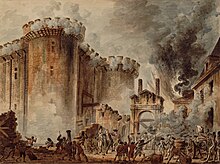
On 14 July, 1789, the people of Paris revolted against the king and demolished the fort of Bastille to show their power as well as anger. The bourgeois class was at the forefront of this revolution. The National Assembly passed the Declaration of Rights of man which, along with other clauses, gave guarantee of private property.

When the peasants revolted in the countryside and attacked the chateaus of the landlords and burned the documents which were against them, the Revolutionary government sent forces to crush these rebellions. Thousands of peasants were slaughtered to silence their voice. The bourgeois class wanted to keep the revolution under its control and called a halt to it when it fulfilled their interest.

The lesson of history is that people are always used by upper classes in case of revolution or resistance movements but never allowed to benefit from the shift of power that takes place as a result of their sacrifices.

"Past present: Response of change" By Mubarak Ali; http://www.dawn.com/2011/04/17/past-present-response-of-change.html 
Comments:
Does it imply that the oppressors be given free hand to indefinitely exploit the masses through loot and plunder? No, the above three examples from history indicate that the movement were beginning of end of oppression. It took more time for the fruits of revolution to  reach the masses but it did. Look at Germany, England and France now, their people are enjoying the freedom for which their ancestors worked hard. 
This is era of mass communication and internet, world is a global village, marking it difficult and harder for oppressors to continue with mass murders. However nothing if free.... freedom has its price .... its worth any cost .... Hence all oppressed people must continue to resist oppression... watch out, be aware of Fifth Columnists among your ranks, do not let any one steal fruits of your struggle....  
Related Links:

Here is some evidence that may enable us to observe the hidden hand of this deity of deception in the recent magical “revolutions” that took place in Tunisia and Egypt and still in progress in several more Arab states. ...
Like the European revolutions of 1848 and the uprising against Stalinism in 1989, the Arabrevolt has rejected fear. An insurrection of suppressed ideas, hope and solidarity has begun. In the United States, where 45 per cent of young ...
Thanks to the revolutions, we now have been forced to rethink whether the categories "Muslim" and "Arab" have any meaning at all. It is time to approach three hundred millionArabic speaking people and more than one billion people ...
... the solutions to the Arab world's ills are remarkably similar. The political, economic and social suffocation that the people of Tunisia and Egypt have endured, before popularrevolutions swept the countries' dictators from power, ...

Nevertheless, a narrative on what has happened in the Arab world has emerged and has become the framework for thinking about the region. The narrative says that the region is being swept by democratic revolutions (in the Western sense) ...
These are countries which had military revolutions and today are experiencing civilrevolutions. Like Tunisia, but in a worse fashion, Libya has invested very little in social capital or civic capacity building. ... Dr Larbi Sadiki is a Senior Lecturer in Middle East Politics at the University of Exeter, and author of Arab Democratisation: Elections without Democracy (Oxford University Press, 2009) and The Search for Arab Democracy: Discourses and Counter-Discourses ...
We are in the middle of a political earthquake in the Arab world and the ground has still not stopped shaking. To make predictions when events are so fluid is risky, but there is no doubt that the uprising in Egypt -- however it ends -- will have a dramatic impact across the ... None of the parties at the demonstration called for the kind of revolutions that happened in Tunisia and Egypt to occur in Jordan, and there is no reason to believe such developments are imminent. ...

Open Letter to Field Marshal Mohamed Hussein Tantawi, New Ruler of Egypt. Also Applicable to All kings and dictators. رسالة مفتوحة إلى المشير حسين طنطاوي محمد ، الحاكم الجديد لمصر. كما ينطبق على جميع الملوك والحكام المستبدين ...
This voluntary forum is open to people of all faiths and atheists. السعي لإحلال السلام الداخلي والخارجي للبشرية من خلال رؤية المفاهيمي لملة إبراهيم الإسلام والمسيحية واليهودية في ضوء الكتاب المقدس في بيئات انتشارا. ...
سلام ، تحية للسلام. Please have mercy on your country and people who have tolerated your family rule for years. Time has changed, free your people don't behave like Saddam Hussain who is responsible for destruction of his country. ...

Problem with liberal intervention


WELCOME to 21st-century war, liberal style. You do not fix an objective and use main force to get it. You nuance words, bomb a little, half assassinate, scare, twist, spin and make it up as you go along.


Nato’s Libyan campaign is proving a field day for the new interventionism. Seemingly desperate to scratch another Muslim itch, Britain’s laptop bombardiers and their tame lawyers go into a daily huddle to choreograph the latest visitation of death on some wretched foreigners.


Each day the tacticians tot up a gruesome calculus of wins and losses. Wednesday’s defection of Libya’s foreign minister, Moussa Koussa, somehow cancelled out two days of retreat by the rebels towards Benghazi. That retreat cancelled out a weekend of victory over Qadhafi’s army along the northern highway. Nato bombing cancelled out rebel ineffectiveness. Everything is stalemate punctuated by surprise.


Meanwhile the legal niceties border on the absurd. We cannot kill Qadhafi, unless we describe killing as “all necessary measures”. We observe an arms embargo, except apparently if the arms are going to our side and are thus “protecting innocent civilians”. Guilty civilians are unprotected. We are forbidden from injecting “a foreign occupying force of any form” into Libya, except if it is a “special force” and aiding the bombing with targeting intelligence. The bombing of Qadhafi’s compound and the witnessed killing of civilians in Sirte clearly breached UN resolution 1973. But who cares? As George Bush and Tony Blair found, you can drum up an international lawyer to defend anything.


Qadhafi’s survival is ostensibly insane. He is the tinpot dictator of a tiny country that Nato could topple in a day. It could bomb his palace, take out his tanks, land paratroops on his airport and ship in reinforcements. Libya is not Iraq or Afghanistan. Nato could set up a client regime, as in Bosnia, secure the oil and give two fingers to the Arab world, as the west always does when its interest so requires.


Instead we have the ludicrous position that Nato can save Benghazi by taking out a tank column and then laying a bombed strip to the west. But all this does is encourage reckless rebels to drive towards Tripoli and die. The maxim is old as the hills. No war can be won from the air. A temporary balance of advantage can be awarded to one side, but pilots can only destroy. Bombs are inherently crude tools of war. They cannot seize and hold land.


At present Nato strategy appears to be to prolong civil war by bolstering the weaker side. It is the equivalent of refereeing a bare-knuckle fight so as to keep the contestants on their feet and still punching. Stalling Qadhafi’s advance on Benghazi appears to have prevented its fall. Whether there would have been a genocidal massacre, as interventionists maintain, is not known. There would surely have been bloody retribution against ringleaders, which is what dictators do to those who cross them. But then Qadhafi, Assad of Syria, Mubarak of Egypt and Hussein of Iraq all did ghastly things to their enemies, usually while the West was cosying up to them.


Holding the ring for someone else’s civil war is a bizarre justification for intervention. It is a distortion of the UN’s peacekeeping role — indeed it might be termed war-keeping — and an abuse of Nato’s supposed purpose, to defend the west against attack. Even setting those objections aside, any humanitarian gain is moot. Iraq and Afghanistan were Muslim dictatorships in a state of suppressed civil war when the West intervened. The result was hardly peace, tranquillity or an easing of tribal tension, rather more destruction and bloodshed. Yet these interventions were claimed as ‘humanitarian’.


Related Links:

31 Mar 2011
The hypocrisy reeks. How the public stands it, I do not know: The American president, whose drones and air force slaughter civilians every day of the year said Libya stands alone in presenting the world with “the prospect of violence on ...
31 Jan 2011
[comments: so democracy only if suits USA, if doesn't, them support dictators, hypocracy ]. Another reason for caution is that even if the US wants to help opposition movements, it can do them as much harm as good. ...
30 Mar 2011
It was a speech of spectacular hypocrisy, and Ray McGovern was in the audience. Outraged, he rose from his chair and silently turned his back on Clinton. He was immediately seized by police and a security goon and beaten to the floor, ... The courageous people gunned down last week in Bahrain and Libya, the latter a “priority UK market”, according to Britain's official arms “procurers”, join those children blown to bits in Gaza by the latest American F-16 aircraft. ...

Libya, the West and the Narrative of Democracy


Forces from the United States and some European countries have intervened in Libya. Under U.N. authorization, they have imposed a no-fly zone in Libya, meaning they will shoot down any Libyan aircraft that attempts to fly within Libya. In addition, they have conducted attacks against aircraft on the ground, airfields, air defenses and the command, control and communication systems of the Libyan government, and French and U.S. aircraft have struck against Libyan armor and ground forces. There also are reports of European and Egyptian special operations forces deploying in eastern Libya, where the opposition to the government is centered, particularly around the city of Benghazi. In effect, the intervention of this alliance has been against the government of Moammar Gadhafi, and by extension, in favor of his opponents in the east.


The alliance’s full intention is not clear, nor is it clear that the allies are of one mind. The U.N. Security Council resolution clearly authorizes the imposition of a no-fly zone. By extension, this logically authorizes strikes against airfields and related targets. Very broadly, it also defines the mission of the intervention as protecting civilian lives. As such, it does not specifically prohibit the presence of ground forces, though it does clearly state that no “foreign occupation force” shall be permitted on Libyan soil. It can be assumed they intended that forces could intervene in Libya but could not remain in Libya after the intervention. What this means in practice is less than clear.


There is no question that the intervention is designed to protect Gadhafi’s enemies from his forces. Gadhafi had threatened to attack “without mercy” and had mounted a sustained eastward assault that the rebels proved incapable of slowing. Before the intervention, the vanguard of his forces was on the doorstep of Benghazi. The protection of the eastern rebels from Gadhafi’s vengeance coupled with attacks on facilities under Gadhafi’s control logically leads to the conclusion that the alliance wants regime change, that it wants to replace the Gadhafi government with one led by the rebels.


But that would be too much like the invasion of Iraq against Saddam Hussein, and the United Nations and the alliance haven’t gone that far in their rhetoric, regardless of the logic of their actions. Rather, the goal of the intervention is explicitly to stop Gadhafi’s threat to slaughter his enemies, support his enemies but leave the responsibility for the outcome in the hands of the eastern coalition. In other words — and this requires a lot of words to explain — they want to intervene to protect Gadhafi’s enemies, they are prepared to support those enemies (though it is not clear how far they are willing to go in providing that support), but they will not be responsible for the outcome of the civil war.


The Regional Context


To understand this logic, it is essential to begin by considering recent events in North Africa and the Arab world and the manner in which Western governments interpreted them. Beginning with Tunisia, spreading to Egypt and then to the Arabian Peninsula, the last two months have seen widespread unrest in the Arab world. Three assumptions have been made about this unrest. The first was that it represented broad-based popular opposition to existing governments, rather than representing the discontent of fragmented minorities — in other words, that they were popular revolutions. Second, it assumed that these revolutions had as a common goal the creation of a democratic society. Third, it assumed that the kind of democratic society they wanted was similar to European-American democracy, in other words, a constitutional system supporting Western democratic values.


Each of the countries experiencing unrest was very different. For example, in Egypt, while the cameras focused on demonstrators, they spent little time filming the vast majority of the country that did not rise up. Unlike 1979 in Iran, the shopkeepers and workers did not protest en masse. Whether they supported the demonstrators in Tahrir Square is a matter of conjecture. They might have, but the demonstrators were a tiny fraction of Egyptian society, and while they clearly wanted a democracy, it is less than clear that they wanted a liberal democracy. Recall that the Iranian Revolution created an Islamic Republic more democratic than its critics would like to admit, but radically illiberal and oppressive. In Egypt, it is clear that Mubarak was generally loathed but not clear that the regime in general was being rejected. It is not clear from the outcome what will happen now. Egypt may stay as it is, it may become an illiberal democracy or it may become a liberal democracy.


Consider also Bahrain. Clearly, the majority of the population is Shiite, and resentment toward the Sunni government is apparent. It should be assumed that the protesters want to dramatically increase Shiite power, and elections should do the trick. Whether they want to create a liberal democracy fully aligned with the U.N. doctrines on human rights is somewhat more problematic.


Egypt is a complicated country, and any simple statement about what is going on is going to be wrong. Bahrain is somewhat less complex, but the same holds there. The idea that opposition to the government means support for liberal democracy is a tremendous stretch in all cases — and the idea that what the demonstrators say they want on camera is what they actually want is problematic. Even more problematic in many cases is the idea that the demonstrators in the streets simply represent a universal popular will.


Nevertheless, a narrative on what has happened in the Arab world has emerged and has become the framework for thinking about the region. The narrative says that the region is being swept by democratic revolutions (in the Western sense) rising up against oppressive regimes. The West must support these uprisings gently. That means that they must not sponsor them but at the same time act to prevent the repressive regimes from crushing them.


This is a complex maneuver. The West supporting the rebels will turn it into another phase of Western imperialism, under this theory. But the failure to support the rising will be a betrayal of fundamental moral principles. Leaving aside whether the narrative is accurate, reconciling these two principles is not easy — but it particularly appeals to Europeans with their ideological preference for “soft power.”


The West has been walking a tightrope of these contradictory principles; Libya became the place where they fell off. According to the narrative, what happened in Libya was another in a series of democratic uprisings, but in this case suppressed with a brutality outside the bounds of what could be tolerated. Bahrain apparently was inside the bounds, and Egypt was a success, but Libya was a case in which the world could not stand aside while Gadhafi destroyed a democratic uprising. Now, the fact that the world had stood aside for more than 40 years while Gadhafi brutalized his own and other people was not the issue. In the narrative being told, Libya was no longer an isolated tyranny but part of a widespread rising — and the one in which the West’s moral integrity was being tested in the extreme. Now was different from before.


Of course, as with other countries, there was a massive divergence between the narrative and what actually happened. Certainly, that there was unrest in Tunisia and Egypt caused opponents of Gadhafi to think about opportunities, and the apparent ease of the Tunisian and Egyptian uprisings gave them some degree of confidence. But it would be an enormous mistake to see what has happened in Libya as a mass, liberal democratic uprising. The narrative has to be strained to work in most countries, but in Libya, it breaks down completely.


The Libyan Uprising


As we have pointed out, the Libyan uprising consisted of a cluster of tribes and personalities, some within the Libyan government, some within the army and many others longtime opponents of the regime, all of whom saw an opportunity at this particular moment. Though many in western portions of Libya, notably in the cities of Zawiya and Misurata, identify themselves with the opposition, they do not represent the heart of the historic opposition to Tripoli found in the east. It is this region, known in the pre-independence era as Cyrenaica, that is the core of the opposition movement. United perhaps only by their opposition to Gadhafi, these people hold no common ideology and certainly do not all advocate Western-style democracy. Rather, they saw an opportunity to take greater power, and they tried to seize it.


According to the narrative, Gadhafi should quickly have been overwhelmed — but he wasn’t. He actually had substantial support among some tribes and within the army. All of these supporters had a great deal to lose if he was overthrown. Therefore, they proved far stronger collectively than the opposition, even if they were taken aback by the initial opposition successes. To everyone’s surprise, Gadhafi not only didn’t flee, he counterattacked and repulsed his enemies.


This should not have surprised the world as much as it did. Gadhafi did not run Libya for the past 42 years because he was a fool, nor because he didn’t have support. He was very careful to reward his friends and hurt and weaken his enemies, and his supporters were substantial and motivated. One of the parts of the narrative is that the tyrant is surviving only by force and that the democratic rising readily routs him. The fact is that the tyrant had a lot of support in this case, the opposition wasn’t particularly democratic, much less organized or cohesive, and it was Gadhafi who routed them.


As Gadhafi closed in on Benghazi, the narrative shifted from the triumph of the democratic masses to the need to protect them from Gadhafi — hence the urgent calls for airstrikes. But this was tempered by reluctance to act decisively by landing troops, engaging the Libyan army and handing power to the rebels: Imperialism had to be avoided by doing the least possible to protect the rebels while arming them to defeat Gadhafi. Armed and trained by the West, provided with command of the air by the foreign air forces — this was the arbitrary line over which the new government keeps from being a Western puppet. It still seems a bit over the line, but that’s how the story goes.


In fact, the West is now supporting a very diverse and sometimes mutually hostile group of tribes and individuals, bound together by hostility to Gadhafi and not much else. It is possible that over time they could coalesce into a fighting force, but it is far more difficult imagining them defeating Gadhafi’s forces anytime soon, much less governing Libya together. There are simply too many issues among them. It is, in part, these divisions that allowed Gadhafi to stay in power as long as he did. The West’s ability to impose order on them without governing them, particularly in a short amount of time, is difficult to imagine. They remind me of Hamid Karzai in Afghanistan, anointed by the Americans, distrusted by much of the country and supported by a fractious coalition.


Other Factors


There are other factors involved, of course. Italy has an interest in Libyan oil, and the United Kingdom was looking for access to the same. But just as Gadhafi was happy to sell the oil, so would any successor regime be; this war was not necessary to guarantee access to oil. NATO politics also played a role. The Germans refused to go with this operation, and that drove the French closer to the Americans and British. There is the Arab League, which supported a no-fly zone (though it did an about-face when it found out that a no-fly zone included bombing things) and offered the opportunity to work with the Arab world.


But it would be a mistake to assume that these passing interests took precedence over the ideological narrative, the genuine belief that it was possible to thread the needle between humanitarianism and imperialism — that it was possible to intervene in Libya on humanitarian grounds without thereby interfering in the internal affairs of the country. The belief that one can take recourse to war to save the lives of the innocent without, in the course of that war, taking even more lives of innocents, also was in play.


The comparison to Iraq is obvious. Both countries had a monstrous dictator. Both were subjected to no-fly zones. The no-fly zones don’t deter the dictator. In due course, this evolves into a massive intervention in which the government is overthrown and the opposition goes into an internal civil war while simultaneously attacking the invaders. Of course, alternatively, this might play out like the Kosovo war, where a few months of bombing saw the government surrender the province. But in that case, only a province was in play. In this case, although focused ostensibly on the east, Gadhafi in effect is being asked to give up everything, and the same with his supporters — a harder business.


In my view, waging war to pursue the national interest is on rare occasion necessary. Waging war for ideological reasons requires a clear understanding of the ideology and an even clearer understanding of the reality on the ground. In this intervention, the ideology is not crystal clear, torn as it is between the concept of self-determination and the obligation to intervene to protect the favored faction. The reality on the ground is even less clear. The reality of democratic uprisings in the Arab world is much more complicated than the narrative makes it out to be, and the application of the narrative to Libya simply breaks down. There is unrest, but unrest comes in many sizes, democratic being only one.


Whenever you intervene in a country, whatever your intentions, you are intervening on someone’s side. In this case, the United States, France and Britain are intervening in favor of a poorly defined group of mutually hostile and suspicious tribes and factions that have failed to coalesce, at least so far, into a meaningful military force. The intervention may well succeed. The question is whether the outcome will create a morally superior nation. It is said that there can’t be anything worse than Gadhafi. But Gadhafi did not rule for 42 years because he was simply a dictator using force against innocents, but rather because he speaks to a real and powerful dimension of Libya.


By George Friedman


Read more: Libya, the West and the Narrative of Democracy | STRATFOR
http://www.stratfor.com/weekly/20110321-libya-west-narrative-democracy?utm_source=GWeekly&utm_medium=email&utm_campaign=110322&utm_content=readmore&elq=88e0b3eb18094c4e925eb46018179143

Geopolitical Weekly

Libya, the West and the Narrative of Democracy
In its response to the recent uprisings in the Arab world, the West has been walking a tightrope of contradictory principles. Libya became the place where they fell off. [more]
Japan, the Persian Gulf and Energy
March 15, 2011 1905 GMT
A profoundly bad week for Japan was a harsh reminder that it cannot escape the realities of geography. [more]
Bahrain and the Battle Between Iran and Saudi Arabia
Bahrain has become the focal point of a struggle between Saudi Arabia and Iran for control of the western littoral of the Persian Gulf. [more]
Never Fight a Land War in Asia
March 1, 2011 0947 GMT
An elective war in which the criteria for success are unclear and for which the amount of land force is insufficient must be avoided. [more]
Revolution and the Muslim World
February 22, 2011 0949 GMT
The Muslim world, from North Africa to Iran, has experienced a wave of instability in the last few weeks. [more]
Egypt: The Distance Between Enthusiasm and Reality
The events in Egypt are more complex than most of media are describing. While the new regime is doing what the demonstrators wanted, it is also increasing the power of the military. [more]
Egypt, Israel and a Strategic Reconsideration
If the long-term center of gravity of Israel's national security is the neutrality of Egypt, then doing everything to maintain that is a military requirement. (With STRATFOR maps.)
Read more: Geopolitical Weekly | STRATFOR 


Islam, Christianity, Judaism, Bible and Qur'an