Featured Post

SalaamOne NetWork

SalaamOne سلام   is   a nonprofit e-Forum to promote peace among humanity, through understanding and tolerance of religions, cul...

How Islamist is Egypt's would-be constitution ? كيف الاسلامية في مصر هو أن يكون بين الدستور؟

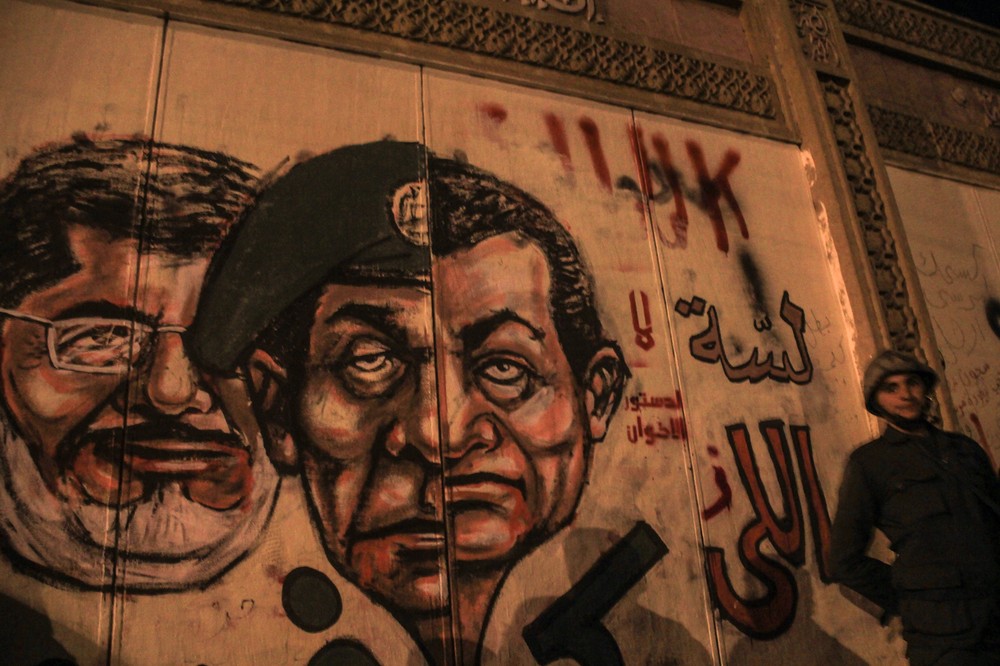
Click for updates <<>>> Egypt's controversial draft constitution will be put to a national referendum on 15 and 22 December. Very few of its 236-articles were agreed to smoothly by members of the Islamist-led Constituent Assembly. The draft, which was approved after a 14-hour voting session on 30 November, was strongly condemned by opponents, many of whom left the assembly prior to the final vote, criticising the drafting process.
On 1 December, President Mohamed Morsi officially received the draft constitution and called for a national referendum on 15 December amid rival mass protests between supporters and opponents, and strong dissent from judges over his 'power-grabbing' constitutional declaration of 22 November.
The position of Islamic Sharia law in the draft constitution was strongly disputed within the assembly and can be seen as an embodiment of the Islamist-secular divide in post-revolution Egypt.
Al-Azhar's new constitutional role in legislation
Although Article 2 of the 1971 constitution, which says the principles of Sharia are the primary source of legislation, remained intact in the draft constitution, two new articles have been added to emphasise the role of Sharia in legislation.
Article 219 (defines the aspects of Sharia on which laws will be based) and Article 4 (states the supreme scholars committee of Al-Azhar, the country's highest Islamic institution, should be consulted on all matters relating to Sharia) gives a religious institution the right to meddle in the law-making process, according to legal expert Hisham Nasr.
"If the Constitutional Court deems a law illegitimate that has been approved by parliament, who would the parliament turn to?” Nasr wrote in an article published by Al-Arabiya earlier this month.
“The draft constitution spells out the exact pillars of Sharia from which laws are formed, so the law will be referred to the scholars at Al-Azhar for a decision,” he added, underscoring the fact that the exclusive power of the Supreme Constitutional Court to interpret the constitution has been omitted from the draft constitution.
Nasr compared Egypt's draft constitution to Iran's constitution, which he said is the embodiment rule by jurists because it says the Islamic provisions are above all legal and constitutional matters.
“Even though the article does not bind law-making bodies to abide by Al-Azhar’s opinions, would parliament object to a recommendation given by Al-Azhar?” he stated.
Al-Azhar is already facing internecine ideological conflicts within its higher tiers.
Reformists inside the institution have said moderate figures are being marginalised and replaced with "extremist" scholars who follow the ultra-conservative Wahhabi school of Islam.
Article 4 also immunises the Grand Imam of Al-Azhar from deposition by the state and even by the members of the Senior Scholars board, which is tasked with appointing him. Critics feel the immunisation of the Grand Imam will allow Islamists to exert control in the future.
“Submitting laws to Al-Azhar is in itself an encroachment on legislative authority. Laws apply to everyone equally and should not be under the jurisdiction of people who act upon a certain conviction, which means they are not impartial,” human rights lawyer Ahmed Ezzat told Ahram Online.
“Al-Azhar should not be given any role in the new constitution because its independence will be compromised if it can interfere with legislation.”
Principles of Sharia
The draft constitution includes an explanatory article about the meaning of the "principle" of Sharia law, as a supposed mean to define the sources of legislation.
The principles of Sharia law include holistic evidence, foundational rules, rules of jurisprudence, and credible sources accepted in Sunna doctrines and by the larger community.
"What is meant by holistic evidence is everything mentioned in the Quran and in the Sunna doctrine. Foundational and jurisprudential rules are those derived from general evidence that is not debatable. Credible sources are the Quran, the Sunna, consensus and analogical deduction,” the Muslim Brotherhood has said in a statement. "With this article, the debate on interpreting the principles of Sharia has been resolved completely.”
However, Nasr challenges the Brotherhood's view that Article 219 ends the debate on interpreting Sharia.
“Since interpretations of the Quran and Sunna are subject to different schools of thought and very few Sharia rulings have consensus, Article 219 does not really narrow down the legislative path of Sharia,” Nasr says.
Ezzat agrees: "Take family laws for instance, they vary greatly in the different Sharia schools of thought. How should there be a unified family law according to this constitution?"
Salafist influence: Obstacle to general freedoms?
Salafists, ultra-conservative allies of the Muslim Brotherhood, have also attempted to further stamp the mark of Islamists on the constitution.
Preacher Yasser El-Borhami, who was a member of the Constituent Assembly, says the Salafists successfully managed to modify three articles.
"There was an article in [the 1971] constitution stating no punishment without a legal text. But we objected to this article and were able to change it to ‘no punishment without a legal or constitutional text’ because if it had remained in the original format, consensual adultery, homosexuality, and usury would not be punished, as they are currently not prohibited by law," he said during a seminar in late November.
He also gave credit to Salafists for altering Article 76, which was referred to in a Brotherhood statement promoting the draft constitution in October.
"For the aim of protecting society, the draft states that no punishment will be carried out unless there is a crime, after verifying all proof of the crime. This will prepare society to understand and accept Sharia and lead to the gradual implementation of Sharia," the statement said.
Ezzat says this article opens the door for unjust punishments: "According to the new format of Article 76, a citizen can be put on trial without a specific law or stating the penalty for crime he is accused of, as now you can directly refer to Sharia for the penalty."
Borhami also believes the Salafist input was evident in Article 10, which reads: “The State, as well as society is keen to preserve the genuine character of the Egyptian family, its cohesion and stability, and to protect its moral values, all as regulated by law."
"We were able to add the word "society" to the text of the article, which will enable us in the future to promulgate an accountability act [legalising a morality police] and it cannot be argued as unconstitutional," Borhami says.
Ezzat argues: "The obscure phrasing of the new Article 10 enables a state-sponsored suppression of freedom in the name of preserving morality, which would then be defined solely by Islamists."
Article 81 says freedom exists "as long as it does not contradict with the first section of the constitution," which includes Sharia law and Al-Azhar’s authority to preside over its interpretation.
This could open the door to further restrictions on freedom, Ezzat says. "For instance, if I made a film, the constitution gives Al-Azhar the authority to have the final say on it, subjecting it to censorship.
"Moreover, [Article 81] allows for the supremacy of Sharia over non-Muslims despite the presence of Article 3, which supposedly allows members of divine religions to refer to their own jurisprudence.”
A statement by the Muslim Brotherhood in October explaining their stance on Sharia's position in the constitution says, "The Muslim Brotherhood has been keen on giving Sharia the position it deserves in the constitution, in a manner that will assist parliament in legislating Sharia rules."
However, the Brotherhood's explanation of Sharia did not include specific provisions and only spoke about its larger "principles" of equality and social justice.
The draft constitution has been rejected by most opposition political groups and they are now campaigning for a 'no' vote against the controversial constitutional referendum in the little time they have left.
The first phase of the referendum polling starts on Saturday, 15 December in ten governorates and the second phase is slated for 22 December. Videos click here <<<>>>
http://english.ahram.org.eg/NewsContent/1/0/60471/Egypt/How-Islamist-is-Egypts-wouldbe-constitution.aspx
Low-key temporary disorder, although disruptive, can yield positive benefits to burgeoning democracies.
<<Free-eBooks Click here>>> 

Islam on good governance

NO nation can dream of development without good governance. It is an essential prerequisite for all state and non-state organisations to abide by the principles of good governance in order to move forward and attain the goal of public welfare.

At the state level, it is considered important and connected with a nation’s overall development and its sustainability. People cannot make progress unless they follow the principles of good governance. Good governance is a culture that makes people act responsibly, thoughtfully and conscientiously.

They behave with restraint and avoid abuse of power. People in authority act within the parameters of the law and take upon themselves the country’s concerns and hardships. They remain impersonal in the discharge of their duties and imperturbable in front of critics. They respect popular will but never go beyond their tether.

Unfortunately, during the course of Muslim history we have hardly seen any worthwhile examples of good governance. The majority of Muslim lands remained under dynastic rule; most rulers were despots, self-serving and a law unto themselves.

Their princes used to fight for the throne and their infighting often led outsiders to invade. They were least concerned about the welfare of their subjects. Common people had very limited access to the corridors of power.

However, we have a shining example when the Holy Prophet (PBUH) became head of the state of Madina and exemplified good governance. He created a bond of brotherhood among the Muslim citizens, concluded agreements with non-Muslims and remained concerned about their welfare. He upheld the Islamic value system in which justice remains central. He declared that all humans are the offspring of Adam and that there is no difference between Arab and non-Arab (Ajam).

Islam is a religion which guides us in all aspects of human life. Our value system originates mainly from the Holy Quran and our progress is forever dependent on its application. We find a number of Quranic injunctions considered to contain the essentials of good governance.

First is the concept of amanah (trust). Allah says that to Him belongs whatever is in the heavens and whatever is on earth.

Every human being is a trustee on earth. All his possessions, including health, wealth, livelihood, power and status belong to Allah. One who performs his or her duties honestly and diligently is upholding his amanah.

Allah enjoins believers to “…Betray not Allah and His Messenger, nor betray knowingly your amanah [things entrusted to you and all the duties which Allah has ordained for you]” (8:27). In the light of this concept, no one in authority is absolute; one has to remain answerable to his conscience.

Another important principle of good governance is that the ruler must be sincere and of impeccable character. He must consider himself not a ruler but a servant. Similarly, he should be mindful of his every act, that it should not harm his subjects. Those who transgress their limits are the most disgraceful, and the Quran refers to them as zalimoon.

Merit is also one of the important principles of good governance, whereby all appointments in state and non-state organisations are made on the basis of competence. Every human is born with certain inherent competencies and those who actualise their competencies with hard work, integrity and honesty get a premium.

Nature rewards them for being active and hardworking. The Quran says “And that man can have nothing but what he does” (53:39). In meritocratic societies people upgrade themselves professionally and grow economically due to their performance, competence and ability.

Islam encourages Muslims to acquire knowledge and occupy the best position in their societies. We read the life story of Hazrat Yousuf who was in captivity but was called to head the food ministry because of his high degree of competence and knowledge. He was thus able to prevent the impending famine.

Here knowledge became fundamental in governance. Many Western societies are ahead of us because of knowledge and it is the demand of the present time that our parliament and all lawmaking and law-enforcing bodies be occupied by knowledgeable people.

Similarly, the concept of taqwa is also closely linked to good governance. It is an all-inclusive concept which says that every believer should be mindful of Allah’s omnipresence and be aware of accountability. We live in the constant presence of Allah. No act goes unrecorded and no one escapes the accountability of his or her doings. If a public servant develops such a sense of Allah’s presence in his mind and heart, it would result in peace and well-being in society.

The absence of taqwa in any society often leads towards unethical practices. For example, our present-day society is in the grip of widespread corruption. This is the result of poor governance over the years.

When a politician submits a fake degree to stand in elections, when a police party kills a person in a fake encounter, when a businessman evades taxes, when a builder uses outdated material, when a teacher skimps on class work in order to sell his time privately and when a doctor recommends a drug to gain commission from a pharmaceutical firm then the concept of taqwa is grossly violated. The foundations of society are undermined and the nation’s future is ruined.

Many think they will escape judgement but the Quran says “And We have fastened every man’s deeds to his neck and on the Day of Resurrection We shall bring out for him a book which he will find wide open” (17:13).

The writer is an educationist. amin.valiani@itrebp.org
http://dawn.com/2012/12/14/islam-on-good-governance/

An India-China nightmare

I ENJOYED Pankaj Mishra’s well-researched episodes from Asia’s intellectual history that string together his thesis on how the East had had enough of the West’s political bullying and cultural domineering.

While he doesn’t pretend to strive for Frantz Fanon’s biting survey of the sociology of colonialism, Mishra’s assembly of historical vignettes from Tagore, Gandhi and Nehru in India; Liang Qichao and Sun Yatsen in China; Jamal al-Din al-Afghani and Abdurreshi al Ibrahim at the waning of the Ottoman Empire, among the intellectuals who shaped Asia’s liberation from colonialism, make up for the unintended lapse.

From the ruins of the empire, the revolt against the West and the remaking of Asia would have made for a more solid argument, however, had India’s current search for an apparently comprador role in the regional and global power play not let down the team, particularly so in the face of a virulent neocolonial onslaught.

Take an example from last week when Prime Minister Manmohan Singh’s point man for China was at pains to play down his navy chief’s remarks about protecting Delhi’s national interests in the choppy seas surrounding a cluster of islands off the Chinese mainland.

The Chinese hissed a terse response at the prospect of India searching for oil in what Beijing considers its domain. The misconceived fracas flagged the question: does India have a genuine stake in the faraway region, and enough for it to be prepared to poke China in the eye?

Or is it yet another case of Indian history repeating itself — being ready to dispatch troops to fight someone else’s battles as the country did in the colonial era?

Indian troops fought in Europe and Africa. And they fought in Afghanistan for the British only to be trounced on one occasion by Malala of Maiwand, whose name the current young heroine from the Swat Valley has taken. They fought the Chinese in China.

Given the pattern of India’s comprador drift in several self-evident ways, its thinly veiled craving to be aligned with America’s naval build-up in the Pacific region may have prompted the naval chief’s comments.

One should have thought though that a surefooted option for India was to talk out the differences with China as it is in any case doing.

Moreover, the greater good lies in accepting a debate on contentions made by Neville Maxwell among others on what really transpired in the build-up to the 1962 military stand-off, rather than frowning on a keen discussion or keeping his book banned for decades.

The present Indian stance is rooted in a similar past, which is what may have partly prompted many Chinese in the late 19th and early 20th centuries, to see India as the prototypical ‘lost’ country, as Mishra observes, “one whose internal weakness, exploited by invaders, had forced it into a state of subjugation that was morally and psychologically shameful, as well as politically and economically catastrophic”.

While some of the author’s examples may not be new or revealing they do come together to explain the psychologies at work today.

“For ordinary Chinese, there were visible symbols of this Indian self-degradation in their own midst: Parsi businessmen from Bombay who acted as middlemen in the British opium trade with China; and Sikh policemen in treaty ports like Shanghai, Hong Kong, Hankou, whom their British masters periodically unleashed on Chinese crowds. Indian soldiers had done the bulk of the fighting in British wars in China for nearly a century after the first opium war in 1841. Indian soldiers from the 37th Madras Native Infantry feature in one of China’s most famous patriotic legends, the so-called Sanyuanli episode, in which the Chinese defeated British troops.”

For the better-equipped Indians winning for their colonial paymasters was a routine affair. Mishra tells us of how 3,000 Indian soldiers assisted the British annexation of Hong Kong in 1841. More men were brought in from among the Muslims of the Punjab to man British garrisons in Hong Kong and Singapore. “Indian clashes with local Chinese, which usually ended with the brutal suppression of the latter, were frequent. The biggest of these occurred in 1899 as the British moved to occupy the New Territories on Mainland China.”

Naturally, Indians were regarded with suspicion, even contempt. In 1886, recalls Mishra, one Chinese writer described the Sikhs as “red-headed flies”, an allusion to their red turbans.

There were less flattering descriptions. He quotes a popular Tokyo-based Chinese journal Jiangsu which published a short story in 1904 describing a dreamlike journey into the future by “a feckless Chinese literati” named Huang Shibiao (literally, ‘representative of yellow elites’) and a mythical old man. Walking down the streets of Shanghai, they see a group of marching people led by a white man. The description in Mishra’s book goes thus:

“Shibiao looked closely at these people, and they all had faces black as coal. They were wearing a piece of red cloth around their heads like a tall hat; around their waists, they wore a belt holding wood clubs. Shibiao asked the old man: ‘Are these Indians?’ The old man said, ‘Yes, the English use them as police.’ Shibiao asked, ‘Why do they not use an Indian as the chief of police?’ The old man answered: “Who ever heard of that! Indians are people of a lost country; they are no more than slaves.”

Can India help Shibiao wake up from his dream to a more agreeable reality, bereft of his recourse to easy conclusions rooted in inverted racialism, a Chinese hallmark? It could start by remembering that the India-China border, trigger of their more recent misgivings is not located in the South China Sea.

By Jawad Naqvi: The writer is Dawn’s correspondent in Delhi. jawednaqvi@gmail.com , http://dawn.com/2012/12/13/an-india-china-nightmare/


Sino-Indian relations, also called Indo-China relations, refers to the bilateral relationship between the People's Republic of China (PRC) and the Republic of India.
en.wikipedia.org/wiki/China–India_relations -
Free-Books by "Peace Forum Network"

Six fascinating talks on better understanding Islam


To many, the word ‘Jihad’ conjures up images of anger, machine guns and Osama bin Laden. But as Bobby Ghosh, editor-at-large of TIME magazine, shares in today’s talk — this actually demonstrates a misappropriation of a word with deep religious significance.
“To the vast majority of practicing Muslims, Jihad is an internal struggle for the faith. It is a struggle within — a struggle against vice, sin, temptation, lust, greed. It is a struggle to try and live a life that is set by the moral code written in the Koran,” says Ghosh. “It is a very powerful word, and there’s a certain almost mystic resonance to it.”
In this talk, given at TEDxGeorgetown, Ghosh shares that — just as Christian families name their daughters Grace — Muslim families often name their daughters Jihad. So why is the global understanding of the word ‘Jihad’ so different?
“There have always been in Islam a small minority who believe that Jihad is not only an internal struggle but an external struggle against forces that would threaten the faith or the faithful,” says Ghosh. “Some of these people believe that in that struggle it is sometimes okay to take up arms.”
As Ghosh shares, bin Laden is the latest to espouse this view and, because of his heinous acts, his extremist definition — to wage a global war of terrorism on the West — has stuck both in the West and in the Muslim world. Quoting an Imam in Tunis who not only named his granddaughter Jihad but also preaches on the true meaning of the word, Ghosh says, “Of bin Laden’s many crimes, this was in his mind one that didn’t get enough attention. He took this word, this beautiful idea — he didn’t so much appropriate it as kidnap it, debase it. He corrupted it and turned it into something it was never meant to be and then persuaded us that it always was.”
To hear why Ghosh believes that bin Laden’s idea of a global holy war is losing, listen to this eye-opening talk. And after the jump, watch five more talks that give subtle understandings of Islam.
Mustafa Akyol: Faith versus tradition in IslamWhen journalist Mustafa Akyol traveled to Mecca, he made an interesting observation — that men and women prayed together at the Kaaba but were separated in a nearby Burger King. In this talk from TEDxWarwick, Akyol reveals how many things thought to be core to Islam — like the separation of the genders and the wearing of headscarfs for women — are actually long-held local traditions as opposed to religious doctrine.
Lesley Hazleton: On reading the KoranLesley Hazleton describes herself as an “accidental theologist.” One day, she decided to sit down and read to Koran. In this talk from TEDxRainier, she shares why it is easy for both Muslim extremists and “Islamaphobes” to take out-of-context Cliffs Notes from the holy book. After studying it in great detail, she shares the insights and complexities found within.
Imam Faisal Abdul Rauf: Lose your ego, find your compassionThe Koran is filled with messages of compassion, says Imam Faisal Abdul Rauf in this talk from TEDSalon 2009. Here, he shares how we must follow the teaching of compassion — and why it is so hard.
Naif Al-Mutawa: Superheroes inspired by IslamIn 2010, Superman, Batman and Wonder Woman teamed up with The 99, a band of superheroes who derive their powers from the 99 attributes of Allah. In this talk from TEDGlobal 2010, Al-Mutawa explains why he created these superheroes in his comics — to break stereotypes and reinforce positive images of Islam, minus extremism.
Maajid Nawaz: A global culture to fight extremismMaajid Nawaz is a former Islamic extremist. In this powerful talk from TEDGlobal 2011, he shares his story of how he joined this cause and how he even became a recruiter at Cambridge University. His insight? That extremist groups are good at communicating across borders. And that those wishing to spread democracy have a lot to learn from them.
http://blog.ted.com/2012/12/03/6-fascinating-talks-on-better-understanding-islam/
Free-Books by "Peace Forum Network"

Documentary explores commonalities Christianity, Islam and Judaism share


Three Faiths, One God: Judaism, Christianity, Islam,” released in November 2005, compares the differences and similarities in beliefs and practices of the Abrahamic faith communities such as the ritual of fasting as well as historical conflicts between the faiths.

Many scenes, shot in the greater Washington area, feature prominent local scholars, theologians, and religious leaders. Among those featured in the program slain Wall Street Journal reporter Daniel Pearl’s father Judea Pearl who is interviewing American University professor and “Islam Under Siege” author Akbar Ahmed; volunteers with the Chicago-based Interfaith Youth CoreImam Yahya Hendi, Muslim chaplain at Georgetown University; as well as the Rt. Rev. John Bryson Chane, the former Episcopal bishop of the Diocese of Washington and former chairman of Howard University’s African Studies Department Sulayman Nyang.

Judea Pearl (right), father of deceased journalist Daniel Pearl, in dialogue with Akbar Ahmed (left), professor of Islamic Studies, American University.


Filmmakers Gerald Krell, Meyer Odze and Adam Krell of Auteur Productions produced the film because in their lives “we have come to the conclusion that if we are to build cultures of peace in the world, interreligious understanding is prerequisite to that vision. If religious conflicts of the past are to be avoided in the future, religious pluralism and serious interfaith conversations are essential to the global community. And so the core message of all our interfaith films is that pluralism is critical to human survival.”
http://www.washingtonpost.com/blogs/under-god/post/documentary-explores-commonalities-christianity-islam-and-judaism-share/2012/12/04/c940aee6-3e66-11e2-bca3-aadc9b7e29c5_blog.html
More:

Interfaith:
  1. Jesus Christ in Islam & Christianity
  2. Dialogue & Debates
  3. Theory of Evolution: Bible & Quran
  4. Bible & Quran
  5. Impact of Islam on Christianity & West
  6. Dialogue Children of Israel, Ishmael & Peace?

Jerusalem’s significance in Islamic civilization


Problem with video? Click here <<<>>>

Jerusalem is considered one of the most ancient cities in the world. It was demolished and reconstructed more than eighteen times throughout history. It was established 5000 years BC by the Arab Jebusites who grow up in the heart of the Arabic peninsula. They moved with other Arabs, constructed Jerusalem and called it the city of peace.

Historians believe that all the residents of Jerusalem shared a Canaanite origins and their mother tongue was the Canaanite language. After the Babylon conquest, Persian was added as an official language. In the beginning, Canaanite people were shepherds and when they settled afterwards in Palestine it was named after them Canaan. Historians were in consensus that the first monuments recognized in Palestine were theirs. They were the first Palestinian inhabitants after departing the Arab peninsula.

Undoubtedly, Jerusalem has Islamic origins, since all the messengers were sent from God with one religion which is Islam. God the Almighty says: “Indeed, the religion in the sight of God is Islam.” [Qur'an 3: 19]. Islam is the first religion, because the Exalted is He sent Noah peace be upon him with the message of Islam a pure religion. God the Almighty said by the tongue of Noah: “And if you turn away [from my advice] then no payment have I asked of you. My reward is only from God, and I have been commanded to be of the Muslims.” [Qur`an 10: 72] and: “And Abraham instructed his sons [to do the same] and [so did] Jacob, [saying], “O my sons, indeed God has chosen for you this religion, so do not die except while you are Muslims.” [Qur`an 2: 132]. And says about Lut peace be upon him: “And We found not within them other than a [single] house of Muslims.” [Qur`an 51: 36]

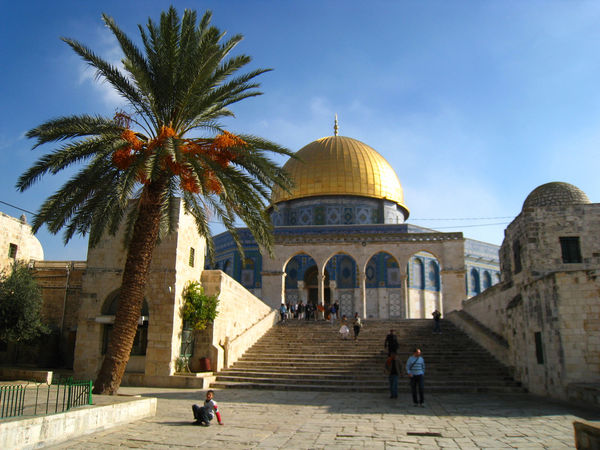
Al-Aqsa mosque is the oldest mosque inhabited for worshipping God alone after the sacred mosque. Therefore, all the Prophets visited the blessed mosque and offered their prayers there. Abdullah ibn ‘Umar may God be pleased with them both said: “The Prophets built and inhabited Bayt al-Maqdis and there isn’t an inch in Bait Al-Maqdis where a Prophet has not prayed or an Angel has not stood.” (Al-Anas al-Jaleel bi Tarikh al-Quds wa al-Khalil 1/239).

When it comes to the issue of the construction of al-Aqsa Mosque, we would find it a matter which occupied the minds of both Muslim scholars and historians. There was a dispute over who founded its earliest construction, the first opinion is that Adam peace be upon him established the two mosques. This opinion was mentioned by the scholar Ibn al-Jawzy and Ibn Hajar the scholar of hadith in Fath supported this opinion. He attested to what Ibn Hisham mentioned in his book al-Teejan that when Adam built the Ka’baa, God commanded him to walk to Bayt al-Maqdis and to build it. So, he built it and worshipped God there. This opinion was confirmed-as said by the scholar in al-Fath- based on this, Adam is the one who established al-Aqsa mosque or one of his offspring because the interval of time between constructing the two mosques is only forty years, (Fath al-Bary 6/409).

The second opinon is that Prophet Abraham peace be upon him is the one who established the mosque because this fact is well recognized by textual evidence of the Qur`an. If it is proved by textual evidence that he has built the Ka’baa, so building al-Aqsa mosque is preponderantly acceptable due to time convergence of both mosques. Among the supporters of that opinion Sheikh Ibn Taymia who said: “Prophets prayed in al-Aqsa mosque since the time of al-Khalil (Abraham).” (Majmou` al-Fatawa 27\258). In a different occasion he said: “al-Aqsa mosque exists since the time of Abraham peace be upon him.” (Majmou` al-Fatawa 27\251).

Engineering specialized researchers confirmed the absolute similarity between the structures of the honorable ka’baa and the blessed Aqsa mosque. By using 3d engineering application and without taking into consideration the two different areas of the ka’ba and al-Aqsa mosque, by means of maps and photos, researchers clarified the superposition of the four angles of the two structures. This supports with more scientific evidences the assumption that Adam peace be upon him built both mosques and fixed their limits with inspiration from God the Almighty. [Bayt al-Maqdis studies magazine].

Since the central message of every prophet is Islam, therefore it is necessarily that al-Aqsa mosque is of Islamic origin. Prophets are brothers, have the same religion and their doctrines may differ. A person’s faith is incomplete until he believes in all God’s messengers and scriptures, God the Almighty says: “The Messenger has believed in what was revealed to him from his Lord, and [so have] the believers. All of them have believed in God and His angels and His books and His messengers.” [Qur`an 2: 285]
The Islamic identity of Jerusalem is reinforced by being the first qibla [direction of prayer] for Muslims. The Prophet peace and blessings be upon him and his companions continued for 16 months praying towards Bayt al-Maqdes until the command of turning towards Bayt al-Haram was revealed in God’s words: “We have certainly seen the turning of your face, [O Muhammad], toward the heaven, and We will surely turn you to a qiblah with which you will be pleased. So turn your face toward al-Masjid al-Haram. And wherever you [believers] are, turn your faces toward it [in prayer].” [Qur`an 2: 144]

Changing the direction of prayer from al-Aqsa mosque to Ka’baa never affects the position of Jerusalem among Islamic sanctuaries and it is still the first of the two directions of prayer and the third holiest mosque to Muslims. 
[by Ali Gomaa, Source: http://ali-gomaa.com]
The reward of a prayer in the Sacred Mosque (in Makkah) is worth 100,000 prayers, a prayer in Prophet's mosque (in Medina) is worth 50,000 prayers and a prayer in al Aqsa Mosque (Jerusalem) is worth 50,000 prayers more than in any other mosque. The figures vary in traditions but it does signify the special status.

Read more:


Free-Books by "Peace Forum Network"

New weapons, new wars

Problem with video? Click here <<<>>>
THROUGHOUT history, the emergence of new and more effective weapons has usually led to war or escalated violence.

Each new weapon — the broadsword, lance, longbow, siege machine, heavy cavalry, gunpowder, cannons, repeating rifle, machine-gun, battle tank, aeroplane, helicopter, submarines, ballistic and cruise missile — in its time changed military equations and led to aggression by those who had gained the military advantage, even if temporarily.

Unfortunately, nuclear weapons were no exception. On the other hand, other than decisive defeat or victory, wars ended, or were avoided, when military power, and the weapons which are its essential components, were equally matched.
Problem with video? Click here <<<>>>
In the modern world, the asymmetry of military power and weapons systems has grown dramatically. Smaller and poorer nations have little or no capacity to defend themselves against the superior military power of larger and more technologically advanced states.

Even the militaries of mid-sized states are unable to defend themselves against the military prowess of the great powers, specially the United States. Saddam Hussein’s military crumbled twice in short order. For most states and groups confronting superior power and weapons, the only recourse is asymmetric warfare.

Referring to Iraq and Afghanistan, President Obama declared in his re-election victory speech that “a decade of war is ending”. However, there is a clear and present danger that the past decade of mainly land wars could be replaced by wars fought in the skies and cyber space with even more deadly consequences.

Several new weapons have been or are about to be developed, deployed or used which may yield this outcome: attack drones, anti-ballistic missiles, cyber weapons and stealth, laser and space weapons technologies. Of these, drones, ABM systems and cyber weapons, have already begun to enhance the proclivity of their possessors to use force.

The use of the Predator and Reaper drones by US forces on the Pakistan-Afghan border has increased the frequency and lethality of attacks against Al Qaeda and the Taliban insurgents. No doubt, this capability has contributed to the US decision to withdraw its land forces from Afghanistan. But, as the land war draws to a close, there will be an inevitable tendency for the US to rely ever more on drones to continue to support the regime or factions it leaves behind in Afghanistan.
Problem with video? Click here <<<>>>
There is a parallel concern in Islamabad that drones could be used for ‘precision’ strikes against Pakistan’s strategic capabilities. Overcoming this suspicion may be key to future Pakistan-US cooperation.
Drones may also become a weapon of choice if and when Western powers decide to play a more active role in support of the opposition forces in Syria. However, their use would lead to an escalation of the conflict and its extension to neighbouring countries.

Drone capabilities are being rapidly developed by other powers. China, India and Pakistan may soon have a capability that matches that of the US. No doubt, Iran will work overtime to reverse-engineer the US drone it captured.

There will be considerable temptation for all these powers to use drones against insurgents and other ‘difficult’ targets, rather than seek political solutions. The insurgents will find asymmetric means — IEDs, suicide attacks — to respond. Internal and cross-border conflicts would thus expand and be prolonged.

Cyberwar is also a reality now. The so-called Stuxnet virus, widely believed to have been used by the US and/or Israel to crash Iran’s centrifuges, is the most celebrated contemporary case of cyberwar. But the US secretary of defence, in a recent speech, alluded to cyber attacks on the US itself. There is no doubt that this covert war is being waged on a wide front, especially among the most advanced ‘IT powers’.
Problem with video? Click here <<>>

The escalation of this ‘war’, or its ‘crossover’ into the realm of physical conflict is a constant danger. Thus, in response to crashing centrifuges or escalating economic sanctions, the target country could launch a cyber strike against the presumed adversary to bring down its electrical grid or disrupt civil air traffic.

In the absence of international control, states will presume that their military command and control systems are under cyber attack. They may delegate military decisions, like the launch of tactical missiles, to junior commanders, multiplying the likelihood of a conflict and its instant escalation. Detection of presumed cyber attacks could also lead to war by miscalculation.

The third ‘new’ weapon — anti-ballistic missiles — is potentially the most destabilising.

Some days ago, the New York Times carried an article asserting that Israel’s recent Gaza operation was designed as a “test” for Israel’s anti-ballistic missile systems against Iranian missiles. The article leads to the disturbing presumption that the greater the success of Israel’s Iron Dome ABM system, the greater the likelihood of an Israeli strike against Iran’s nuclear facilities. This would be the clearest illustration of how a so-called ‘defensive’ system can contribute to ‘offensive’ action.

During the Cold War, the US and the Soviet Union expressly limited ABM systems to one on each side. They agreed that their widespread deployment would destabilise ‘Mutual Assured Destruction’ and nuclear deterrence. However, the faster technological development of ABM systems by the US and the decline and disappearance of the Soviet Union enabled the US to discard the ABM treaty and its restraints.

Now, there is every likelihood that ABM systems will proliferate. The US is deploying ABM systems against tactical, medium and long-range missiles, in the Arab part of the Gulf as well as in Europe. The proposed European deployment has evoked a strong response from Moscow which believes that these ABM deployments are aimed principally to neutralise Russia’s strategic capabilities. Intentions to deploy similar systems in Asia will no doubt evince opposition from Beijing. The stability of great power nuclear deterrence could be in jeopardy.

Closer to home, India too is in the process of acquiring advanced ABM systems. This could erode ‘minimum nuclear deterrence’ between Pakistan and India. To preserve the credibility of nuclear deterrence, Pakistan would have a choice: follow the extremely expensive path of acquiring ABM systems also, or the cheaper route of multiplying the number of offensive missiles and nuclear warheads.

Western analysts have not explained this as the reason for Pakistan’s enlargement of fissile material production. Adding ABM systems to the uncertain nuclear and missile equations in South Asia is equivalent to throwing a match into a tinderbox.

It is surprising that the international community has taken no steps to address the danger of new wars posed by these new weapons. The Geneva Conference on Disarmament — the sole multilateral disarmament negotiating forum — remains preoccupied by the agenda of Western powers — a treaty to halt fissile material production — while nudging aside calls for nuclear and space disarmament.

It is time that the Geneva body turned its attention to controlling those new and emerging weapons which pose a real and present threat to peace and security. It should put on its agenda and consider, as a priority, measures to regulate and control the deployment and use of drones, cyberwar and anti-ballistic missiles.

The writer is a former Pakistan ambassador to the UN.
Free-Books by "Peace Forum Network"

Israel's Oppression: The latest Gaza catastrophe

What now for the people and politics of Gaza?

He was one of the last Palestinians to be killed during Gaza's eight-day war with Israel - a conflict which Hamas, despite the loss of a military chief and scores of men, celebrated as its victory.>>>> keep reading


Many aspects of the current assault on Gaza pass under the radar screens of world conscience.

The media double standards in the West on the new and tragic Israeli escalation of violence directed at Gaza were epitomised by an absurdly partisan New York Times front page headline: "Rockets Target Jerusalem; Israel girds for Gaza Invasion" (NYT, Nov 16, 2012). Decoded somewhat, the message is this: Hamas is the aggressor, and Israel when and if it launches a ground attack on Gaza must expect itself to be further attacked by rockets. This is a stunningly Orwellian re-phrasing of reality.
The true situation is, of course, quite the opposite: Namely, that the defenseless population of Gaza can be assumed now to be acutely fearful of an all out imminent Israeli assault, while it is also true, without minimising the reality of a threat, that some rockets fired from Gaza fell harmlessly (although with admittedly menacing implications) on the outskirts of Jerusalem and Tel Aviv. There is such a gross disproportion in the capacity of the two sides to inflict damage and suffering due to Israeli total military dominance as to make perverse this reversal of concerns to what might befall Israeli society if the attack on Gaza further intensifies.
The reliance by Hamas and the various Gaza militias on indiscriminate, even if wildly inaccurate and generally harmless, rockets is a criminal violation of international humanitarian law, but the low number of casualties caused and the minor damage caused, needs to be assessed in the overall context of massive violence inflicted on the Palestinians. The widespread non-Western perception of the new cycle of violence involving Gaza is that it looks like a repetition of Israeli aggression against Gaza in late 2008, early 2009, that similarly fell between the end of American presidential elections and scheduled Israeli parliamentary elections.
Pointing fingers
Inside Story Americas -
Gaza: How can the US manage the crisis?
There is the usual discussion over where to locate responsibility for the initial act in this renewed upsurge violence. Is it some shots fired from Gaza across the border and aimed at an armoured Israeli jeep or was it the targeted killing by an Israeli missile of Ahmed Jabari, leader of the military wing of Hamas, a few days later? Or some other act by one side or the other? Or is it the continuous violence against the people of Gaza arising from the blockade that has been imposed since mid-2007?
The assassination of Jabari came a few days after an informal truce that had been negotiated through the good offices of Egypt, and quite ironically agreed to by none other than Jabari acting on behalf of Hamas. Killing him was clearly intended as a major provocation, disrupting a carefully negotiated effort to avoid another tit-for-tat sequence of violence of the sort that has periodically taken place during the last several years.
An assassination of such a high profile Palestinian political figure as Jabari is not a spontaneous act. It is based on elaborate surveillance over a long period, and is obviously planned well in advance partly with the hope of avoiding collateral damage, and thus limiting unfavourable publicity. Such an extra-judicial killing, although also part and parcel of the new American ethos of drone warfare, remains an unlawful tactic of conflict, denying adversary political leaders separated from combat any opportunity to defend themselves against accusations, and implies a rejection of any disposition to seek a peaceful resolution of a political conflict. It amounts to the imposition of capital punishment without due process, a denial of elementary rights to confront an accuser.
Putting aside the niceties of law, the Israeli leadership knew exactly what it was doing when it broke the truce and assassinated such a prominent Hamas leader, someone generally thought to be second only to the Gaza prime minister, Ismail Haniya. There have been rumours, and veiled threats, for months that the Netanyahu government plans a major assault of Gaza, and the timing of the ongoing attacks seems to coincide with the dynamics of Israeli internal politics, especially the traditional Israeli practice of shoring up the image of toughness of the existing leadership in Tel Aviv as a way of inducing Israeli citizens to feel fearful, yet protected, before casting their ballots.
Under siege
Beneath the horrific violence, which exposes the utter vulnerability, of all those living as captives in Gaza, which is one of the most crowded and impoverished communities on the planet, is a frightful structure of human abuse that the international community continues to turn its back upon, while preaching elsewhere adherence to the norm of "responsibility to protect" whenever it suits NATO. More than half of the 1.6 million Gazans are refugees living in a total area of just over twice the size of the city of Washington, DC. The population has endured a punitive blockade since mid-2007 that makes daily life intolerable, and Gaza has been harshly occupied ever since 1967.
Israel has tried to fool the world by setting forth its narrative of a good faith withdrawal from Gaza in 2005, which was exploited by Palestinian militants at the time as an opportunity to launch deadly rocket attacks. The counter-narrative, accepted by most independent observers, is that the Israeli removal of troops and settlements was little more than a mere redeployment to the borders of Gaza, with absolute control over what goes in and what leaves, maintaining an open season of a license to kill at will, with no accountability and no adverse consequences, backed without question by the US government.
From an international law point of view, Israel's purported "disengagement" from Gaza didn't end its responsibility as an Occupying Power under the Geneva Conventions, and thus its master plan of subjecting the entire population of Gaza to severe forms of collective punishment amounts to a continuing crime against humanity, as well as a flagrant violation of Article 33 of Geneva IV. It is not surprising that so many who have observed the plight of Gaza at close range have described it as "the largest open air prison in the world".
 Israel pounds Gaza Strip from air and sea
The Netanyahu government pursues a policy that is best understood from the perspective of settler colonialism. What distinguishes settler colonialism from other forms of colonialism is the resolve of the colonialists not only to exploit and dominate, but to make the land their own and superimpose their own culture on that of indigenous population. In this respect, Israel is well served by the Hamas/Fatah split, and seeks to induce the oppressed Palestinian to give up their identity along with their resistance struggle even to the extent of asking Palestinians in Israel to take an oath of loyalty to Israel as "a Jewish state".
Actually, unlike the West Bank and East Jerusalem, Israel has no long-term territorial ambitions in Gaza. Israel's short-term solution to its so-called "demographic problem" (that is, worries about the increase in the population of Palestinians relative to Jews) could be greatly eased if Egypt would absorb Gaza, or if Gaza would become a permanently separate entity, provided it could be reliably demilitarised. What makes Gaza presently useful to the Israelis is their capacity to manage the level of violence, both as a distraction from other concerns (eg backing down in relation to Iran; accelerated expansion of the settlements) and as a way of convincing their own people that dangerous enemies remain and must be dealt with by the iron fist of Israeli militarism.
No peace
In the background, but not very far removed from the understanding of observers, are two closely related developments. The first is the degree to which the continuing expansion of Israeli settlements has made it unrealistic to suppose that a viable Palestinian state will ever emerge from direct negotiations. The second, underscored by the recent merger of Netanyahu and Lieberman forces, is the extent to which the Israeli governing process has indirectly itself irreversibly embraced the vision of Greater Israel encompassing all of Jerusalem and most of the West Bank.
The fact that world leaders in the West keep repeating the mantra of peace through direct negotiations is either an expression of the grossest incompetence or totally bad faith. At minimum, Washington and the others calling for the resumption of direct negotiations owe it to all of us to explain how it will be possible to establish a Palestinian state within 1967 borders when it means the displacement of most of the 600,000 armed settlers now defended by the Israeli army, and spread throughout occupied Palestine. Such an explanation would also have to show why Israel is being allowed to quietly legalise the 100 or so "outposts", settlements spread around the West Bank that had been previously unlawful even under Israeli law. Such moves toward legalisation deserve the urgent attention of all those who continue to proclaim their faith in a two-state solution, but instead are ignored.
This brings us back to Gaza and Hamas. The top Hamas leaders have made it abundantly clear over and over again that they are open to permanent peace with Israel if there is a total withdrawal to the 1967 borders (22 percent of historic Palestine) and the arrangement is supported by a referendum of all Palestinians living under occupation.
Israel, with the backing of Washington, takes the position that Hamas as "a terrorist organisation" that must be permanently excluded from the procedures of diplomacy, except of course when it serves Israel's purposes to negotiate with Hamas. It did this in 2011 when it negotiated the prisoner exchange in which several hundred Palestinians were released from Israeli prisons in exchange for the release of the Israel soldier captive, Gilad Shalit, or when it seems convenient to take advantage of Egyptian mediation to establish temporary ceasefires.
 
As the celebrated Israeli peace activist and former Knesset member, Uri Avnery, reminds us a cease-fire in Arab culture,hudna in Arabic, is considered to be sanctified by Allah, has tended to be in use and faithfully observed ever since the time of the Crusades. Avnery also reports that up to the time he was assassinated, Jabari was in contact with Gershon Baskin of Israel, seeking to explore prospects for a long-term ceasefire that was reported to Israeli leaders, who unsurprisingly showed no interest.
Waiting for justice
There is a further feature of this renewal of conflict involving attacks on Gaza. Israel sometimes insists that since it is no longer, according to its claims, an occupying power, it is in a state of war with a Hamas governed Gaza. But if this were to be taken as the proper legal description of the relationship between the two sides, then Gaza would have the rights of a combatant, including the option to use proportionate force against Israeli military targets. As earlier argued, such a legal description of the relationship between Israel and Gaza is unacceptable. Gaza remains occupied and essentially helpless, and Israel as occupier has no legal or ethical right to engage in war against the people and government of Gaza, which incidentally was elected in internationally monitored free elections in early 2006.
On the contrary, its overriding obligation as Occupier is to protect the civilian population of Gaza. Even if casualty figures in the present violence are so far low as compared with Operation Cast Lead, the intensity of air and sea strikes against the helpless people of Gaza strikes terror in the hearts and minds of every person living in the Strip, a form of indiscriminate violence against the spirit and mental health of an entire people that cannot be measured in blood and flesh, but by reference to the traumatising fear that has been generated.
We hear many claims in the West as to a supposed decline in international warfare since the collapse of the Soviet Union twenty years ago. Such claims are to some extent a welcome development, but the people of the Middle East have yet to benefit from this trend, least of all the people of Occupied Palestine, and of these, the people of Gaza are suffering the most acutely. This spectacle of one-sided war in which Israel decides how much violence to unleash, and Gaza waits to be struck, firing off militarily meaningless salvos of rockets as a gesture of resistance, represents a shameful breakdown of civilisation values. These rockets do spread fear and cause trauma among Israeli civilians even when no targets are struck, and represent an unacceptable tactic. Yet such unacceptability must be weighed against the unacceptable tactics of an Israel that holds all the cards in the conflict.
It is truly alarming that now even the holiest of cities, Jerusalem, is threatened with attacks, but the continuation of oppressive conditions for the people of Gaza, inevitably leads to increasing levels of frustration, in effect, cries of help that world has ignored at its peril for decades. These are survival screams! To realise this is not to exaggerate! To gain perspective, it is only necessary to read a recent UN Report that concludes that the deterioration of services and conditions will make Gaza uninhabitable by 2020
Completely aside from the merits of the grievances on the two sides, one side is militarily omnipotent and the other side crouches helplessly in fear. Such a grotesque reality passes under the radar screens of world conscience because of the geopolitical shield behind which Israel is given a free pass to do whatever it wishes. Such a circumstance is morally unendurable, and should be politically unacceptable. It needs to be actively opposed globally by every person, government, and institution of good will.
Richard Falk is the United Nations Special Rapporteur on Palestinian human rights.

The views expressed in this article are the author's own and do not necessarily reflect Al Jazeera's editorial policy.
http://www.aljazeera.com/indepth/opinion/2012/11/2012111874429224963.html


Read More >>>>

Stuart Littlewood views the ideology of Christian Zionism, which is rampant in the United States and has made some inroads in other "Christian" societies, and argues that, in essence, Christian Zionism is "a gross corruption of ...
Zionist Christians: Useful tool for Zionist Jews. Christian Zionists believe that in order to fulfill Biblical prophecy, Israel must conquer most of the Middle East. They are a growing force in American politics with ties to many ...
If you are as puzzled as I am as to how a true Christian could possibly be taken in by Zionism, a short paper on the phenomenon is available from the Irish-Palestinian alliance, Sadaka. Sadaka sums up the Christian Zionist .
The notorious crusades were initiated in by Pope Urban 2nd in 1096 when the Church was losing its hold on Christians, this ploy was used by them to bring the Christians back under the yoke of the Church. As a reaction to ...
Free-Books by "Peace Forum Network"