All these refugees, homeless, destroyed, killed people are Muslims whose lands are attacked by US/NATO/West..

Related:
More:
| Follow @AftabKhanNet | Facebook Page |
| Follow @AftabKhanNet | Facebook Page |

The peer who fled the Nazis, aged six, on Labour’s troubles – and his attempts to make the government accept 3,000 unaccompanied child refugees
The public support Lord Dubs received when the Labour peer’s amendment to the immigration bill passed through the Lords in March took him by surprise. “I’ve had people in the street shouting at me, saying well done,” he says. “And you know, when politicians in the street normally get shouted at, it’s with abuse.”
The Dubs amendment to compel the government to take 3,000 unaccompanied child refugees from Europe – proposed amid reports that some 95,000 refugee children have reached Europe without their parents – was voted down by the Commons last week. But it was immediately revised by the Lords and sent back – to be voted on in the Commons again next week. Dubs says the new amendment, which states that numbers of child refugees will be determined by the government in consultation with councils, has made it “easier for the government to accept”, but the key principle, that Britain should take in unaccompanied, mostly Syrian minors from Europe, remains in place. The government has argued that the UK is already helping refugees in the Middle East, and that accepting vulnerable children from European camps would create a “pull factor”. But Dubs, who arrived in the UK from Czechoslovakia on Kindertransport aged six, disagrees. “There is little evidence to suggest that, but in any case the plight of unaccompanied children in various parts of Europe is so serious that one has to set that off against the possibility that one or two might come as a result of a magnet effect,” he says.
This isn’t the first time Dubs has worked on migration issues – he chaired the Refugee Council for seven years and worked on immigration while on the Labour shadow cabinet front benches during the late 1970s and early 1980s. But he believes that public support for his amendment is significant at a time when resentment and negative sentiment has been stirred around the issue of refugees and migrants across Europe.
“It seems to have got hope to people, that it’s something we could easily do as a country and is important to do,” he says, adding: “British people have good humanitarian instincts. Basically people feel that it’s a rough world, and if we can do something to help a few people, then we should do that.”
A Labour working peer since 1994, the Prague-born Dubs says that he is fighting this case on principle, but in terms of garnering media attention his background has obviously helped. He arrived in Britain in 1939, one of 10,000 children who the UK received as part of the government-backed Kindertransport scheme from Germany and Nazi-occupied countries before the outbreak of the second world war.
Dubs was one of the youngest children and also, he says, luckier than most, because both his parents survived the war: his father was already in Belsize Park, north London, and his mother also eventually escaped – he is not sure how – and joined them in Britain. His father died of a heart attack shortly afterwards, leaving her alone with a child and no money, scrubbing floors and travelling the country for various jobs. She died of leukaemia just after Dubs finished university at the London School of Economics. Years later, he learned that he was one of the 669 children saved from the Nazi regime by Sir Nicholas Winton – the “British Schindler” – and the two became friends.
Dubs says that, steeped in politics at an early age, he quickly realised he wanted to enter this field, because “if evil politicians had caused so much that was dreadful in the world, maybe politics could also be used for good”. Always aligned to the Labour party – “the only way forward” – he was selected as Labour candidate for Battersea South, which he represented until 1987, a post he describes as “a privilege”. There followed a short period out of work – he went to sign on for the dole after losing his seat and wrote “not enough votes” on the form as the reason for his unemployment. After writing a book on how to lobby parliament, to help campaigners and activists, he worked for the Refugee Council, becoming the first refugee director of the organisation, and later for Liberty, as well as other charities and trusts.
It seems that Dubs has always been a thorn in the side of governments, during Labour tenures too. In 2008, while Gordon Brown was prime minister, Dubs refused to approve the government’s attempts to increase the period of detention without charge, from 28 to 42 days.
“The whips asked me four times if I’d support the government and I said no. Then they asked me if I’d take the day off and I said no.” He opposed the Iraq war, though he says that, to this day, he regrets not moving a Lords amendment that declined to support military action in Iraq without endorsement from the UN security council. It wouldn’t have passed, he says, but still: “There was a point of principle about it and a time when it was important to go on the record. I would have felt more at peace with myself if I had played my part”
In the Lords he has fought, among many other things, to make mental health trusts more open, to provide more support for neurological diseases – his son has MS – and in favour of assisted dying. He wants to see an income tax increase hypothecated to the underfunded health service – something he feels the public would support if they knew every penny of the increase was going to the NHS.
He has also been consistently vocal on race relations – during the Brixton riots of the early 1980s he “got into long arguments” about police stop and search, which was disproportionately targeting young black men and which he views as one of the factors causing “understandable resentment”. Still clearly passionate in opposing discrimination of any sort, and at a time when the Labour party has been under fire over antisemitism, Dubs says: “I think antisemitism, Islamophobia and racism are all absolutely and equally abhorrent,” adding: “If I thought the Labour party had a problem with antisemitism, I would leave tomorrow.” He does, however, feel that party leader Jeremy Corbyn began to address the issue “too slowly, and didn’t make a clear enough statement” about it early on.
As for the government, he thinks the current administration is “harsher than the Thatcher government in some ways – the cuts in our services are awful, the cuts in social security support, all these things are a terrible package, where the poor are having to carry the burden”. He was pushing to tackle tax avoidance long before the Panama Papers and still believes this is key – along with opposing austerity measures. The unfairness in our society is much more manifest. How can we have a world with such wealth inequality? It is scandalous – and I shall go on playing my part, to lessen inequality, to work for equality, to oppose discrimination of any sort and to have decent public services.”
As the new amendment on unaccompanied child refugees goes back to the Commons, he remains hopeful that MPs will do the right thing. “Britain is a great country, but I don’t think we are doing a good enough job,” he says. “I keep saying, I’d like other people to have the same opportunities in Britain that I had.”
Alf Dubs: ‘Antisemitism, Islamophobia and racism are all equally abhorrent’
by RACHEL SHABI, theguardian.com
Education Cheadle Hulme school, Cheshire; London School of Economics, BSc politics and economics.
Career 1994 to present: Labour peer, House of Lords; 1997-99: junior minister, Northern Ireland Office; 1994–97: opposition whip; 1988-95: director, Refugee Council; 1979-87: Labour MP, Battersea South (later Battersea); 1983-87: opposition front bench spokesman on home affairs; 1981–83: member, home affairs select committee; 1971-78: member, Westminster city council.
Public life chaired the Fabian Society and Liberty; past trustee of Action Aid and the Immigration Advisory Service.
Interests Walking in the Lake District, tennis, political histories, biographies and thrillers.
http://google.com/newsstand/s/CBIwvK_3oio
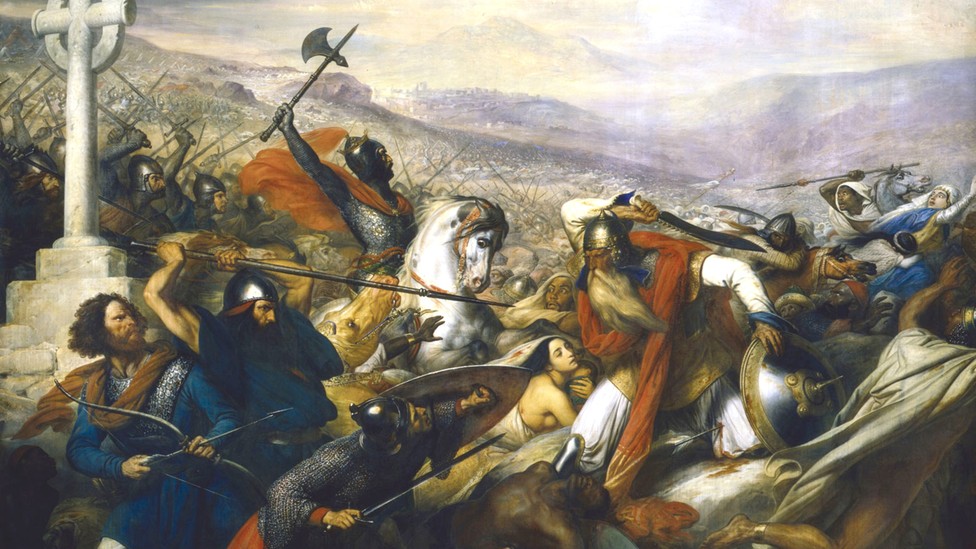
Charles Auguste Steuben's painting of the Battle of the Poitiers in 732. The Frankish leader Charles Martel's victory over Muslim invaders is seen as a decisive moment in European history. Wikimedia
Photo by: Wikimedia
Europe was essentially defined by Islam. And Islam is redefining it now.
For centuries in early and middle antiquity, Europe meant the world surrounding the Mediterranean, or Mare Nostrum (“Our Sea”), as the Romans famously called it. It included North Africa. Indeed, early in the fifth century A.D., when Saint Augustine lived in what is today Algeria, North Africa was as much a center of Christianity as Italy or Greece. But the swift advance of Islam across North Africa in the seventh and eighth centuries virtually extinguished Christianity there, thus severing the Mediterranean region into two civilizational halves, with the “Middle Sea” a hard border between them rather than a unifying force. Since then, as the Spanish philosopher José Ortega y Gasset observed, “all European history has been a great emigration toward the North.”
After the breakup of the Roman empire, that northward migration saw the Germanic peoples (the Goths, Vandals, Franks, and Lombards) forge the rudiments of Western civilization, with the classical legacy of Greece and Rome to be rediscovered only much later. It would take many more centuries for the modern European state system to develop. Slowly, though, feudalism, whose consensual give-and-take worked in the direction of individualism and away from absolutism, gave way to early modern empires and, over time, to nationalism and democracy. Along the way, new freedoms allowed the Enlightenment to take hold. In sum, “the West” emerged in northern Europe (albeit in a very slow and tortuous manner) mainly after Islam had divided the Mediterranean world.
Islam did much more than geographically define Europe, however. Denys Hay, a British historian, explained in a brilliant though obscure book published in 1957, Europe: The Emergence of an Idea, that European unity began with the concept (exemplified by the Song of Roland) of a Christendom in “inevitable opposition” to Islam—a concept that culminated in the Crusades. The scholar Edward Said took this point further, writing in his book Orientalism in 1978 that Islam had defined Europe culturally, by showing Europe what it was against. Europe’s very identity, in other words, was built in significant measure on a sense of superiority to the Muslim Arab world on its periphery. Imperialism proved the ultimate expression of this evolution: Early modern Europe, starting with Napoleon, conquered the Middle East, then dispatched scholars and diplomats to study Islamic civilization, classifying it as something beautiful, fascinating, and—most crucial—inferior.
In the postcolonial era, Europe’s sense of cultural preeminence was buttressed by the new police states of North Africa and the Levant. With these dictatorships holding their peoples prisoner inside secure borders—borders artificially drawn by European colonial agents—Europeans could lecture Arabs about human rights without worrying about the possibility of messy democratic experiments that could lead to significant migration. Precisely because the Arabs lacked human rights, the Europeans felt at once superior to and secure from them.
Islam is now helping to undo what it once helped to create. A classical geography is organically reasserting itself, as the forces of terrorism and human migration reunite the Mediterranean Basin, including North Africa and the Levant, with Europe. The Continent has absorbed other groups before, of course. In fact, Europe has been dramatically affected by demographic eruptions from the east: In the medieval centuries, vast numbers of Slavs and Magyars migrated into central and eastern Europe from deeper inside Eurasia. But those peoples adopted Christianity and later formed polities, from Poland in the north to Bulgaria in the south, that were able to fit, however bloodily, inside the evolving European state system. As for the Algerian guest workers who emigrated to France and the Turkish and Kurdish guest workers who emigrated to Germany during the Cold War, they represented a more containable forerunner to the current migration.
Today, hundreds of thousands of Muslims who have no desire to be Christian are filtering into economically stagnant European states, threatening to undermine the fragile social peace. Though Europe’s elites have for decades used idealistic rhetoric to deny the forces of religion and ethnicity, those were the very forces that provided European states with their own internal cohesion.
Meanwhile, the new migration, driven by war and state collapse, is erasing the distinction between the imperial centers and their former colonies. Orientalism, through which one culture appropriated and dominated another, is slowly evaporating in a world of cosmopolitan interactions and comparative studies, as Said intuited it might. Europe has responded by artificially reconstructing national-cultural identities on the extreme right and left, to counter the threat from the civilization it once dominated.
Although the idea of an end to history—with all its ethnic and territorial disputes—turns out to have been a fantasy, this realization is no excuse for a retreat into nationalism. The cultural purity that Europe craves in the face of the Muslim-refugee influx is simply impossible in a world of increasing human interactions.
“The West,” if it does have a meaning beyond geography, manifests a spirit of ever more inclusive liberalism. Just as in the 19th century there was no going back to feudalism, there is no going back now to nationalism, not without courting disaster. As the great Russian intellectual Alexander Herzen observed, “History does not turn back … All reinstatements, all restorations have always been masquerades.”
The question is thus posed: What, in a civilizational sense, will replace Rome? For while empire, as Said documented, certainly had its evils, its very ability to govern vast multiethnic spaces around the Mediterranean provided a solution of sorts that no longer exists.
Europe must now find some other way to dynamically incorporate the world of Islam without diluting its devotion to the rule-of-law-based system that arose in Europe’s north, a system in which individual rights and agency are uppermost in a hierarchy of needs. If it cannot evolve in the direction of universal values, there will be only the dementia of ideologies and coarse nationalisms to fill the void. This would signal the end of “the West” in Europe.
By Robert D. Kaplan, theatlantic.com
http://www.theatlantic.com/magazine/archive/2016/05/how-islam-created-europe/476388/
Canadian children performed the same song for refugees that was sung to Prophet Muhamad (pbuh) when he sought refuge
The first plane of Syrian refugees landed in Toronto late on Thursday, and Canada has wasted no time in welcoming them.
Prime Minister Justin Trudeau was at the airport to personally welcome the 163 new arrivals from Beirut, helping distribute warm winter coats.
On Friday, a video of a children's choir singing a beautiful song in Arabic to their new neighbours surfaced.
The traditional song 'Tala' al-Badru 'Alayna' is one of the oldest in Islam. It was sung by the Ansar (Helpers) to the Prophet Mohamed when he sought refuge in their city of Medina and its message is one of welcome and hope.
Several commenters on social media said the gesture made them cry.
The lyrics are:
Oh the white moon rose over us
From the valley of Wada'
And we owe it to show gratefulness
Where the call is to Allah
Oh you, who were raised among us
Coming with a word to be obeyed
You have brought to this city nobleness,
Welcome best caller to God's way


The greatest influx of people into Europe in decades is not just a humanitarian emergency, but also a potential stroke of luck for many countries facing the economic threat of an aging population.
A plunge in birth rates means there will be a dearth of European workers in coming years to support the growing number of retirees. So the arrival of thousands of young and of ten well-e ducate d potential workers stands to boost the long-term economic prospects of the region.
The key is how well they are integrated and how many jobs are on offer.
Germany, among the most vocal in welcoming refugees, is also conveniently the country that stands to gain most quickly, as it has a strong labour market with lots of vacancies. But weaker economies like Greece and Italy will take years, even decades, to see positive effects as they struggle to create jobs though they too face the threat of a demographic time bomb.
`Let us not forget, we are an aging continent in demographic decline,` the president of the European Union Commission, Jean-Claude Juncker, said last month in a speech. `We will be needing talent.
Before the influx of people began this year, the German statistics office said it expected the country`s population, now 80.8 million, to shrink by a tenth or more by 2060. Germany forecasts its workforce will drop by 6m in the next 15 years.
Welcoming an estimated 800,000 people from Syria, Iraq and other countries this year will cost Germany about 6 billion euros ($6.6bn) next year in welfare support and language training.
But such upfront costs may be recouped through higher economic growth. Andreas Rees, economist at UniCredit banlc, estimates that the flood of new arrivals over the next few years could grow Germany`s economy by an extra 1.7 per cent by 2020.
Daimler CEO Dieter Zetsche made the case this week: `To take into Germany more than 800,000 people who need our help is without a doubt a Herculean task, but in the best case, it can also be the basis for the next German economic miracle.
Sweden, which last year received 80,000 asylum seekers, second highest in the EU behind Germany, also views the newcomers as a net gain, though up-front costs may be stiff. `Because we have an aging population,` Kristina Persson, minister for Nordic cooperation, said, `we have to replace those who leave the labour market.
That may not be so easy in other countries. Greece, which is the first EU country of arrival for many people travelling from the Middle East, has an unemployment rate near 25pc, with about half of young people out of work. It is expected to take a generation to turn the economy around.
And the new arrivals know it, preferring to move on to try to reach Germany and thericher countries of Northern Europe.
Ironically, some of the countries in Europe that are most threatened by a drop in birth rates are working the hardest to keep newcomers out. Hungary is one such case. It is sealing its borders with barbed wire and firing tear gas and water cannons to keep migrants away.
In Poland, a shift to smaller-size families years ago means fewer workers now support each retiree, a trend expected to worsen dramatically over the next two decades. So far, Poland has agreed to accept 2,000 refugees.
And the Czech government has barely cracked its door open, allowing in just 1,500 migrants, despite a demographic drag on its own economy.
Overall, the politics of welcoming refugees and other migrants is influenced more by cultural and political factors than economic ones. Germany`s economy could benefit from an even greater increase in immigration, experts say, but the government is hesitant. Chancellor Angela Merl
A migration expert at the OECD in Paris, Jean-Christophe Dumont, said that it`s costlier upfront tointegrate refugees than other categories of immigrants, because they often need language and vocational training as well as treatment for physical injuries or psychological trauma.
However, refugees, if well integrated, ultimately have a positive impact on the economy, Dumont said. One Australian study found that within 15 years, humanitarian migrants contribute more to their new country of residence than they cost it in benefits.
Ulrich Grillo, head of the Federation of German Industries, has said the German government needs to ensure the refugees now arriving are quickly permitted to work. Already, some companies have indicated their willingness to take on some of the newcomers, with Siemens and Deutsche Telekom offering a small number of paid internships.
McDonald`s Germany has said it would help the government provide 20,000 online language courses for asylum-seekers.
Zetsche, Daimler`s CEO, has been among the most bullish about migrants` impact, saying at the Frankfurt auto show this weel< that anyone who has managed to surmount the obstacles to make it to Germany from the Middle East or Africa has obviously got what it takes to work for him.
`I believe anybody who leaves their life completely behind will be highly motivated to learn and work here, and to build a new life,` said Zetsche. `We are looking for exactly this type of person at Mercedes, and everywhere in our country.
Dawn.com
The real tragedy is the refusal of Western leaders to acknowledge the cause of the refugee crisis – Western imperialism’s genocidal and never ending wars on the people of the Middle East, Central Asia, and Africa.
There are now more refugees than at any time since World War 2, and the number of refugees has increased markedly since the start of the “Global War on Terror” [3]. Wherever the U.S. and its imperialist allies have intervened, whether through direct military action or indirect proxy wars, economic sabotage, and coups, in the name of “democracy”, the “War on Terror”, or the “responsibility to protect”, death and despair have been forced upon millions of innocent people, who have been left no other choice than to abandon their native lands to embark on a dangerous future of desperate struggle.
In Afghanistan, Iraq, Libya, Syria, Yemen, Pakistan, Somalia, Mali, Korea, Vietnam, East Timor, Sudan, Ukraine, and elsewhere the livelihoods of millions have been destroyed by the forces of U.S. and Western imperialism.
In the 1980s, Afghanistan had a “genuinely popular government”, according to John Ryan, retired professor from the University of Winnipeg, that was implementing widespread reforms [4]. Labour unions were legalized, a minimum wage was established, hundreds of thousands of Afghans were enrolled in educational facilities, and women were freed from age-old tribal bondage and able to earn an independent income. U.S. and Western imperialism, fearful of that kind of equitable distribution of wealth, supported the feudal landlords and fundamentalist mullahs to sow chaos across the country, bringing rise to elements that later formed al-Qaeda and the Taliban. The Afghan people were once more dealt a severe punishment by the forces of Western imperialism following 9/11, despite a lack of conclusive evidence linking either the Taliban or al-Qaeda to the attacks. 30 years of U.S. intervention in Afghanistan have left the people of Afghanistan impoverished, traumatized, and desperate.
The conflicts in Libya and Syria are eerily similar to the Western destabilization of Afghanistan. In 2011, when the Arab Spring protests swept across the Middle East and North Africa, Western imperialism hijacked legitimate grievances of the masses as a pretext for intervention in the name of the “responsibility to protect” and “democracy promotion”.
Prior to the 2011 U.S./NATO intervention, Libya was among the wealthiest and most stable countries in Africa, with the continent’s highest standard of living. Housing was enshrined as a human right, education and healthcare services were free for all citizens, and the country was pushing to establish an African currency linked to gold to help end the endless cycle of debt and impoverishment of the African masses by Western imperialism [5]. Under the cloak of the United Nations, Western imperialism, using the pretext of protecting the people of Libya from Gaddafi’s murderous rule, launched airstrikes on Libya and allied themselves with al-Qaeda in the Islamic Maghreb and other Libyan extremists [6]. NATO airstrikes killed hundreds of civilians and forced Libya back into the Stone Age; Gaddafi was mercilessly tortured and murdered by the rebels. Thousands have been killed as rival tribal and extremist factions, some now allied with ISIS, battling for control of the country.
The conflict in Syria has frequently been referred to as “Libya 2.0”. U.S. imperialism with the support of Israel, Turkey, and the Persian Gulf States, trained and financed “moderate” rebels to overthrow the secular and popularly supported government of Bashar al-Assad. The “Free Syrian Army”, i.e., the “moderate” rebels, has been virtually eliminated in the conflict despite millions of dollars in aid from the U.S. and its regional allies [7]. FSA fighters have deserted to the ranks of ISIS en masse, itself a product of the illegal U.S. occupation of Iraq that killed 1 million Iraqis. There is overwhelming evidence that the U.S. and its allies have been actively training and supporting ISIS elements since the start of the proxy war in Syria [8][9]. It wasn’t until ISIS invaded Iraq with its new Toyota technicals, curtesy of U.S. imperialism, that ISIS was declared a threat to the world. Western imperialism changed its tactic from supporting ISIS to airstrikes on Iraq and Syria, with the support of other Western imperialist states, Turkey (which is also conveniently bombing anti-ISIS Kurdish fighters [10]), Saudi Arabia and the Persian Gulf States, but without consultation with the Syrian government, Iran, or Hezbollah that have been fighting ISIS and al-Qaeda elements since the start of the conflict. Hundreds of thousands have died in the West’s proxy war against the Syrian government.
From Libya to Afghanistan, the Democratic Republic of the Congo, Pakistan and Somalia, U.S. and Western imperialist interventions, coups, and sanctions have displaced and killed millions of people. Physicians for Social Responsibility estimates that in Afghanistan, Iraq, and Pakistan alone Western imperialist interventions have caused the deaths of 1.3 million people [11]. It is no wonder then that hundreds of thousands seek asylum elsewhere; however, after traveling huge distances overland and on water, refugees find themselves abused, discriminated against, held in detention, or rejected from Europe, Canada, the U.S., and Australia.
More than 2, 500 have died this year trying to cross the Mediterranean Sea into Europe, while the International Organization for Migration estimates that 30, 000 could die by the end of 2015 [12].
Refugees attempting to enter Europe, even if they are granted asylum in a mainland European country such as Germany, have been met with police violence in Greece, Italy, and other countries on the Mediterranean that are the first landing points for boats sailing from North Africa and Turkey.
Greek riot police have beaten refugees protesting the failure of local governments to process their applications. Conditions are so poor for refugees that while waiting for processing newborn babies have died in Greece [13].
On the Macedonia-Greece border, where more than a thousand refugees are crossing daily, refugees that broke through the barbed wire fences were shot at with stun grenades, and the Macedonian police have treated refugees as rioters, according to Amnesty International [14].
Italian police forcibly removed African refugees camping out at the French border after France refused to grant them asylum [15]. Hungary is building a fortified wall, similar to the barbaric wall that divides the U.S.-Mexico border, to stop refugees from crossing the border [16].
The thousands of refugees that seek asylum in Australia are detained in Australia’s detention facilities in Papua New Guinea and the small island nation of Nauru, dubbed the “Guantanamo Bay of the Pacific” [17]. Refugees can be detained for several years in these facilities, where social workers have observed “profound damage” to those detained through “prolonged deprivation of freedom, abuse of power, confinement in an extremely harsh environment, uncertainty of future, disempowerment, loss of privacy and autonomy and inadequate health and protection services” [18]. An Australian Senate investigation received reports of guards raping women on tape and sexually exploiting children as young as 2-years-old [19]. Just as Britain refuses to assist drowning refugees in the Mediterranean out of fear that it will encourage more migrants to seek asylum [20], the unannounced policy of Australian authorities is to make refugees suffer abuse and inhumane living conditions to deter them from seeking asylum in Australia, as if Australian imperialism hasn’t inflicted enough suffering on the people of the Middle East, South and Southeast Asia.
U.S. and Western imperialism is the root cause of the “refugee crisis”. Everyday men, women, and children are killed by U.S. drone strikes in Pakistan, U.S. and Western-backed militias in Afghanistan, Syria, and Somalia, European and North American mining and oil conglomerates in Central and Western Africa, or are starved to death in Yemen by the U.S.-backed Arab blockade of the country. Until the genocidal aims of U.S. imperialism, with the support of Canada, Australia, the European Union, and regional allies, are defeated, the “War on Terror” will continue to make life too unbearable for working people in Asia, Africa, and the Middle East to remain in their home countries.
The Refugee Crisis is a Crisis of Imperialism
by T. J. Petrowski, globalresearch.ca
http://www.globalresearch.ca/the-refugee-crisis-is-a-crisis-of-imperialism/5475014


