Featured Post

SalaamOne NetWork

SalaamOne سلام   is   a nonprofit e-Forum to promote peace among humanity, through understanding and tolerance of religions, cul...

Showing posts with label Oil. Show all posts

Causes of conflict between Islam and the USA , West


Why Islam has not undergone culture reform?  His answer: Muslims have been on the defensive for hundreds of years, their enemies continually threaten them and Westerners have never given Muslims an opportunity to think. They have always bombarded the Muslim world with their industrial power, scientific and technological capabilities and with their capacity to rule and dominate the world. They have never let it develop and examine itself. Writes Robert Fisk of The Independent.
Fisk argued the US policy on Islam is based on enmity, asking: Why is the US in Iraq, the Middle East, Kazakhstan, Uzbekistan, Pakistan, Germany, Turkey and Greece? Why are there US soldiers all around the world, beyond the US boundaries? What do they intend to do there? He made a comparison between the number of soldiers involved in the Crusades in the 12th century and the number of US soldiers currently deployed in the Middle East. The result is unbelievable: currently, the number of the US soldiers in the Middle East is twice the number of the soldiers involved in the Crusades. (Vatan newspaper, May 16, 2007).

Whether you like it or not, there are serious conflicts between Islam and the West. Without delving into the real causes of these conflicts, a fresh start does not seem likely:
(1) The West is exerting control over the Muslim territories where one-third of the world's energy resources are located, as well as exerting control over energy transfer routes. Muslims are denied ownership of their own natural resources.
(2) The primary obstacle to change in the Muslim world is the existence of oppressive regimes. The great majority of the population is young, desperate and unemployed and millions are seeking better education and health services, fair income distribution, freedom of expression and the right for a free opposition, in short, more humane conditions. However, these oppressive regimes are supported by the US and Europe. Yet, Western regimes and the media tend to portray the Islamic Salvation Front (FIS), Hamas, Hezbullah and the Muslim Brotherhood, all of which advocate free elections, democratic participation and parliamentary regimes as "extremists" and the autocracies, dictatorships and kingdoms as "moderates." Thus, one can conclude that for Westerners, "moderates" are those who do not raise objections to the Western presence in the region while "extremists" are those who do.
(3) Israel, which was mounted in the heart of the region, has been occupying lands for nearly 70 years and raining hell on the lives of Palestinians, but despite all the atrocities it commits, it gets unconditional support from all Western countries. The Palestinian issue is the "mother of all issues." This issue will not be settled unless the Israeli occupation ends, Palestinian refugees return to their own lands, Israeli settlers are stopped and the destruction of the Masjid al-Aqsa is stopped.
(4) Islam and its practitioners are being "othered" in a planned and intentional manner, and they are demonized through exclusion from the global system. Every day we face a new definition and another campaign for defamation: fanaticism, fundamentalism, political Islam, integrism, radicalism, Islamophobia, Islamofascism, reactionaryism, conservatism, extremism, Islamic terror, etc.
(5) The West imposes its culture and its lifestyle; it urges governments in Muslim countries to implement policies to ensure this, and it does not enter into dialogue on a paradigmatic level. It manipulates the social and cultural textures of Muslims without allowing them to change in their natural courses.

These are real conflicts. These are at the heart of the conflicts. On one side of the cleavage caused by these issues is the West, and on the other side is the Muslim world. Russia and China intervene in the Muslim world only from a political and strategic perspective. On the other hand, the West meddles with the Muslim world in every aspect. If the West really wants to make peace and coexist with Islam, it must pull out its occupation forces, it must stop supporting oppressive regimes, it has to make sure that Israel withdraws to pre-1967 borders and it must respect Islam and the lifestyles of Muslims.

http://www.islamicity.org/3559/causes-of-conflict-between-islam-and-the-west/

Related:

~ ~ ~ ~ ~ ~ ~ ~ ~ ~ ~ ~ ~ ~ ~ ~ ~  ~ ~ ~  ~


~ ~ ~ ~ ~ ~ ~ ~~ ~ ~ ~ ~ ~  ~ ~ ~  ~
Humanity, Knowledge, Religion, Culture, Tolerance, Peace

Books, Articles, Blogs, Magazines,  Videos, Social Media

سلام فورم نیٹ ورک  Peace Forum Network 
Join Millions of visitors: 
Salaamforum.blogspot.com 

Join 'Peace-Forum' at Social Media, WhatsApp/SMS Name,Cell#at +923004443470
     
  
Facebook: fb.me/AftabKhan.page

Does the U.S. Military Actually Protect Middle East Oil?

America’s experience in the Middle East over the past fifteen years has been bruising, to say the least. For his part, President-elect Donald Trump has repeatedly, if inconsistently, exploited Americans’ frustration with what are widely viewed as foreign policy failures in Afghanistan, Iraq, Libya and Syria. At a rally last month, Trump promised to “stop racing to topple foreign regimes that we know nothing about,” adding that “this destructive cycle of intervention and chaos must finally come to an end.” On the other hand, Trump has also used brazenly hawkish rhetoric and has filled his cabinet with people not at all averse to bold U.S. interventionism.
Trump’s inconsistencies aside, it seems voters welcomed his blunt criticisms of U.S. military action in the Middle East. But scrutiny of U.S. foreign policy in the region should go beyond a potent skepticism of regime change or exasperation with chasing after terrorists. In addition to our ill-fated nation-building effort in Afghanistan and the fight against ISIS, the traditional rationale boils down to oil. As it turns out, though, forward deployment isn’t all that useful in securing the free flow of oil. 
Overall the United States has approximately 35 thousand troops in the Middle East. Those that are based in Kuwait (about 13 thousand) and in Bahrain (about five thousand) are most explicitly about energy security, although various U.S. bases across the region cooperate in that role. This  forward deployed military presence is supposed to achieve four basic energy security objectives: (1) protect against the rise of a regional hegemon that could gain control of energy resources; (2) deter any external power from gaining a foothold in the region; (3) dampen regional rivalries and stave off a war that could disrupt supply; and finally, (4) deter or rapidly reverse any attempt to close the Strait of Hormuz, a critical chokepoint through which 30 percent of the world’s seaborne oil passes.
But do permanent peacetime military forces really serve these objectives? According to Charles L. Glaser and Rosemary A. Kelanic, “the conventional wisdom, which holds that U.S. oil interests in the Persian Gulf are so large and threatened that the United States must dedicate large military capabilities to their defense” is wrong. Danielle F. S. Cohen and Jonathan Kirshner go so far as to call the belief in “energy insecurity”—common among policymakers and some academics—“a myth,” and “an erroneous belief that national security requires ambitious and vigilant foreign policy measures to assure adequate access to energy.”
Indeed, the United States today is far less reliant on foreign oil supplies than it once was. In 2015, only about 24 percent of the petroleum consumed by the United States was imported from foreign countries (the lowest level since 1970), and only about 16 percent of that was imported from the Middle East. This is largely because U.S. domestic production has significantly increased thanks to technological advances in exploiting shale reserve areas. Since 2008, annual U.S. crude production has grown by about 75 percent and net import volumes are projected to decline by 55 percent by 2020. Canadian oil output is also expected to double by 2040, meaning North America is on track to be a net oil exporter by 2020 and to remain so through 2040.
More importantly, oil is a fungible commodity traded on global markets and subject to the laws of supply and demand. Supply disruptions from one source impact the overall price, but can quickly be offset by an increase in output from another source. In every oil shock since 1973, global energy markets adapted quickly, by increasing production from other sources, rerouting existing supplies and putting both private and government-held stockpiles around the world into use.  These market adjustments mitigated the ramifications of the shocks and stabilized prices and supply. U.S. military presence in the Persian Gulf did not prevent the disruptions, nor did it ease the resulting economic pain.
In addition, the balance of power globally and in the region today is favorable for energy security. First, an external power gaining a stranglehold over the Persian Gulf region is implausible. The Soviet Union is long gone and today’s Russia suffers from systemic economic problems that hinder its potential to project power in the Middle East. China, while increasingly powerful in its own sphere, lacks the political will to dominate the Gulf.

http://nationalinterest.org/blog/the-skeptics/does-the-us-military-actually-protect-middle-east-oil-18995

ISIS ... Daesh Oil route

Inside Isis Inc: The journey of a barrel of oil
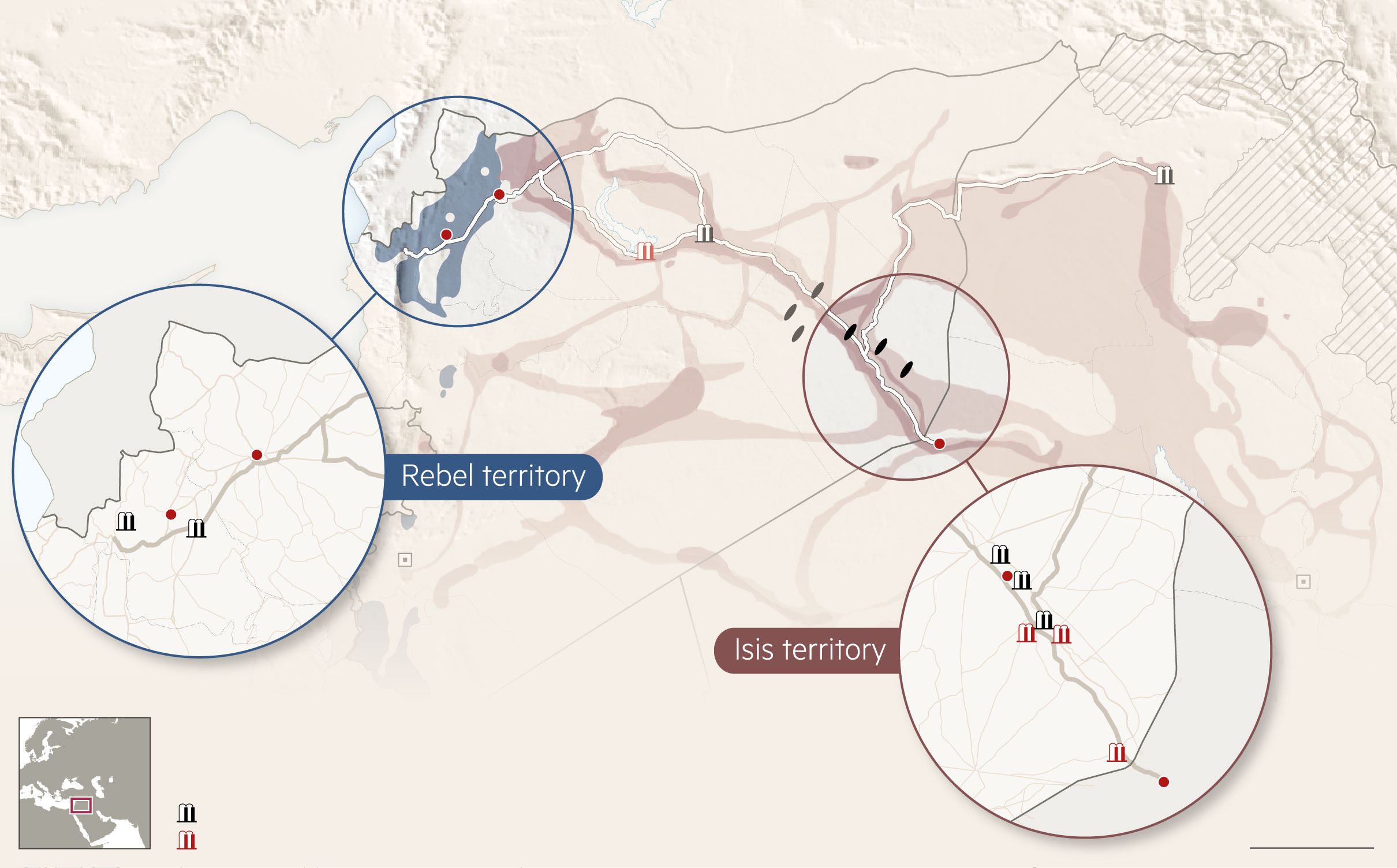
Isis controls most of Syria’s oil fields and crude is the militant group's biggest single source of revenue. Here we follow the progress of a barrel of oil from extraction to end user to see how the Isis production system works, who is making money from it, and why it is proving so challenging to disrupt, even with airstrikes.
By Erika Solomon, Robin Kwong and Steven Bernard
Source: http://ig.ft.com/sites/2015/isis-oil/
Where the oil is extracted
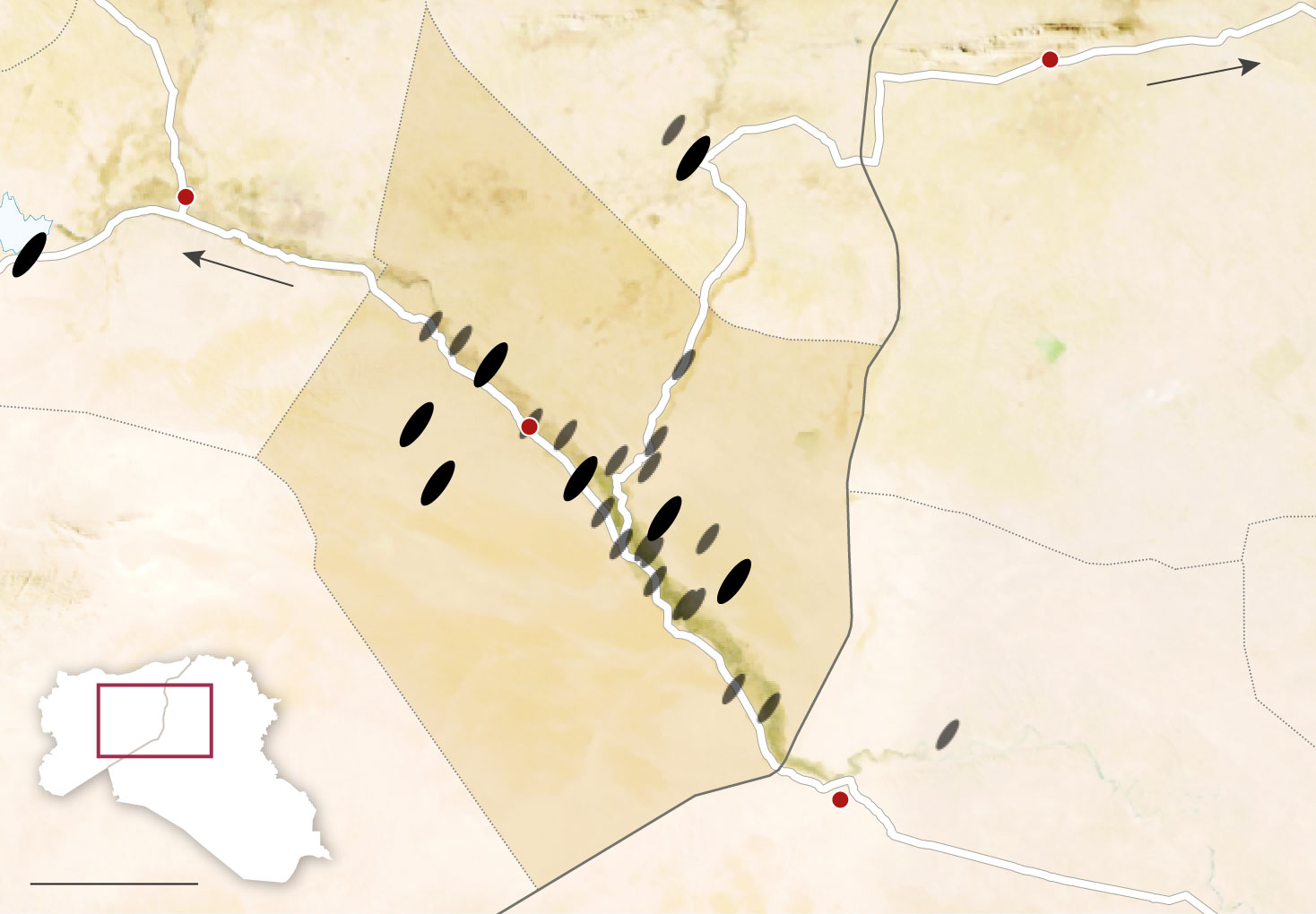
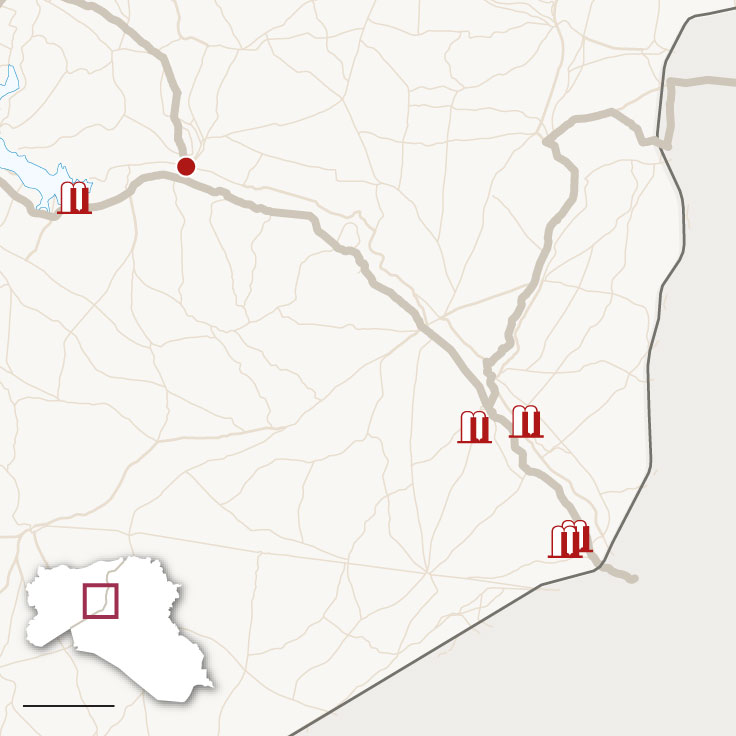
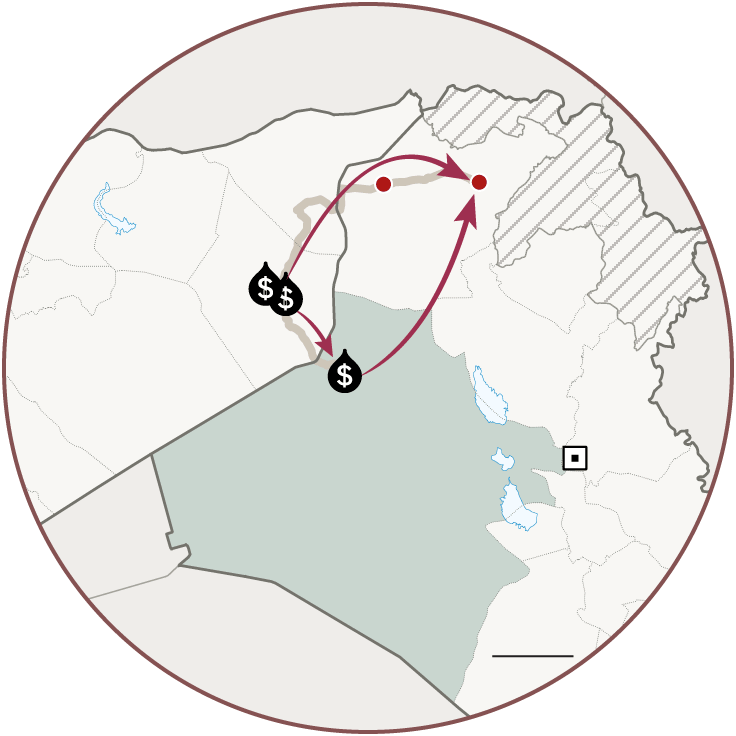
Isis’s main oil producing region is in Syria’s eastern Deir Ezzor province, where production was somewhere between 34,000 to 40,000 barrels a day in October, according to locals. This has since fallen due to coalition and Russian airstrikes against oil facilities. Isis also controls the Qayyara field near Mosul in northern Iraq that produces about 8,000 barrels a day of heavier oil that is mostly used locally to make asphalt.
It is difficult to determine a definitive oil production figure for Isis-controlled areas. But it is clear production levels have dropped in the Syrian fields since they were taken over by the militants. Most oil fields in the area are aging and the group does not have the technology or equipment needed to maintain them.
A new air campaign on Isis oil by the US-led coalition started at the end of October and is now more effectively disrupting Isis's crude extraction. Production fell by 30 pct this month at al-Omar and al-Tanak, Isis's two top producing fields and the most targeted by the recent offensive. Up to now, however, it is still likely the most lucrative revenue stream for Isis's central leadership.
The price of the oil depends on its quality. Some fields charge about $25 a barrel. Others, like al-Omar field, one of Syria’s largest, charge $45 a barrel. Overall, Isis is estimated to earn about $1.1m a day.
OilfieldEst. production (bpd)Price ($/barrel)
al-Tanak11,000-12,000$40
al-Omar6,000-9,000$45
al-Jabseh2,500-3,000$30
al-Tabqa1,500-1,800$20
al-Kharata1,000$30
al-Shoula650-800$30
Deiro600-1,000$30
al-Taim400-600$40
al-Rashid200-300$25
Selling crude oil
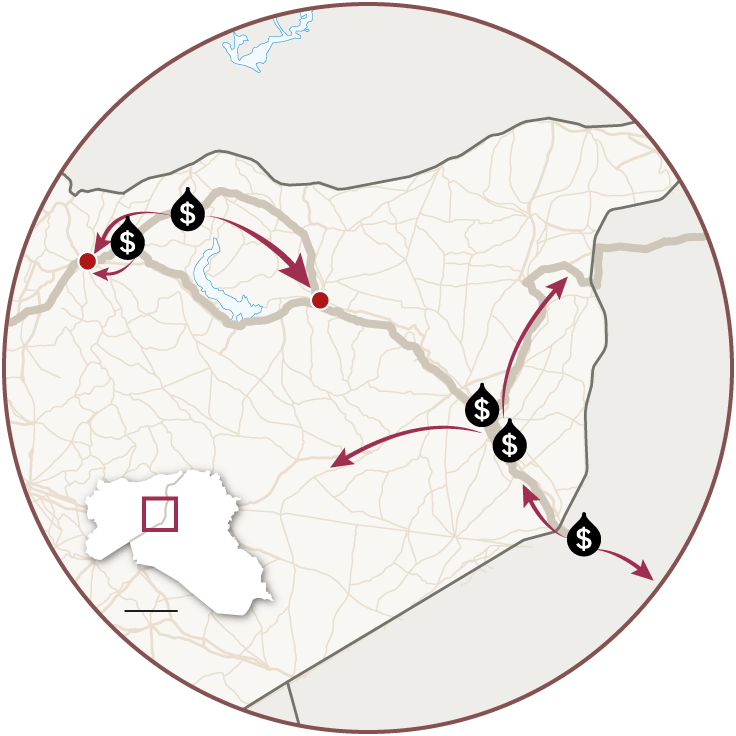
Though many believe that Isis relies on exports for its oil revenue, it profits from its captive markets closer to home in the rebel-held territories of northern Syria and in its self-proclaimed “caliphate”, which straddles the border between Syria and Iraq.
The group sells most of its crude directly to independent traders at the oil fields. In a highly organised system, Syrian and Iraqi buyers go directly to the oil fields with their trucks to buy crude. This used to result in them waiting for weeks in traffic jams that sprawled for miles outside of oilfields. But since airstrikes against oil vehicles intensified, Isis revamped its collection system. Now, when truckers register outside the field and pick up their number in line, they say they are told exactly what time they can return to fill up to avoid a pile-up of vehicles and make a more obvious target for strikes.
Oil refineries
Traders have several options after they pick up their cargo:
Take the oil to nearby refineries, unload it and return to queue at the field—usually done by traders under contract to refineries.
Sell their oil on to traders with smaller vehicles, who then send it to rebel-held northern Syria, or east towards Iraq.
Try their luck selling to a refinery or sell it at a local oil market. The biggest are near al-Qaim on the Syrian-Iraqi border.
Most traders prefer to sell the oil on immediately and pick up a fresh number at the fields. They can expect to make a profit of at least SL3,000 (about $10) per barrel.
Traders in Syria's eastern Deir Ezzor province say coalition airstrikes have not targeted their trucks by as much the coalition claims, and say Russia has targeted them more aggressively. Instead the attacks focused on disrupting the extraction process - hitting around the wells or facilities at the oil fields, as well as Isis vehicles. The goal does not appear to be to hit the actual wells but impede efforts to extract from them.

The bulk of oil refineries are in Isis-controlled Syria. The few in rebel-held territories have a reputation for lower quality output than the refineries in the east.
The refineries produce petrol and mazout, a heavy form of diesel used in generators – a necessity as many areas have little or no electricity. Because the quality of the petrol can be inconsistent and is more expensive, mazout is in greater demand.
Refining is done by local residents who constructed their rudimentary refineries after Isis's prefabricated "mobile" facilities were destroyed by coalition airstrikes. The owners make purchase agreements with the militants for their products.
There are also signs that in recent months Isis may have returned to refining. In interviews with traders, the FT discovered the group had bought five refineries since mid-2015.

At Isis refineries, the former owner stays on as a "front" man. The group supplies the oil; in return it takes all mazout production and splits the profits on petrol production with the original owner.
Traders say Isis has its own tankers that supply crude to its refineries from oil fields regularly. The group also appears to retain many of its earlier contracts with unaffiliated gas stations and other refineries.

Fuel to market
Once the oil is refined, it is bought by traders or taken by dealers to markets across Syria and Iraq. At this point, Isis is almost completely disengaged from the trade. About half the oil goes to Iraq, while the other half is consumed in Syria, both in Isis territories and rebel-held areas in the north.
There are fuel markets throughout Isis-controlled areas and rebel-held Syria, often located close to refineries. Most towns have a small fuel market where locals buy and sell oil. But traders supplying these smaller markets often buy their oil in bulk from larger hubs.

Isis markets
There are larger Isis-controlled markets in towns like Manbij or al-Bab in Aleppo’s eastern countryside. Traders here must present a document proving they have paid zakat, a tithe, to buy oil without tax. Traders from rebel-held Syria who have not paid the tithe, must pay a tax of SL200 per barrel, or about $0.67.
Some privately-owned markets also levy taxes. Al-Qaim market, one of the largest in the region, charges buyers and sellers about SL100 ($0.30) per barrel of crude purchased.
Mosul
In Isis-controlled Iraqi cities like Mosul, the fuel is sold at mini “petrol stations” with two pumps. They are ubiquitous on Mosul street corners and locals usually name the oil according to the part of Syria it came from. This helps buyers determine the quality of the oil and compare prices.
Rebel markets
Two types of fuel are sold in rebel-held Syria: pricier fuel refined in Isis areas, and cheaper locally refined fuel. Residents typically buy a mix of both, and use the cheaper variety for generators and keep better quality variety for their vehicles.
Since the airstrikes began, prices of mazout and diesel in rebel-held areas have doubled. Prices of food are higher as well because transport costs are rising.
Fuel smuggling
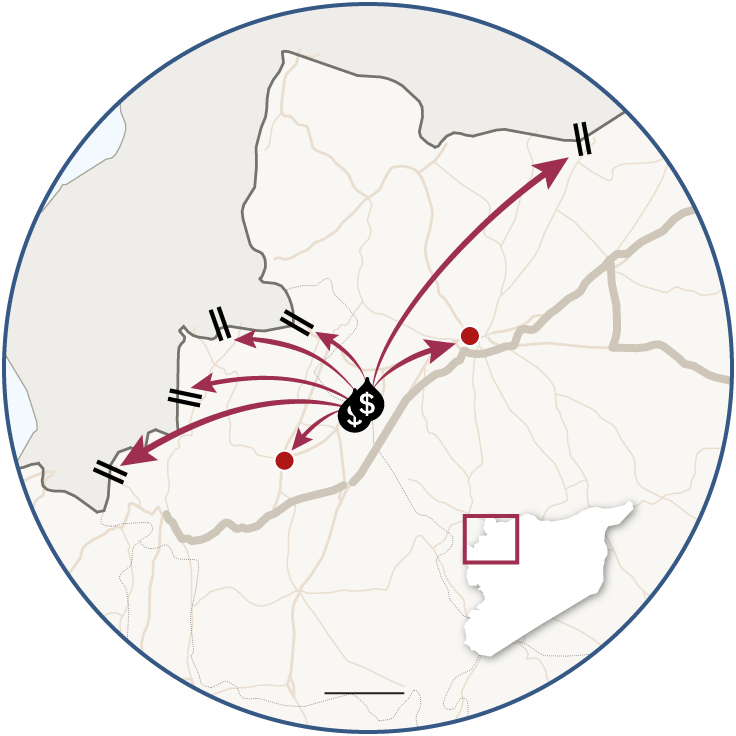
With Isis only concerned with making its profits ‘at the pump’, smuggling fuel into neighbouring countries can be good business for entrepreneurial Syrians and Iraqis. Syrian smugglers say it has been declining in recent months, not because of tighter border controls but because the sharp fall in international oil prices make it unprofitable. But some determined smugglers continue their trade.
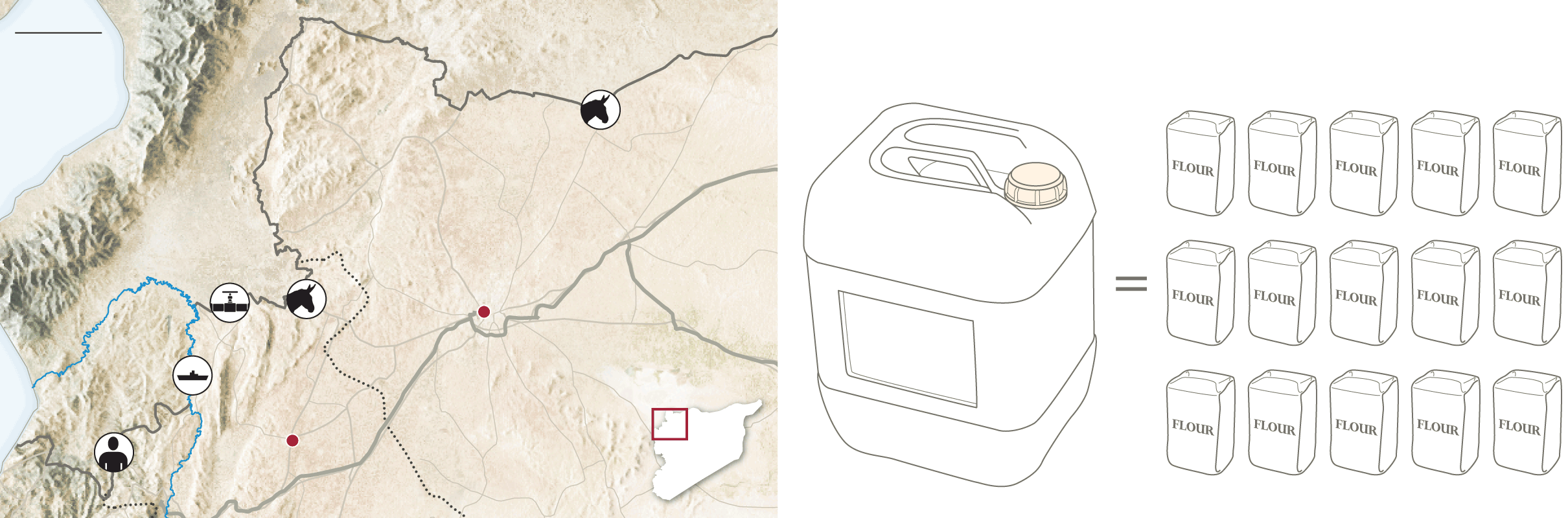
Most of the smuggling from the Syrian side has gone through opposition areas in the northwest. Locals buy fuel at the market, pour it into jerry cans and carry it over the border on foot or, in mountainous areas, by donkey or on horseback.
In Iraq, the bulk of smuggling through the northern Kurdistan region has been blocked, so locals say the route now goes south through Anbar province towards Jordan.
Boat
BoatWhen oil prices were high, smugglers loaded larger jerry cans (50-60 litres) of oil into metal tubs or small row boats and, using ropes attached to each river bank, pulled their cargo across the river and into Turkey. On the other bank, tractors picked up the supply and took it to a local informal market, where it was picked up by large trucks, which sold it on.
Pumps
PumpSome Syrian and Turkish border towns have co-operated by burying small rubber tubes under the border, such as at Besaslan. In recent months, Turkey has stepped up border patrols and are constantly digging out the makeshift pipelines.
On foot
FootA popular crossing point for smugglers carrying jerry cans of fuel on their backs has been from Kharbet al-Jawz in rebel-held Syria to Guvecci in Turkey. This has been largely shut down by Turkish forces, but the remote terrain makes it impossible to stop.
Horseback
DonkeyIn places like al-Sarmada and al-Rai, smugglers have crossed the border by mule, donkey or horses that can carry four to eight jerry cans at a time.
Airstrikes
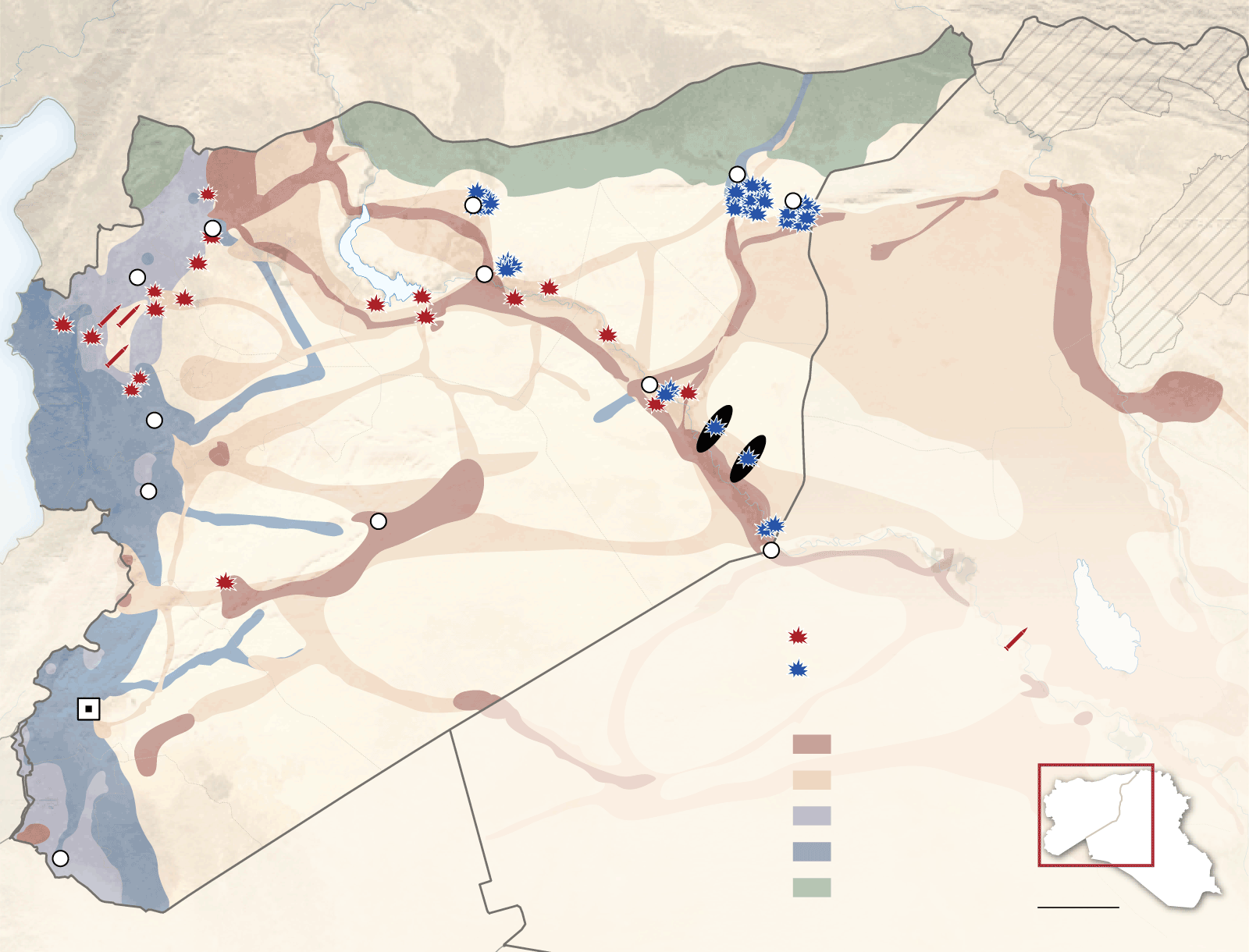
At the end of October, the US-led coalition launched a fresh assault on Isis oil infrastructure. These airstrikes were followed by Russian attacks, and intensified in mid-November.
The coalition airstrikes against Isis oil operations have mainly targeted the oil extraction process, rather than refineries or oil markets. Bombs have hit Isis vehicles operating at the oil fields, and facilities for pumping or moving oil.
For example, the biggest single blow to Isis oil extraction, locals say, was a strike that took out the machinery that allowed oil workers to centrally control the wells at al-Omar field, Isis's single biggest oil source.
This had been critical because wells there can be 30km away from each other, and the machinery allowed workers to close down a well that was struck and avoid a fire spreading. Now, each well must be operated manually, which dramatically slows down the process of running the entire field.
Strikes on Syria from Nov 20
Kurds
Sources: Institute for the Study of War, US Central Command,
US Department of Defense, FT research
These efforts to stop Isis earning money from oil is starting to have an effect. Production fell by 30 per cent in December at al-Omar and al-Tanak.
But it comes at a human cost. Civilian traders have been hit by an increasing number of strikes. Local civilians are angry about the new campaign and they fear for their own economic survival, which is now entangled with that of Isis's finances.
"This is considered our infrastructure, and destroying it like this...shows that the objective is to kill the Syrian people," says Omar al-Shimali, who lives in the rebel-held Aleppo province to the northwest.
Where Isis buys its bullets

Where Isis buys its bullets
Fighting can consume tens of thousands of bullets in a single day. Securing this ammunition requires a complex logistical operation

US at war with an imaginary Islam: Lies, propaganda and the real story of America and the Muslim world

American propaganda exaggerates the power and moral depravity of the Islamic enemy, in the service of our empire

Excerpted from "One Islam, Many Muslim Worlds: Spirituality, Identity and Resistance Across Islamic Lands"

The United States is at war with a very different, mythic Islam of its own making that has nothing at all to do with this Islam of the Qur’an. To make sense of that conjured threat, scholarly studies of Islam or Islamic movements are of no help at all. Even the examination of the real-world history and practice of empire has limited value, unless the perceived Islamic dimension is considered. The American imperial project cannot be brought into clear view without assessment of the distinctive rationale that the Islamist Imaginary provides. The task is not an easy one. The Islamist Imaginary has no simple and unitary existence. Rather, it is a complex amalgam that shapes both the delusions of empire and a conjured threat to imperial power into a co-evolving composite. It is a “difficult whole,” in the helpful language of complexity theory. The Islamist Imaginary, unlike Islam itself and political movements of Islamic inspiration, does not exist outside of the imperial interests that shape it. It has no independent cultural or historical reality, outside its role as predatory threat to Western global interests. The American empire, in turn, requires a hostile and threatening enemy, which today takes the form of Islam of its imagination, to realize and rationalize its expansionist project that must remain unacknowledged and unspoken. The two elements of the imaginary and empire co-evolve. The needs of a threatened empire as vulnerable victim change over time. The Islamist Imaginary transforms itself to meet those needs. Imaginary and empire circle one another in a dance of predator and prey. Their roles are interchangeable, a clear sign that they are not entirely real. The predator is prey; the prey is predator. They develop in tandem in a complex process of mutual adaptation. Boundaries give way between the real and the imagined. In the end it is the imagined that haunts our imaginations and drives our policies.

The idea of the co-evolution of Islam and empire in the Islamist Imaginary is not as strange as it might at first seem. Scholars know that the entanglement of Islam and empire has an intricate chain of precedents. Edward Said provided a useful starting point for analyzing these complex linkages with his frequently quoted assertion that ours is an age of “many Islams.” It is also the time of the singular American empire. He pointed out that Islam and empire have an intricate history of connections.

The dominant notion of civilizational conflict between the Islamic world and the West rightly highlights the Islamic ideological roots of the most persistent resistances to American global dominance, provided that we recognize that the conflict has political and economic causes. However, this same notion obscures an important history of instrumental cooperation between Islam and the United States. American assertions of imperial power have had a consistent and often compliant Islamic dimension. It is now rarely acknowledged, though, that the cooperative dimension is at least as important for understanding the relationship today of the Islamic world and the West as the contrary record of oppositions to American hegemony of Islamic inspiration.

Of the “many Islams,” America has for decades actively fostered and manipulated its own useful preferences. These “preferred Islams” of earlier periods are part of the story of the Islamist Imaginary of our own. The consequences of the manipulations of these preferred Islams have not always been those intended, at least not in the long run. They have often entailed violence that in the end was turned back first on U.S. clients and then on the United States itself. Yet, for all these qualifications, it remains true that the preferred Islams, cultivated and shaped by the United States, have been critical to the post–World War II projections of American power.

At the end of World War II, President Roosevelt made an historic agreement with the house of Saud in Saudi Arabia. In exchange for privileged access to oil, the United States guaranteed the royal family’s hold on power, declaring the defense of Saudi Arabia a vital U.S. interest. The eighteenth-century origins of the current Saudi regime in the alliance between Muhammad Ibn Sa’ud, a local chieftain, and Ibn Abdul Wahhab, a puritanical and ultraconservative Islamic reformer, proved no obstacle.

U.S. material support for all the usual instruments of repression enabled the Saudi royals to impose themselves on “their” people, despite Islam’s deeply rooted antipathy to monarchy. It also allowed the interpretation of Islam to take firm hold in Saudi Arabia and, through Saudi oil revenue funding, make itself felt worldwide as a powerful reactionary tradition. The royal family’s self-appointed role as guardian of Islam’s most holy sites, Mecca and Medina, provided the requisite religious cover for the U.S.-backed repression that secured their hold on power. This critical Saudi connection ensured American triumph over its European rivals for control of Middle Eastern oil. It also ensured a linkage between American empire and one of the most reactionary forces in the Islamic world, if not the world at large.

Complicit Saudi Islam played a critical role in the subsequent geopolitical competition with the Soviet Union in the 1950s and 1960s. The United States knowingly used the retrograde Wahhabi Islam of the Saudis as a counterweight to progressive Arab nationalisms. These nationalisms had shown themselves willing to open doors to the Soviets in exchange for support for their projects of independent national development. By doing so, they threatened to challenge American hegemony over the Middle East and its precious oil resources.

Personified most effectively by Gamal Abdul Nasser of Egypt, Arab nationalists threatened to chart the kind of independent path of development that is intrinsically anathema to any imperial power. A combination of external blows and internal manipulations brought these nationalist assertions to an end by the late 1960s. In the wake of the collapse of the nationalist project, the United States saw no problems when a state-controlled Islam provided ideological cover for the compliant Egyptian successor military regimes. Egypt after Nasser was effectively brought within the American orbit and voided of all genuine nationalist content. For such regimes, the threat to their hold on power came from the left and the memories among the masses of the material and social advances registered under progressive Arab nationalist banners. Such successor regimes were no less repressive in pursuing their regressive aims than their predecessors had been in advancing more progressive objectives of autonomous development and improvement of mass welfare. Once again, Egypt provided the prototype, with Anwar al Sadat as the “believing President” who expelled the “Godless” Soviets, opened Egypt to American penetration, and welcomed disciplined Islamists back into public life as a counter to the “atheist left.” The Americans embraced both Sadat and the domesticated Islam in which he draped himself. In the end, however, Sadat’s cynical manipulation of Islamic symbols as a cover for policies of alignment with America and capitulation to Israel on the issue of Palestine incited the anger of Islamic extremists. Khalid al Islambouli assassinated Sadat on October 6, 1981, shouting “Death to Pharaoh!”

When an already weakened Soviet Union blundered into Afghanistan in 1979, the United States turned to yet another variety of politicized Islam to hasten Soviet defeat. U.S. intelligence services, with assistance from their regional counterparts, actively and effectively mobilized the resources of Islamic militants, drawn from all over the Islamic world and including the Saudi Osama bin Laden. Enormous levels of funding were provided from American and Saudi sources, variously estimated but certainly in the billions. They aimed to take advantage of Soviet vulnerability in occupied Afghanistan. The strategy worked: Defeat in Afghanistan helped precipitate the demise of the Soviet Union.

That direct contribution to unchallenged American hegemony was neither the last nor the most significant by the violent transnational Islamic networks the United States helped finance and train for work in Afghanistan. As a result of the successful American-sponsored guerrilla war against the Soviet Union, violent extremist groups proliferated. They created havoc, everywhere not least in New York City on September 11, 2001. These terrible events were reprisals for American Middle East policies and the work of assassins, whom the United States initially encouraged and even in some cases trained.

The crime against humanity committed on September 11, 2001, had the unintended consequence of serving the breathtaking expansionist plans of the neoconservatives who dominated the Bush administration. Only a plausible enemy was lacking to make their execution possible. From the storehouse of the Western historical imagination, age-old images of a hostile Islam were retrieved. Islamic terrorists conjured up in a believable form for a frightened America the “threat to civilization” that every empire requires to justify its own violent acts of domination.

The Islamist Imaginary in the service of the neoconservative version of empire was born. The administration used all the resources of media control at its disposal to make sure that no links were made between the 9/11 crime and unjust U.S. Middle Eastern policies and the bloody instrumentalities the United States forged to enforce them. Plans for the United States to topple the Taliban and occupy Iraq, and for the Israelis to “resolve” the Palestinian issue by force, were all in place before 9/11. The most expansive version of the neoconservative agenda to advance U.S. and Israeli interests found forthright expression in a position paper written for the newly elected Israeli Prime Minister Benjamin Netanyahu of the Likud party in 1996. It is entitled “Clean Break: A New Strategy for Securing the Realm” and was published by the Institute for Advanced Strategic and Political Studies. The document calls for a “clean break from the peace process,” the annexation of the West Bank and Gaza, and the elimination of Saddam’s regime in Iraq, as prelude to regime changes in Syria, Lebanon, Saudi Arabia, and Iran. The authors all became influential players in the second Bush administration.

President Bush’s elaboration of a more comprehensive strategy of global hegemony came in the fall of 2002 in a document called “National Security Strategy of the United States.” The United States would never again allow a hostile power to approach parity with U.S. military capabilities. The United States would take the offensive to ensure its continued “full spectrum” dominance. Endlessly repeated images of 9/11 provided the backdrop for a doctrine of “preventive” wars that would give a defensive coloration to what were, in reality, projections of American imperial power. The president rallied a cowed Congress to a strategy of endless wars to ensure global hegemony under the cover of a worldwide War on Terrorism whose features, while murky, were still recognizably Islamic.

An innocent and wounded America recast its public role in the Middle East as the champion of democracy and the bulwark against the Islamic wellsprings of irrationalism that ostensibly fed global terrorism. The stage was set for the full-blown evocation of the Islamist Imaginary. There was already an established American practice of manipulating Islam, including the most backward-looking and violent versions, for imperial ends. This time, however, strategic planners for the Bush administration departed from the established pattern with a breathtaking innovation.

At each prior critical strategic moment, America had made use of an existing form of Islam that could be reshaped to serve its needs. The Saudi connection yielded a royal, reactionary, and repressive Islam with which America cooperated without complaints for decades. The American-backed jihad against the Soviets in Afghanistan, in contrast, called forth an assertively violent rather than simply repressive Islam. America enthusiastically assembled, funded, and trained its transnational advocates. At the same time, the subservient successor regime in Egypt needed a domesticated “house Islam” that would support the right-leaning, authoritarian government. The Sadat regime would preside over the deindustrialization of Egypt and facilitate the ruthless pacification of the Palestinians. The United States had little good to say about Nasser and his Arab socialist policies. It did, however, welcome his efforts to “modernize” the venerable mosque-university of al Azhar. Nasser pursued a strategy of enhancing the role of Islam in Egyptian life while at the same time bringing al Azhar under firm state control. The number of mosques doubled and Islamic broadcasts from Cairo, supported by the government, reached to countries across Dar al Islam. Sadat, for his part, sought to manipulate official Islamic figures and institutions to support his right-wing domestic policies and global realignment into the American orbit. The Americans welcomed Sadat’s self-interested efforts to wrap his pro-American policies with whatever legitimacy a domesticated Islam could provide.

In each of these instances, the Islamic dimension derives from a “found Islam” that originated to meet the needs of local actors. It had its own independent roots in the soil of the Islamic world and served, in the first instance, identifiable aims of already existing regimes or movements. The Bush administration sought to pioneer a distinctive variant on this general pattern, in ways that would clarify the new cultural and intellectual dimensions of its exercise of global power. Iraq was made the case in point.

The Islamist Imaginary: America’s Preferred Islam

The preferred Islam of the Bush administration comes into view most clearly and authoritatively in a Rand Corporation study. For that reason, rather than any scholarly value, Cheryl Benard’s work merits very close attention. I know of no other source as revealing about the way Islam was understood by the circle of neoconservative intellectuals to which Benard belonged in these critical years of assertions of American imperial power. The book carries the engaging title Civil, Democratic Islam: Partners, Resources, and Strategies. It was prepared with the imprimatur of Rand’s National Security Research Division in 2003. Benard’s assessment of the Islamic world quiets the apprehensions that resistance in the name of Islam raised for America’s neoconservative strategic planners.

The worries of the Bush team were not entirely misplaced. There was an Islamic threat, not to America per se but rather to American empire. There still is. To be sure, American propaganda exaggerates both the power and moral depravity of the Islamic enemy. The idea that hostility toward America in the Islamic world springs from frustration with the obvious and inherent failings of the Islamic world and envy at the equally obvious success and innate superiority of the West is sheer nonsense, no matter how frequently and portentously repeated. It parrots the message of every expansionist imperial power that history has known. It does so for all the obvious reasons. The colonized are at fault and their failings invite, even demand, colonization. There is no better way to exculpate the West for the consequences of its historical record of violent occupation and exploitation of Islamic lands. Attention is shifted from any serious evaluation of American dominance of the Middle East and its destructive policies in Palestine, Afghanistan, and most dramatically Iraq.

Benard takes the reality of an Islamic threat as a premise of her argument. Her analysis begins with a presentation of the self-imposed predicaments of the Arab Islamic world that threaten to spill over and endanger others. In Benard’s formulation the entire world, and not just the United States, is the innocent and vulnerable witness to the tumultuous internal disorders in the Islamic world. “What role,” she asks, “can the rest of the world, threatened and affected as it is by this struggle, play in bringing about a more peaceful and positive outcome?” Benard states clearly that these dangerous predicaments of the Islamic world are entirely self-imposed. She writes that “Islam’s current crisis has two main components: a failure to thrive and a loss of connection to the global mainstream. The Islamic world has been marked by a long period of backwardness and comparative powerlessness; many different solutions, such as nationalism, pan-Arabism, Arab socialism, and Islamic revolution, have been attempted without success, and this has led to frustration and anger.” To conclude, Benard gravely notes that “at the same time, the Islamic world has fallen out of step with contemporary global culture, an uncomfortable situation for both sides.”

Benard’s assessment eliminates any reference to the West’s colonization of the Islamic world, and of the physical and psychological damage those violent assaults caused. There are no hints at all of an American imperial presence in the Islamic world through an impressive and constantly expanding network of bases. There is no consideration of the ways that presence constrains autonomous development. There are no references to the awkward facts of consistent American political and economic interventions, often violent and consistently aimed at undermining economic and political autonomy. Israel, heavily armed with all forms of weapons of mass destruction, a cruel occupying force, and the regional superpower, mysteriously disappears from view. These awkward realities are overshadowed by the Islamist Imaginary.

Only with these erasures can Benard take for granted the irrational grounding of the Islamic threat. Her analysis highlights the ways that the usual state-based threats to the national security exemplified by the Soviet Union in the era of the Cold War have been replaced by the challenge of nonstate actors, operating below the nation-state horizon. To face this threat, she argues that American strategic planners must make Islam itself a resource. In short, like her predecessors Benard is in the business of strategic manipulations of Islam to serve American economic and political ends. She evokes a malleable Islam that can be turned into an instrument to confront the Islams of resistance, while obediently serving America’s ends. However, Benard does so with a difference.

Excerpted from “One Islam, Many Muslim Worlds: Spirituality, Identity and Resistance Across Islamic Lands” by Raymond William Baker. Published by Oxford University Press.
We are at war with an imaginary Islam: Lies, propaganda and the real story of America and the Muslim world
by Raymond William Baker, salon.com

http://flip.it/DdIGD

The Refugee Crisis is a Crisis of Imperialism

The real tragedy is the refusal of Western leaders to acknowledge the cause of the refugee crisis – Western imperialism’s genocidal and never ending wars on the people of the Middle East, Central Asia, and Africa.

There are now more refugees than at any time since World War 2, and the number of refugees has increased markedly since the start of the “Global War on Terror” [3]. Wherever the U.S. and its imperialist allies have intervened, whether through direct military action or indirect proxy wars, economic sabotage, and coups, in the name of “democracy”, the “War on Terror”, or the “responsibility to protect”, death and despair have been forced upon millions of innocent people, who have been left no other choice than to abandon their native lands to embark on a dangerous future of desperate struggle.

In Afghanistan, Iraq, Libya, Syria, Yemen, Pakistan, Somalia, Mali, Korea, Vietnam, East Timor, Sudan, Ukraine, and elsewhere the livelihoods of millions have been destroyed by the forces of U.S. and Western imperialism.

In the 1980s, Afghanistan had a “genuinely popular government”, according to John Ryan, retired professor from the University of Winnipeg, that was implementing widespread reforms [4]. Labour unions were legalized, a minimum wage was established, hundreds of thousands of Afghans were enrolled in educational facilities, and women were freed from age-old tribal bondage and able to earn an independent income. U.S. and Western imperialism, fearful of that kind of equitable distribution of wealth, supported the feudal landlords and fundamentalist mullahs to sow chaos across the country, bringing rise to elements that later formed al-Qaeda and the Taliban. The Afghan people were once more dealt a severe punishment by the forces of Western imperialism following 9/11, despite a lack of conclusive evidence linking either the Taliban or al-Qaeda to the attacks. 30 years of U.S. intervention in Afghanistan have left the people of Afghanistan impoverished, traumatized, and desperate.

The conflicts in Libya and Syria are eerily similar to the Western destabilization of Afghanistan. In 2011, when the Arab Spring protests swept across the Middle East and North Africa, Western imperialism hijacked legitimate grievances of the masses as a pretext for intervention in the name of the “responsibility to protect” and “democracy promotion”.

Prior to the 2011 U.S./NATO intervention, Libya was among the wealthiest and most stable countries in Africa, with the continent’s highest standard of living. Housing was enshrined as a human right, education and healthcare services were free for all citizens, and the country was pushing to establish an African currency linked to gold to help end the endless cycle of debt and impoverishment of the African masses by Western imperialism [5]. Under the cloak of the United Nations, Western imperialism, using the pretext of protecting the people of Libya from Gaddafi’s murderous rule, launched airstrikes on Libya and allied themselves with al-Qaeda in the Islamic Maghreb and other Libyan extremists [6]. NATO airstrikes killed hundreds of civilians and forced Libya back into the Stone Age; Gaddafi was mercilessly tortured and murdered by the rebels. Thousands have been killed as rival tribal and extremist factions, some now allied with ISIS, battling for control of the country.

The conflict in Syria has frequently been referred to as “Libya 2.0”. U.S. imperialism with the support of Israel, Turkey, and the Persian Gulf States, trained and financed “moderate” rebels to overthrow the secular and popularly supported government of Bashar al-Assad. The “Free Syrian Army”, i.e., the “moderate” rebels, has been virtually eliminated in the conflict despite millions of dollars in aid from the U.S. and its regional allies [7]. FSA fighters have deserted to the ranks of ISIS en masse, itself a product of the illegal U.S. occupation of Iraq that killed 1 million Iraqis. There is overwhelming evidence that the U.S. and its allies have been actively training and supporting ISIS elements since the start of the proxy war in Syria [8][9]. It wasn’t until ISIS invaded Iraq with its new Toyota technicals, curtesy of U.S. imperialism, that ISIS was declared a threat to the world. Western imperialism changed its tactic from supporting ISIS to airstrikes on Iraq and Syria, with the support of other Western imperialist states, Turkey (which is also conveniently bombing anti-ISIS Kurdish fighters [10]), Saudi Arabia and the Persian Gulf States, but without consultation with the Syrian government, Iran, or Hezbollah that have been fighting ISIS and al-Qaeda elements since the start of the conflict. Hundreds of thousands have died in the West’s proxy war against the Syrian government.

From Libya to Afghanistan, the Democratic Republic of the Congo, Pakistan and Somalia, U.S. and Western imperialist interventions, coups, and sanctions have displaced and killed millions of people. Physicians for Social Responsibility estimates that in Afghanistan, Iraq, and Pakistan alone Western imperialist interventions have caused the deaths of 1.3 million people [11]. It is no wonder then that hundreds of thousands seek asylum elsewhere; however, after traveling huge distances overland and on water, refugees find themselves abused, discriminated against, held in detention, or rejected from Europe, Canada, the U.S., and Australia.

More than 2, 500 have died this year trying to cross the Mediterranean Sea into Europe, while the International Organization for Migration estimates that 30, 000 could die by the end of 2015 [12].

Refugees attempting to enter Europe, even if they are granted asylum in a mainland European country such as Germany, have been met with police violence in Greece, Italy, and other countries on the Mediterranean that are the first landing points for boats sailing from North Africa and Turkey.

Greek riot police have beaten refugees protesting the failure of local governments to process their applications. Conditions are so poor for refugees that while waiting for processing newborn babies have died in Greece [13].

On the Macedonia-Greece border, where more than a thousand refugees are crossing daily, refugees that broke through the barbed wire fences were shot at with stun grenades, and the Macedonian police have treated refugees as rioters, according to Amnesty International [14].

Italian police forcibly removed African refugees camping out at the French border after France refused to grant them asylum [15]. Hungary is building a fortified wall, similar to the barbaric wall that divides the U.S.-Mexico border, to stop refugees from crossing the border [16].

The thousands of refugees that seek asylum in Australia are detained in Australia’s detention facilities in Papua New Guinea and the small island nation of Nauru, dubbed the “Guantanamo Bay of the Pacific” [17]. Refugees can be detained for several years in these facilities, where social workers have observed “profound damage” to those detained through “prolonged deprivation of freedom, abuse of power, confinement in an extremely harsh environment, uncertainty of future, disempowerment, loss of privacy and autonomy and inadequate health and protection services” [18]. An Australian Senate investigation received reports of guards raping women on tape and sexually exploiting children as young as 2-years-old [19]. Just as Britain refuses to assist drowning refugees in the Mediterranean out of fear that it will encourage more migrants to seek asylum [20], the unannounced policy of Australian authorities is to make refugees suffer abuse and inhumane living conditions to deter them from seeking asylum in Australia, as if Australian imperialism hasn’t inflicted enough suffering on the people of the Middle East, South and Southeast Asia.

U.S. and Western imperialism is the root cause of the “refugee crisis”. Everyday men, women, and children are killed by U.S. drone strikes in Pakistan, U.S. and Western-backed militias in Afghanistan, Syria, and Somalia, European and North American mining and oil conglomerates in Central and Western Africa, or are starved to death in Yemen by the U.S.-backed Arab blockade of the country. Until the genocidal aims of U.S. imperialism, with the support of Canada, Australia, the European Union, and regional allies, are defeated, the “War on Terror” will continue to make life too unbearable for working people in Asia, Africa, and the Middle East to remain in their home countries.
The Refugee Crisis is a Crisis of Imperialism
by T. J. Petrowski, globalresearch.ca

http://www.globalresearch.ca/the-refugee-crisis-is-a-crisis-of-imperialism/5475014