Featured Post

SalaamOne NetWork

SalaamOne سلام   is   a nonprofit e-Forum to promote peace among humanity, through understanding and tolerance of religions, cul...

London's Muslim mayor invites Trump to 'educate' him on Islam

London’s Muslim Mayor Sadiq Khan has invited Donald Trump to England's capital city to “educate” the bombastic US presidential candidate about Islam.

Khan rejected the notion that Islam was incompatible with modern Western values and said Trump’s “ignorant” views on Islam were “playing into the hands of extremists.”

“I want Donald Trump to come to London so I can introduce myself to him as a mainstream Muslim, very, very comfortable with Western liberal values, but also introduce him to hundreds of thousands, dare I say millions of Muslims in this country, who love being British, love being Western,” the new mayor said in an interview with NBC News on Friday.

In December, Trump called for a “total and complete” ban on Muslims entering the United States after a deadly mass shooting in San Bernardino, California, which was inspired by the Daesh (ISIL) terrorist group.

The proposal triggered widespread criticism and condemnation in the US and around the world.

Protesters gather outside of the Republican National Committee where Donald Trump was about to meet party leaders on Capitol Hill in Washington, DC on May 12, 2016. (AFP photo)
“I want to educate Donald Trump. I want to show him that you can be Muslim and be Western,” said Khan.

Khan, the son of a Pakistani bus driver scored a resounding victory in last week's London mayoral election over his billionaire Conservative rival Zac Goldsmith, who was accused of running a “dog whistle” campaign of drawing attention to Khan’s Muslim faith and trying to link him to extremist groups.

Khan condemned Goldsmith's campaign as coming “straight out of the Donald Trump playbook,” and said he would help Democratic presidential candidate Hillary Clinton beat the billionaire businessman.

Trump, the presumptive Republican nominee, told the New York Times this week that he was “happy” about Khan's election and that the Muslim mayor could be an exception to his proposed ban.

Khan rejected Trump's exemption, and said he will try to visit the United States before the November presidential election.
http://www.presstv.ir/Detail/2016/05/14/465528/Khan-wants-to-educate-Trump-on-Islam-

The emergence of science


The writer is vice-chancellor of the Pakistan Institute of Development Economics. He holds a PhD in Economics from Stanford University
Historical accidents have shrouded the emergence of science and the scientific method behind multiple veils of mystery. Misunderstanding the nature of science has led to seriously defective methodologies in modern social science, especially economics. The first barrier to understanding is created by Eurocentric history which states that roots of modern sciences originated with the Greeks. According to this account, the Muslims preserved Greek knowledge, and passed it on to Europe, without making any significant improvements. The Europeans took up the mantle of their Greek ancestors and have since made fantastic progress. The myth that “Europeans are unique in their capacity for rational and scientific thought” has been debunked effectively by many historians, notably Blaut in Eight Eurocentric Historians. Nonetheless, these ideas have been widely propagated, and permeate public consciousness.

Jack Goody in The Theft of History has shown that many inventions of other civilisations were appropriated by European historians and attributed to Europeans to create a Eurocentric history. Even though it is transparently obvious that the flames of the European Enlightenment were lit by sparks from the advanced civilisation of Islamic Spain, one will not find any mention of this in the standard historical accounts. Similarly, conventional histories gloss over the breeding of corn by the master botanists among the Incas (which feeds half the world today), the crucial inventions of papermaking, printing, gunpowder and compass by the Chinese, development of calculus by the Kerala school of mathematicians, and the diverse and extensive contributions of the Islamic civilisation in many fields. Quite apart from the injustice in this distortion of history, this process of negating the Islamic contribution to development of science results in a loss of understanding of the nature and significance of the contribution. If we peel apart the veils of these historical distortions, it becomes crystal clear that science and the scientific method originated in the Islamic civilisation. The discovery of the experimental method by the Muslims was such an important advance on Greek science that it has been termed a conceptual revolution which was “greatest idea of the second millennium”. Our goal is to explain the nature of this advance.

The Greeks originated the first systematic study of Geometry, via the famous axioms of Euclid. The tremendous value and importance of these methods is obvious because these methods are still taught in schools and universities. The purely axiomatic and logical structure of these methods leads to iron-clad certainties which do not require empirical verification. When the Greeks turned to the study of nature, they tried to use the same method that had been so successful. Aristotle argued that induction from observations could be used to frame axioms, but the laws of science must be based on logic, parallel to geometry. Logic reveals grand universal truths, while observations can only reveal lowly ‘contingent truths’ which are valid within a particular historical context under specific circumstances. Richard Powers writes that “the most important idea of this millennium was (due to) Abu Ali al-Hasan Ibn ul-Haitham [who] … remains little-known … But the idea that Ibn al-Haytham championed is so ingrained in us that we don’t even think of it as an innovation, let alone one that has appeared so late in the human day.” Greek axioms and logic had led to two rival theories about vision, which had remained deadlocked for 800 years. One way of framing axioms led to the conclusion that light emanated from the eyes and struck the object, while the other led to the reverse conclusion. Ibn-ul-Haitham used observational evidence to definitively settle the matter. For example, he argued that staring at the sun burns the retina, establishing that light travels from the sun to the eyes. His striking innovation was that he made no appeal to theory, axioms or logic. Instead, he demolished a whole mountain of Greek theory with a single appeal to data.

The difference between axiomatic-deductive methodology of the Greeks and scientific methodology developed by Ibn-ul-Haitham and followers is like night and day. This difference can be illustrated and clarified by a wide range of examples. For instance, let us consider the discovery of the atom. Often credited for discovery of the atom, Democritus followed the typical Greek method. He argued that if we kept subdividing matter, we would reach the smallest possible particle, after which no further subdivision would be possible. This was seen as a logical necessity, not as an empirical fact. If viewed experimentally, this logic is deeply flawed. The process of subdivision is constrained by human experimental capabilities, not just the properties of matter. Experimentation and observational evidence have led to knowledge which could never be achieved by axioms and logic. Advances in experimental techniques led to the splitting of atoms, clarifying the structure of matter in ways which were impossible earlier. It was precisely this time-barred and contingent nature of experimental truths which repelled the Greeks.

In contrast to Democritus, Dalton’s discovery of the atom reflects the scientific method. The observation that certain chemicals only combine in fixed proportions, led Dalton to postulate that this was due to properties of the atoms which made up the chemicals. Dalton derived properties of atoms from the observation of a particular fact which was impossible to derive from logic or from intuitive certainties. Similarly, observational evidence about electrons led Niels Bohr to scientific theories which appear logically impossible — that electrons jump from one orbit to another without passing intermediate stages. If economists had imposed their axioms for rational behaviour on electrons, forcing them to behave in a logical manner, we would never have arrived at quantum theory. The essence of the scientific method consists of letting observations guide the construction of theory, regardless of how crazy the theory appears to be logically. Contemporary economic methodology is firmly based on the Greek conception of science and gives primacy to axioms and logic over observations. The mystery of why economists use a pre-scientific methodology and confuse it with science will be resolved later.

The emergence of science,  by Dr Asad Zaman, tribune.com.pk
http://tribune.com.pk/story/1100063/the-emergence-of-science/

Drugs that replace statins but without the side effects approved for use by the NHS

  Statins often come with side affects such as aching muscles
Officials have approved the use of new cholesterol-reducing drugs that are as effective as statins but without the side effects.

Repatha and Praluent are in the vanguard of a new class of treatments that are expected to halve levels of ‘bad’ cholesterol in patients.

Scientists say they promise to save thousands of lives by preventing heart attacks and strokes in patients for whom statins do not work.

Some 325,000 patients could be taking the new drugs within weeks after the National Institute for Health and Clinical Excellence (NICE) approved them for use.

They will benefit those with inherited high cholesterol and those with heart disease who cannot cope with the side-effects of statins.

Statins, which are taken by more than seven million people daily in the UK, were developed 30 years ago but are renowned for side-effects such as muscle pain.

It is estimated that up to 20 percent of patients prescribed statins have to stop using the drugs because of muscle pain, leaving them at a high risk of heart attacks or strokes.

In some other patients statins do not work at all.

The new drugs will be self-administered with an injection pen and will be available for around 200,000 people who have symptoms of heart disease and who cannot tolerate statins or for whom statins do not work.

Credit: Telegraph
They will also be available for the roughly 125,000 patients who cannot bring their cholesterol down to a safe level with statins.

Professor Carole Longson, a director at NICE, said: “We are very pleased to be able to recommend alirocumab and evolocumab.

“People with hypercholesterolaemia or mixed dyslipidaemia who have a high risk of a heart attack or stroke despite taking the highest tolerated dose of other cholesterol-lowering drugs, have very few treatment options.

“The committee concluded that both drugs are effective in reducing levels of ‘bad cholesterol’ when compared with placebo, ezetimibe or statins in people with hypercholesterolaemia or mixed dyslipidaemia.

“However, both drugs are relatively expensive, costing over £4,000 per patients per year compared with about £350 for ezetemibe.

“Therefore the draft guidance recommends alirocumab [Praluent] and evolocumab [Rapetha] as a cost effective use of NHS resources only with the discounts agreed with the companies and only for people with hypercholesterolaemia or mixed dyslipidaemia whose cholesterol is still not under control despite making changes to their lifestyle and taking other cholesterol-lowering drugs.”

NHS providers are expected to begin receiving stocks of the new drugs over the next two months and every hospital will be given a further three months before they are obliged to offer the drugs to patients.

Drugs that replace statins but without the side effects approved for use by the NHS
by Henry Bodkin, telegraph.co.uk
http://flip.it/RBO.R

Alf Dubs: ‘Antisemitism, Islamophobia and racism are all equally abhorrent’

The peer who fled the Nazis, aged six, on Labour’s troubles – and his attempts to make the government accept 3,000 unaccompanied child refugees

The public support Lord Dubs received when the Labour peer’s amendment to the immigration bill passed through the Lords in March took him by surprise. “I’ve had people in the street shouting at me, saying well done,” he says. “And you know, when politicians in the street normally get shouted at, it’s with abuse.”

The Dubs amendment to compel the government to take 3,000 unaccompanied child refugees from Europe – proposed amid reports that some 95,000 refugee children have reached Europe without their parents – was voted down by the Commons last week. But it was immediately revised by the Lords and sent back – to be voted on in the Commons again next week. Dubs says the new amendment, which states that numbers of child refugees will be determined by the government in consultation with councils, has made it “easier for the government to accept”, but the key principle, that Britain should take in unaccompanied, mostly Syrian minors from Europe, remains in place. The government has argued that the UK is already helping refugees in the Middle East, and that accepting vulnerable children from European camps would create a “pull factor”. But Dubs, who arrived in the UK from Czechoslovakia on Kindertransport aged six, disagrees. “There is little evidence to suggest that, but in any case the plight of unaccompanied children in various parts of Europe is so serious that one has to set that off against the possibility that one or two might come as a result of a magnet effect,” he says.

This isn’t the first time Dubs has worked on migration issues – he chaired the Refugee Council for seven years and worked on immigration while on the Labour shadow cabinet front benches during the late 1970s and early 1980s. But he believes that public support for his amendment is significant at a time when resentment and negative sentiment has been stirred around the issue of refugees and migrants across Europe.

“It seems to have got hope to people, that it’s something we could easily do as a country and is important to do,” he says, adding: “British people have good humanitarian instincts. Basically people feel that it’s a rough world, and if we can do something to help a few people, then we should do that.”

A Labour working peer since 1994, the Prague-born Dubs says that he is fighting this case on principle, but in terms of garnering media attention his background has obviously helped. He arrived in Britain in 1939, one of 10,000 children who the UK received as part of the government-backed Kindertransport scheme from Germany and Nazi-occupied countries before the outbreak of the second world war.

Dubs was one of the youngest children and also, he says, luckier than most, because both his parents survived the war: his father was already in Belsize Park, north London, and his mother also eventually escaped – he is not sure how – and joined them in Britain. His father died of a heart attack shortly afterwards, leaving her alone with a child and no money, scrubbing floors and travelling the country for various jobs. She died of leukaemia just after Dubs finished university at the London School of Economics. Years later, he learned that he was one of the 669 children saved from the Nazi regime by Sir Nicholas Winton – the “British Schindler” – and the two became friends.

Dubs says that, steeped in politics at an early age, he quickly realised he wanted to enter this field, because “if evil politicians had caused so much that was dreadful in the world, maybe politics could also be used for good”. Always aligned to the Labour party – “the only way forward” – he was selected as Labour candidate for Battersea South, which he represented until 1987, a post he describes as “a privilege”. There followed a short period out of work – he went to sign on for the dole after losing his seat and wrote “not enough votes” on the form as the reason for his unemployment. After writing a book on how to lobby parliament, to help campaigners and activists, he worked for the Refugee Council, becoming the first refugee director of the organisation, and later for Liberty, as well as other charities and trusts.

It seems that Dubs has always been a thorn in the side of governments, during Labour tenures too. In 2008, while Gordon Brown was prime minister, Dubs refused to approve the government’s attempts to increase the period of detention without charge, from 28 to 42 days.

“The whips asked me four times if I’d support the government and I said no. Then they asked me if I’d take the day off and I said no.” He opposed the Iraq war, though he says that, to this day, he regrets not moving a Lords amendment that declined to support military action in Iraq without endorsement from the UN security council. It wouldn’t have passed, he says, but still: “There was a point of principle about it and a time when it was important to go on the record. I would have felt more at peace with myself if I had played my part”

In the Lords he has fought, among many other things, to make mental health trusts more open, to provide more support for neurological diseases – his son has MS – and in favour of assisted dying. He wants to see an income tax increase hypothecated to the underfunded health service – something he feels the public would support if they knew every penny of the increase was going to the NHS.

He has also been consistently vocal on race relations – during the Brixton riots of the early 1980s he “got into long arguments” about police stop and search, which was disproportionately targeting young black men and which he views as one of the factors causing “understandable resentment”. Still clearly passionate in opposing discrimination of any sort, and at a time when the Labour party has been under fire over antisemitism, Dubs says: “I think antisemitism, Islamophobia and racism are all absolutely and equally abhorrent,” adding: “If I thought the Labour party had a problem with antisemitism, I would leave tomorrow.” He does, however, feel that party leader Jeremy Corbyn began to address the issue “too slowly, and didn’t make a clear enough statement” about it early on.

As for the government, he thinks the current administration is “harsher than the Thatcher government in some ways – the cuts in our services are awful, the cuts in social security support, all these things are a terrible package, where the poor are having to carry the burden”. He was pushing to tackle tax avoidance long before the Panama Papers and still believes this is key – along with opposing austerity measures. The unfairness in our society is much more manifest. How can we have a world with such wealth inequality? It is scandalous – and I shall go on playing my part, to lessen inequality, to work for equality, to oppose discrimination of any sort and to have decent public services.”

As the new amendment on unaccompanied child refugees goes back to the Commons, he remains hopeful that MPs will do the right thing. “Britain is a great country, but I don’t think we are doing a good enough job,” he says. “I keep saying, I’d like other people to have the same opportunities in Britain that I had.”

Alf Dubs: ‘Antisemitism, Islamophobia and racism are all equally abhorrent’
by RACHEL SHABI, theguardian.com
Education Cheadle Hulme school, Cheshire; London School of Economics, BSc politics and economics.
Career 1994 to present: Labour peer, House of Lords; 1997-99: junior minister, Northern Ireland Office; 1994–97: opposition whip; 1988-95: director, Refugee Council; 1979-87: Labour MP, Battersea South (later Battersea); 1983-87: opposition front bench spokesman on home affairs; 1981–83: member, home affairs select committee; 1971-78: member, Westminster city council.

Public life chaired the Fabian Society and Liberty; past trustee of Action Aid and the Immigration Advisory Service.

Interests Walking in the Lake District, tennis, political histories, biographies and thrillers.
http://google.com/newsstand/s/CBIwvK_3oio

Creation of Israel was ‘a great catastrophe’

Former London mayor Ken Livingstone called the creation of Israel “fundamentally wrong,” and “a great catastrophe.” The existence of the Jewish state in the Middle East, he said, could ultimately lead to nuclear war.

“The creation of the state of Israel was fundamentally wrong, because there had been a Palestinian community there for 2,000 years,” Livingstone told an Arabic language TV station based in London, in a clip posted and translated by the watchdog MEMRI group.

“The creation of the state of Israel was a great catastrophe,” he repeated. “We should have absorbed the post-World War II Jewish refugees in Britain and America. They could all have been resettled, whereas 70 years later, the situation is still very tense, and there is potential for many more wars, potential for nuclear war,” Livingstone told Al-Ghad Al-Arabi.

He also advocated for an international boycott on Israeli products, telling his interviewer that “I never buy anything” that comes from Israel. “I like dates, but I don’t buy dates that come from Israel,” he said.

The former mayor was last week suspended by the Labour party for saying that Hitler supported Zionism “before he went mad and ended up killing 6 million Jews.” He has refused to apologize for the comments and even claimed that previous remarks by Prime Minister Benjamin Netanyahu on the relationship between the grand mufti of Jerusalem and Hitler supported his argument.

He repeated his claims on Hitler and Zionism on Wednesday, saying that “When Hitler won the elections in 1932 and came to power, his policy was not directed toward killing the Jews. He wanted to deport all the Zionists to Israel [sic].” The State of Israel was created in 1948, three years after the end of the Holocaust.

Livingstone also attributed the mass expulsion of Jews across the Arab world to Israel’s founding.

Prior to the creation of the Jewish state, he said, “there were large Jewish communities that never suffered threats or attacks. They lived in peace alongside their Arab neighbors. But all of this was destroyed with the establishment of the State of Israel, and all the Israeli [sic] communities in the Arab world were deported to Israel.”

The veteran politician also blamed Israel’s ongoing conflict with the Palestinians for global terrorism, including the recent brutal Islamic State attacks in Paris and Brussels.

“I have always believed that the failure to resolve the [Palestinian] problem fuels the terrorist attacks,” he said. “What makes a 15- or 16-year-old boy go and fight with ISIS, or carry out the barbaric attacks that we saw in Paris or Brussels? They don’t do it because they enjoy killing, but because they believe that they are the victims of injustice. The West must deal with the injustice, or will continue to fuel terrorism.”

His latest comments came as Labour struggled to deal with multiple suspensions of members for anti-Israel and anti-Semitic remarks and posts on social media, a scandal that threatens to reduce Jewish support for the party. He was also speaking on the eve of Thursday’s local elections in the UK, in which Labour’s MP Sadiq Khan was seeking to win back the London mayoralty for the party. Britons went to the polls on Thursday to select local leaders across the country, including for London mayor. Khan, a Muslim, is facing off against Conservative candidate Zac Goldsmith, who is of partial Jewish ancestry.
http://www.timesofisrael.com/ken-livingstone-creation-of-israel-was-a-great-catastrophe/

The Jewish Intellectual Who Predicted America’s Social Collapse

The great American sociologist Philip Rieff (1922–2006) stands as one of the 20th century’s keenest intellectuals and cultural commentators. His work was stunning in its intellectual breadth and depth. Rieff did sociology on a grand scale—sociology as prophecy—diagnosing the ills of Western society and offering a prognosis and prescription for the future. Although he wasn’t a Christian, his work remains one of the greatest gifts—even if a complicated and challenging one—to Christians living today. (Tim Keller often lists Rieff’s The Triumph of the Therapeutic as one of his essential “big books” on culture.)

Rieff began his academic career in the 1950s and 60s by focusing on the work of Sigmund Freud. According to Rieff, Freud’s exploration of neurosis was really an exploration of authority, as Western man was realizing the idea of divine authority is an illusion. God doesn’t exist; therefore, he isn’t a legitimate authority. Freud recognized that as belief in God faded, psychological neuroses multiplied. Instead of correcting this by pointing persons back to God, however, Freud sought to heal by teaching his patients to accept this loss of authority as a positive development.

Thus the therapeutic culture was born. In place of theology, Freud and his progeny left us with sociology. Rieff warned that the tradeoff would not be a fruitful one.

Religion in Our Blood

Though Rieff rose to prominence as a public intellectual in the 1970s, he suddenly withdrew from the public eye for more than three decades. In fact, it wasn’t until the year of his death—2006—that he re-entered the public square with the publication of his magnum opus, My Life Among the Deathworks.

Deathworks is a devastating critique of modern culture, focusing on our vain Western attempts to reorganize society without a sacred center. According to Rieff, a patently irreligious view of society—which the Western world desires—isn’t only foolish and destructive, but impossible. We can no more live without a religious framework than we can communicate without a linguistic framework or breathe without a pulmonary framework. Religion is in our blood, and the more we deny it, the sicker our society becomes. As Rieff surveyed the 21st-century Western world, he perceived the sickness had become nearly fatal.

Cultural Works of Death

To expose the problems of modern society, Rieff outlines Western history according to three cultural “worlds,” each representing a time period (not a separate sphere of existence). The first was the pagan world, enchanted by its many gods. Following this was the second cultural world, one dominated by monotheism. This era has only recently given way to the third cultural world, our present age, in which many wish to do away with the gods altogether.

As Rieff saw it, human civilizations have always understood social order to be underlain by sacred order. The latter always and necessarily funds the former by providing a world of meaning and a code of permissions and prohibitions. Sacred order translates its truths into the tangible realities of the social order. Thus culture makers and cultural products served as middlemen between sacred order and social order, between God and society.

But the spirit of our third cultural world seeks to undo all of this.

Within this three-world conception of history, Rieff placed Christianity in the second cultural world. Christian monotheism provided the sacred foundation on which Western society was built, and gave individuals a place to stand. Virtue wasn’t just taught explicitly but reinforced implicitly through cultural institutions—in such a way that it shaped the instinctual desires of each successive generation. Most importantly perhaps, the underlying sacred order provided a powerful means of opposing social and cultural decadence.

The third cultural world, however, defines itself by its desire to sever this sacred/social connection. Whereas each of the first two worlds sought to construct identity vertically from above, our third world rejects the vertical in favor of constructing identity horizontally from below. Rieff knew the result of this rejection would be nihilism: “Where there is nothing sacred, there is nothing” (Deathworks, 12). 

Rieff pulls no punches in describing the cultural fruits of this project, describing them as deathworks. Instead of causing society to flourish (via works of life), modern cultural products function as subversive agents of destruction (works of death), undermining the very culture from which they arose. Rieff indicts an array of cultural elites—but especially Freud, Joyce, Picasso, and Mapplethorpe—for their role in poisoning society. “The guiding elites of our third world,” he observes, “are virtuosi of de-creation, of fictions where once commanding truths were” (4). Wishing to forget religion and rebuild society (irreligiously) from the ground up, these elites carefully construct a contemporary tower of Babel.

Enslaved to Desire

Of course, the attempt to construct a religionless society is as absurd as the attempt to reach God with a physical tower. As Reiff notes, “Culture and sacred order are inseparable. . . . No culture has ever preserved itself where there is not a registration of sacred order” (13). Yet our third world continues its production of deathworks as a “final assault [on] the sacred orders, of which their arts are some expression.” Deathworks, then, are “battles in the war against second culture” (7). In Rieff’s eyes, the third world is now busy with self-congratulatory festivities in honor its apparent rout.

One of the front lines of the contemporary battle is the notion of truth. The third-world perspective abolishes truth, leaving only desire. Yet desire proves to be as fierce an authority as any god—and jealous to boot. Nature, after all, abhors a vacuum. So the throne on which God once sat doesn’t remain empty; it’s simply filled with the more erratic god of desire.

The chief desire in our American third-world culture is sexual, and this desire demands freedom of exercise. You may now believe or disbelieve in the existence of God (yawn), but you must never question the dogma of absolute sexual freedom, nor restrict its public exercise.

Onward to a Fourth World

Christians who resonate with Rieff’s grim assessment may be tempted to go back, attempting to retrieve the lost Christendom of a previous age. But Rieff pushes us forward to envision a fourth world. We cannot ignore the deathworks our third cultural world has created, but we can work towards a world in which sacred order once again underlies social order. And if Rieff is right, the time for such change may be sooner than we think. The third cultural world seems powerful now, but its foundations are weak and already starting to crumble. A world founded on material desire, after all, may promise much, but our society requires much more (see Rieff’s The Crisis of the Officer Class, 6). 

Even amid a crumbling third-cultural world, we must recognize that the fourth world will not enact itself; it awaits a people who will speak and act responsibly. Responsibility in a time such as this will involve a return to seemingly defunct notions of truth and virtue. And this will become increasingly possible as our culture undergoes a “radical disenchantment” with the permissiveness of third-world culture (Crisis, 169). It seemed so liberating to fire God from his post and live without limits! But a world without boundaries is a frightening—not a freeing—place. We must recover the beauty of the “thou shalt” and “thou shalt not.”

When we read the events of our own time with Rieff-like eyes, we’re able to recognize many cultural products of our time as deathworks, and their authors as subversive agents undermining social order. But while Rieff generally takes aim at the creative class, we can expand our vision to include not only elite artists but also more ubiquitous culture-makers—popular entertainers, media outlets, corporate giants, and Supreme Court justices. As one example, we might point to the Supreme Court majorities who created “rights” to abortion and same-sex marriage out of thin air; those decisions are social deathworks in the deepest sense.

And yet, as helpful as Rieff is in identifying the cultural deathworks of contemporary society, his prescription for overcoming them is deficient. He often glances backward, pointing society to the moral code of a previous era. He also points forward, speaking of a future that ought to follow our corrupt age, a future defined by a virtuous cultural elite. But Rieff could never fully articulate a vision for either. He understood well the poison, but could never fully formulate the antidote.

Where Hope Prevails 

As he looked backward, what Rieff saw dimly was the biblical doctrine of creation. Had he reached for the wealth in that Christian doctrine, he might have grasped the enigma of humanity—of our created goodness and fallen badness—along with the Bible’s rich teaching about human flourishing. Moreover, what Rieff yearned to see in the future can only be found in a fully Christian eschatology, in its powerful and beautiful vision of Christ’s consummation of the kingdom. Only a Christian eschatology, rooted in the atonement of Christ and awaiting his triumphant return, can provide both avision for the future and the power to work toward it. We don’t merely need a heavenly vision; we need divine power to bring heaven down to earth.

This is what Christianity, and Christianity alone, offers. The resurrection of Jesus declares that where death seems to have the final word, the ending is not ultimate. God will restore the earth, and his kingdom will prevail. What he created, what he mourned over as it reveled in deathworks ranged against him, what he pursued and redeemed—this he will restore, from top to bottom. And what finally grounds our hope—a hope that, sadly, seems to have eluded Rieff—is that we’re privy to this finale before the finale. Though we live in the muddy middle of the script, we’ve caught a glimpse of the last scene.

As those who know the end of history’s story, then, Christians can engage in cultural activity with a humble confidence. As dark as it may seem, the realm of culture will one day be raised to life, made to bow in submission to the King. Since Jesus will gain victory and restore the earth, we remain confident. And since it will be his victory, we remain humble.

The 20th-century missionary theologian Lesslie Newbigin aptly captured this idea of Christian hope and action, even amid a culture of death:

[A transformed society] is not our goal, great as that is. . . . Our goal is the holy city, the New Jerusalem, a perfect fellowship in which God reigns in every heart, and his children rejoice together in his love and joy. . . . And though we know that we must grow old and die—that our labors, even if they succeed for a time, will in the end be buried in the dust of time—yet we are not dismayed. . . . We know that these things must be. But we know that as surely as Christ was raised from the dead, so surely shall there be a new heaven and a new earth wherein dwells righteousness. And having this knowledge, we ought as Christians to be the strength of every good movement of political and social effort, because we have no need either of blind optimism or of despair. (Signs Amid the Rubble: The Purposes of God in Human History, 55)

By Bruce Ashford,  the provost and professor of theology & culture at Southeastern Baptist Theological Seminary. He co-authored the recently-released One Nation Under God: A Christian Hope for American Politics (with Chris Pappalardo) and the author of Every Square Inch: An Introduction to Cultural Engagement for Christians. You can follow him atwww.BruceAshford.net and on Twitter. 
http://flip.it/T_.Fp

How Islam Created Europe


In late antiquity, the religion split the Mediterranean world in two. Now it is remaking the Continent.

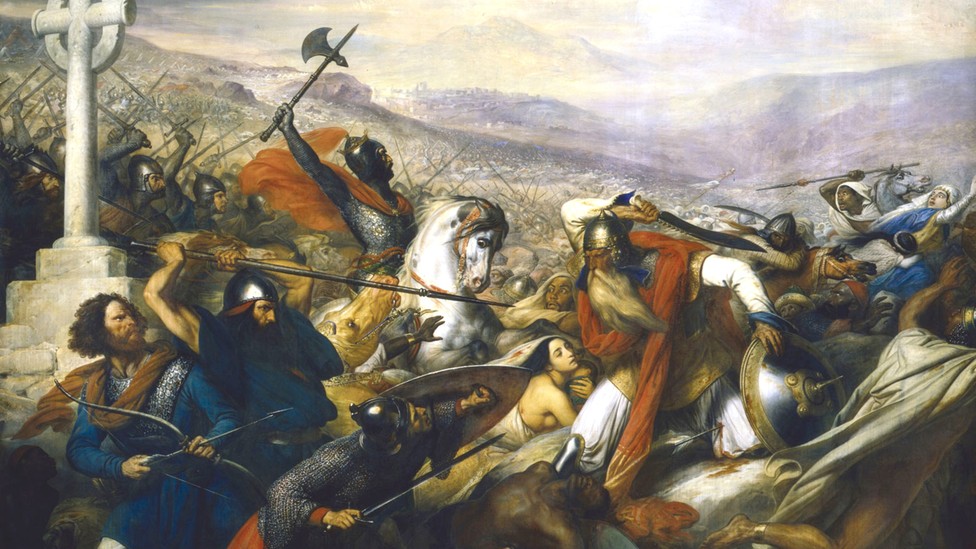
Charles Auguste Steuben's painting of the Battle of the Poitiers in 732. The Frankish leader Charles Martel's victory over Muslim invaders is seen as a decisive moment in European history. Wikimedia
Photo by: Wikimedia
Europe was essentially defined by Islam. And Islam is redefining it now.

For centuries in early and middle antiquity, Europe meant the world surrounding the Mediterranean, or Mare Nostrum (“Our Sea”), as the Romans famously called it. It included North Africa. Indeed, early in the fifth century A.D., when Saint Augustine lived in what is today Algeria, North Africa was as much a center of Christianity as Italy or Greece. But the swift advance of Islam across North Africa in the seventh and eighth centuries virtually extinguished Christianity there, thus severing the Mediterranean region into two civilizational halves, with the “Middle Sea” a hard border between them rather than a unifying force. Since then, as the Spanish philosopher José Ortega y Gasset observed, “all European history has been a great emigration toward the North.”

After the breakup of the Roman empire, that northward migration saw the Germanic peoples (the Goths, Vandals, Franks, and Lombards) forge the rudiments of Western civilization, with the classical legacy of Greece and Rome to be rediscovered only much later. It would take many more centuries for the modern European state system to develop. Slowly, though, feudalism, whose consensual give-and-take worked in the direction of individualism and away from absolutism, gave way to early modern empires and, over time, to nationalism and democracy. Along the way, new freedoms allowed the Enlightenment to take hold. In sum, “the West” emerged in northern Europe (albeit in a very slow and tortuous manner) mainly after Islam had divided the Mediterranean world.

Islam did much more than geographically define Europe, however. Denys Hay, a British historian, explained in a brilliant though obscure book published in 1957, Europe: The Emergence of an Idea, that European unity began with the concept (exemplified by the Song of Roland) of a Christendom in “inevitable opposition” to Islam—a concept that culminated in the Crusades. The scholar Edward Said took this point further, writing in his book Orientalism in 1978 that Islam had defined Europe culturally, by showing Europe what it was against. Europe’s very identity, in other words, was built in significant measure on a sense of superiority to the Muslim Arab world on its periphery. Imperialism proved the ultimate expression of this evolution: Early modern Europe, starting with Napoleon, conquered the Middle East, then dispatched scholars and diplomats to study Islamic civilization, classifying it as something beautiful, fascinating, and—most crucial—inferior.

In the postcolonial era, Europe’s sense of cultural preeminence was buttressed by the new police states of North Africa and the Levant. With these dictatorships holding their peoples prisoner inside secure borders—borders artificially drawn by European colonial agents—Europeans could lecture Arabs about human rights without worrying about the possibility of messy democratic experiments that could lead to significant migration. Precisely because the Arabs lacked human rights, the Europeans felt at once superior to and secure from them.

Islam is now helping to undo what it once helped to create. A classical geography is organically reasserting itself, as the forces of terrorism and human migration reunite the Mediterranean Basin, including North Africa and the Levant, with Europe. The Continent has absorbed other groups before, of course. In fact, Europe has been dramatically affected by demographic eruptions from the east: In the medieval centuries, vast numbers of Slavs and Magyars migrated into central and eastern Europe from deeper inside Eurasia. But those peoples adopted Christianity and later formed polities, from Poland in the north to Bulgaria in the south, that were able to fit, however bloodily, inside the evolving European state system. As for the Algerian guest workers who emigrated to France and the Turkish and Kurdish guest workers who emigrated to Germany during the Cold War, they represented a more containable forerunner to the current migration.

Today, hundreds of thousands of Muslims who have no desire to be Christian are filtering into economically stagnant European states, threatening to undermine the fragile social peace. Though Europe’s elites have for decades used idealistic rhetoric to deny the forces of religion and ethnicity, those were the very forces that provided European states with their own internal cohesion.

Meanwhile, the new migration, driven by war and state collapse, is erasing the distinction between the imperial centers and their former colonies. Orientalism, through which one culture appropriated and dominated another, is slowly evaporating in a world of cosmopolitan interactions and comparative studies, as Said intuited it might. Europe has responded by artificially reconstructing national-cultural identities on the extreme right and left, to counter the threat from the civilization it once dominated.

Although the idea of an end to history—with all its ethnic and territorial disputes—turns out to have been a fantasy, this realization is no excuse for a retreat into nationalism. The cultural purity that Europe craves in the face of the Muslim-refugee influx is simply impossible in a world of increasing human interactions.

“The West,” if it does have a meaning beyond geography, manifests a spirit of ever more inclusive liberalism. Just as in the 19th century there was no going back to feudalism, there is no going back now to nationalism, not without courting disaster. As the great Russian intellectual Alexander Herzen observed, “History does not turn back … All reinstatements, all restorations have always been masquerades.”

The question is thus posed: What, in a civilizational sense, will replace Rome? For while empire, as Said documented, certainly had its evils, its very ability to govern vast multiethnic spaces around the Mediterranean provided a solution of sorts that no longer exists.

Europe must now find some other way to dynamically incorporate the world of Islam without diluting its devotion to the rule-of-law-based system that arose in Europe’s north, a system in which individual rights and agency are uppermost in a hierarchy of needs. If it cannot evolve in the direction of universal values, there will be only the dementia of ideologies and coarse nationalisms to fill the void. This would signal the end of “the West” in Europe.

By Robert D. Kaplan, theatlantic.com
http://www.theatlantic.com/magazine/archive/2016/05/how-islam-created-europe/476388/


~ ~ ~ ~ ~ ~ ~
Islamic Revival رساله تجديد الاسلام ‏

An in-depth study of the Qur’an and Islamic religious history reveals startling facts. “Risala-e-Tajdeed-ul-Islam” is a message to develop positive change in the thought and practices of Muslims.
قرآن اور اسلام کے گہرے مطالعه سےحیران کن حقائق کا انکشاف ہوا، "رساله تجديد الاسلام" مسلمانوں کے انداز فکروعمل میں مثبت تبدیلی کا پیغام ہے:

Islamic Extremism is a Product of Western Imperialism

As we struggle to come to terms with the latest terrorist attacks in Brussels, it is important that we understand the causes of such extremism. After all, Islamic extremism was virtually unknown fifty years ago and suicide bombings were inconceivable. And yet today it seems that we are confronted with both on a daily basis. Keep reading >>>>>


Related:
~ ~ ~ ~ ~ ~ ~ ~ ~ ~ ~ ~ ~ ~ ~ ~ ~  ~ ~ ~  ~
Humanity, ReligionCultureSciencePeace
 A Project of 
Peace Forum Network
Peace Forum Network Mags
BooksArticles, BlogsMagazines,  VideosSocial Media
Overall 2 Million visits/hits

8 Beliefs You Should Have About Money And the 14 you should give up

“Very few people can afford to be poor.”
-- George Bernard Shaw

I talk about the Law of Attraction and what it takes to really become the magnet that activates this Law. Many of us have been unconsciously magnetizing what we don’t want to come to us. I think this is particularly apparent when it comes to money—or the lack of money. So let’s tackle it:
Why aren’t you wealthy?
》》》》》》
https://www.psychologytoday.com/blog/focus-forgiveness/201604/8-beliefs-you-should-have-about-money

Panama Papers: What are they, who is involved and why are they important?

Have they exposed any crimes?
The shadowy financial dealings exposed in the leaks are not in themselves illegal but the ICIJ said the leaks show how "dark money flows through the global financial system, breeding crime and stripping national treasuries of tax revenues".
"Most of the services the offshore industry provides are legal," the report adds. "But the documents show that banks, law firms and other offshore players have often failed to follow legal requirements that they make sure their clients are not involved in criminal enterprises, tax dodging or political corruption.
"In some instances, the files show, offshore middlemen have protected themselves and their clients by concealing suspect transactions or manipulating official records."
Offshore accounts and shell companies are among the methods used to conceal the ownership of assets. Keep reading 》》》 http://m.timesofindia.com/world/us/Panama-Papers-What-are-they-who-is-involved-and-why-are-they-important/articleshow/51682037.cms

India's Pakistan Stragey : Military and political pressure; subversion; Terrorism; Diplomatic Isolation; Media and Ppublic Defamation and Cultural domination


INDIA’S ambitions of achieving Great Power status cannot be fully realised unless Pakistan is strategically neutralised. A conventional military defeat of Pakistan has been a costly and unlikely option ever since the latter acquired a credible nuclear deterrence capability. Pakistan has also built a strategic relationship with China which provides it with the capacity to balance, to a considerable extent, India’s larger military and economic capabilities.

India’s need to bring Pakistan to heel has intensified in the context of the emerging Great Power contest in Asia. Pakistan’s incorporation into an Indian sphere of influence would be a grave setback to China’s future role in South, West and Central Asia and the western Indian Ocean. The prospect of the China-Pakistan Economic Corridor, while India has no land access to the west and Central Asia, has added a new dimension to India’s determination to neutralise Pakistan. India’s strategic goals, if not its methods, are fully supported by the US and its allies.

India has adopted a complex strategy to wear down Pakistan’s resistance. This strategy encompasses: military and political pressure; subversion; terrorism; diplomatic isolation; media and public defamation and cultural domination.
Explore: Pakistan's guide to engaging with India

Some elements of India’s comprehensive strategy and actions are now public knowledge, such as Indian National Security Adviser Ajit Doval’s boastful speech recalling how Indian agencies eroded the Kashmiri freedom struggle through corruption and intimidation; forecasting the separation of Balochistan; and expressing glee at the Tehreek-i-Taliban Pakistan’s beheading of Pakistani soldiers in Fata.

India has adopted a complex strategy to wear down Pakistan’s resistance.
India’s strategy has a wide canvas.

1. One element of the strategy is the attempt, pursued in tandem with the West, to neutralise Pakistan’s nuclear deterrence capabilities. Thus, the discriminatory Western restraints on equipment and technology transfers to Pakistan and the vigorous US opposition to Pakistan’s deployment of theatre nuclear weapons and long-range missiles which are designed, respectively, to counter India’s Cold Start doctrine and its second-strike capability.

2. Meanwhile, India maintains military pressure on Pakistan through deployment of advanced weapons systems (ballistic missiles, anti-ballistic missiles etc), expanded offensive deployments, military exercises to refine the capacity for a surprise attack (as envisaged in India’s Cold Start doctrine) and frequent shelling along the Line of Control in Kashmir.

3. Subversion, involving infiltration, sponsorship and support for dissident or disgruntled groups within Pakistan, is a third element of this strategy. The sponsorship of the Baloch Liberation Army and terrorism in Balochistan and Sindh has now been confirmed by the recent capture and confession of the Indian spy. Disaffected groups in Karachi, rural Sindh and Khyber Pakhtunkwa have been encouraged for many years to disrupt peace and security.

Substantial proof has been gathered by Islamabad’s agencies of Indian sponsorship of terrorism against Pakistan through the TTP, in collaboration with Kabul’s National Directorate of Security and certain power brokers. Some of this evidence has been shared with the UN but has not evoked any action so far from the world organisation. An Indian link to the Lahore park atrocity, responsibility for which has claimed by an affiliate of the TTP, cannot be ruled out.

Pakistan’s armed forces are one of the few organised institutions left in the country. Not surprisingly, because of their profession and training, their resistance to Indian domination is robust. Tarnishing the reputation and credibility of the Pakistan Army is an important element of the Indian strategy. Through the Indian and Western media, the Pakistan Army is incessantly accused of doing today what it did yesterday — supporting the Afghan Taliban and the Kashmiri jihadi groups.

The reality is clouded by ‘fifty shades of grey’. Despite old relationships, Pakistan’s security establishment is either confronting some of these Jihadi groups or has little influence over them (the Afghan Taliban). The violent sectarian groups in Punjab are known to have enjoyed in recent years the protection of some politicians rather than the security establishment. Notwithstanding this, the Indian-inspired mantra against the army and the ISI is frequently echoed not only by the Western media but even within Pakistan.

At the opposite end of India’s kinetic actions, is the wide and successful use of its “‘soft power’, epitomised by Bollywood. This song and dance culture has been warmly embraced by large segments of Pakistan’s young and moneyed elite. Over time, this can lead to greater acceptance in Pakistan of India’s political and strategic goals.

Since early days, India has attempted to co-opt Pakistani politicians, by fair means and foul. When out of office, some political leaders have had intimate contacts with the Indians. Shamefully, some of them — excluding the ruling party — are known to have expressed the desire for Indian and other foreign intervention in Pakistan’s internal affairs. Even today, the desire of some of Pakistan’s leaders to ‘normalise’ relations with India at any cost is inexplicable.
India has been able to play on the fears and predilections of Pakistan’s politicians to set the tone and pace of the bilateral relationship. Dialogue is held out as a favour to Pakistan. India’s positions on both substance and process keep hardening with each encounter. Concessions continue to be made by Pakistan on process and substance — to no avail or purpose.

It is high time for Pakistan’s National Defence Council, which includes both the civilian and military leadership, to undertake a frank and in-depth review of India’s objectives and policies towards Pakistan and evolve a coherent and consensual strategy to respond to each of the elements of India’s policies aimed against Pakistan.

To those Americans who disingenuously chide Pakistan for being paranoid about India, I would respond as Trotsky did shortly before being assassinated: “Just because I am paranoid, does not mean I am not persecuted.”
By Miunir Akram, a former Pakistan ambassador to the UN.
Courtesy: Dawn.com
http://www.dawn.com/news/1249653
Explore: 

Guantanamo is being emptied - but its legacy of making the guilty innocent and the innocent guilty will continue

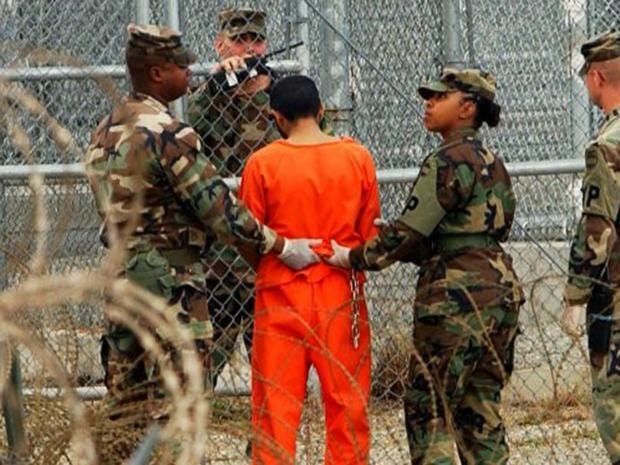
7-guantanamo-get.jpg
Almost half the remaining inmates are Yemeni, but I have to say that I don’t remember many Yemenis in Osama bin Laden’s camps – and I met the man twice in Afghanistan 

They could go on hunger strike. They could talk to the International Red Cross. Their wretched trials could be witnessed by journalists. Their utterly illegal detention – under international law, that is – was known about, and widely condemned as an outrageous and flagrant breech of human rights. But they couldn’t be waterboarded.

The fact that the CIA thugs didn’t get their hands on them – or not as far as we know – must be the one charitable thing to come out of Guantanamo, whence a dozen extra prisoners are to be released, according to the Pentagon. 91 still to go. And oh yes, one of the dozen is a Yemeni who has been on hunger srike since 2007 and has lost half his body weight. So that just shows you. Go on hunger strike, and you get released. 

The Americans don’t want anyone dying on hunger strike;  Tariq Ba Odah has been force-fed daily --strapped down, a rubber tube forced inside his nose and a liquid supplement pumped into his stomach.  Sounds a bit like torture to me.  But that’s how it goes at Guantanamo.  When there’s no rule of law, you’ve got to keep these guys alive. 
No rules, no law. Remember how the bad guys picked up on this? Remember how al-Qaeda and Isis used those orange jumpsuits for their prisoners, how they dressed up their inmates before butchering them?  I can’t recall any US official commenting on that particular theatrical prop. Because this would suggest, wouldn’t it, that a theatrical prop is exactly what it was at Guantanamo - a method of humiliating prisoners, of flaunting their imprisonment.

And then there were the obviously flawed charges - I can think of a bunch of Bosnians locked up to no purpose and then handed back to Bosnia, not to mention an Afghan so old he was obviously senile and let us not forget a few Brits, too – and then a few men who did indeed return to ‘active duty’.  Because the problem is that by putting the ‘guilty’ along with the ‘innocent’ – I use the quotation marks advisedly – you make everyone innocent. 

And this is the point, isn’t it? By including men of violence with men who would never commit violence, you both contaminate the innocent and cleanse the guilty. This is what George Bush did. This is what the Americans did.  No wonder Barack Obama wanted to close Guantanamo. He saw in it something iniquitous:  he saw in it the staining of a whole group of people – mainly Muslim, of course, often brown, even black people – who were imprisoned outside the law. Indeed, the law didn’t even get a look in.

‘Illegal combatants’ was the phrase, I seem to recall.  Illegal – as in ‘non-legal’.  And of course, that’s how Isis and company treated their truly innocent hostages.  They shrewdly understood that the final humiliation was to dress up their victims in the same clothes as the Guantanamo men – to make them equally ‘guilty’, equally bad, equally horrific.  That is George Bush’s legacy to us.

Now let’s go back to Ba Odah, who was taken to Guantanamo in 2002 – that’s fourteen years in prison, for heaven’s sake – but he can’t be sent to his home (Yemen, of course) because of a congressional ban on repatriations to Yemen.  And he’s one of 41 Yemenis who can’t be transferred there.  Incredible! That’s almost half the entire prisoner roll-call in Guantanamo.
Now let me get this right.  When they were sent to the Cuban camp, these were the worst of the worst, the bad guys, the dudes in the black hats.  And now it turns out that the Yemenis were the worst of the worst.  But I have to say that I don’t remember many Yemenis in Osama bin Laden’s camps – and I met the man twice in Afghanistan – so how come there are so many in Guantanamo?

True, there were Egyptians, Algerians, Tunisians, Saudis (bin Laden was one of them) and Moroccans.  But Yemenis?  Well, I guess the Saudis are killing a lot of them right now (the Shia variety, needless to say, for Ba Odah’s faith is commonly believed to be Sunni). 

But then again, we come back to the fact that the Saudis are the principal supporters of the Wahhabi Salafist Sunni faith whose religion is espoused by the Taliban and Isis (and a lot of Gulf states).  And if we’re going to name the bad guys, maybe we should be talking about some ‘folk’ (a Bushism, by the way) who live in the Kingdom of Saudi Arabia as...  Oh hell no, let’s not go down that road. 

By Robert Fisk @indyvoices

Related:
~ ~ ~ ~ ~ ~ ~ ~ ~ ~ ~ ~ ~ ~ ~ ~ ~  ~ ~ ~  ~
Humanity, ReligionCultureSciencePeace
 A Project of 
Peace Forum Network
Peace Forum Network Mags
BooksArticles, BlogsMagazines,  VideosSocial Media
Overall 2 Million visits/hits

Wake-up Call to Muslims


Muslims have to work out the solutions to their problems, themsleves:-
(1) Read online or dowlnoad E Book, pdf at https://goo.gl/9S1cpe or
(2) Keep reading at this page (Web link: http://goo.gl/S26GhY ) or
(3) Read in Urdu: http://goo.gl/reWFXA اردو میں پڑھیں

“The War Against Terrorism; is a war of narratives ... there is a dire need to come up with counter-narratives ... the menace of terrorism cannot be dealt with without countering the extremist, militant ideologies.”  >>>>>

جوابی بیانیہ>>>>>


Related:
~ ~ ~ ~ ~ ~ ~ ~ ~ ~ ~ ~ ~ ~ ~ ~ ~  ~ ~ ~  ~
Humanity, ReligionCultureSciencePeace
 A Project of 
Peace Forum Network
Peace Forum Network Mags
BooksArticles, BlogsMagazines,  VideosSocial Media
Overall 2 Million visits/hits

The "Strategic" Partnership Between India and Iran or The Un-Holy Alliance against Pakistan?


In the worst-case Scenario of war with Pakistan, The Possibility that India might access Iranian Military bases, Thereby encircling and Containing Pakistan, cannot be excluded. [Read full report]
Writes, Jalil Roshandil a well reputed Iranian scholar and researcher. He has been on research penal of many universities in USA, Turkey, and Denmark. He has also been associated with with a well known think tank of University of Iran.
Excerpts:
Iran’s decision to bypass Pakistan and sign an agreement with India was the result of several factors. Of key importance was the old belief that “the enemy of my enemy is my friend.” Iran had simply learned to distrust the West through experiences like the 1953 coup, in which the United States supported the Shah, and even older British and European interventionist policies. In the late 1980s, Pakistan was still seen as a close ally of the despised United States.

Iran and India find themselves coming together not only economically, but also politically. The foreign policies of the two countries have always had commonalities; in particular, both detested Afghanistan’s Taliban and feared the militant Sunni Islam that the Taliban represented. (It is worth remembering that India has more Muslims than either Iran or Pakistan.) Though the Taliban are no
longer in power,Afghanistan remains unstable and a regional concern. Both Iran and India have had difficult dealings with Pakistan as well—it is well known that India blames Pakistan for fanning a secessionist struggle in India’s majority-Muslim state [nore.. its occupied] of Kashmir. One more factor that has helped solder ties between the two countries is Iran’s desire to survive under American pressure and the U.S.-led embargo—in a sense, Iran is still “looking East.”

On the military side, India and Iran agreed  to explore opportunities for joint training and exchange of visits, while declaring that defense cooperation is not aimed against any third country. That the military aspect of the deal will go much further is unlikely. Both India and Iran fear the possible seizure of Pakistan’s nuclear arsenal by Islamic fundamentalists—but both Iran and India have their own religious thugs who might attempt to do the same thing. In the worst-case scenario of war with Pakistan, the possibility that India might access Iranian military bases, thereby encircling and containing Pakistan, cannot be excluded. Such a move would fundamentally alter Islamabad’s strategic calculations. Depending on the strength of India-Iran relations, Iran could get access to advanced Indian military technology.

India keeps its Iran option open for two major reasons:

  1. First, relations with Iran are strategically important for India’s relations with Pakistan. 
  2. Second, even a superficially good relationship with Iran can be sold politically to Muslim Indians who might have some sympathy towards the Islamic Republic of Iran For example, discussion will continue on projects in Iran such as the Chahbahar Free Trade Zone port complex,the Chahbahar-Fahraj-Bam railway link, and the Marine Oil Tanking Terminal. 
Read full >>>


India and Iran—one the object of much wooing from Washington, the other a member of President Bush’s “axis of evil” —announced the creation of a “strategic partnership” in 2003. This Special Report explores the new cordiality in relations between New Delhi and Tehran, as well as the ways this partnership may impact upon the interests of other regional players. Christine Fair explains the calculations that make Iran an attractive partner for New Delhi, and concludes that the bilateral relationship is here to stay. Jalil Roshandel offers an Iranian perspective on the relationship. Pakistan, geographically situated between the two, views closer links between its neighbors with considerable alarm, a subject examined by Sunil Dasgupta. P.R. Kumaraswamy asks how this new Indian-Iranian collaboration may influence New Delhi’s economic and strategic ties with Israel. In addition, all four essays address the implications for the United States of the new -

See more at: https://www.wilsoncenter.org/publication/the-strategic-partnership-between-india-and-iran-pdf#sthash.Sv6zZ6s0.dpuf

It is common to brush aside the conspiracy theories. However if one critically examines the plans conceived decades back by scholar or groups with close association with the policy makers in USA and UK and the events on ground bear close semblance, its difficult to reject it out rightly. The governments of Muslim countries should consider these aspects seriously and instead of investing in construction of high rise building and other symbols of luxury, should invest in education, and establish think tanks, with genuine intellectuals, analysts and thinkers. They should constantly review the international plans and conspiracies, suggesting concrete counter measures for the national survival and advancement of peace and stability. 
Also read: