Featured Post

SalaamOne NetWork

SalaamOne سلام   is   a nonprofit e-Forum to promote peace among humanity, through understanding and tolerance of religions, cul...

Necrophilia, Sex with dead woman: Misquoting Bukhari Book # 23, Hadith # 426

It is well known that the critics and enemies of Islam after failing to find any logical, rational argument against true teachings if Islam indulge in mud slinging against the person of Prophet Muhammad (pbuh). For this purpose they try to twist the historic narratives from Islamic sources. As you know  that history has its … Continue reading »


Fatimah bint Asad, was the mother of ‘Ali bin Abu Talib, and the mother-in-law of the Prophet’s daughter, Fatimah bint Muhammad. Her grandsons, Hasan and Husain are to be the leaders of the youths of Paradise. Besides ‘Ali, she had two other sons, Ja’far Tayyir who was a famous General. He led the forces of Islam in the battle of Mu’tah and was martyred in the same battle.

When the Prophet [sallallahu alayhi wa sallam] grew up and proclaimed himself to be the Prophet [sallallahu alayhi wa sallam] and Last Messenger of Allah, she still stood by him. All the relentless persecution did not deter her in any way. She was exceptionally fond of her son Ja’far, but for the sake of Islam she bore the separation from him and his wife, Asma bint ‘Omais, when they migrated to Abyssiniah on the Prophet’s orders with the first group of migrant Muslims.

Fatimah bint Asad, being one of the first to swear allegiance to Islam and its concept of the Oneness of Allah, faced the economic and social boycott of the Shi’ab Abi Talib for those three terrible years. She was also a member of the privileged group who migrated to Madinah.

‘Abdul Muttalib, who was a very discriminating man, had assessed her nature, her intelligence and her capabilities from the very beginning and proposed for her for his son, Abu Talib. When the Prophet [sallallahu alayhi wa sallam] was told by Allah to spread the Message of Islam among his kith and kin, it was she who immediately accepted this invitation and swore allegiance and entered the fold of Islam. When the Prophet’s grandfather, ‘Abdul Muttalib, passed away, the guardianship of the orphan Muhammad [sallallahu alayhi wa sallam] passed on to Abu Talib . His wife, Fatimah bint Asad, looked after him, loving him as if he were her own. He remembered in his later life that she would go hungry to feed him. He respected her so highly that whenever she visited him he would stand up and receive her with great love, addressing her as ‘Mother’.

His uncle, too, loved him deeply. Muhammad [sallallahu alayhi wa sallam] in his childhood was so well mannered and so fastidious about his personal cleanliness that Abu Talib would hold him up as an example to his other children. Normally boys would be dirty and tousled from playing rough games with the other boys, but Muhammad [sallallahu alayhi wa sallam] was always dignified with a neat appearance. People were impressed when they saw him. Abu Talib liked all the children to eat together because he felt that whenever Muhammad [sallallahu alayhi wa sallam] ate with other children, food would be sufficient, and when the children ate alone, they would remain hungry. Abu Talib often told his nephew that he was specially blessed, as there was plenty when he was around.

Fatimah bint Asad did not spare any pains and looked after the Prophet [sallallahu alayhi wa sallam] in his infancy, boyhood and youth. Once in his childhood he accompanied his uncle on a business trip to Syria. Some very unusual and surprising incidents took place on the journey, and Abu Talib described these to his wife when they came back.

The Prophet [sallallahu alayhi wa sallam] placed the invitation to a religion with a new and rational perspective before the Quraish of Makkah, the worshippers of all the false idols in the Ka’bah were infuriated. They could not dream that the Prophet [sallallahu alayhi wa sallam] would dismiss their gods as useless helpless creatures, and they became his bitter enemies for propagating a new faith that did away with their traditional and inherited practices. They adopted a very antagonistic attitude and swore to crush him and Islam. During this period they resorted to the most cruel and sadistic forms of torture to make the converts give up the new faith and return to their old barbaric practices and rituals. It was only the power and influence of Abu Talib that prevented them from doing any harm to Muhammad. He stood by him with all his love and carried out the responsibilities of a guardian faithfully by giving him his protection. No enemy could dare to do anything to him as long as he was under the mantle of his uncle’s protection.

Fatimah bint Asad cooperated with Abu Talib wholeheartedly and she was a mother, pure and simple, where the safety and well being of Muhammad [sallallahu alayhi wa sallam] was concerned. No wonder he loved and respected her so highly. Considering the dangerous conditions which developed for the Muslims in Makkah, he thought it was better that the Muslims migrate to Abyssiniah where the ruler was known to be tolerant and hospitable. The leader of this first group of migrants was Ja’far bin Abi Talib, the brother of ‘Ali, and the favorite son of Fatimah bint Asad. She loved him more than the others because he resembled Muhammad [sallallahu alayhi wa sallam] very much, and was extremely intelligent.

He seemed to have inherited the family’s mastery over language and was also an eloquent speaker who could win people over to his viewpoint. It was with this same skill that he had won over the king of Abyssiniah when the Quraish appealed to him to surrender the Muslims to them.

The Quraish now decided to restrict the Muslims to one small area, besiege them and boycott them. Social and economic sanctions were imposed, and these three years were perhaps the toughest that the followers of lslam faced. Economically, it was certainly the worst ever. Children could be heard on all sides sobbing with hunger, and the elders looked on helplessly with tears in their eyes. To satisfy their hunger they started eating the leaves of trees and grass; they even sucked on wet skins to slake their thirst. Fatimah bint Asad passed this terrible period with fortitude and patience, and did not waver in the smallest degree. Ten years after the first revelation to Muhammad [sallallahu alayhi wa sallam] appointing him the Messenger of Allah, this harsh siege was finally lifted. It was in the same year that the Prophet’s wife and most faithful supporter, Khadijah, passed away. The pangs of separation from her were very strong for the Prophet [sallallahu alayhi wa sallam] . He had not yet recovered from her loss, when he was dealt another terrible blow – his best ally, Abu Talib, also passed away. This year is known as ‘The Year of Sorrows’ in Islamic history.

The torture and torment, atrocities and cruelties reached such proportions that Allah finally ordered the Prophet [sallallahu alayhi wa sallam] to migrate to Madinah. Fatimah bint Asad was among these migrants.

“So patience is most fitting. And it is Allah Whose help can be sought against that (lie) which you describe.” (12:18)

Anas bin Malik says that when the Prophet [sallallahu alayhi wa sallam] got news of the death of Fatimah bint Asad, he immediately went to her house, sat beside her and prayed for her.

“My dear mother, may Allah keep you under His Protection. Many times you went hungry in order to feed me well. You fed me and clothed me on delicacies that you denied yourself. Allah will surely be happy with these actions of yours. And your intentions were surely meant to win the goodwill and pleasure of Allah and success in the Hereafter.”

He gave his shirt to be used as part of her shroud, saying he prayed to Allah to forgive her and give her the dress of Paradise.

‘When the grave was prepared the Prophet [sallallahu alayhi wa sallam] himself examined it and with his own hands placed her into the grave.

Thus, she was one of the few blessed people whose graves the Prophet [sallallahu alayhi wa sallam] himself examined.

“Fatimah bint Asad is that great lady for whom he gave the glad tidings that she would be blessed with a place in Paradise. He said that he shrouded her with his shirt, praying that Allah would give her the dress of Paradise. Allah pleased with them and they pleased Allah.”

Taken from the book: Great Women of Islam (Who were given the good news of Paradise) By: Mahmoud Ahmad Ghadanfar Revised by: Sheikh Safur-Rahman Al Mubarak puri which may be purchased at :http://www.dar-us-salam.com/store/main.mvc?Screen=PROD&Store_Code=Dus&Product_Code=125&Category_Code=Eng_Womenas well as other places.
http://southernmuslimah.wordpress.com/2008/01/24/great-women-of-islamfatimah-bint-asad/

Is Sharia immutable?

IT is believed by millions of Muslims across the world that Sharia laws are immutable and represent divine will. This is based on serious misunderstanding. Sharia is not and cannot be immutable.

Recently I was invited to the Jaipur Literary Festival to be part of a panel discussion on the book Heaven on Earth by Sadakat Kadri of London, which is on the application of Sharia laws across the Muslim world. He has travelled to different Muslim countries and talked to various ulema and muftis about Sharia as applied to their respective countries.

All of them were defenders of conservative Sharia formulations and refused to admit any change. They maintained that Sharia being divine cannot be changed. It is from this rigidity of our ulema that the misunderstanding among common Muslims arises that Sharia is divine and hence immutable.

In fact our ulema forget that ijtihad was not only permitted but encouraged by the Prophet of Islam (PBUH) and the hadith pertaining to Ma’adh bin Jabal is well-known. When the Prophet appointed him to the governorship of Yemen and he came to take leave of the Prophet, Ma’adh was asked how he would govern. Ma’adh said, according to the Quran. The Prophet thereupon asked what he would do if he did not find the solution to the problem in the Quran, to which Ma’adh said he would govern according to the Sunnah. But when the Prophet asked if he could not find it in the Sunnah also, Ma’adh said “ana ajtahidu” (I will exert myself to find the solution). The Prophet thereupon patted his back and told him he was right.

All ulema accept this hadith and yet, while theoretically admitting the permissibility of ijtihad, refuse to engage in it or allow it saying there is no one capable of doing it. In fact, what is unalterable are the principles and values underlying Sharia ie usul al-fiqh. But laws based on these usul must undergo change in keeping with changes in the social and cultural context. In fact cultural context plays a very important role in the formulation of Sharia. The Arab adaat (customs and traditions) form an important part of Sharia formulations.

The late Abdurrahman Wahid, who headed Indonesia’s religious organisation Nahdlatul Ulama and also served as president of that country, told me once that there was great debate among the ulema of Indonesia over whether Indonesian customs and traditions can become part of Sharia as applicable in that country; those who advocated Indonesian adaat ultimately won.

Let us remember that what was called the Muslim ummah (community) during the Prophet’s time was limited to Arabia only. But when Islam spread to different areas the ummah was no more confined to the Arabs alone; it also encompassed the Iranians, Uzbeks, Turks, Chinese, Indians and others. Thus there were various linguistic and cultural groups within the fold of Islam.

Sharia was influenced by these factors. Thus the ummah was no longer a homogenous group but comprised of various cultural communities with their own age-old customs and traditions.

However, the values, maqasid (intentions) and masalih (welfare) of human beings did not change. Maqasid al-sharia and masalih al-sharia do not change, but in order to keep these values, maqasid and masalih intact, the rules framed by the ulema must change. When Imam Shafi’i moved from Hejaz to Egypt, which was a confluence of Arab and Coptic cultures, he realised this and changed his position on several issues.

However, what I am saying does not apply to ibadaat ie matters pertaining to worship, the world hereafter etc but only to matters pertaining to mu’amalat ie interpersonal relations like marriage, divorce, inheritance and many other similar socio-economic matters.

The most important, of course, among these is matters pertaining to marriage, divorce etc. In Jaipur I spoke mainly on women’s position in Sharia and women’s position in the Quran.

The fact that the venue was packed with people shows the interest women’s position in general and that of Muslim women in particular generates. I commented that the book referred to earlier deals with only the status quo and application of Sharia laws of patriarchal and feudalised Islamic societies. It very much misses what I call the transcendental Quranic vision. The Quran gives absolutely equal rights to man and woman without any discrimination.

However, the Quran was revealed in a highly patriarchal society which later also became feudalised when the caliphate turned into a feudal empire. Thus patriarchy and feudalism completely distorted the fundamental Quranic vision of gender equality and women’s individuality and dignity.

Unless we understand these sociological and cultural aspects and relate them to the theological one, we will miss the very revolutionary role which Islam wanted to play in totally transforming women’s status.

However, it is highly regrettable that Muslim societies could not produce ulema with the capacity to relate sociology with theology. Even in modern and post-modern societies our ulema totally lack a transcendental vision of Islam. They have become prisoners of the past and have frozen Islam in a feudal, patriarchal state.

We need theologians with vision to fulfil the Quran’s mission of going beyond the present which is full of injustice. Our society is replete with gender injustices and the Quran’s central value is justice — justice in all areas of life. Gender justice is as emphatically emphasised as justice in social and economic matters.

In order to emphasise gender justice it is high time that we produce female theologians with profound knowledge of the Arabic language. Even the most conservative ulema cannot oppose the concept of female theologians.

By Asghar Ali Engineer : The writer is an Islamic scholar who also heads the Centre for Study of Society & Secularism, Mumbai: http://dawn.com/2013/02/01/is-sharia-immutable/
~~~~~~~~~~~~~~~~~~~~~~~~~~~~~~~~~~~
Shariah:
Islam being a complete code of life (Din) covers all aspects including social, economic, political, military and other aspects of human life, hence the Islamic law, spells out the moral goals of the community, where state and religion are not separate entity. Total and unqualified submission to the will of Allah  is the fundamental tenet of Islam: Islamic law is therefore the expression of Allah's command for Muslim society and, in application, constitutes a system of duties that are incumbent upon a Muslim by virtue of his religious belief. Known as the Shari’a (literally means path leading to the watering place). The Jews flouted the law: “The likeness of those who are entrusted with the Law of Moses, yet apply it not, is as the likeness of the ass carrying books. Wretched is the likeness of folk who deny the revelations of Allah. And Allah does not guide the wrongdoers.”(Qur’an;62:5). Allah say: “And unto thee have We revealed the Scripture with the truth, confirming whatever Scripture was before it, and a watcher over it. So judge between them by that which Allah hath revealed, and follow not their desires away from the truth which hath come unto thee. For each We have appointed a divine law and a traced out way.”(Qur’an;5:48). The Jews and Christians have been commanded to follow Prophet Muhammad (peace be upon him) and Qur’an: “O people of the Book (Jews and Christians)! Now Our Messenger (Muhammad) has come to you to reveal much of what you have concealed from the Holy Books and to pass over much which is no longer necessary. There has come to you from God a new Light and a clear Book (Qur’an), with which God will guide to the ways of peace all those who seek His good pleasure and bring them out of the depth of darkness into the light of His grace and guide them to the Right Way.”(Qur’an;5:15-16). In Islamic society, therefore, the term law has a wider significance than it does in the modern secular West, because Islamic law includes both legal and moral imperatives. The Islamic law constitutes a divinely ordained path of conduct, that guides the Muslim toward a practical expression of his religious conviction (rituals) and all aspects of life (social, economic, political etc) in this world and the goal of divine favour in the world to come. For the same reason, not all-Islamic laws can be stated as formal legal rules or enforced by the courts. Much of it depends on conscience alone. The Shari’a duties are broadly divided into those that an individual owes to Allah (the ritual practices or 'ibadat) and those that he owes to his fellow men (mu'amalat). It is the latter category of duties alone, constituting law in the Western sense, that is penal law. The other laws include; offenses against the person, homicide, law of transactions, family law, succession law, procedure and evidence etc. The Qur’anic revelations laid down basic standards of conduct for the first Muslim community established under the leadership of the Prophet (peace be upon him) at Medina in 622 C.E.  The Qur’an is the book of guidance for the believers; it also lay down the parameters of legal code. The Qur’an contains about ninety verses directly and specifically addressing questions of law. Islamic legal discourse refers to these verses as Allah's law and incorporates them into legal codes. The remainder of Islamic law is the result of jurisprudence (fiqh), human efforts to codify Islamic norms in practical terms and legislate for cases not specifically dealt with in the Qur’an and Sunnah, through Ijma, (agreement among scholars) and Qiya, (analogical reasoning).
Beginning in the mid eighth cen­tury, the four major Sunni schools of legal thought (madhhabs) Hanafi, Maliki, Shafii, Hanbali and the Shi’a Jafari madhhab (Twelvers) emerged. They were named after the great scholars Imam Abu Hanifah (699-767 C.E),  Imam Malik ibn Anas (715-795 C.E), Imam Al-Shaf’ie (767-820 C.E), Imam Ahmad ibn Hanbal (780-855 C.E) and Imam Jafar al-Sadiq (699-748 C.E) respectively. These schools differ in their methodologies, which help them to arrive at verdicts to questions that are put to them. All Sunni schools use systematic reasoning to deal with areas of law not directly covered by the Qur’an or Sunnah. They differ primarily in their emphasis on textual authority or analogical reasoning, but each school recognizes the conclusions of the others as being perfectly legitimate and within the framework of orthodox Islam. Imamah is one of the core beliefs of Shiite Islam, which separates Shiites from other Muslims. Imamah is the belief that, in every time and place, there must be an infallible, divinely appointed guide who preserves the religion exactly as it was revealed by the Prophet Muhammad (peace be upon him). The person who bears the duty of guarding and preserving the Divine message after it is revealed and is chosen by God for this function is called the Imam; in the same way that the person who bears the prophetic spirit and has the function of receiving Divine injunctions and laws from God is called the Prophet. It is possible for the Imamate and Prophecy (Nubuwwat) either to be joined in one person or to be separate. Shi’a Muslims, believe that Prophet Muhammad's (peace be upon him) religious leadership, spiritual authority, and divine guidance were passed on to his descen­dants, beginning with his son-in-law and cousin, Ali ibn Abi Talib, his daughter, Fatimah, and their sons, Hasan and Husain.  Sunnis and Shi’a differed in their understanding of ‘who held the power to inter­pret Shari’a’. Shi’as initially believed that only an infal­lible Imam could interpret Shari’a. When the line of appropriate descen­dants ended, this tradition was reinterpreted to grant judicial authority to the fuqaha as the Imam's representatives.  The Sunnis, consider that the competent scholars of religious sciences can conduct Ijtihad, which means ‘independent reasoning’ as opposed to taqlid (imitation). In the absence of direct guidance from Qur’an or Sunnah for a given situation, the exercise of rational judgment by a competent authority is termed as Ijtihad. It is a unique and important component of Shari’a. Ijtihad  started during the life of the Prophet  (peace be upon him) in the far flung areas. The rules of Ijtihad were framed by Abu Bakr, the first Caliph. Ijtihad, being human generated legislation is considered fallible; since more than one interpretation of a legal issue is possible: it is open to revision. The term Shari’a is sometimes applied to all Islamic legislation. Modern scholars have however challenged this claim, distinguishing between Shari’a and fiqh and call­ing for reform of fiqh codes in light of modern conditions. [Extract from eBook:  Legacy Abraham: https://t.co/Dw4ZTuSo ]

<<Free-eBooks Click here>>> 

War on terror forever: Now Gold & Uranium of Africa

And the winner of the Oscar for Best Sequel of 2013 goes to... The Global War on Terror (GWOT), a Pentagon production. Abandon all hope those who thought the whole thing was over with the cinematographic snuffing out of "Geronimo", aka Osama bin Laden, further reduced to a fleeting cameo in the torture-enabling flick Zero Dark Thirty. 

It's now official - coming from the mouth of the lion, Chairman of the Joint Chiefs of Staff General Martin Dempsey, and duly posted at the AFRICOM site, the Pentagon's weaponized African branch. 
Exit "historical" al-Qaeda, holed up somewhere in the Waziristans, in the Pakistani tribal areas; enter al-Qaeda in the Islamic Maghreb (AQIM). In Dempsey's words, AQIM "is a threat not only to the country of Mali, but the region, and if... left unaddressed, could in fact become a global threat." 

With Mali now elevated to the status of a "threat" to the whole world, GWOT is proven to be really open-ended. The Pentagon doesn't do irony; when, in the early 2000s, armchair warriors coined the expression "The Long War", they really meant it. 

Even under President Obama 2.0's "leading from behind" doctrine, the Pentagon is unmistakably gunning for war in Mali - and not only of the shadow variety. [1] General Carter Ham, AFRICOM's commander, already operates under the assumption Islamists in Mali will "attack American interests". 

Thus, the first 100 US military "advisers" are being sent to Niger, Nigeria, Burkina Faso, Senegal, Togo and Ghana - the six member-nations of the Economic Community of West African States (ECOWAS) that will compose an African army tasked (by the United Nations) to reconquer (invade?) the parts of Mali under the Islamist sway of AQIM, its splinter group MUJAO and the Ansar ed-Dine militia. This African mini-army, of course, is paid for by the West. 

Students of the Vietnam War will be the first to note that sending "advisers" was the first step of the subsequent quagmire. And on a definitely un-Pentagonese ironic aside, the US over these past few years did train Malian troops. A lot of them duly deserted. As for the lavishly, Fort Benning-trained Captain Amadou Haya Sanogo, not only did he lead a military coup against an elected Mali government but also created the conditions for the rise of the Islamists. 

Nobody, though, is paying attention. General Carter Ham is so excited with the prospect of AFRICOM accumulating more gigs than Led Zeppelin in its heyday, and himself acquiring iconic savior status (Carter of Africa?), that he's bungling up his data. [2] 
The general seems to have forgotten that AFRICOM - and then the North Atlantic treaty Organization (NATO) - irretrievably supported (and weaponized) the NATO rebels in Libya who were the fighting vanguard in the war against Muammar Gaddafi. The general does know that AQIM has "a lot of money and they have a lot of weapons". 

But he believes it was "mercenaries paid by Gaddafi" who abandoned Libya and brought their weapons, and "many of them came to northern Mali". No, general, they were not Gaddafi mercenaries; most were NATO rebels, the same ones who attacked the US Consulate, actually a CIA station, in Benghazi, the same ones commuting to Syria, the same ones let loose all across the Sahel. 

So what is Algeria up to?
Right on cue, British Prime Minister David Cameron followed His Masters Voice, announcing the intervention in Mali will last years "or even decades". [3] 

This Tuesday, the creme de la creme of Britain's intelligence establishment is meeting to plan nothing else than a pan-Sahara/Sahel war, for which they want yet another Bush-style "coalition of the willing". [4] For the moment, British involvement means yet more "advisers" in the usual "military cooperation" and "security training" categories, lots of money and, last but not least, Special Forces in shadow war mode. 

The whole scenario comes complete with another providential "Geronimo"; Mokhtar Belmokhtar, aka "The Uncatchable" (at least by French intelligence), the leader of MUJAO who masterminded the raid on the In Amenas gas field in Algeria. 

Haven't we seen this movie before? Of course we did. But now - it's official - Mali is the new Afghanistan (as Asia Times Online had already reported - Burn, burn Africa's Afghanistan, January 18, 2013). Here's Cameron: "Just as we had to deal with that in Pakistan and Afghanistan, so the world needs to come together to deal with this threat in North Africa." Right; Belmokhtar is already rehearsing for his cameo appearance in a Zero Dark Thirty sequel.

So by now it's clear where the Anglo-American Pentagon/Africom/British intelligence "special relationship" stands - with the French under President Francois Hollande, reconverted as a warlord, momentarily "leading" the way towards Operation African Quagmire. Crucially, no one in the European Union, apart from the Brits, is loony enough to follow in the footsteps of warlord Hollande. 

By comparison, what is definitely not clear is where the key to this equation - Algeria - stands, from the point of view of the Western GWOT. 

Number one fact is that the new "Geronimo", Belmokhtar, and his Mulathameen Brigade ("The Masked Ones"), of which the "Signed in Blood Batallion" which attacked in Algeria is a sub-group, enjoy extremely cozy links with Algerian secret intelligence. In a way, this could be seen as a remix of the relationship between the Taliban - and "historic" al-Qaeda - with the Pakistani Inter-Services Intelligence (ISI). 

The Algerian military's ultra-hardcore response to the Islamist raid was predictable (this is how they did it during the 1990s in their internal war against the Islamic Salvation Front). We don't negotiate with terrorists; we kill them (along with scores of hostages). We do it by ourselves, without nosy foreigners, and we go for total information blackout. 

No wonder this modus operandi raised a rosary of eyebrows across the Anglo-American "special relationship". Thus the Washington/London bottom line: we cannot trust the Algerians. Our GWOT - the Sahara/Sahel chapter - will be fought without them. Perhaps, even against them. 

A serious complicating factor is that the 40 or so Islamists (including Libyans, Syrians and Egyptians) crossed at least 1,600 kilometers of high desert coming from Libya, not Mali. They had to have serious "protection" - anything from intelligence provided by a foreign power to qualified Algerian insiders. Hostages told of kidnappers "with North American accents" (including a Canadian whom Reuters has named "Chedad") and that all of them knew exactly where the foreigners were located inside the compound. [5] 

Professor Jeremy Keenan of the School of Oriental and African Studies in London frames it in terms of an Algerian false-flag operation gone wrong. [6] Algiers may have wanted to signal to the West that French bombing in Mali would inevitably lead to blowback; but then Belmokhtar turned the whole thing upside down because he was furious the French were allowed to own Algerian airspace to bomb Mali. In a way, this could be seen as another remix of the Taliban revolting against the ISI. 

Algerian public opinion is immensely suspicious, to say the least, of all the players' motives, including the Algerian government and especially France. Here is a fascinating sample. This perspective, by a political science professor, is worth quoting at length, as it neatly summarizes the French "lead" in the new GWOT chapter.
In an interview with the French-language daily Le Soir d'Algerie, political science professor Ahmed Adimi described the intervention as an attempt to "undermine Algeria" and a "step in a plan for the installation of foreign forces in the Sahel region". Adimi's thesis is that France has worked for years to destabilize the Sahel as a means of strengthening its geopolitical stance. 

Asked whether the French operation in Mali was consistent with United Nations security council resolution 2085, Adimi states that the resolution "does not pose much of a problem in itself. Western powers have used it to intervene and adopt resolutions to justify their military operations. This has already happened in Iraq. In fact, the French operation may seem legal since it comes at the request of the Acting Present of Mali. However, it is important to remember that the current government came to power in a coup. Regarding the intervention, it was certainly predictable but the French have precipitated matters. [...] These terrorist groups are being manipulated by foreign powers," continuing to argue that these groups were "allowed" to move south to Konna as means of justifying the French intervention. 

Adimi argues that Algerians have "been sounding the alarm about the situation in the Sahel in general. Ahmed Barkouk and myself have organized several seminars on this topic. We discussed the role of France and its commitment to the region. It was France that was behind the creation of the movement for the Azawad, and I speak of course of the political organization and not of the people of Azawad, who have rights as a community. The French knew that their intervention in Libya would lead to a return of the pro-Qaddafi military Tuareg to Mali. They also planned the release of Libyan arms stockpiles across the Sahel band. The project is to transform the region into a new Afghanistan, the result of long-term planning."
Tariq Ramadan, in a devastating piece, [7] also unmasks Paris, drawing the connection between the dodgy Sarkozy "humanitarian" intervention in Libya and the current Hollande drive to protect a "friendly" country - all coupled with the hypocrisy of France for decades not giving a damn about "the people" suffering under assorted African dictatorships. 

But the Oscar for Best Hypocritical Scenario certainly goes to the current French-Anglo-American concern about Mali being the new al-Qaeda playground, when the major playgrounds are actually NATO-supported northern Syria (as far as the Turkish border), north Lebanon and most parts of Libya. 

Follow the gold, and follow the uranium 
Even before it's possible to fully analyze the myriad ramifications - many of them unforeseen - of the expanded GWOT, there are two fronts to be carefully observed in the near future. So let's follow the gold, and let's follow the uranium. 

Follow the gold. A host of nations have gold bullion deposited at the New York Federal Reserve. They include, crucially, Germany. Recently, Berlin started asking to get back its physical gold back - 374 ton from the Bank of France and 300 tons out of 1,500 tons from the New York Federal Reserve. 

So guess what the French and the Americans essentially said: We ain't got no gold! Well, at least right now. It will take five years for the German gold in France to be returned, and no less than seven years for the stash at the New York Federal Reserve. Bottom line: both Paris and Washington/New York have to come up with real physical gold any way they can. 

That's where Mali fits in - beautifully. Mali - along with Ghana - accounts for up to 8% of global gold production. So if you're desperate for the genuine article - physical gold - you've got to control Mali. Imagine all that gold falling into the hands of... China.
Now follow the uranium. As everyone who was glued to the Niger yellowcake saga prior to the invasion of Iraq knows, Niger is the world's fourth-largest producer of uranium. Its biggest customer is - surprise! - France; half of France's electricity comes from nuclear energy. The uranium mines in Niger happen to be concentrated in the northwest of the country, on the western range of the Air mountains, very close to the Mali border and one of the regions being bombed by the French. 

The uranium issue is intimately connected with successive Tuareg rebellions; one must remember that, for the Tuaregs, there are no borders in the Sahel. All recent Tuareg rebellions in Niger happened in uranium country - in Agadez province, near the Mali border. So, from the point of view of French interests, imagine the possibility of the Tuaregs gaining control of those uranium mines - and starting to do deals with... China. Beijing, after all, is already present in the region. 

All this crucial geostrategic power play - the "West" fighting China in Africa, with AFRICOM giving a hand to warlord Hollande while taking the Long War perspective - actually supersedes the blowback syndrome. It's unthinkable that British, French and American intelligence did not foresee the blowback ramifications from NATO's "humanitarian war" in Libya. NATO was intimately allied with Salafis and Salafi-jihadis - temporarily reconverted into "freedom fighters". They knew Mali - and the whole Sahel - would subsequently be awash in weapons. 

No, the expansion of GWOT to the Sahara/Sahel happened by design. GWOT is the gift that keeps on giving; what could possibly top a new war theatre to the French-Anglo-American industrial-military-security-contractor-media complex? 

Oh yes, there's that "pivoting" to Asia as well. One is tempted to donate a finger - extracted Islamist-style - to know how and when will come the counterpunch from Beijing. 

Notes:
1. Mali conflict exposes White House-Pentagon split, Los Angeles Times, January 18, 2013.
2. African nations can, must do for themselves - with US support, December 4, 2012. 
3. David Cameron: fight against terrorism in north Africa may last decades, The Guardian, January 20, 2013. 
4. Intelligence chiefs and special forces plot Sahara mission, The Independent, January 21, 2013. 
5. In Amenas : les ex-otages racontent quatre jours d'angoisse, Liberation, January 20, 2013. (In French). 
6. Algeria Hostage Crisis: Terror Attack 'Inside Job' Gone Wrong, Says Professor Jeremy Keenan, The Huffington Post, January 19, 2013.
7. Le Mali, la France et les extremistes, journaldumali.com, January 18, 2013. (In French). 

By Pepe Escobar is the author of Globalistan: How the Globalized World is Dissolving into Liquid War (Nimble Books, 2007) and Red Zone Blues: a snapshot of Baghdad during the surge. His new book, just out, is Obama does Globalistan (Nimble Books, 2009). He may be reached at pepeasia@yahoo.com. 

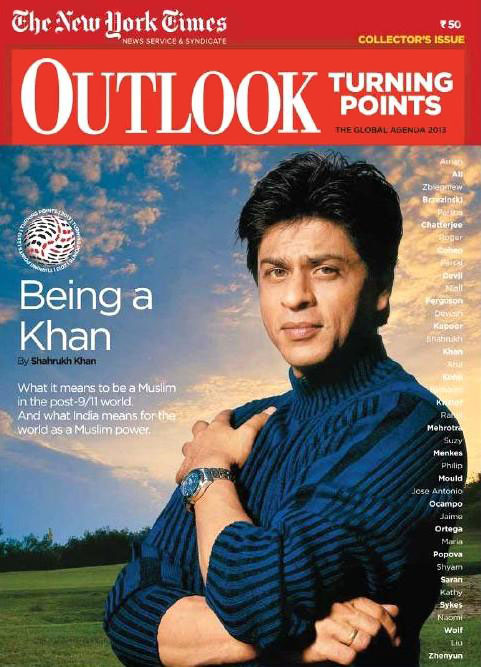
'Being A Khan’ by Shahrukh Khan (excerpts) - Deplorable state of Muslims in Secular India Exposed


The Outlook  magazine features a write-up by Shahrukh on ‘what it means to be a Muslim in the Post 9/11 world’.
Below are some excerpts from the article titled “Being a Khan”
  • I sometimes become the inadvertent object of political leaders who choose to make me a symbol of all that they think is wrong and unpatriotic about Muslims in India. There have been occasions when I have been accused of bearing allegiance to our neighbouring nation (Pakistan) rather than my own country – this even though I am an Indian, whose father fought for the freedom of India. Rallies have been held where leaders have exhorted me to leave and return what they refer to my ‘original’ homeland
  • I gave my son and daughter names that could pass for generic (pan-India and pan-religious) ones – Aryan and Suhana. The Khan has been bequeathed by me so they can’t really escape it. I pronounce it with my epiglottis when asked by Muslims and throw the Aryan as evidence of their race when non-Muslims enquire. I imagine this will prevent my offspring from receiving unwarranted eviction orders or random fatwas in the future
  • SRK also added that he became so sick of being mistaken for some crazed terrorist, “who co-incidentally carries the same name as mine that I made a film subtly titled ‘My Name Is Khan’ (and I am not a terrorist) to prove a point.”
  • Ironically, I was interrogated at the airport for hours about my last name when I was going to promote the film in America for the first time.
~~~~~~~~~~~~~~~~~~~
SRK bares it, in what it means to be a Muslim in the post-9/11 world

Shahrukh Khan says how he became an “inadvertent object of political leaders” in his interview to Outlook Turning Points magazine, published in association with The New York Times newspaper. Titled Being a Khan, the write-up appears in the current issue of the magazine and the 47-year-old actor, one of the few Indian actors with international recognition, writes: “I sometimes become the inadvertent object of political leaders who choose to make me a symbol of all that they think is wrong and unpatriotic about Muslims in India.”

“There have been occasions when I have been accused of bearing allegiance to our neighbouring nation rather than my own country – this even though I am an Indian, whose father fought for the freedom of India. Rallies have been held where leaders have exhorted me to leave and return what they refer to my original homeland,” added the superstar of Hindi cinema.

SRK is married to Gauri, a Hindu, and has two children – Aryan and Suhana. “I gave my son and daughter names that could pass for generic (pan-India and pan-religious) ones – Aryan and Suhana. The Khan has been bequeathed by me so they can’t really escape it.”

“I pronounce it with my epiglottis when asked by Muslims and throw the Aryan as evidence of their race when non-Muslims enquire. I imagine this will prevent my offspring from receiving unwarranted eviction orders or random fatwas in the future,” he wrote.

He said he became so sick of being mistaken for some crazed terrorist, “who co-incidentally carries the same name as mine that I made a film subtly titled My Name Is Khan (and I am not a terrorist) to prove a point.”

Set in the post 9/11 US, My Name Is Khan focuses on religious and national identities through Rizwan (SRK), who has Asperger’s syndrome, and how his Khan identity becomes all important in a suspicious America.

“Ironically, I was interrogated at the airport for hours about my last name when I was going to promote the film in America for the first time,” said SRK.

~~~~~~~~~~~~~~~~~~~~~~

Comments:
Shah Rukh Khan! 
Remeber this verse, though its about about Jews and Christians but may also be applied to other non Muslims/unbelievers:
"And never will the Jews or the Christians approve of you until you follow their religion. Say, "Indeed, the guidance of Allah is the [only] guidance." If you were to follow their desires after what has come to you of knowledge, you would have against Allah no protector or helper.(Quran2:120) 
What have you done for your people? 
Make universities and schools for Muslims, to live as dignified, peaceful citizens of India.
"That is because Allah would not change a favor which He had bestowed upon a people until they change what is within themselves. And indeed, Allah is Hearing and Knowing. (Quran;8:53) 

It's one of those seasons again when India's politicians rediscover the existence of Muslims. With elections in five states, including Uttar Pradesh, and possibly early general elections looming on the horizon, the Congress has ...
This only confirms how the police in India picks up young Muslims whenever there is a blast. Most in the majority community are so biased that they accept the official version readily. The truth is out only when the authorities ...
The cable indicates that the Director Mueller points, “terrorists come from more than just Muslim backgrounds.” In this regard, Guardian reported on December 16, Rahul Gandhi, the “crown prince” of Indian politics, told the US ...
-----------------------------------------------------------------------------------------------------------------
Why partition of India?

Muhammad Ali Jinnah agreed to united India with safeguards for all Muslims of India, by accepting The British Cabinet Mission of 1946 to India. Promulgated on 16 May 1946, the plan to create a united dominion of India as a loose confederation of provinces came to be known by the date of its announcement:

  1. A united Dominion of India would be given independence.
  2. Muslim-majority provinces would be grouped - BaluchistanSindPunjab and North-West Frontier Province would form one group, and Bengal and Assam would form another.
  3. Hindu-majority provinces in central and southern India would form another group.
  4. The Central government would be empowered to run foreign affairs, defence and communications, while the rest of powers and responsibility would belong to the provinces, coordinated by groups.
  5. The Central government would be empowered to run foreign affairs, defence and communications, while the rest of powers and responsibility would belong to the provinces, coordinated by groups.'
The Congress Working Committee had initially approved the plan. However, on 10 July, Jawaharlal Nehru, who later became the first prime minister of India, held a press conferencein Bombay declaring that the Congress had agreed only to participate in the Constituent Assembly and "regards itself free to change or modify the Cabinet Mission Plan as it thought best. The Muslim League gave its approval to the plan. There was an impression that the Congress also had accepted the scheme and the Plan would be the basis of the future constitution of India.Jinnah, in his speech to the League Council, clearly stated that he recommended acceptance only because nothing better could be obtained. [This could have saved the killing and migration of millions ] Kanji Dawarka Das in his famous book "Ten Years to freedom 1937-47" and Jaswant singh in his recent book "Jinnah India-Independence-Partition" writes all details of congress working committee debates and untimely press conference by JLN in which congress rejected the last effort to avoid partition.[from Wikipedia]


I personally feel Jawahar Lal Nehru and his associates mischievously turned down Cabinet Mission Plan 1946, and divided India for personal gains and to keep exploiting Muslim minority in India. Imagine in united India [Over 1000 Million] the Muslims population would have been equal [50-58%] or more than Hindus [Pak 180 Mn+BD 150 Mn+ 200 Mn=580 Million]. It would have not been  possible to treat them  unfairly.

You Indian Muslims sacrificed your present for our batter future, but you were betrayed. A prosperous, economically strong Pakistan would have been source of moral strength. We could have provided economic and moral support to our Muslim brothers in India, but alas! the White Masters were replaced by Brown Sahibs ... The day is not far off when we shall throw away this yoke of slavery... and help brothers to stand at their own with dignity. Indian and Pakistani leadership can learn from European Union, US-Canada, resolve issues like Kashmir and live like good neighbours. Concentrate towards welfare of their citizens.
However just a reminder from the Holy Book:
"Verily, God does not change men's condition unless they change their inner selves"[Quran;13:11]  
ذَٰلِكَ بِأَنَّ اللَّـهَ لَمْ يَكُ مُغَيِّرًا نِّعْمَةً أَنْعَمَهَا عَلَىٰ قَوْمٍ حَتَّىٰ يُغَيِّرُوا مَا بِأَنفُسِهِمْ ۙ وَأَنَّ اللَّـهَ سَمِيعٌ عَلِيمٌ ﴿٥٣
This is because Allah has never changed a favor which He has conferred upon a people until they change their own condition; and because Allah is Hearing, Knowing;[Quran;8:53]  
یہ اس لئے کہ اللہ تعالیٰ ایسا نہیں کہ کسی قوم پر کوئی نعمت انعام فرما کر پھر بدل دے جب تک کہ وه خود اپنی اس حالت کو نہ بدل دیں جو کہ ان کی اپنی تھی اور یہ کہ اللہ سننے واﻻ جاننے واﻻ ہے (53)
यह इसलिए हुआ कि अल्लाह उस उदार अनुग्रह (नेमत) को, जो उसने किसी क़ौम पर किया हो, बदलनेवाला नहीं हैं, जब तक कि लोग उस चीज़ को न बदल डालें, जिसका सम्बन्ध स्वयं उनसे है। और यह कि अल्लाह सब कुछ सुनता, जानता है (8:53) 
তার কারণ এই যে, আল্লাহ কখনও পরিবর্তন করেন না, সে সব নেয়ামত, যা তিনি কোন জাতিকে দান করেছিলেন, যতক্ষণ না সে জাতি নিজেই পরিবর্তিত করে দেয় নিজের জন্য নির্ধারিত বিষয়। বস্তুতঃ আল্লাহ শ্রবণকারী, মহাজ্ঞানী। (53) 
"ஏனெனில், எந்த ஒரு சமுதாயமும் தன் உள்ளத்திலுள்ள (போக்குகளை) மாற்றிக் கொள்ளாத வரையில், அல்லாஹ் அவர்களுக்கு வழங்கிய அருட்கொடைகளை மாற்றிவிடுவதில்லை - நிச்சயமாக அல்லாஹ் (எல்லாவற்றையும்) செவியுறுபவனாகவும், (யாவற்றையும்) நன்கறிபவனாகவும் இருக்கின்றான். (8:53) 
ഒരു ജനവിഭാഗത്തിനു് താന്‍ ചെയ്തുകൊടുത്ത അനുഗ്രഹം അവരുടെ സ്വന്തം നിലപാടില്‍ അവര്‍ മാറ്റം വരുത്തുന്നത് വരെ അല്ലാഹു മാറ്റിക്കളയുന്നതല്ല എന്നത്കൊന്നുത്രെ അത്‌. അല്ലാഹു എല്ലാം കേള്‍ ക്കുന്നവനും അറിയുന്നവനുമാണ് എന്നത്കൊന്നുു‍ം (8:53) 


<<Free-eBooks Click here>>> 

Religion comes to Davos forum

DAVOS, Switzerland—Who created Davos, and why does it exist?
Questions about God and religion were rife at the World Economic Forum in the Swiss resort of Davos this year — providing a philosophical break from the more temporal concerns that tend to dominate the annual gathering of business and political leaders.
“Religion is more relevant now than ever,” asserted Rabbi Pinchas Goldschmidt, a leader of the Russian Jewish community.
Studies around the world show conflicting trends: while Christianity and Islam are showing steady growth in developing countries, the number of people who identify with no religion is on the rise in the richer world.
Goldschmidt quickly found himself in a deep debate with Arizona State University theoretical physicist Lawrence M. Krauss that reflected age-old tensions over religion, science and reason.
Why believe in explanations that lack evidence, and obsess about a book written by ancients who “didn’t know about the revolution of the Earth around the sun,” Krauss asked.
Narkis Alon, a youthful Israeli social activist on the same panel, countered that the religious instinct in essence required no particular proof.
“For me religion is the connection to something higher,” she said.
Sister Carol Keehan, head of the Catholic Health Association, a group representing more than 600 hospitals around the United States, noted that people all over the world have a need to believe in a higher power.
An analysis of more than 2,000 polls, census and other data by the Pew Forum on Religion & Public Life found that 84 percent of the world’s 6.9 billion people identified with a religion as of 2010. Christians were the largest group with 2.2 billion, followed by Muslims with 1.6 billion.
However, the study also found about one-in-six, or 1.1 billion people, have no religious affiliation, making them the third-largest group after Christians and Muslims. The unaffiliated mostly live in Asia, with a majority in China, where the government controls official churches.
The debate at Davos reflected a widening gulf within and among nations between the deeply devout and those who identify with no faith.
The conflicts can be seen in recent lawsuits in Italy over displaying crucifixes in public schools and another in the UK where a marriage counselor cited his religious beliefs when refusing to work with a same-sex couple. Both cases reached the European Court of Human Rights.
In the United States, Americans with no religion are becoming as important a constituency to the Democratic Party as religious conservatives are to the Republican Party. The “nones,” who overwhelmingly support abortion rights and gay marriage, comprise about a quarter of voters who are registered as Democrats or lean toward the party.
Roman Catholic and other religious conservatives have found themselves on the losing side of culture war battles that a few decades ago they could have won. Gay marriage has been legalized in Belgium, Spain, Canada, Portugal, Argentina and other countries.
Standouts remain, not least in Russia, where 20 gay rights campaigners and militant Orthodox Christian activists were arrested Friday in Moscow near the Russian Duma as it overwhelmingly backed a bill that would ban “homosexual propaganda.”
In Israel, there is a protracted culture war between secular and ultra-Orthodox Israelis, especially in Jerusalem.
Within religions, clergy are facing a crisis of authority caused in part by the Internet. Rank-and-file believers are as likely to turn to Google for information about faith as they are to seek guidance from recognized scholars.
The issue has been especially vexing in the fight against Islamic extremism. Muslim religious edicts, or fatwas, have proliferated across the Internet, along with YouTube video lectures, where dangerous teachings are presented as mainstream religious thought.
In response, many religious groups have been beefing up their online presence, holding lectures and worship services on Facebook and other platforms that include live chats with pastors, study of scriptures and virtual baptisms conducted via Skype.
Meanwhile, religious freedom is an increasingly important consideration in international policy making.
In a study tracking freedom of religion worldwide over three years, Pew found that three-quarters of the world’s population live in countries with tight government restrictions on religious expression.
In Pakistan, Islamist groups have pushed through laws that marginalized Christians and other religious minorities. In Egypt, where the Coptic Christian minority has persistently faced discrimination, violence has flared more frequently between Christians and Muslims following the Arab Spring uprisings. Radical Islamists are behind deadly violence in Mali, Nigeria, the Philippines and elsewhere.
At several of the Davos meetings, speakers debated the consequences of the rise of political Islam across the Middle East as a result of the Arab Spring. Is there something in Islam that is antithetical to liberal values? Definitely not, insisted former Arab League secretary-general Amr Moussa and Turkish foreign minister Ahmet Davutoglu; these are distortions of Islam.
Mohammed Ashmawey, head of an Islamic charity, argued that faith-based charities were behind much of the health care system in his native Egypt.
He drew support from Rabbi David Saperstein, a Reform Jewish leader from the United States, who acknowledged that religion was a force for bad as well as good.
On balance though, he said it was “immensely positive.”
Sania Nishtar, a Pakistani health care activist, almost jumped out of her seat.
“The interplay of religion and politics is very exploitative,” she said.
She argued that religion was behind the absence of family planning in much of the developing world and that clerical objections were raised against even vaccinations.
Like much of the discussions at Davos, this one yielded mostly an agreement to disagree.
Krauss, a militant secularist, said he was open to tweaking his views.
If the stars realigned in the night sky to spell out the words “I am here,” Krauss said he would reassess.
http://globalnation.inquirer.net/62739/religion-comes-to-davos-forum
<<Free-eBooks Click here>>>